wayground logo

Free Printable Worksheets

Font size

S
M
L
XL
Worksheets

Bio 162 Practice exam 2

Total questions: 133

Worksheet time: 2hrs 0mins

Name
Class
Date
1.
Which one is NOT an example of a decomposer?
a)
mushroom
b)
leaves
c)
mold
d)
worm
2.
Examples of a producer
a)
frog
b)
algae
c)
worm
d)
mouse
3.
Example of a decomposer
a)
fungus
b)
mouse
c)
plants
d)
frogs
4.
What is a producer?
a)
an organism that gets energy from eating other organisms
b)
an organisms that uses sunlight to make its own food
c)
an organism that gets energy from eating dead organisms, non-living material or waste
d)
an organism that uses chemical energy to make its own food
5.
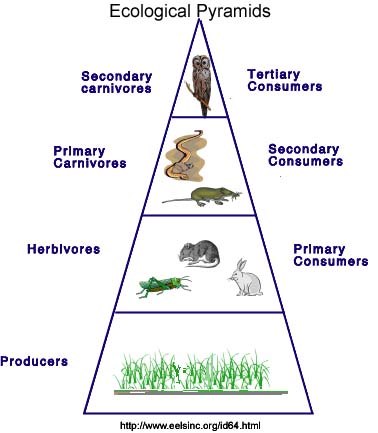
In the energy pyramid here, which organisms have the most energy available?
a)
Producers
b)
Carnivores
c)
Herbivores
d)
Top Predator
6.
In the energy pyramid below, which organism has the least amount of energy available?
a)
Producers
b)
Herbivores
c)
Carnivores
d)
Top Predator
7.
If there is 1000 Kcal available in the producers in trophic level 1, how much energy is available in the herbivores in trophic level 2?
a)
10 Kcal
b)
1 Kcal
c)
100 Kcal
d)
1000 Kcal
8.
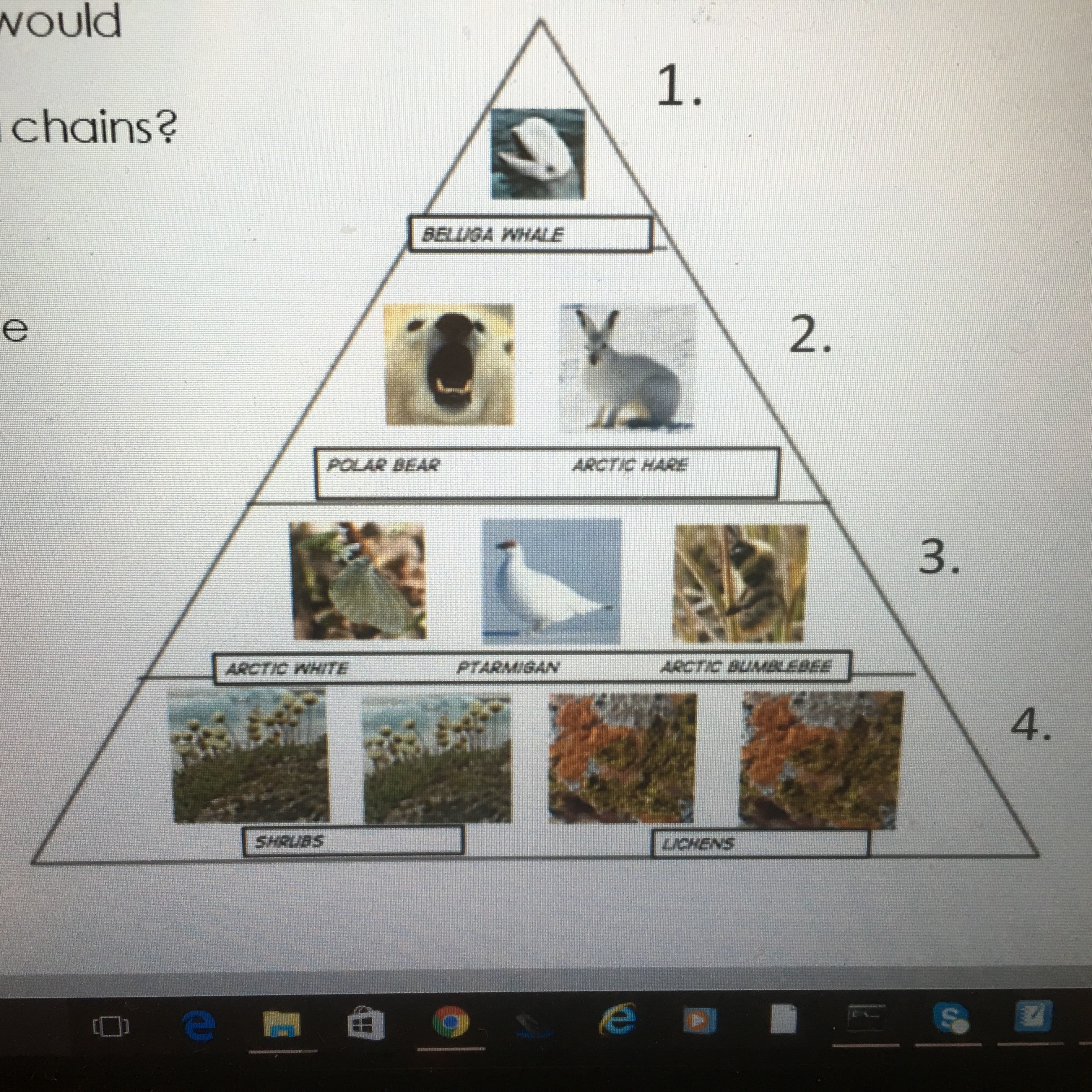
If these organisms were arranged in a food pyramid, which organism would have the least amount of total energy available?
a)
coyote
b)
insect
c)
lizard
d)
shrub
9.
Which organism recieves the least amount of energy from the producer?
a)
Owl
b)
Grasshopper
c)
Lilypad
d)
Mouse
10.
The largest group of organisms found in a food web would be:
a)
Primary Consumers
b)
Producers
c)
Decomposers
d)
Tertiary Consumers
11.
A food pyramid represent the relative amount of energy in trophic levels. Which of the following correctly shows a food pyramid?
a)
A
b)
B
c)
C
d)
D
12.
A third-level consumer has to be which type?
a)
Carnivore.
b)
Decomposer.
c)
Producer.
d)
Herbivore.
13.
A secondary consumer 
a)
eats primary consumers
b)
eats producers
c)
eats plants
14.
Level 1 is called the _____________ trophic level. 
a)
Tertiary consumer
b)
Tertiary producer
c)
Primary consumer
d)
Primary producer
15.

What amount of percentage does the energy decrease as it goes up the pyramid?

a)

100%

b)

1000%

c)

10%

d)

1%

16.

How does the energy flow in an energy pyramids?

a)

up the pyramid

b)

down the pyramid

17.
Which is the smallest level of an ecosystem?
a)
organsism
b)
population
c)
community
d)
ecosystem
18.
a system of food chains that shows the transfer of energy  is termed
a)
food web
b)
food chain
c)
prey
d)
predator
19.
Biodiversity is 
a)
the variety of species within an ecosystem
b)
a large number of the same species in an ecosystem
c)
an abundant amount of the same primary consumers 
d)
the ability to have an abundant source from the same species
20.

Photosynthesis is important because...

a)

it makes carbon dioxide

b)

it makes food for the food webs

c)

it makes water

d)

it's not important

21.
A population is...
a)
A group of one species in one area
b)
Multiple species that live in one area
c)
All of the living and nonliving things in an area
d)
None of these
22.
If the number of births in a population is the same as the number of deaths in a population, what will happen to the growth of the population?
a)
It will increase.
b)
It will decrease.
c)
It will stay the same.
d)
It will fluctuate.
23.
When organisms move out of the population, this is known as
a)
emigration
b)
abandonment
c)
immigration
d)
succession
24.

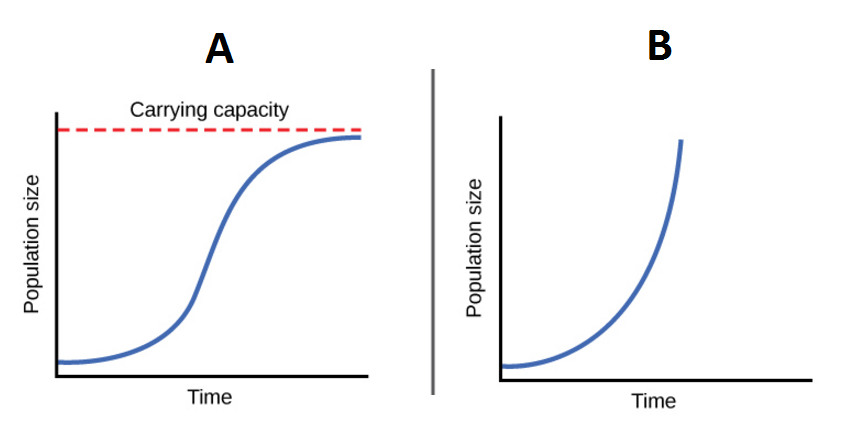
What type of growth model is shown in image B?

a)

Exponential

b)

Logistic

25.

What type of growth model is shown in image A?

a)

Exponential

b)

Logistic

26.
Any thing or organism that regulates the size of a population of another organism is known as __________.
a)
a limiting measure
b)
a limiting factor
c)
factorization
d)
materialization of precipitation
27.

This graph shows ....

a)

When one population increases, the other decreases.

b)

When one population decreases, the other increases.

c)

When one population increases, the other increases instantly.

d)

When one population increases, it causes the other to increases shortly after.

28.

Which of the following are density dependent factors?

a)

competition for resources

b)

predation

c)

disease

d)

natural disasters

29.

Which of the following are examples of a density independent factors?

a)

forest fire

b)

seasonal cycles

c)

storms

d)

disease

30.
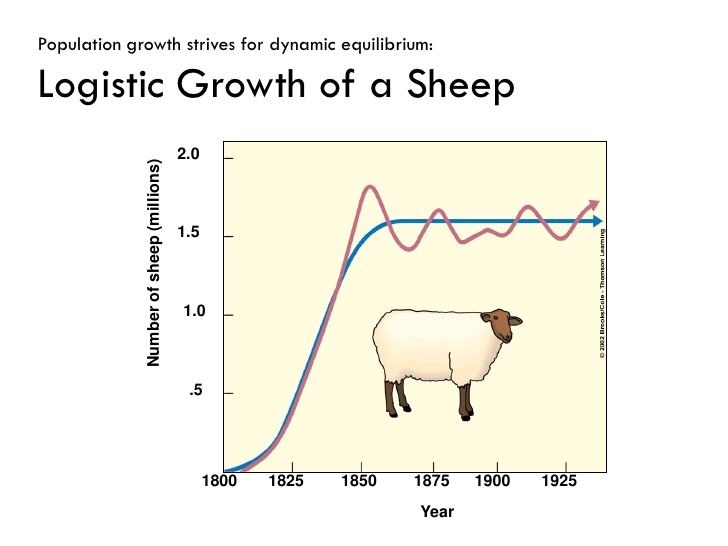
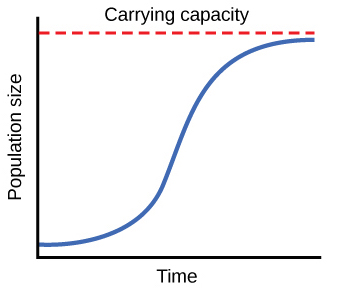
What is the carrying capacity for this sheep population?
a)
1.8 million
b)
1.25 million
c)
1.6 million
d)
1.o million
31.
When a population grows past the ecosystem's carrying capacity, what happens to the population?
a)
Continues to grow
b)
The population starts to die off to return to carrying capcity
c)
The population will go extinct due to lack of resources
d)
The population grows then finds a new carrying capacity
32.

Emigration is

a)

the movement out of an area

b)

the movement into an area

c)

movement in and out of an area

d)

migration

33.

What are survivorship curves?

a)

curves that describe the number of survivors over time

b)

curves that tell us what the limiting factors are

c)

curve that tells us about the carrying capacity

d)

a curve

34.

Why don't populations grow indefinitely?

a)

limiting factors

b)

only biotic factors

c)

only abiotic factors

d)

none of the above

35.

What is an example of a density-independent (Abiotic) limiting factor?

a)

food

b)

parasites

c)

disease

d)

pollution

36.

What is the arrow pointing at?

a)

carrying capacity

b)

biotic potential

c)

density-independent

d)

density dependent

37.

parasites, disease, predators, are examples of what type of limiting factors?

a)

density dependent

b)

density independent

c)

survivorship

d)

type 1 curve

38.

What is the carrying capacity mean?

a)

The number of individuals an area can carry

b)

the number of births

c)

The number of deaths an area has

d)

not sure

39.

(Im)migration is ...

a)

the movement into an area

b)

The movement out of an area

c)

The migration process

d)

exponential graph

40.

The exponential graph is a graph that shows us population size increasing quickly, which one below shows us that

a)
b)
c)
d)
41.

One of the factors that can change the size of population is....

a)

Name of schools

b)

Number of dezs

c)

Jobs

d)

Numbers of births

42.

Why don't populations grow indefinitely?

a)

limiting factors

b)

only biotic factors

c)

only abiotic factors

d)

none of the above

43.

the number of people in a defined area such as a square kilometre

a)

population density

b)

birth rate

c)

death rate

d)

population

44.

Why would an area be sparsely populated?

a)

lack of natural resources

b)

land is covered with ice

c)

land cannot be developed

d)

all of the above

45.

Communities are made up of living things only. Which one of these is a community?

a)

Trees, birds, dirt, worms

b)

Deer, grass, leaves, bunnies

c)

Whales, water, seashells, fish

d)

Sand, camels, mountains, coyotes

46.
The place where an organism lives is its _________.
a)
habitat
b)
abiotic
c)
ecosystem
d)
community
47.
A group of organisms of the same species living in the same area are called a/an ________.
a)
community
b)
habitat
c)
population
d)
ecosystem
48.
All of the living and nonliving things in an area that interact with each other are called a/an ______.
a)
community
b)
habitat
c)
population
d)
ecosystem
49.
What are the nonliving parts of the ecosystem? This includes temperature, water, sunlight, air, and soil.
a)
biotic factors
b)
communities
c)
abiotic factors
d)
microorganisms 
50.
How do producers obtain energy?
a)
They conduct photosynthesis.
b)
They consume plants.
c)
They consume primary consumers.
d)
They consume secondary consumers.
51.
Organisms that feed on both living producers and other consumers.
a)
Carnivores
b)
Omnivores
c)
Herbivores
d)
Detritivores
52.

What is the branch of science that deals with the study of living things and their relationship with the environment?

a)

Anthropology

b)

Ecology

c)

Ecosystems

53.

An organism that must eat to get energy is called a:

a)

decomposer

b)

producer

c)

composer

54.

What is a decomposer?

a)

An organism that breaks down dead plants and animals.

b)

An organism that uses energy from the sun to make it's own food.

c)

An organism that must eat to get energy.

55.

A consumer that eats animals only.

a)

herbivore

b)

carnivore

c)

omnivore

56.

A consumer that eats plants only.

a)

herbivore

b)

carnivore

c)

omnivore

57.

A diagram that shows the transfer of energy in an ecosystem by using several food chains.

a)

ecosystem

b)

food web

c)

environment

d)

food chain

58.
Which are located at the very BOTTOM of an energy pyramid? 
a)
producers
b)
consumers - Level 1
c)
consumers - Level 2
d)
decomposers
59.
Organisms that hunt other organisms for food are called __________.
a)
predators
b)
prey
c)
producers
d)
heterotrophs
60.

What factor describes when populations decrease because animals are moving out of a population?

a)

Emigration

b)

Limiting Factors

c)

Immigration

d)

Exponential Growth

61.
What does the graph represent?
a)
Emigration
b)
Exponential growth
c)
Immigration
d)
Logistic Growth
62.
Which limiting factor is independent of the number of individuals in a population?
a)
competition
b)
parasitism/disease
c)
stress
d)
natural disasters
63.

What point on the graph represents the carrying capacity?

a)

A

b)

B

c)

C

d)

D

64.

A population is...

a)

All members of one species in one area

b)

All members of all species that live in one area

c)

All of the living and nonliving things in an area

d)

None of these

65.
Which factor is a density-dependent limiting factor on the population of a species?
a)
seasonal variation
b)
natural disasters
c)
unusual weather
d)
predation
66.

What is happening at the 'A' on the graph?

a)

the population overshoots above the carrying capacity

b)

the population stops growing

c)

growth begins to slow down due to limited resources

d)

growth is speeding up due to an abundance of resources

67.
To measure population density, you must divide the number of individuals living in a defined space by the
a)
area of the space
b)
birth and death rates
c)
carrying capacity
d)
height of the space
68.
Nesting birds often space themselves evenly from other nests. This pattern is called
a)
clumped dispersion.
b)
uniform dispersion.
c)
random dispersion
d)
scatter dispersion
69.
Lichens and mosses that first live in uninhabited areas are examples of
a)
secondary species
b)
non-native species
c)
pioneer species
d)
climax species
70.
Which threat to biodiversity is being displayed?
a)
overexploitation
b)
invasive species
c)
pollution
d)
habitat fragmentation
71.
Species that could become endangered in the near future are called
a)
unlucky
b)
extinct
c)
endangered
d)
threatened
72.
The sea otter is a(n) ___________ that influences the survival of many other species in its ecosystem.
a)
Cute furry creature
b)
endangered species
c)
keystone species
d)
important animal
73.
Which of these would NOT be true of a specialist species?
a)
They are more likely to go extinct during changes to an ecosystem. 
b)
They have a very narrow niche.
c)
They often lose in competition for resources to generalists. 
d)
They often feed on a very specific diet. 
74.
Introduced or invasive species are often difficult because:
a)
They contribute to habitat fragmentation
b)
They do not adapt well to new environments
c)
They increase biodiversity
d)
They often lack natural predators
75.
A species described as r-strategist would definitely NOT have which of the following characteristics?
a)
clumped population pattern
b)
much parenting
c)
many offspring
d)
random population pattern
76.
__________ growth shows growth of a population under environmental constraints (carrying capacity-K) that sets a maximum population size 
a)
logistic
b)
exponential
c)
niche
d)
uniform
77.
________ grow slowly over time, cares for its young over a long period of time and is usually near the carrying capacity of its ecosystem.
a)
K-strategists
b)
R-strategists
c)
Uniform strategists
d)
environmentalists
78.
J-Shaped curves
a)
show a decline after an increase
b)
display populations that have reached carrying capacity
c)
represent exponential growth
d)
does not depend on the numbe rof resources
79.

Two male Giraffes are fighting over the last green leaf of a tree that is dying.

a)

Intraspecific Competition

b)

Mutualsim

c)

Predation

d)

Commensalism

e)

Interspecific Competition

80.
Represents the biotic potential of the species
a)
A
b)
B
c)
D
d)
E
81.

Population increases at a constant rate over time.

a)

Exponential Growth

b)

Logistic Growth

c)

Stable Growth

d)

Strategic Growth

82.
What is the carrying capacity of the following graph?
a)
1000
b)
8000
c)
800
d)
600
83.

Largest number of individuals of a population that the environment can support...

a)

carrying capacity

b)

population

c)

biome

d)

mutualism

84.

Will competition increase or decrease the population of a species of animals?

a)

Decrease

b)

Increase

85.
Barnacles create home sites by attaching themselves to whales. This neither harms nor benefits the whales.
a)
commensalism
b)
parasitism
c)
mutualism
86.
Yucca flowers are pollinated by yucca moths. The moths lay their eggs in the flowers where the larvae hatch and eat some of the developing seeds. Both species benefit.
a)
commensalism
b)
parasitism
c)
mutualism
87.
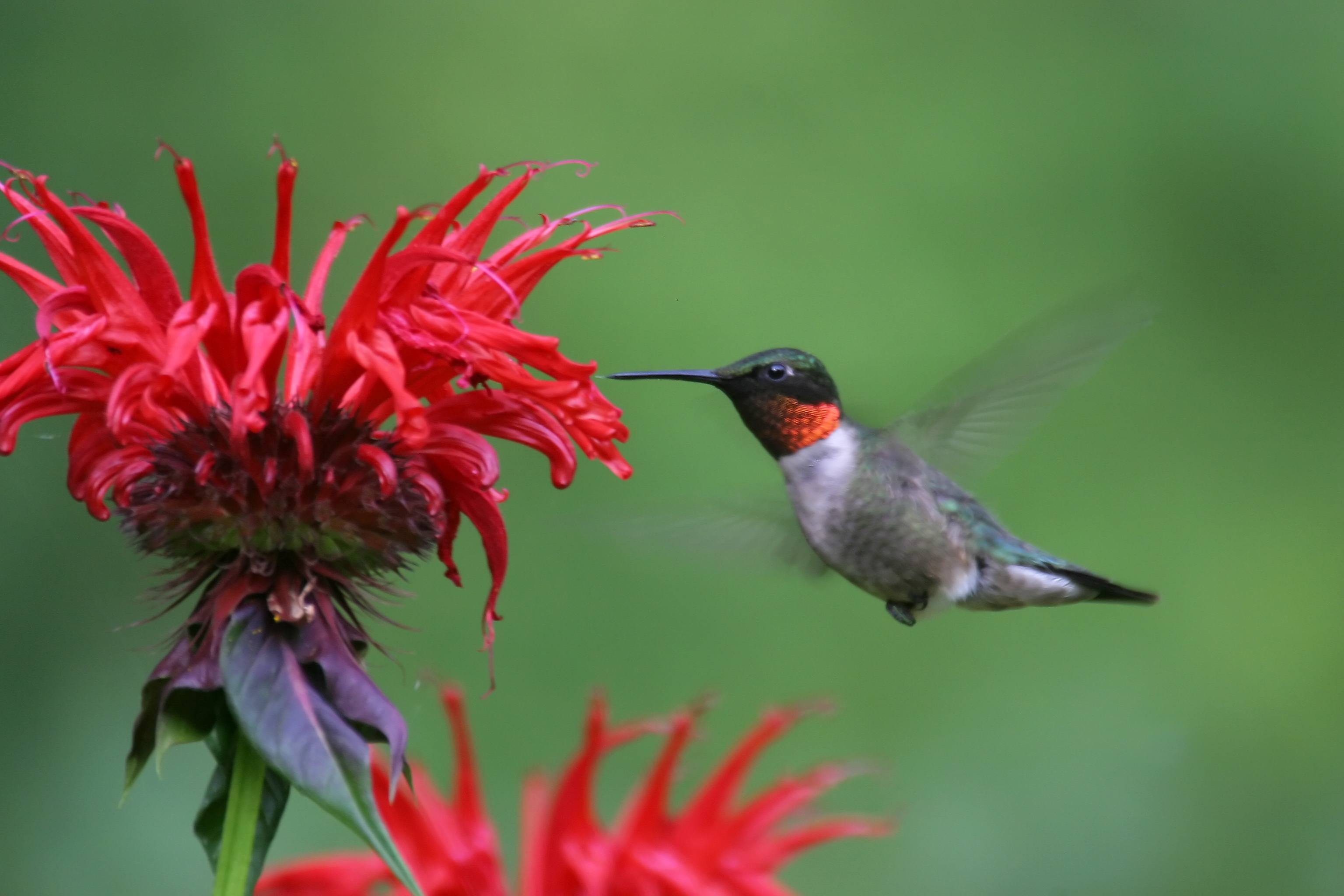
What type of symbiosis?  Hummingbirds feed on nectar from flowers.  The flowers are pollinated by hummingbirds as they move from flower to flower.
a)
commensalism
b)
mutualism
c)
parasitism
d)
predation
88.
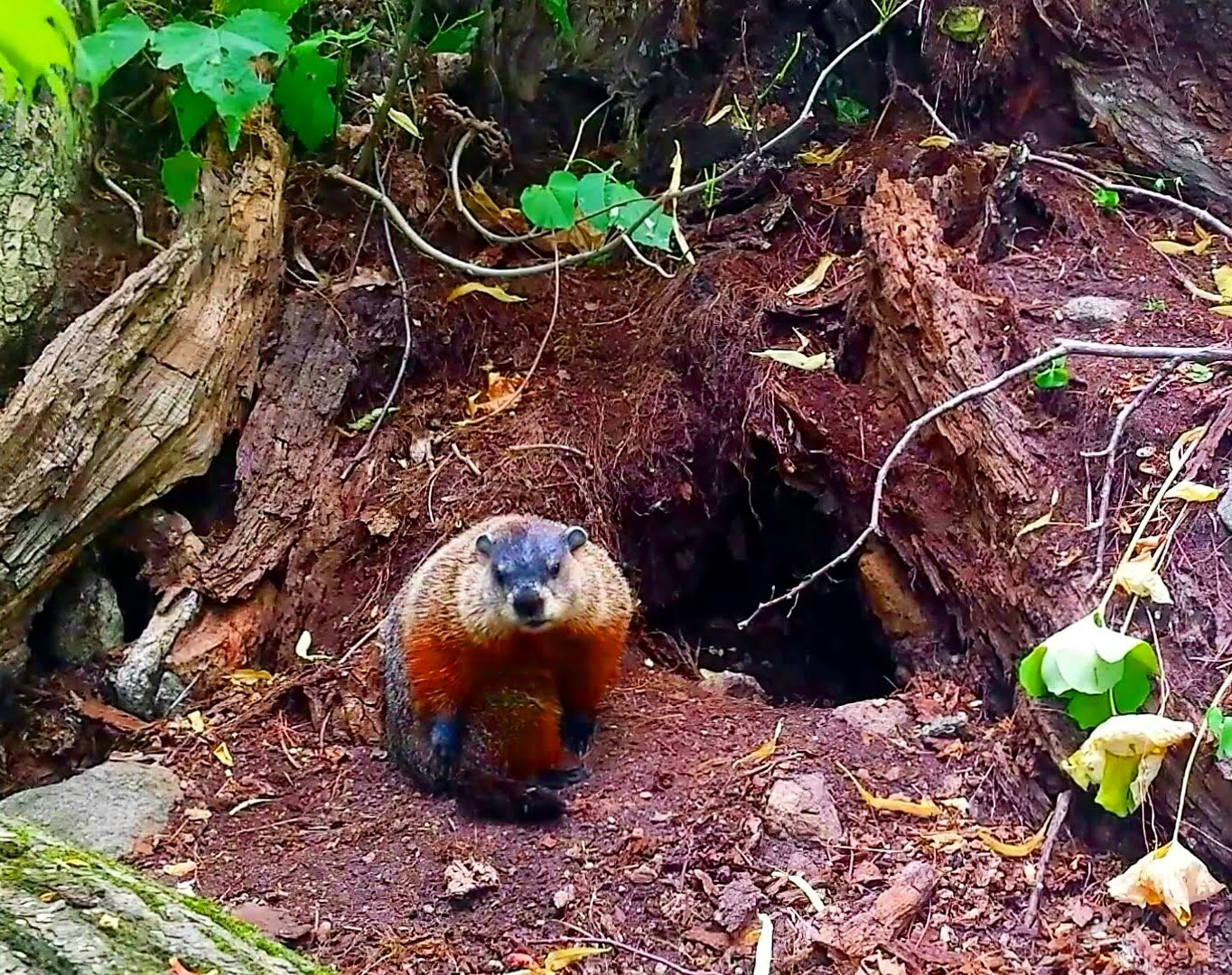
What type of symbiosis?  Skunks often live in burrows that have been dug and abandoned by woodchucks.  
a)
commensalism
b)
mutualism
c)
parasitism
d)
predation
89.

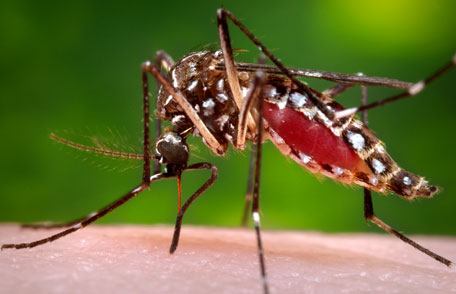
When a mosquito bites you, you are the __________ and the mosquito is the ____________.

a)

host, endoparasite

b)

endoparasite, host

c)

host, ectoparasite

d)

ectoparasite, host

90.
What type of symbiosis is this?
*
Hermit crabs find shells left by snails that have died and move in.
*
  Snails die and leave behind their shells.
a)
commensalism
b)
mutualism
c)
parasitism
d)
predation
91.

A tick and a dog have this type of relationship.

a)

mutualism

b)

commensalism

c)

predation

d)

parasitism

92.
Mistletoe extracts water and nutrients from a spruce tree. The spruce tree is harmed. 
a)
parasitism
b)
commensalism
c)
mutualism
93.
In a parasitic relationship, one organism is ___________ and one organism is benefiting. 
a)
helped
b)
harmed
c)
not effected
d)
happy
94.
Remora are small fish with a sucker-like organ that allows them to attach themselves to larger animals like a shark.  By doing this, the remora is able to gain protection from the presence of the shark while helping the shark stay clear from parasites.  This relationship shows _?
a)
 parasitism
b)
mutualism       
c)
commensalism
d)
predation
95.
The introduction of a non-native species into an ecosystem can result in serious ecological problems.  This is often because the non-native species
a)
adapt to changes quickly
b)
mutations
c)
lacks natural predators 
d)
provides additional genetic diversity
96.
What factor would cause animals of the same species to begin competing with one another?
a)
increase in precipitation         
b)
the presence of decomposers
c)
the introduction of a new food source
d)
limited supply of resources
97.
In an ecosystem, members of the lizards are observed eating members of the insect population.  In this same ecosystem, birds are also observed using insects as a food source.  The relationship between lizards and birds would best be described as –
a)
predator
b)
 competitive
c)
parasitic
d)
mutualistic
98.
Different species are most likely to compete for resources in an ecosystem if both species attempt to –
a)
occupy the same niche.
b)
successfully reproduce.
c)
live in different habitats.         
d)
find different food sources.   
99.
Animals of the same species would most likely compete over a limited amount of -
a)
minerals
b)
Oxygen
c)
sunlight
d)
mating partners
100.
Which of the following levels of organization would accurately fill the gap in the diagram above?
a)
biosphere
b)
organ system
c)
organism
d)
cells
101.
The collection of all of the biotic and abiotic factors in an area describes -
a)
community
b)
population
c)
ecosystem
d)
organism
102.
All of the members of a species that occupy a certain area are defined as -
a)
organism
b)
community
c)
population
d)
ecosystem
103.

Competition becomes more important as the number of individuals ______ or the availability of resources _________.

a)

increases, decreases

b)

increases, increases

c)

decreases, increases

d)

decreases, decreases

104.

The milkweed plant serves an important role in the life cycle of the monarch butterfly. Adult monarchs lay their eggs on milkweed, and then caterpillars eat that same plant during their development. Based on the relationship between monarchs and milkweed, which of the following trends would be predicted when looking at data on the populations of these two organisms?

a)

A decrease in the milkweed population will cause a decrease in the monarch butterfly population.

b)

When the milkweed population decreases, the monarch butterfly population stays the same.

c)

A decrease in the milkweed population will cause the monarch population to increase.

d)

When the monarch population increases, the milkweed population stays the same.

105.

The milkweed plant serves an important role in the life cycle of the monarch butterfly. Adult monarchs lay their eggs on milkweed, and then caterpillars eat that same plant during their development. Based on the relationship between monarchs and milkweed, which of the following trends would be predicted when looking at data on the populations of these two organisms?

a)

A decrease in the milkweed population will cause a decrease in the monarch butterfly population.

b)

When the milkweed population decreases, the monarch butterfly population stays the same.

c)

A decrease in the milkweed population will cause the monarch population to increase.

d)

When the monarch population increases, the milkweed population stays the same.

106.

Two species of fish live in the same pond. Which of the following would increase competition between these two species of fish?

a)

Habitat temperature increases.

b)

Population of birds that eat the fish increases.

c)

Number of food plants the fish eat increases.

d)

Water level in the pond decreases.

107.

Which of the following lists contains only abiotic factors?

a)

water, air, temperature

b)

grass, air, people

c)

trees, fish, polar bears

d)

grass, water, sand

108.

This diagram shows the variety of organisms that live in different tide zones. Mussels are common organisms that compete for space in intertidal (middle) tide zones. If all of the mussels were removed from zone A, which organisms would likely compete for the space in Zone A?

a)

Periwinkle and Limpets

b)

Sea lettuce and Chiton

c)

Sea urchins and Hermit crabs

d)

Rock louse and Periwinkle

109.

Organism X feeds mainly on small fish, amphibians, and reptiles. With which organism is organism X most likely to compete?

a)

Great blue heron

b)

Mallard

c)

Pied-billed grebe

d)

Great egret

110.
those organisms that do not have a backbone
a)
molting
b)
Mammals
c)
Vertebrates
d)
Invertebrates
111.
Have 4 main traits in common: notochord, tail, nerve cord, and pharyngeal pouch
a)
Sponges
b)
Molting
c)
Metamorphosis
d)
Chordates
112.
A flexible rod shaped structure that supports the body of a developing chordate
a)
Notochord
b)
Pharyngeal pouch
c)
tail
d)
Nerve cord
113.
To which phylum do vertebrates belong?
a)
Chordata
b)
Cnidaria
c)
Echinodermata
d)
Arthropoda
114.

The ________ is a support rod that runs along the dorsal side of the organism.

a)

Dorsal nerve cord

b)

Notochord

c)

Brain

d)

Nervous system

115.
Which of the following filters food from water that then enters the mouth?
a)
Mammals
b)
Echinoderms
c)
Lancelets
d)
Tunicates
116.

Which of the following are characteristics of a chordate?

a)

presence of pharyngeal pouches and presence of a backbone

b)

existence of a nerve cord

c)

both a and b

d)

neither a nor b

117.

Which of the following groups of chordates are invertebrates?

a)

humans

b)

sharks

c)

lancelet

d)

fish

118.

Which of the following lists all the major groups of vertebrates?

a)

amphibians and birds

b)

birds, reptiles, lancelets

c)

fish, amphibians, reptiles, birds, mammals

d)

mammals, birds, reptiles

119.

Of the following, which is NOT an amphibian?

a)

fish

b)

salamander

c)

frog

d)

toad

120.

Of the following, which do all fish have?

a)

gills

b)

fins

c)

scales

d)

movable jaws

121.

All chordates are vertebrates.

a)

True

b)

False

122.
Which of the following is a characteristic that all mammals share?
a)
they all have a pouch
b)
they all have a cloaca
c)
they all have hair
d)
they all have a short gestational period
123.
Mammals are cold blooded
True or false
a)
False
b)
True
124.
Which of the following keep about the same temperature all the time. 
a)
Reptiles
b)
Mammals
c)
Birds
125.
In what would a marsupial carry their baby?
a)
carriage
b)
bag
c)
pouch
d)
stroller
126.
I breathe with lungs, lay eggs, am ectothermic (cold-blooded), and often have scaly skin which holds in the water.  What am I?  
a)
fish
b)
mammals 
c)
birds
d)
reptile 
127.
I live part of my life in water and part on land.  I am born with gills but grow lungs.  I am ectothermic (cold-blooded).  I have moist smooth skin.  What am I? 
a)
fish
b)
bird
c)
amphibian 
d)
mammal
128.
Many animals in this group go through metamorphosis (bodies change as they get older).
a)
fish
b)
reptile
c)
amphibian
d)
mamma;
129.
All invertebrates _________
a)
Have a backbone
b)
Do not have a backbone
c)
Are really just Vertebrates
d)
Have a nerve cord
130.

What do each of the following animals have in common?

fish, snake, turtle, lizard

a)

endothermic

b)

Lay eggs

c)

invertebrates

d)

exothermic

131.

Fishes that have long, eel-like bodies, no scales, no appendages, and no jaws

a)

Class Agnatha

b)

Class Osteichthyes

c)

Class Chondrichthyes

d)

Class Gnathostomata

132.

Cartilaginous fishes that include sharks, skates, and rays

a)

Class Agnatha

b)

Class Osteichthyes

c)

Class Chondrichthyes

d)

Class Gnathostomata

133.

Bony fishes that include perch, trout, catfish, salmon, seahorses

a)

Class Agnatha

b)

Class Osteichthyes

c)

Class Chondrichthyes

d)

Class Gnathostomata