wayground logo

Free Printable Worksheets

Font size

S
M
L
XL
Worksheets

APES Semester 1 Final Exam

Total questions: 135

Worksheet time: 4hrs 47mins

Name
Class
Date
1.
Pfisteria can become a serious problem in marine environments when what is greatly increased?
a)
temperature
b)
nutrients
c)
fishing pressure
d)
introduction of invasive species
2.
Which one of the following environmental issues is the primary cause of the others?
a)
Increasing resource use
b)
Destruction of habitat
c)
Premature extinction
d)
Human population growth
3.
Which city needed the water in Mono Lake?
a)
Berkeley
b)
Los Angeles
c)
San Diego
d)
San Francisco
4.
The Hawaiian Islands are a result of 
a)
a subduction zone
b)
a divergent boundary
c)
a transform boundary
d)
a hot spot
5.

Algal blooms occur due to the presence of an excess amount of nutrients, like phosphorus, in freshwater. How does excess phosphorus get into fresh water?

a)

The nutrients are added to the water by fishermen to feed the fish.

b)

The nutrients leak into fresh water from oil refineries in the vicinity.

c)

The nutrients are formed by the decomposition of organic wastes dumped into fresh water.

d)

The nutrients are a part of the fertilizers that are often washed away into ponds

6.

How old is the Earth?

a)

~ 4.6 billion years old

b)

~ 3.5 billion years old

c)

~ 4.6 million years old

d)

~ 3.5 million years old

7.

What was the first form of life to inhabit Earth?

a)

humans

b)

jellyfish

c)

bacteria

d)

dinosaurs

8.

Environmental scientist believe that we are currently experiencing a mass extinction even

a)

true

b)

false

9.

What often occurs at tectonic plate boundaries?

a)

increasing air pressure

b)

thinning of the biosphere

c)

mountain building

d)

increased erosion

10.

What physical layer of Earth is located beneath the lithosphere?

a)

asthenosphere

b)

inner core

c)

outer core

d)

mesosphere

11.

Scientists divide Earth into three layers, based on their chemical composition. which of the following is NOT one of them?

a)

the crust

b)

the mantle

c)

the core

d)

the center

12.

A population of squirrels that contains a wide variety of phenotypes has a:

a)

Large amount of genetic variation

b)

High allele frequency

c)

Poor chance of surviving habitat change

d)

Decreased chance of frequent gene flow

13.
What is a species?
a)
A group of organisms that can mate with each other and produce fertile offspring. 
b)
A group of organisms that genetically are very different from each other. 
c)
A group of organisms that can mate and produce offspring even if those offspring are infertile.
d)
Indivual organisms that live in the same environment. 
14.
What is speciation?
a)
The change from one species into two or more distinct species. 
b)
The movement of a group of organisms into a new area. 
c)
The ability to mate and reproduce.
d)
The death of an entire species. 
15.

Which type of isolation occurred when a few finches were blown from the coast of South America to the Galapagos Islands and then evolved into 14 different finch species?

a)

geographical isolation

b)

behavioral isolation

c)

temporal isolation

16.
When has speciation occurred?
a)
When populations no longer look the same
b)
When populations no longer have the same frequency of alleles
c)
When populations are living in different environments
d)
When populations can no longer interbreed
17.

Which of the following is an abiotic component?

a)

an eagle

b)

a rock

c)

a tree

d)

a human

e)

a virus

18.

Which of the following is NOT true about ecosystems?

a)

They include biotic components.

b)

They can be a wide range of sizes.

c)

They include no human components.

d)

Many interactions among species occur in them.

e)

They include abiotic components.

19.

How many hectares of land is a 500-acre park?

(1 acre = 0.405 ha)

a)

200 ha

b)

250 ha

c)

500 ha

d)

750 ha

e)

1,250 ha

20.

In 2011, 640,000 ha of the Amazon rainforest were cleared. Approximately how many hectares is that each hour?

a)

1.2 ha

b)

29 ha

c)

73 ha

d)

178 ha

e)

1,752 ha

21.

A person's ecological footprint is

a)

the land that a person lives on.

b)

the amount of carbon dioxide a person contributes to climate change.

c)

the land required to produce a person's food.

d)

the land needed to support all of a person's activities.

e)

the amount of fossil fuel a person uses.

22.

Challenges in the study of environmental science include all of the following except

a)

dangers of studying natural systems.

b)

lack of baseline data.

c)

subjectivity of environmental impacts.

d)

complexity of natural systems.

e)

complex interactions between humans and the environment.

23.

A control group is

a)

a group with the same conditions as the experimental group.

b)

a group with conditions found in nature.

c)

a group with a randomly assigned population.

d)

a group with the same conditions as the experimental group except for the study variable.

e)

a group that is kept at the same conditions throughout the experiment.

24.
Problems developed at Mono Lake as a consequence of the
a)

redirection of water that fed the lake for use by Los Angeles.
b)
rerouting of water that fed the lake to support the development of Las Vegas.
c)
addition of pollution from detergents to the lake in the 1940’s.
d)
failure of Canadian geese to migrate from the area around the lake.   
25.
The salinity problem at Mono Lake was corrected after
a)
legislation required that the lake should not be used for fishing.
b)
additional water was extracted for use by agriculture.
c)
water was diverted and the lake filled back to historical levels and the Audubon Society worked together with the Los Angeles Department of Water.
d)
none of these
26.
 Matter is
a)
anything that has volume and mass.
b)
anything that has energy.   
c)
anything that doesn’t have mass.
d)
anything that doesn’t have volume.
27.
The polarity of the water molecule is the result of
a)
the slight negative charge of the hydrogen atoms.
b)
shared electrons spending more time near the oxygen atom than near the hydrogen atoms.
c)
shared electrons spending more time near the hydrogen atoms than near the oxygen atom.
d)
two positive sides repelling each other.
28.

As a solid or a liquid, water reaches its lowest density at

a)

4°C.

b)

39°F.

c)

100°C.

d)

0°C.

29.
On the pH scale,   is neutral.
a)
2
b)
0
c)
14
d)
7
30.
A substance with a pH of 4 has_______   times the hydrogen ion concentration of a substance with a pH of 6.
a)
2
b)
5
c)
10
d)
100
31.
DNA is
a)
formed by long chains of nucleic acids and is the genetic material organisms pass to their offspring.
b)
formed by sugars that are responsible for protecting organisms from foreign substances.
c)
   formed by proteins that is important for structural support.
d)
none of these
32.
The “ability to do work “ is called
a)
power
b)
joules
c)
energy
d)
heat
33.
Most energy on Earth comes from
a)
the Sun
b)
volcanoes
c)
trees 
d)
water
34.
Energy conversion by living things is
a)
evident in animals producing food.
b)
not necessary because animals eat food.
c)
a fundamental component of all environmental systems.
d)
the way electromagnetic radiation is produced.
35.
Energy is measured in
a)
hertz
b)
joules or calories
c)
watts
d)
wavelength
36.
The difference between potential and kinetic energy is that
a)
potential energy has not yet been released.
b)
kinetic energy has not yet been released
c)
potential energy is measured in calories, whereas kinetic energy is measured in joules.
d)
potential energy is measured in watts, whereas kinetic energy is measured in joules.
37.
A dishwasher uses 700 watts each time it is run.  The cycle takes one hour.  It is run 150 times per year. How much energy does it use in one year?
a)
105 kWh
b)
1050 kWh   
c)
1050 J
d)
700 kWh
38.

Energy quality

a)

from gasoline is high.

b)

is high when it is found in a concentrated form.

c)

is measured by the ease with which it can be used for work.

d)

all of the above

39.
A systems analysis of an ecosystem could involve
 I.  inputs of nutrients.
II.  outputs of energy.

III.  evaporation.
a)

II only
b)
III only
c)
I and II
d)
I, II, and III 
40.

Greenhouse gases in the Earth’s atmosphere

a)

are in steady state.

b)

are decreasing.

c)

are increasing.

d)

prove that inputs are equal to outputs.

41.
The state of global systems on Earth, such as the atmosphere and oceans
a)
are in steady state today.
b)
   have never been in steady state.
c)
were in steady state until 2010.
d)
are changing.
42.

A positive feedback loop

a)

is when feedback moves in the same direction and may be seen in some examples of population growth.

b)

is when feedback into a system has no effect on the rate of response.

c)

is when feedback into a system moves in oppositve direction

d)

is when a system responds to a change by returning it to its original state.

43.
A negative feedback loop is
a)
when feed back into the system increases the rate of progress.
b)
seen in the example of increased greenhouse gases leading to global warming.
c)
seen in the example of world population growth.
d)
when a system responds to a change by returning it to its original state.
44.
Extinctions of species can be the result of
a)
natural systems changing.
b)
introduction of invasive species.
c)
is when feedback into a system moves in opposite direction of system 
d)
All of these answers are correct.
45.

Organisms that feed only on plants are called:

a)

detritivores

b)

omnivores

c)

carnivores

d)

herbivores

46.

The very necessary process of breaking down the dead bodies of organisms is a function of:

a)

detritivores

b)

omnivores

c)

decomposers

d)

carnivores

47.

organisms that complete the final breakdown and recycling of organic materials from the remains of all organisms are:

a)

producers

b)

consumers

c)

detritovores

d)

decomposers

48.

the typical percentage of high quality energy loss in transfers from one trophic level to the next is about:

a)

1%

b)

10%

c)

90%

d)

50%

49.

Carbon is a major component of:

a)

water

b)

the oceans

c)

organic compounds

d)

the atmosphere.

50.

Which of the following of Earth's spheres are not part of the phosphorus cycle?

a)

lithosphere

b)

hyrdorsphere

c)

atmosphere

d)

biosphere

51.

All of the following are ways humans interfere in the phosphorus cycle except:

a)

erosion from fertilized crop fields, lawns, increases phosphate ions in streams.

b)

increasing phosphate levels in tropical forests by clearing forests

c)

removing large quantities of phosphorus from the earth for fertilizer

d)

stimulating aquatic systems to overproduce through runoff of phosphate ions.

e)

All of these practices interfere with the phosphorus cycle

52.

Humans intervene in the nitrogen cycle in several ways. Which is NOT one of those ways?

a)

Burning fossil fuels adds nitric oxide

b)

Agriculture using fertilizers adds nitrogen to aquatic ecosystems.

c)

we store nitrogen in the topsoil when we harvest nitrogen rich crops

d)

Destruction of forests releases nitrogen

53.
Which list is in the correct order of atmospheric layers starting from Earth's surface?
a)
troposphere, stratosphere, mesosphere, thermosphere, exosphere
b)
Thermosphere, stratosphere, troposphere, mesosphere, exosphere
c)
Exosphere, troposphere, mesosphere, stratosphere, thermosphere
d)
mesosphere, stratosphere, thermosphere, exosphere, troposphere
54.
Which of the following contributes to the unequal warming of earth?
I. variation in the angle of sunlight that reaches Earth
II. variation in the amount of surface area over which the Sun's rays are distributed
III. variation in the amount of sunlight reflected from clouds
a)
I only
b)
I and II only
c)
II and III only
d)
III only
55.
Which of the following has the highest albedo?
a)
soil
b)
snow
c)
water
d)
pavement
56.
The maximum amount of water vapor air can hold at a given temperature is called the
a)
saturation point
b)
latent heat capacity
c)
absolute humidity
d)
dew point
57.
The Coriolis effect is responsible for
a)
the convergence of two ascending Hadley cells
b)
the location of atmospheric currents caused by the unequal heating of Earth
c)
the cooling effect of air as it rises and expands
d)
the deflection of atmospheric currents
58.
High productivity and nutrient availability in the ocean occurs in the areas with
a)
gyres
b)
upwelling
c)
warm waters
d)
prevailing wersterlies
59.
In addition to temperature a terrestrial biome is defined by
I. annual precipitation
II. distinctive animal species
III. distinctive plant species
a)
I only
b)
I and II only
c)
I and III only
d)
I, II, and III
60.
Which biome contains the aphotic zone?
a)
open ocean
b)
freshwater wetlands
c)
coral reefs
d)
streams and rivers
61.
The most important abiotic factors when studying biomes are...
a)
Food and Water
b)
Water and Sunlight
c)
Temperature and Oxygen
d)
Water and Temperature 
62.
Which biome is MOST LIKE the "desert" in terms of precipitation?
a)
tropical rainforest
b)
temperate deciduous forest
c)
tundra
d)
coniferous forest
63.
What are the key features of the Tundra?
a)
cold winter, thin acidic soil, evergreen trees
b)
treeless, permafrost, cold dark winters
c)
ong cool summers, short dark winters, migrating animals
d)
many evergreen trees, short moist summers, long snowy winters
64.
The kangaroo rat is able to get all of the water it needs through it's food and therefore, never needs to drink liquid. This animal has adapted to survive in which biome?
a)
Forest
b)
Tundra
c)
Desert
d)
Grassland
65.
 As you travel from the North Pole toward the equator, you would expect to see
a)
tropical rain forests, then deserts, then taiga.
b)
temperate deciduous forests, then taiga, then tropical rain forests.
c)
tundra, then grasslands, then tropical rain forests.
d)
taiga, then desert, then tundra.
66.
The biome known for trees with broad leaves that fall off the trees in the winter.
a)
Coniferous Forests
b)
Deciduous Forests
c)
Deserts
d)
Tropical Rain Forests
67.

The Earth's ozone layer, which limits damaging solar radiation striking the planet is found in the ____________________.

a)

thermosphere

b)

stratosphere

c)

troposphere

d)

mesosphere

68.

The pattern of atmospheric conditions found across a relatively large geographic region over a long period of time is _____________-.

a)

climate

b)

weather

c)

seasonal cycles

d)

Hadley cells

69.

The layer of the atmosphere that contains the earth's daily weather

a)

mesosphere

b)

stratosphere

c)

thermosphere

d)

troposphere

70.
Winds on the surface of Earth do not move in a straight line because ______.
a)
the earth revolves around the Sun
b)
the earth spins and causes the Coriolis effect
c)
the air moves from low pressure to high pressure
d)
the winds do not move
71.
Large bodies of water affect climate because
a)
water heats up and cools more slowly than land
b)
water heats up and cools faster than land
c)
water and land cool at the same time
d)
water and land heat at the same rate
72.
The sun's rays are least direct
a)
near the poles
b)
near the equator
c)
at high altitudes
d)
far from the ocean
73.

Why we have seasons

a)

the tides

b)

Earth's tilt

c)

sun's rotation around the Earth

d)

Milankovitch cycles

74.

The two properties of ocean water that influence density are:

a)

location and precipitation

b)

salinity and speed

c)

speed and temperature

d)

temperature and salinity

75.
In which location would you expect to find the greatest species diversity?
a)
Canada
b)
Costa Rica
c)
Mexico
d)
United Stastes
76.
Which term best describes this collection of locations: a forest, a freshwater lake, an estuary, and a prarie
a)
Ecosystem Diversity
b)
Extinction
c)
Genetic Diversity
d)
Species Diversity
77.
Which is not a way in which species lose their habitats?
a)
Background extinction
b)
Disruption
c)
Destruction
d)
Pollution
78.
Approximately how much greater is the current background extinction compared to the normal rate?
a)
1 Time
b)
10 Times
c)
1000 Times
d)
10,000 Times 
79.
The number and abundance of species in a biological community is called ____.
a)
Species Diversity
b)
Genetic Diversity
c)
Ecosystem Diversity
d)
Biomass
80.
What are the main factors in ecosystem diversity?
a)
Organisms and their genetics
b)
Populations and abiotic factors
c)
weather and abiotic factors
d)
Rivers and abiotic factors
81.
How do beetles display genetic diversity?
a)
With variations of color
b)
Different species in one population
c)
are identical colors
d)
have identical genes
82.
An event in which a large percentage of all species become extinct is called a _______.
a)
Biodiversity shift
b)
Background extinction
c)
Mass extinction
d)
Evolutionary shift
83.
In a population of spiders there are three different sizes: small, medium, and large.
---The large spiders are easily seen by predators.
---Small spiders have a difficult time finding food.
What will most likely happen to this population of spiders after many generations?
a)
Small and large spiders will mutate
b)
Medium spiders will be the most plentiful
c)
Large spiders will learn to hide from predators
d)
Small and medium spiders will be the least plentiful
84.
The habitat of a moth species included trees with both light and dark colored bark.Therefore the moth species included both light and dark colored variants.Then the light-colored trees were wiped out by a disease, and within a few years nearly all the moths in this forest were dark colored. Which of the following choices BEST explains what happened?
a)
The light moths that survived all had dark offspring in order to adapt to the change.
b)
The dark moths were less visible to predators, so mostly light moths were eaten.
c)
The few light moths that survived did not mate, and therefore they had no offspring.
d)
The light moths changed their wing pigments to darker colors to avoid being eaten.
85.
Which statement best explains how natural selection occurs?
a)
when adaptations help an organism reproduce and survive.
b)
when organisms are geographically isolated.
c)
when an organism’s offspring grow vestigial structures.
d)
when characteristics from the parent organism are inherited.
86.
What does this picture represent?
a)
species diversity
b)
ecosystem diversity 
c)
genetic diversity
d)
biodiversity
87.
Globally, the leading cause of biodiversity loss is 
a)
invasive species
b)
poaching and overharvesting
c)
pollution
d)
habitat change and loss 
88.
 Characteristic or trait that helps an organism survive in its environment
a)
skills
b)
speciation
c)
natural instinct
d)
adaptation
89.
Charles Darwin noticed that birds of the Galapagos Islands were very similar in size and shape but their beaks were very different. What is the explanation for birds having different beaks? 
a)
gathering food
b)
building nest
c)
fighting
d)
scaring predators
90.
Northern foxes can have different fur colors.The foxes hunt squirrels for food. Foxes that have fur the same color as their environment are better at getting closer to squirrels and catching them.The diagram shows a population of foxes that live in one area. At time 1, the population had the same number of brown and white foxes. At time 2, after many generations, there were many more brown foxes and fewer white foxes in the population.
How did the environment change between time 1 and time 2? How did the population change?
a)
You cannot tell how the environment changed. With each generation, more foxes passed on the gene for brown fur to their offspring.
b)
The environment became brown. Brown foxes are more likely to survive, so the white foxes changed to have brown fur.
c)
The environment became brown. Brown foxes are more likely to survive, so both kinds of foxes passed on the gene for brown fur to their offspring.
d)
The environment became brown. With each generation, more brown foxes survived long enough to pass on the gene for brown fur to their offspring.
91.
Which of the following describes the importance of biodiversity to an ecosystem?
a)
a. People like to be able to see all the different plants and animals
b)
b. If there aren�t all the different species, there will be resources that aren�t being used
c)
c. Biodiversity is not as important as many people think
d)
d. Biodiversity can help minimize the effects of losing a species.
92.
Why are invasive species such a problem in their new ecosystem?
a)
a. The new ecosystem isn�t adapted to their presence
b)
b. The new ecosystem is probably weaker than the native one
c)
c. They have mutations making them more adapted to the new ecosystem
d)
d. They cause mutations in the native species
93.
All food chains_____________________
a)
have more consumers than producers
b)
produce and use same amount of energy
c)
begin with a producer
d)
are unhealthy 
94.
How does energy enter an ecosystem? 
a)
sunlight
b)
soil 
c)
animals 
d)
invasive species 
95.
How do consumers get their energy? 
a)
laying in the sun
b)
eating other organisms 
c)
providing food for other organisms
d)
surviving in an ecosystem 
96.
A species that needs to be protected but is not in danger of becoming extinct.
a)
endangered species
b)
threatened species
c)
sub species
d)
special species
97.
A species that is in danger of becoming extinct.
a)
Threatened species
b)
out of luck
c)
do do birds
d)
endangered species
98.

An ecosystem that rapidly returns to its original state after a disturbance is

a)

resistant

b)

vigorous

c)

resilient

d)

stable

e)

adaptable

99.

The intermediate disturbance hypothesis states that intermediate levels of disturbance will

a)

increase runoff

b)

increase nutrient cycling

c)

decrease primary productivity

d)

increase species diversity

e)

decrease biomass

100.

Which is a measure of how much a disturbance can affect the flows of energy and matter in an ecosystem?

a)

diversity

b)

intensity

c)

resistance

d)

resilience

e)

homeostasis

101.

All land in a given landscape that drains into a particular stream, river, lake, or wetland

a)

intermediate disturbance hypothesis

b)

watershed

c)

resistance

d)

disturbance

e)

resilience

102.
Where is most of the usable, accessible freshwater located?
a)
rivers
b)
lakes
c)
groundwater
103.
What do we call water that flows over the ground surface rather than soaking in?
a)
runoff
b)
discharge
c)
recharge
d)
tributary
104.
Eutrophic lakes are described to have:
a)
low nutrients, plant life, and murky water
b)
several nutrients, plant life, and clear water
c)
several nutrients, plant life, and murky water
d)
low nutrients, plant life, and clear water
105.

In which ways do humans impact freshwater systems?

a)

Dams and canals restrict the flows of rivers

b)

Flood control levees and dikes destroy aquatic habitats and alter wetlands

c)

Cities and farms pollute water

d)

Draining of wetlands

e)

All of these are true

106.
When soil washes into a river from a stream or from land, what is added to the water?
a)
dirt
b)
oxygen
c)
rocks
d)
nutrients
107.
Which of the following is NOT one of the three types of soil?
a)
clay
b)
sand
c)
silt
d)
mud
108.
_______ is the type of soil used most often with plants and on farms. It is a mixture of clay, sand, and silt.
a)
loam
b)
humus
c)
soil
d)
dirt
109.
Physically breaking down rocks and materials is called__________weathering.
a)
Chemical
b)
Mechanical
c)
Biological
d)
Permeable
110.
What effect did over plowing and cutting down trees in the Great Plains during the 1930’s?
a)
It had little effect
b)
It increased soil fertility
c)
It was a primary cause of the Dust Bowl
d)
Farmers had a great harvest
111.
The movement of rocks and weathered materials is called_________.
a)
Chemistry
b)
Physical
c)
Weathering
d)
Erosion
112.

What type of soil is 28% clay, 63% sand, 9% silt?

a)

silty clay

b)

clay

c)

loamy sand

d)

sandy clay loam

113.
Reclamation is.....
a)
not required in the US.
b)
a process that causes significant environmental damage.
c)
returning the land back to its original condition after mining
d)
required for every country and every type of mine in the world.
114.

Which of the following is NOT environmental impacts of mining?

a)

Destroys natural communities over large areas.

b)

Acid drainage pollutes groundwater.

c)

Creates minimal dust.

d)

Causes erosion

115.
Which of the one of the following is and effect of land being disturbed by mining?
a)
Better water quality 
b)
Loss of Habitat for animals 
c)
New habitat for animals 
d)
No negative effects 
116.
A layer of permeable rock or soil that allows water to move in or out freely is called a(n):
a)
water table
b)
pore
c)
aquifer
d)
well
117.
A well is drilled into:
a)
the water table
b)
an aquifer
c)
impermeable soil or rock
d)
not enough information is given
118.
When deep wells are heavily pumped, one result can be
a)
decreased groundwater recharge
b)
spring formation
c)
a cone of depression
d)
increased groundwater recharge
119.
Which is true of floodplains?
a)
they have increased fertility
b)
humans are unable to use them
c)
they occur near ponds and lakes
d)
they occur in areas with saltwater intrusion
120.
Groundwater recharge
a)
is the result of precipitation
b)
sometimes occurs as a spring
c)
occurs rapidly in confined aquifers
d)
can cause saltwater intrusions
121.
Which is NOT a primary use of dams?
a)
recreation
b)
electricity generation
c)
flood control
d)
habitat restoration
122.
Which is true of desalination?
a)
brine can be dumped onto land without affecting plant and animal life
b)
the technique of distillation requires less energy than reverse osmosis
c)
desalination is primarily used in North Africa
d)
the technique of reverse osmosis leaves brine
123.
In the United States, most water is used for
a)
agriculture
b)
households
c)
industry
d)
tansportation
124.
The primary use of industrial water in the United states is
a)
mining
b)
paper products
c)
electricity generation
d)
cooling and heating
125.
Which statement about aqueducts is correct?
a)
aqueducts designed as open canals can lose a lot of water through evaporation
b)
aqueducts are a modern invention
c)
aqueducts do not divert water from lakes
d)
aqueducts do not affect the amount of water remaining in rivers
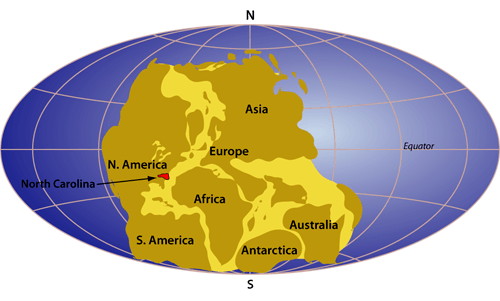
126.

What is this a picture of?

a)

plate tectonics

b)

continental drift

c)

Pangaea

d)

glacier scaring

127.
What two specific continents fit together most noticeably?
a)
Africa and North America
b)
South America and Europe
c)
South America and Africa
d)
Antartica and Africa
128.
The equation for photosynthesis
a)
4HF+SiO2 + Light Energy = SiF4+2H2O
b)
2Na+2H2O + Light Energy = 2NaOH+H2
c)
6CO2 + 6H2O + Light Energy = C6H12O6 + 6O2
d)
2K+2H2O + Light Energy = 2KOH+H2
129.
The rate at which photosynthetic primary producers incorporate energy from the sun is called
a)
Gross Primary Production
b)
Photosynthetic Primary Production
c)
Net Primary Production
d)
Primary Production
130.
How to calculate Net Primary Production:
a)
(GPP)(respiration)=NPP
b)
GPP/respiration=NPP
c)
GPP+respiration=NPP
d)
GPP-respiration=NPP
131.
A system of interlocking and interdependent food chains is called a______________
a)
food chain
b)
food web
c)
trophic pyramid
d)
numbers pyramid
132.

What does sustainability mean?

a)

Using lots of resources.

b)

Maintaining the world we live in for future generations.

c)

Cutting down trees.

d)

Using lots of water and electricity.

133.

What are examples of non-renewable resources?

a)

Oil, coal and solar energy.

b)

Gas, coal and water.

c)

Oil, gas and wind.

d)

Oil, gas and coal.

134.

Why do we need to conserve water?

a)

Australia is the world’s driest inhabited continent.

b)

If we reduce our water use, we can also reduce our energy consumption.

c)

Our population is increasing and so is the demand for water.

d)

All of the above.

135.

What is the best toilet to use to help conserve water?

a)

A lightly flushing toilet.

b)

A single flush toilet.

c)

A drip flush toilet.

d)

A dual flush toilet.