
 Worksheets
Circuit Components and Ohm’s Law — Grade 10 Quiz
Total questions: 62
Worksheet time: 31mins
In an electric circuit, which component type supplies electrical energy to the circuit (e.g., battery, solar cells, generator)?
Source components
Load components
Control components
Protective components
Which statement best describes load components in a circuit?
They convert electrical energy to other forms of energy.
They distribute electrical energy without converting it.
They safeguard the circuit from excess current or voltage.
They regulate or direct the flow of electrical energy.
Which of the following is given as an example of a load component that converts electrical energy to mechanical energy?
Motor
Buzzer
Bulb
Electric heater
What is the primary role of transfer components (e.g., wires, connectors) in a circuit?
Carry or distribute electrical energy
Measure electrical quantities
Convert electrical energy to light
Protect the circuit from overloads
Which component category regulates or directs the flow of electrical energy and includes switches, transistors, and relays?
Control components
Load components
Source components
Measuring components
Protective components such as fuses and circuit breakers perform which function?
Safeguard the circuit from excess current or voltage
Store electrical energy for later use
Increase the circuit’s potential difference
Convert electrical energy to heat
Passive components do not convert energy but influence how it flows. Which set lists only passive components mentioned?
Resistor, capacitor, inductor
Motor, bulb, buzzer
Switch, relay, transistor
Battery, generator, solar cell
Which instrument is identified for measuring potential difference in a circuit?
Voltmeter
Ammeter
Ohmmeter
Galvanometer
Which instrument measures current according to the material?
Ammeter
Voltmeter
Multimeter only
Wattmeter
According to Ohm’s Law, which equation relates potential difference, current, and resistance?
V = I R
I = V + R
R = V + I
V = I / R
Which description matches potential difference in the context of Ohm’s Law?
Work done per unit charge to move electric charge from one point to another
Rate of flow of electric charge through a conductor
Opposition a material offers to the flow of electric current
Energy stored in a capacitor per unit volume
What is electric current as defined in the key terms?
Rate of flow of electric charge through a conductor
Work done per unit charge between two points
Opposition to the flow of electric current
Amount of charge stored on a plate
Which statement about resistance is consistent with the key terms provided?
It is the opposition a material offers to the flow of electric current.
It is the energy gained per coulomb of charge.
It is the total charge passing a point per second.
It is the mechanical work done by a motor.
What effect does high resistance have on current flow in a conductor?
It makes it hard for current to flow.
It allows current to flow easily.
It increases the potential difference automatically.
It converts electrical energy to light.
A current of 2 A flows through a 10 Ω resistor. Find the potential difference across the resistor.
5 V
10 V
20 V
40 V
A 12 V battery is connected across a resistor and a current of 3 A flows. Find the resistance.
2 Ω
3 Ω
4 Ω
6 Ω
What current will flow through a 5 Ω resistor connected to a 20 V source?
2 A
3 A
4 A
5 A
A 9 V battery is connected to a resistor of 18 Ω. Calculate the current flowing.
0.25 A
0.3 A
0.5 A
0.75 A
A resistor has a resistance of 4 Ω and carries a current of 2.5 A. Find the voltage across it.
6 V
8 V
10 V
12 V
A wire of resistance 15 Ω carries a current of 0.4 A. Find the potential difference across it and the power dissipated.
4 V and 1.6 W
6 V and 2.4 W
8 V and 3.2 W
10 V and 4.0 W
A bulb takes a current of 0.6 A when connected to a 12 V battery. Find its resistance and the power it consumes.
10 Ω and 6.0 W
15 Ω and 9.0 W
20 Ω and 7.2 W
24 Ω and 12.0 W
A 24 V battery causes a current of 3 A in a circuit. What is the resistance? If the current were doubled, what would be the new voltage (assuming the resistance stays constant)?
6 Ω and 36 V
8 Ω and 48 V
9 Ω and 54 V
12 Ω and 72 V
A lamp of resistance 48 Ω is connected to a 12 V battery. Find the current.
0.2 A
0.25 A
0.3 A
0.4 A
Three resistors are connected in series to a 10 V battery. How is the total resistance for this series circuit calculated?
Add the individual resistances: R1 + R2 + R3
Use the reciprocal sum: 1/(1/R1 + 1/R2 + 1/R3)
Multiply the resistances: R1 × R2 × R3
Take the average resistance: (R1 + R2 + R3)/3
In the same series circuit with three resistors and a 10 V battery, which expression gives the total current in the circuit?
I = 10 V ÷ (R1 + R2 + R3)
I = 10 V × (R1 + R2 + R3)
I = (R1 + R2 + R3) ÷ 10 V
I = 10 V × (1/R1 + 1/R2 + 1/R3)
For the three-resistor series circuit connected to a 10 V battery, how is the voltage across a particular resistor Ri determined?
Vi = I × Ri, where I is the series current
Vi = 10 V regardless of Ri
Vi = 10 V ÷ 3 for each resistor
Vi = I ÷ Ri
Two resistors are connected in parallel across a 12 V battery. Which relationship correctly gives the equivalent resistance?
1/Req = 1/R1 + 1/R2
Req = R1 + R2
Req = (R1 + R2)/2
Req = R1 × R2 × 12 V
For two resistors in parallel across a 12 V battery, how do you find the current through a branch with resistance Ri?
Ii = 12 V ÷ Ri
Ii = 12 V ÷ (R1 + R2)
Ii = 12 V × Ri
Ii = 12 V ÷ Req only
In the two-resistor parallel circuit across a 12 V battery, what gives the total current drawn from the battery?
Itotal = I1 + I2
Itotal = 12 V ÷ (R1 + R2)
Itotal = 12 V × (R1 + R2)
Itotal = I1 − I2
A 24 V battery is connected in series with two resistors. What is the total resistance of the circuit?
Rtotal = R1 + R2
Rtotal = (R1 × R2)/(R1 + R2)
Rtotal = 24 V ÷ (R1 + R2)
Rtotal = 24 V × (1/R1 + 1/R2)
For the 24 V series circuit with two resistors, which expression gives the current in the circuit?
I = 24 V ÷ (R1 + R2)
I = 24 V × (R1 + R2)
I = (R1 + R2) ÷ 24 V
I = 24 V ÷ (R1 × R2)
In the 24 V series circuit with two resistors, how is the potential difference across each resistor determined?
Vi = I × Ri and V1 + V2 = 24 V
Each resistor has 24 V across it
Vi = 24 V ÷ Ri
Vi = I ÷ Ri and V1 + V2 > 24 V
A 9 V battery is connected across two resistors in parallel. Which expression correctly gives the equivalent resistance for the two resistors?
Req = (R1 × R2)/(R1 + R2)
Req = R1 + R2
Req = (R1 + R2)/2
Req = 9 V ÷ (R1 + R2)
For the 9 V parallel circuit with two resistors, which expression gives the total current supplied by the battery?
Itotal = 9 V ÷ Req
Itotal = 9 V ÷ (R1 + R2)
Itotal = 9 V × Req
Itotal = (I1 − I2)
Three resistors are connected in series across a battery. Which expression gives the total current in the circuit?
I = Vbattery ÷ (R1 + R2 + R3)
I = Vbattery × (R1 + R2 + R3)
I = (R1 + R2 + R3) ÷ Vbattery
I = Vbattery ÷ (R1 × R2 × R3)
In the same three-resistor series circuit across a battery, how is the voltage across a particular resistor Ri found?
Vi = I × Ri
Vi = Vbattery for each resistor
Vi = Vbattery ÷ 3 regardless of Ri
Vi = I ÷ Ri
Three resistors are connected in parallel across a 12 V supply. What is the correct relationship for the equivalent resistance?
1/Req = 1/R1 + 1/R2 + 1/R3
Req = R1 + R2 + R3
Req = (R1 + R2 + R3)/3
Req = 12 V ÷ (R1 + R2 + R3)
For the three-resistor parallel circuit across a 12 V supply, how do you calculate the current through a branch with resistance Ri?
Ii = 12 V ÷ Ri
Ii = 12 V ÷ Req only
Ii = 12 V × Ri
Ii = Req ÷ 12 V
In the three-resistor parallel circuit across a 12 V supply, which statement gives the total current in the circuit?
Itotal = I1 + I2 + I3
Itotal = 12 V ÷ (R1 + R2 + R3)
Itotal = 12 V × (R1 + R2 + R3)
Itotal = I1
A lamp is connected to a 12 V battery and draws a current of 0.5 A. Find the power of the lamp.
3 W
6 W
12 W
24 W
An electric heater uses a current of 10 A from a 240 V mains supply. Calculate the power consumed by the heater.
240 W
1200 W
2400 W
4800 W
A kettle operates on 220 V and draws 8 A of current. Find the electrical power it consumes.
880 W
1760 W
2200 W
1960 W
A current of 4 A flows through a 10 Ω resistor. Calculate the power dissipated as heat in the resistor.
40 W
160 W
400 W
80 W
A wire of resistance 8 Ω carries a current of 2.5 A. Find the power loss in the wire.
20 W
50 W
80 W
62.5 W
A resistor of 12 Ω is connected in a circuit where 3 A of current flows. Calculate the power developed in the resistor.
36 W
90 W
108 W
120 W
A 240 V potential difference is applied across a resistor of 120 Ω. Find the power dissipated in the resistor.
240 W
480 W
960 W
120 W
A 12 V battery is connected across a resistor of 6 Ω. Calculate the power in the circuit.
6 W
12 W
24 W
36 W
A 9 V potential difference is applied across a lamp of resistance 18 Ω. Find the power of the lamp.
2 W
4.5 W
9 W
18 W
An electrical transformer is a passive device that transfers energy between circuits by electromagnetic induction. What is its primary purpose in AC circuits?
To convert AC to DC
To increase or decrease voltage levels
To store electrical charge
To generate mechanical motion
In a basic transformer, which component is connected to the input AC voltage source?
Primary coil
Secondary coil
Soft iron core
Load resistor
In a transformer, the primary and secondary coils are not electrically connected. How are they linked?
By a common ground wire
By the magnetic field in the core
By a rectifier bridge
By shared current through the windings
Why is the core of a transformer typically made of laminated soft iron sheets?
To increase electrical resistance and heat production
To concentrate the magnetic field and reduce eddy current losses
To decrease magnetic flux linkage
To make the transformer lighter without affecting performance
According to the working principle described, what is supplied to the primary coil of a transformer?
Direct current (DC)
Alternating current (AC)
Pulsed DC only
Static magnetic field
Because the input current is alternating, what is produced within the soft iron core of a transformer?
A constant magnetic field
A continuously changing magnetic field (magnetic flux)
A purely electric field without magnetism
No significant field
Faraday's Law explains that a changing magnetic flux induces which quantity across the secondary coil?
Resistance
Capacitance
Electromotive force (voltage)
Mechanical force
In essence, how does a transformer transfer electrical energy from primary to secondary?
Through a direct electrical connection between coils
Through a changing magnetic field without direct electrical connection
By converting electricity into heat and back
By using a battery between the coils
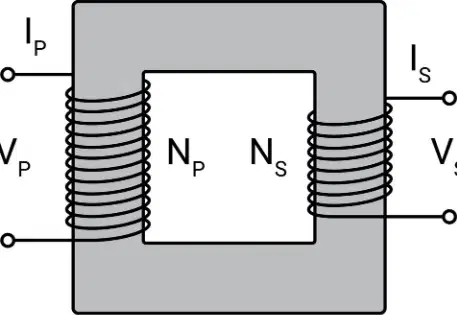
The ability of a transformer to step up or step down voltage depends on which ratio?
Core mass to winding resistance
Primary current to secondary current
Number of turns in the coils
Core area to wire gauge
In a step-up transformer, which statement about the number of turns is correct?
Primary has more turns than secondary
Secondary has more turns than primary
Both coils have the same number of turns
Turns are irrelevant to voltage change
Which function correctly describes a step-up transformer?
It decreases voltage from primary to secondary and increases current
It increases voltage from primary to secondary and decreases current
It keeps voltage the same while increasing power
It converts AC to DC
Which everyday use best matches a step-down transformer as described?
Raising generator voltage at power stations for long-distance transmission
Reducing mains voltage for electronic device chargers to about 5V or 12V
Balancing reactive power in transmission lines
Converting electrical energy directly into light
Which structural feature best characterizes a step-down transformer?
More turns on the secondary coil than the primary
Fewer turns on the secondary coil than the primary
Equal turns on both coils
No laminated core is used
Which statement about the output condition of a transformer is accurate according to the description?
An induced voltage appears only if the secondary is open-circuited
An induced voltage drives alternating current through the load when the secondary coil is part of a closed circuit
No voltage is induced unless the coils are electrically connected
The induced voltage is DC regardless of input

