
 Worksheets
Chapter 15: Autoimmunity
Total questions: 72
Worksheet time: 36mins
Which statement best defines autoimmunity?
Immune responses against self-antigens
Immunity exclusively against pathogens
Tolerance toward all foreign antigens
Enhanced barrier defenses without antibodies
Loss of self-tolerance most directly means what?
Failure to suppress responses to self
Overproduction of neutrophil chemokines
Inability to recognize any foreign antigens
Complete absence of humoral immunity
Which pairing best matches autoimmune disease scope with description?
Systemic disease
Affects multiple tissues broadly
Organ-specific disease
Targets one organ predominantly
Immunologic tolerance
Mechanisms preventing anti-self responses
Autoimmune diseases can be mediated by which arms of immunity?
Humoral antibody mechanisms
T-cell mediated
Innate barrier keratinization
Complement-independent coagulation
What consequence commonly results from autoimmune responses to self-antigens?
Tissue and organ damage
Improved wound healing rate
Sterile immunity without inflammation
Permanent pathogen resistance
Self-tolerance is best described as the immune system’s ability to do what?
Accept self-antigens without response
Eliminate all foreign antigens
Produce high-affinity autoantibodies
Prevent pathogen entry at barriers
Organ-specific autoimmune diseases primarily involve which pattern of damage?
Restricted to a single organ
Diffuse across entire body
Limited to epithelial barriers
Confined to blood components
Which group from the overview includes rheumatoid arthritis and other SARDs?
Systemic autoimmune diseases
Organ-specific autoimmune diseases
Etiology and tolerance section
Environmental exposure chapter
Which process in the thymus removes T cells with high affinity for self-antigens?
Positive selection of naïve T cells
Negative selection eliminating autoreactive T cells
Receptor editing to change TCR
Clonal expansion of memory T cells
Match each tolerance mechanism to its primary site.
Negative selection of T cells
Thymus
Receptor editing in B cells
Bone marrow
Treg-mediated suppression
Peripheral lymphoid organs
Which features characterize regulatory T cells (Treg) in maintaining tolerance? Select all that apply.
Suppress effector T cell responses
Require IL-2 for maintenance
Induce receptor editing in B cells
Secrete anti-inflammatory cytokines
Drive co-stimulatory upregulation on APCs
A self-reactive B cell in bone marrow most likely avoids autoimmunity through which central tolerance mechanism?
Receptor editing of light-chain genes
Anergy after peripheral activation
Deletion by Fas-FasL signals
Class-switch recombination blockade
Which sequence best describes progression to autoimmune disease in a genetically susceptible person exposed to triggers?
Triggers → central tolerance strengthening → disease
Genetics → loss of tolerance → triggers → disease
Triggers → activation of self-reactive lymphocytes → disease
Genetics → environmental triggers → loss of tolerance → disease
Loss of tolerance → genetics change → disease
Which outcome results when both central and peripheral tolerance fail to eliminate self-reactive lymphocytes?
Enhanced vaccine responses
Persistent anergy of all lymphocytes
Development of autoimmune disease
Expansion of naïve T cell pool
Which description best characterizes Systemic Lupus Erythematosus (SLE)?
A chronic systemic inflammatory disease affecting multiple organs
An acute localized infection limited to one organ system
A hereditary metabolic disorder without inflammation
A chronic degenerative joint disease without immune features
Which autoantibody is classically associated with SLE pathogenesis?
Antibodies to double-stranded DNA and nuclear components
Antibodies to insulin receptors on pancreatic beta cells
Antibodies to acetylcholine receptors at neuromuscular junctions
Antibodies to thyroid-stimulating hormone receptors in thyroid
What is the immediate immunologic consequence of abundant autoantibodies in SLE?
Immune complex formation with subsequent complement activation
Direct bacterial killing by enhanced neutrophil phagocytosis
Clonal deletion of autoreactive T cells in the thymus
Isotype switching exclusively to IgE against allergens
Which sequence best outlines a key pathogenic cascade in SLE?
Autoantibodies form complexes, complement activates, neutrophils migrate to the site
B cells fail to mature, macrophages die, eosinophils degranulate
Dendritic cells phagocytose bacteria, NK cells expand, fever resolves
Cytotoxic T cells lyse platelets, basophils release histamine widely
Which group lists systemic autoimmune diseases?
SLE, rheumatoid arthritis, systemic autoimmune rheumatic diseases
Type 1 diabetes, celiac disease, autoimmune thyroiditis
Myasthenia gravis, multiple sclerosis, autoimmune liver disease
Anti–glomerular basement membrane disease, celiac disease, Graves
Which condition is organ-specific rather than systemic?
Autoimmune thyroid disease affecting the thyroid gland
Systemic lupus erythematosus involving multiple organs
Rheumatoid arthritis with extra-articular manifestations
Granulomatosis with polyangiitis involving many systems
Which clinical manifestation is commonly seen in SLE?
Joint involvement such as inflammatory arthritis
Hyperglycemia due to insulin deficiency
Chorea with anti–streptococcal antibodies
Severe bullous pemphigoid limited to the skin
Which hematologic abnormalities are typical in SLE?
Anemia, leukopenia, thrombocytopenia due to immune injury
Polycythemia with elevated neutrophil counts and eosinophilia
Hemophilia A with factor VIII congenital deficiency
Sickle cell disease caused by hemoglobin polymerization
Which organ involvement is a major cause of morbidity in SLE?
Renal involvement due to immune complex deposition
Pancreatic destruction causing absolute insulin deficiency
Thyroid hyperfunction from stimulating autoantibodies
Alveolar destruction leading to emphysematous changes
Match each disease category with examples.
Systemic autoimmune diseases
SLE, RA, other SARDs
Organ-specific autoimmune diseases
Autoimmune thyroiditis, type 1 diabetes, celiac disease
Vasculitic systemic diseases
Granulomatosis with polyangiitis
Which immunologic event most directly promotes tissue inflammation in SLE lesions?
Complement activation attracting neutrophils to deposit sites
Somatic hypermutation of B cells in germinal centers
Downregulation of MHC class II on antigen-presenting cells
Apoptosis of autoreactive clones in peripheral tissues
Which laboratory test is most specific for systemic lupus erythematosus when positive at high titers?
Anti-ds DNA antibodies
CRP/ESR levels
Urinalysis findings
CBC abnormalities
During an SLE flare, which acute phase reactants are typically elevated?
CRP and ESR
C3 and C4
Serum calcium
Serum albumin
Complement component C3 levels in active SLE are best described as:
Often decreased during inflammation
Always normal in remission
Consistently increased in flares
Unaffected by immune complex disease
Antinuclear antibodies are directed against:
Antigens in cell nuclei
Antigens on cell membranes
Bacterial cytoplasmic antigens
Extracellular matrix proteins
ANAs are present in what proportion of lupus patients?
More than 95 percent
About 50 percent
Less than 25 percent
Exactly 75 percent
Which of the following is lupus-specific among ANA subsets?
Anti–ds DNA
Anti–ss DNA
Anti-histone
Anti-centromere
Select the ANA specificities commonly included in testing panels. Select all that apply.
Anti-histones and nucleosomes
Anti-ENA such as anti-Sm
Antibodies to centromere
Anti-RNP and anti-SS-A
Which statement best describes the first step of the FANA test?
Incubate patient serum with Hep-2 cells
Add fluorescein-labeled anti-IgM reagent
Mount slides and read by brightfield
Dilute serum in hypertonic saline
In the FANA test, the secondary reagent used after patient serum is:
Fluorescein-labeled anti-human IgG
Biotinylated anti-complement C3
Horseradish peroxidase anti-IgA
Unlabeled anti-nuclear protein
After incubation with secondary antibody in FANA, the slides are:
Washed and viewed under fluorescent microscope
Dried and evaluated under phase contrast
Stained with hematoxylin and eosin
Fixed with methanol and stored
Match each ANA specificity to its typical target structure.
Anti-ds DNA
Double-stranded nuclear DNA
Anti-histone
Chromatin structural proteins
Anti-centromere
Kinetochore-associated regions
Anti-SS-A (Ro)
Extractable nuclear antigen complex
Which laboratory test helps monitor renal involvement in SLE?
Urinalysis for proteinuria
Serum amylase testing
Spirometry measurements
Liver function panels
Which statement about ANAs is true regarding disease prevalence and utility?
Present in most lupus patients
Absent in autoimmune diseases
Only found in infections
Never used for diagnosis
Place the procedural steps of the FANA test in order.
Incubate serum on Hep-2 cells
Step 1
Apply fluorescein-labeled anti-IgG
Step 2
Wash and examine under fluorescence
Step 3
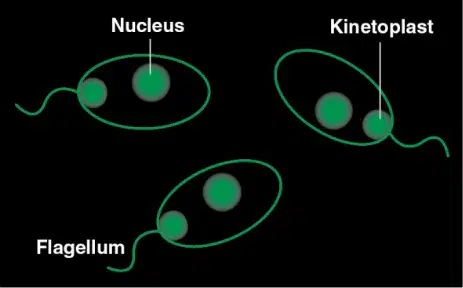
Which substrate is used in an indirect immunofluorescence assay to detect anti-dsDNA antibodies due to its kinetoplast rich in dsDNA?
Crithidia luciliae kinetoplast smear
Human neutrophil nuclear extract
HeLa cell chromatin slides
Rat liver nuclear sections
A patient’s anti-dsDNA titer rises markedly over time. What clinical implication is most consistent with this change?
Increasing SLE disease activity
Resolving lupus nephritis
Laboratory reagent contamination
Development of antiphospholipid syndrome
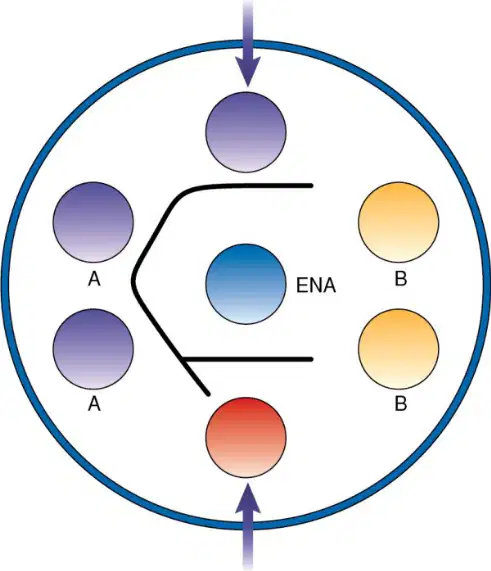
The ENA Ouchterlony test is primarily which type of method?
Double immunodiffusion assay
Indirect hemagglutination test
Western blot electrophoresis
Complement fixation reaction
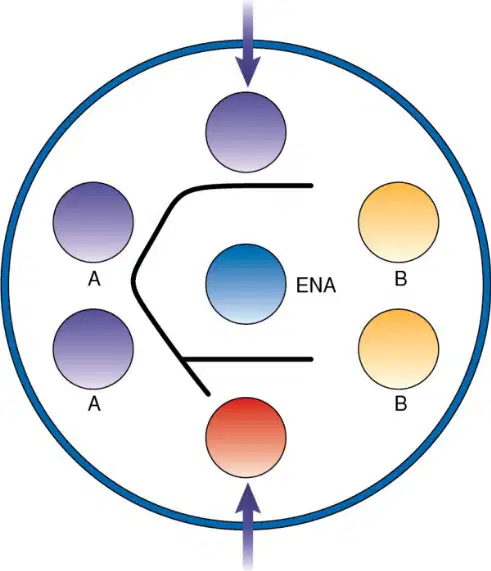
Two outer wells labeled A show identity lines with the ENA center well, indicating antibodies to which target in the example provided?
Sm antigen specificity
dsDNA double helix
Cardiolipin phospholipid
Beta-2 glycoprotein I
Which combination of findings supports antiphospholipid syndrome in a lupus patient? Select all that apply.
Recurrent pregnancy loss
Prolonged APTT and PT
Deep vein thrombosis
Negative ENA immunodiffusion
Low anti-dsDNA titers
Phospholipid antibodies are present in approximately what proportion of lupus patients?
About sixty percent
About fifteen percent
About ninety percent
About thirty percent
Why might nontreponemal syphilis tests yield false positives in patients with phospholipid antibodies?
Antibodies react with cardiolipin antigen
Excess complement activation occurs
Hemolysis of red cells interferes
Treponemal antigens cross-react directly
The lupus anticoagulant is best characterized by which laboratory effect?
Prolonged phospholipid-dependent clotting times
Shortened thrombin time and APTT
Normal PT with prolonged bleeding time
Markedly elevated fibrinogen concentration
Match each test or feature with its primary target or principle.
Crithidia luciliae IIF
dsDNA-rich kinetoplast
ENA Ouchterlony assay
Double immunodiffusion against ENA
Lupus anticoagulant
Prolonged phospholipid-dependent clotting
Antiphospholipid antibodies
Risk of thrombosis and pregnancy loss
Which statement best characterizes rheumatoid arthritis involving peripheral joints?
Chronic inflammation causing deformity and disability
Acute infection resolving without structural damage
Degenerative wear primarily from mechanical stress
Metabolic crystal deposition limited to single joint
Which process directly contributes to bone and cartilage destruction in rheumatoid arthritis?
Persistent inflammation within synovium
Reduced blood flow to epiphysis
Excess calcium deposition in cartilage
Mechanical overuse of affected joints
TNF-alpha in rheumatoid arthritis is best described as:
A key cytokine driving inflammation
An enzyme degrading cartilage matrix
A hormone increasing bone density
A vitamin required for collagen synthesis
Overactive osteoclasts in rheumatoid arthritis primarily lead to:
Enhanced bone resorption and erosion
Accelerated cartilage regeneration
Improved osteoblast differentiation
Reduced immune complex formation
Autoantibodies in rheumatoid arthritis combine with antigens to form:
Immune complexes causing inflammation
Lipid rafts stabilizing membranes
Complement inhibitors blocking lysis
Protein chaperones aiding folding
Match each treatment class with its primary role in rheumatoid arthritis management.
NSAIDs
Reduce pain and inflammation
DMARDs
Modify disease course and progression
Biologic anti–TNF agents
Target TNF-alpha mediated signaling
Which treatment primarily targets TNF-alpha signaling in rheumatoid arthritis?
Biologic agents blocking TNF-alpha
Nonsteroidal anti-inflammatory drugs
Low-dose corticosteroid injections
Physical therapy and exercise plans
Which mechanism best explains joint deformity and disability over time in rheumatoid arthritis?
Chronic synovial inflammation with bone erosion
Transient edema resolving without damage
Cartilage hypertrophy strengthening joints
Ligament ossification preventing movement
Which statement distinguishes rheumatoid arthritis pathology from osteoarthritis pathology?
Immune-driven inflammation damages bone and cartilage
Age-related wear concentrates on articular cartilage
Crystal deposition initiates acute monoarthritis
Bacterial toxin triggers purulent joint infection
Which statement best describes rheumatoid factor in rheumatoid arthritis?
Autoantibody usually IgM targeting IgG Fc
Autoantibody IgG targeting IgM heavy chain
Cytokine released by activated T lymphocytes
Enzyme produced by synovial fibroblasts
A positive rheumatoid factor is found in many conditions. In RA, what is its diagnostic characteristic?
Present in about eighty percent, not specific
Present in nearly all cases, fully specific
Present in half of cases, highly specific
Rarely present, highly sensitive
Anti-CCP antibodies are directed against which target?
Cyclic citrullinated peptide containing modified arginine
Native collagen peptide containing glycine residues
Linear polypeptide with unmodified lysine sidechains
Denatured albumin peptide with oxidized methionine
Which laboratory feature distinguishes anti-CCP from rheumatoid factor in RA?
Higher specificity for rheumatoid arthritis
Lower sensitivity than ESR measurement
Exclusive presence in juvenile arthritis
Ability to predict complement consumption
Select ALL tests primarily used to assess inflammation activity in RA rather than autoantibody specificity. Select all that apply.
ESR
CRP
Rheumatoid factor
Anti-CCP
Complement levels
Which statement about antinuclear antibodies (ANAs) in rheumatoid arthritis is most accurate?
May be present but are not specific for RA
Always absent and exclude RA diagnosis
Highly specific, confirm RA definitively
Only elevated during acute infection
Match each test to its typical clinical utility in rheumatoid arthritis.
Rheumatoid factor
Common but not specific autoantibody
Anti-CCP antibody
Highly specific autoantibody for RA
ESR/CRP
Markers of systemic inflammation
Complement levels
May be altered with immune complex activity
Elevated CRP and ESR in a patient with suspected RA most directly indicate what?
Active systemic inflammation is present
Presence of anti-CCP autoantibodies
Complement pathway genetic deficiency
Specificity of rheumatoid factor testing
Which feature most characterizes Sjögren’s syndrome in clinical presentation?
Dry eyes and mouth symptoms
Diffuse muscle weakness patterns
Raynaud phenomenon with ulcers
Acute polyarticular joint swelling
Which autoantibodies are classically associated with Sjögren’s syndrome?
SS-A and SS-B antibodies
Anti-centromere antibodies
Anti-Jo-1 antibodies
Anti-dsDNA antibodies
In systemic sclerosis, which pathologic processes primarily drive organ involvement?
Fibrosis and vasculitis changes
Immune complex deposition
Cartilage degradation enzymes
Neuronal demyelination events
Systemic sclerosis includes a limited cutaneous variant often summarized by an acronym. Which statement best identifies it?
Includes CREST syndrome features
Dominated by anti-U1-RNP
Primarily causes sicca symptoms
Defined by proximal muscle weakness
Which disease commonly shows overlap features and anti-U1-RNP antibodies?
Mixed connective tissue disease
Sjögren’s syndrome
Systemic sclerosis
Inflammatory myopathies
Match each SARD with its key association.
Sjögren’s syndrome
SS-A/SS-B antibodies
Systemic sclerosis (SSc)
Fibrosis with vasculitis; CREST
Mixed connective tissue disease
Overlap; anti-U1-RNP
Which set lists autoantibodies correctly paired with disease associations in this context?
SS-A/SS-B with Sjögren’s
Anti-U1-RNP with MCTD
Many ANAs with SSc
Anti-Jo-1 with sicca

