
 Worksheets
excercise test p4
Total questions: 90
Worksheet time: 2hrs 42mins

This part of skeleton is called....
Skull
Pelvis
Ribs
Spine
The function of ribs is protecting....
Lungs only
Lungs and heart
Heart only
Brain
The picture of pelvis is ____


Brain wll be protected by....


This bone is called....
Femur
Pelvis
Skull
Ribs
Fracture is shown in picture ____


Which data is belong to teacher?
A
B
C
D
Animal that is grouped into Vertebrate is ____


What happen with his biceps and triceps?
biceps relax and triceps contract
biceps relax and triceps relax
biceps contract and triceps relax
biceps contract and triceps contract

What happen with his biceps and triceps?
biceps relax and triceps contract
biceps relax and triceps relax
biceps contract and triceps relax
biceps contract and triceps contract
Bones are made up of calcium.
TRUE
FALSE
Snail is exoskeleton animal.
TRUE
FALSE
All of our muscles are joined to bones.
TRUE
FALSE
Our heart is made of muscle.
TRUE
FALSE

In this position, his biceps contract.
TRUE
FALSE
Why do we need skeleton?
Tick 3 boxes with correct answers.
To protect important organs
To support our body
To make us looks like jelly
To shape our body
To keep the bones save
Tick 3 boxes of invertebrates animals.


Tick 3 boxes with picture of contracting biceps.


Tick 3 boxes which contain muscles picture.


Tick 3 boxes of ENDOSKELETON animals.

What are the signs of healthy plants?
Brown or black spots
Firm well-formed leaves
Crinkled leaves
Wilting leaves
How can germs be spread?
by saliva from the mouth
by touch
from plants to humans
when a person with the disease coughs or sneezes
How can you prevent the spread of germs?
Covering your cough by coughing into your elbow or a tissue
Exercising regularly
Eating healthy food
Watching TV all day
What should you do if your friend offers you his/her dad’s medicine for your headache?
Share it with others
Tell an adult
Ignore it
Take it immediately
What is the main concept of vaccines?
They are only for animals
They help our body to fight germs such as viruses
They are harmful
They have no impact on health
What should you do if you find a jar of medicine that looks like sweets on the kitchen table?
Eat them all
Throw them away
Ask an adult to read the instructions first
Take them to school
What are some ways to store medicines?
In the refrigerator
In the bathroom
In a cool, dry place
In the car
What are infectious diseases?
Diseases that are not contagious
Diseases that are not harmful
Diseases caused by plants
Diseases caused by germs that can spread from one person to another
What is the purpose of vaccines?
To cause allergies
To spread diseases faster
To prevent diseases in humans and animals
To make people sick
What should you do if you are sick and don’t feel like going to the doctor?
Take medicine without permission
Ignore the symptoms
Take your brother's medicine
Ask an adult to read the instructions first
What are some of the diseases that vaccines prevent?
Epilepsy
Alzheimer's
Measles
Cancer
What is the impact of diseases on humans?
No impact at all
Positive impact
Negative impact
Neutral impact
What is the correct order for hand-washing technique?
Get soapy, Rub, Rinse, Shake and dry
Get you hands wet in clean water, Rub, Rinse, Shake and dry
Rinse, Get soapy, Rub, Shake and dry
Rub, Get soapy, Rinse, Shake and dry
What are some things you need to be healthy?
Avoiding people who are sick
Eating junk food daily
Not exercising
Wearing dirty clothes
What happens when you are sick?
You become stronger
You feel great
You feel unwell
You have no symptoms
Who can help you feel better when you are sick?
Your friends
Your pet
A doctor or nurse
Watching TV
Why do we need medicines? Choose two correct answers.
to prevent an injury from playing sports
to treat illnesses
to prevent from getting sick
What are some common symptoms of the flu?
Runny nose and sneezing
Clear skin and bright eyes
Strong muscles and bones
Shiny hair and nails
How can you protect yourself from getting sick?
Washing hands regularly
Never drinking water
Playing in the mud all day
Sharing food with everyone
Why is it important to cover your mouth when you cough or sneeze?
To spread germs faster
To keep your hands clean
To prevent the spread of germs to others
Because it's fun
Due to the fact that plants can make their own food using photosynthesis, what are plants considered in food chains?
omnivores
consumers
producers
carnivores
What is the process called when a plant uses the sun to make its own food (glucose)?
photosynthesis
respiration
transpiration
circulation

Look at this food chain.
The arrows in the food chain means ....
is bigger than
is eaten by
is smaller than
is eating

Look at this food chains !
Based on the food chain, we know that the grass and trees get energy from ....
Lion
Deer
Sun
Vulture

Look at this food chains!
Based on the food chains, the predator of the rat is
Snake
Eagle
Grassopher
Rice plant

Look at this food chain!
Based on the food chain, the prey of the rat is ....
Rice plant
Grassopher
Snake
Eagle
What would a rabbit be considered in a food chain if it ONLY EATS PLANTS?
herbivore
omnivore
carnivore
producer
What would a lion be considered in a food chain if they ONLY EAT MEAT?
producer
herbivore
carnivore
omnivore
What would a human that eats BOTH PLANTS AND ANIMALS be considered in a food chain?
herbivore
carnivore
producer
omnivore


Which of these is a possible food chain for this environment?
Sun → grass → fly → frog
frog → fly → grass → Sun
Sun ← grass ← fly ← frog
Sun → fly → frog → snake

plant plankton
animal plankton
sardine
tuna

the snake
the rat
the grasshopper
the grass
The true following food chain are ….
Caterpillar -> Bird -> Owl
Plant -> Aphid -> Ladybird
Corn plant -> Mouse -> Owl
Rabbit -> Snake -> Eagle

a rock
a fox
a plant
an egg

Birds – Beetles – Aphids – Roses
Roses – Aphids – Beetles - Birds
Birds -> Beetles -> Aphids -> Roses
Roses -> Aphids -> Beetles -> Birds

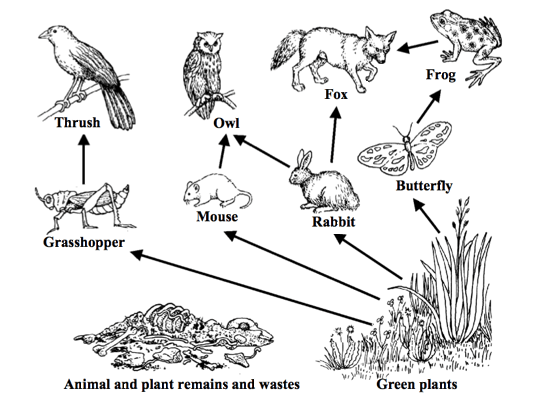

Look at food chains A and B.
The following animals predator are ….
Rat
Owl
Lion
Rabbit
Habitat is ……
Habitat is a natural home only for plants to live and survive
Habitat is a natural homes for living things to have food, water, and shelter to survive
Habitat is a natural home only for the animal to have food, water, and reproduce
Habitat is a natural home for pets to live and survive
What 4 things must be present in a habitat?
space, shelter, water, food
ponds
food and air
shelter and no water

What's the name of this habitat?
Rainforest
Arctic
Ocean
Desert

What's the name of this habitat?
Rainforest
Arctic
Ocean
Grassland

Where does the monkey live?
Grassland
Desert
Rainforest
Arctic
Which of these habitats has a very cold temperature?
Grassland
Polar regions
Desert
Tropical rainforest
What is the tropical rainforest?
Tropical rainforests doesn’t have many trees
Tropical rainforest is the driest place on earth
Tropical rainforests is usually warm, humid, and wet
Tropical rainforest has extremely cold weather throughout the year
Fish, dolphins, coral, sea turtles, and plants live here. What habitat is this describing . . . .


The habitat which is wide, open areas where mostly grass and flowers grow is known as a ....
grassland
lake
ocean
desert
The habitat which has water that contains a lot of salt is known as an/a ....
ocean
river
rainforest
grassland
Liquid takes the shape of its_____:
container
size
color

Identify the process.
Freezing
Evaporation
Melting
Condensation

Identify the process.
Melting
Condensation
Freezing
Evaporation
_________is made up of the same type of particles.
mixture
solution
substances
material
There are the examples of chemical reaction, except ....
burning wood
rusted nails
builders make concrete
melting ice
when a substance or materials change from a liquid to a solid. they lose heat. It is called ....
freezing
melting
material
substance
A chocolate can melt because it is (a)
Banu's ice cream started as solid, when the sun heated, ice cream changed into liquid. it is called ....
melting
freezing
solidifying
materials
Which is the right statement for describing LIQUIDS particles?
the particles are packed tightly together
the particles are close together, but they are not packed
the particles are very far apart from each other
there are big spaces between the particles

The picture describes the particles of (a)
Plastic, wood, glass, and rubber are (a)
Which materials are solid?
oxygen and carbon dioxide
pure water and oil
vinegar and syrup
sugar and powder milk
The process of changing from a solid into a liquid (a)
One or more new substances are formed during ....
chemical reaction
physical changes
What is the physical change?
Particles move around one another.
So ... can flow and take the shape of any container.
(a)
Write the properties of solid particles.
A ... is made of one type of matter.
(a)

The incorrect description about the particles is ….
Packed very closely together
Have a fixed position
Particles vibrate
Taking the shape of any container
A ... is made of one type of matter.
(a)

