
 Worksheets
Final Concepts
Total questions: 110
Worksheet time: 1hrs 3mins
Biology is best described as the study of
the physical laws of the universe.
the living world.
geological formations.
atomic structure.
Which choice below represents the correct classification scheme of taxonomy?
kingdom → phylum → domain → class → order → family → genus → species
domain → kingdom → phylum → class → order → family → genus → species
domain → kingdom → phylum → class → family → order → species → genus
phylum → domain → kingdom → order → class → genus → family → species
The lowest level of biological organization that can perform all activities required for life is a/an
Organelle—for example, a chloroplast.
Tissue—for example, nervous tissue.
Organism—for example, a fungus, dog, human, or maple tree.
Cell—for example, a skin cell.
What are the two domains of prokaryotic organisms?
Bacteria and Archaea
Bacteria and Monera
Eukarya and Bacteria
Archaea and Eukarya
Which compounds contain only carbon and hydrogen atoms, making them very hydrophobic?
sucrose
ethanol
hydrocarbons
fatty acids
Peptide bonds are found in polymers of which class of biological macromolecules?
proteins
carbohydrates
lipids
nucleic acids
What is the pH of urine with [H+]=1×10⁻⁵ mol/L ?
0.00001
0.5
10
5
What is the term used for a change in a protein's three-dimensional shape when exposed to adverse environmental conditions?
condensation
renaturation
stabilization
denaturation
Thalidomide and L-dopa are examples of pharmaceutical drugs that occur as enantiomers, or molecules that
are mirror images of one another.
have identical three-dimensional shapes.
differ in the location of their double bonds.
lack an asymmetric carbon.
Many mammals control their body temperature by sweating. Which property of water is most directly responsible for the ability of sweat to lower body temperature?
water's change in density when it freezes
water's high surface tension
water's ability to dissolve molecules in the air
the absorption of heat by the breaking of hydrogen bonds during vaporization
All organisms are composed of at least one cell. This is a central part of the
Fluid-Mosaic Model
Laws of Thermodynamics
Cell Theory
Theory of Endosymbiosis
Animal cells have all of the following components EXCEPT
plasma membrane
cell walls
mitochondria
ribosomes
Which of the following types of molecules are the major structural components of the plasma membrane?
phospholipids and proteins
proteins and cellulose
phospholipids and cellulose
nucleic acids and proteins
Secretion of proteins is accomplished by what process?
exocytosis
pinocytosis
phagocytosis
osmosis
The electrochemical gradient across the plasma membrane of most of the cells in the human body is established and maintained by the Na+-K+ pump moving ions AGAINST THEIR CONCENTRATION GRADIENTS. This is an example of which of the following?
osmosis
simple diffusion
active transport
passive transport
Which of the following is a correct statement about diffusion?
A carrier protein must be present for it to occur.
It requires an expenditure of energy by the cell.
It is a passive process in which molecules move from a region of higher concentration to one of lower concentration.
It is an active process in which molecules move from a region of lower concentration to one of higher concentration.
Which of the following are NOT found on/in any prokaryotic cell?
capsule
nucleic acids
membrane-bound organelles
cell walls
What are the membrane structures that function in active transport?
carbohydrates
cholesterol
cytoskeleton filaments
integral proteins
The second law of thermodynamics states that all energy conversions are inefficient, and some energy is always lost as which biologically unusable form?
chemical energy
potential energy
thermal energy (heat)
ATP
Which of the following relationships between cell structures and their respective functions is correct?
ribosomes: secretion of lipids
cell wall: support, protection
chloroplasts: chief sites of cellular respiration
lysosomes: formation of ATP
A red blood cell placed into a hypotonic solution will potentially undergo which of the following processes?
plasmolysis
crenation
hemolysis
nothing
Zn2+ (zinc), an inorganic metal ion, is normally present in the active site of the enzyme carboxypeptidase. The Zn2+ most likely functions as a:
noncompetitive inhibitor of the enzyme
competitive inhibitor of the enzyme
coenzyme derived from a vitamin
cofactor necessary for enzyme activity
White blood cells and amoebas engulf bacteria through what process?
exocytosis
osmosis
pinocytosis
phagocytosis
Which organelle maintains turgor pressure inside plant cells?
central vacuole
golgi apparatus
chloroplast
cell wall
The reaction shown below is performed by baker's yeast (S. cerevisiae). C6H12O6→2C2H5OH+2CO2+2 ATP Which of the following is true about this reaction?
This process requires O2.
This process occurs anaerobically.
Human muscle cells also perform this reaction.
Yeast cells do not produce carbon dioxide during this reaction.
Which of the following processes produces the most ATP molecules when one glucose molecule is completely broken down during aerobic cellular respiration?
oxidative phosphorylation
lactic acid fermentation
citric acid cycle
glycolysis
Which curve represents the profile of an enzyme taken from a bacterial species that lives in hot springs at temperatures of approximately 75°C?
curve 1
curve 2
curve 3
curve 4
curve 5
Which curve represents the profile of an enzyme taken from the human stomach where conditions are strongly acidic?
curve 1
curve 2
curve 3
curve 4
curve 5
Which of the following statements describes the results of this reaction? C6H12O6+6 O2→6 CO2+6 H2O+Energy
C6H12O6 is oxidized, and O2 is reduced.
O2 is reduced, and CO2 is oxidized.
C6H12O6 is reduced, and CO2 is oxidized.
None of the above answer choices are correct.
Which of the following correctly lists the sequence of stages for aerobic cellular respiration?
glycolysis → oxidative phosphorylation → citric acid cycle
oxidative phosphorylation → citric acid cycle → glycolysis
citric acid cycle → glycolysis → oxidative phosphorylation
glycolysis → citric acid cycle → oxidative phosphorylation
For questions 31–36, use the reactions below. Reaction A: C6H12O6+6 O2→6 CO2+6 H2O+32 ATP Reaction B: 6 CO2+6 H2O+light energy→C6H12O6+6 O2 Which reaction shows the chemical equation for photosynthesis?
Reaction A
Reaction B
both
neither
For questions 31–36, use the reactions below. Reaction A: C6H12O6+6 O2→6 CO2+6 H2O+32 ATP Reaction B: 6 CO2+6 H2O+light energy→C6H12O6+6 O2 Which reaction shows the chemical equation for cellular respiration?
Reaction A
Reaction B
both
neither
For questions 31–36, use the reactions below. Reaction A: C6H12O6+6 O2→6 CO2+6 H2O+32 ATP Reaction B: 6 CO2+6 H2O+light energy→C6H12O6+6 O2 Which reaction is catabolic?
Reaction A
Reaction B
both
neither
For questions 31–36, use the reactions below. Reaction A: C6H12O6+6 O2→6 CO2+6 H2O+32 ATP Reaction B: 6 CO2+6 H2O+light energy→C6H12O6+6 O2 Which reaction is anabolic?
Reaction A
Reaction B
both
neither
For questions 31–36, use the reactions below. Reaction A: C6H12O6+6 O2→6 CO2+6 H2O+32 ATP Reaction B: 6 CO2+6 H2O+light energy→C6H12O6+6 O2 Which reaction is exergonic?
Reaction A
Reaction B
both
neither
For questions 31–36, use the reactions below. Reaction A: C6H12O6+6 O2→6 CO2+6 H2O+32 ATP Reaction B: 6 CO2+6 H2O+light energy→C6H12O6+6 O2 Which reaction is endergonic?
Reaction A
Reaction B
both
neither
What are the three components of a DNA nucleotide?
phosphate, deoxyribose, nitrogenous base (A, T, C, or G)
phosphate, ribose, nitrogenous base (A, U, C, or G)
phosphate, deoxyribose, nitrogenous base (A, U, C, or G)
phosphate, ribose, nitrogenous base (A, T, C, or G)
What is meant by the description "antiparallel" regarding the strands that make up DNA?
Base pairings create unequal spacing between the two DNA strands.
The double helical nature of DNA creates uneven strands.
The 5' to 3' direction of one strand runs opposite to the 5' to 3' direction of the other strand.
One strand contains only purines, and the other contains only pyrimidines.
DNA replication is best described as ________.
conservative
dispersive
semiconservative
All choices are correct
What is the direction of DNA synthesis?
3' to 3'
5' to 3'
5' to 5'
3' to 5'
Which enzyme catalyzes the synthesis of a DNA strand in prokaryotes?
Primase
Topoisomerase
DNA Polymerase III
DNA Ligase
All three domains of life use the same genetic code. This illustrates what property of the code?
It is semiconservative
It is universal
It is redundant
It is antiparallel
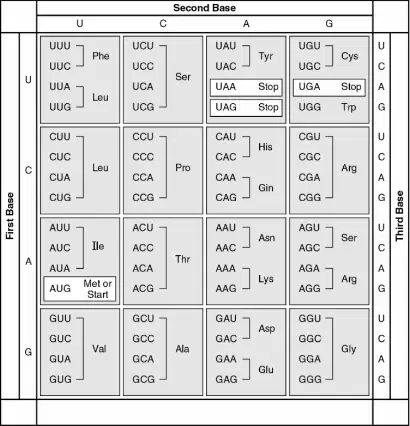
Given the DNA template strand sequence 3' TAC TGC GGT TCA CGG 5', what mRNA sequence would result if this DNA sequence were transcribed?
5' ATG ACG CCA AGU GCC 3'
3' AUG AGG GGA AGU GCC 5'
3' AUG ACG CCA AGU GCC 5'
5' AUG ACG CCA AGU GCC 3'
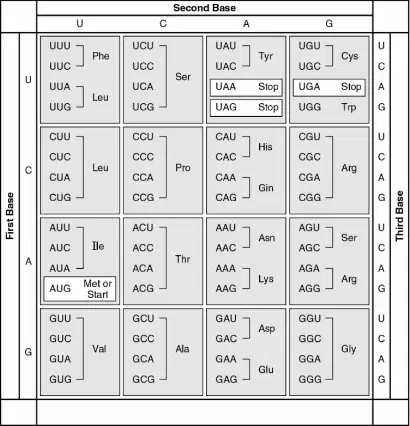
Using the DNA template strand sequence 3' TAC TGC GGT TCA CGG 5' and the standard genetic code, the amino acid sequence coded for by the resulting mRNA would be
Met - Arg - Trp - Tyr - His
Met - Thr - Pro - Ser - Ala
Met - Ala - Thr - Ile - Val
Met - Thr - Ala - Ile - Val
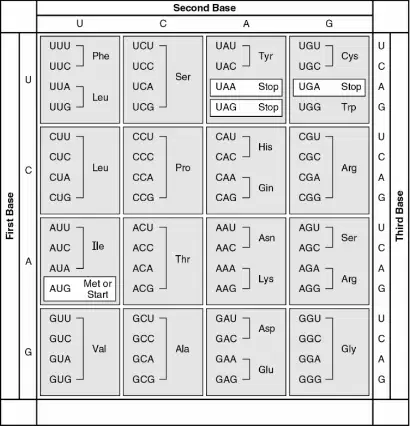
For the DNA template strand sequence 3' TAC TGC GGT TCA CGG 5', what anticodon would be on the tRNA that brings in the fifth amino acid from the left?
CGG
AGU
GCC
CCC
According to the original Central Dogma of Molecular Biology, which of the following correctly describes the flow of genetic information in all living organisms?
RNA → protein → DNA
protein → RNA → DNA
DNA → RNA → protein
DNA → protein → RNA
Which of the following findings changed our understanding of the central dogma of molecular biology?
the discovery of telomeres
the discovery of the structure of DNA
the discovery of the structure of RNA
the discovery of RNA viruses (like HIV) that synthesize DNA using reverse transcriptase
What causes translation to terminate?
The 5' poly-A tail is synthesized.
The 3' cap is detected by the ribosome.
A methionine is reached.
A stop codon in the mRNA is reached.
Use the following information: As a genetic counselor, you meet with Sam and Dianne, who have both tested positive as carriers for the recessive allele (p) that causes phenylketonuria (PKU). What are the genotypes of the parents who have come into your office?
Sam is PP, and Dianne is pp.
Sam and Dianne are both Pp.
Sam and Dianne are both PP.
Sam is Pp, and Dianne is pp.
Use the following information: As a genetic counselor, you meet with Sam and Dianne, who have both tested positive as carriers for the recessive allele (p) that causes phenylketonuria (PKU). What is the chance that their first child will have PKU?
1/4 (25%)
3/4 (75%)
1/2 (50%)
no chance
4/4 (100%)
Use the following information: As a genetic counselor, you meet with Sam and Dianne, who have both tested positive as carriers for the recessive allele (p) that causes phenylketonuria (PKU). What is the chance that their first child will not be affected by PKU?
1/4 (25%)
3/4 (75%)
1/2 (50%)
no chance
4/4 (100%)
Eye color, skin color, and height in humans are controlled by multiple genes. These traits demonstrate which of the following?
monohybrid ratios
polygenic inheritance
nondisjunction
polyploidy
A species of tulip can have either yellow or red flowers. If we cross a homozygous yellow flower plant with a homozygous red flower plant, all of the offspring have red flowers. Based on that result, which of the following is true?
The red allele is dominant.
The yellow allele is dominant.
The red and yellow alleles exhibit incomplete dominance.
The red and yellow alleles exhibit codominance.
Use the following information: Huntington's disease is caused by a dominant allele (H). Jane is heterozygous for the Huntington's allele. What is Jane's genotype?
She has Huntington's disease.
HH
She does not have Huntington's disease.
Hh
Use the following information: Huntington's disease is caused by a dominant allele (H). Jane is heterozygous for the Huntington's allele. What is Jane's phenotype?
She has Huntington's disease.
HH
She does not have Huntington's disease.
Hh
Use the following information: Huntington's disease is caused by a dominant allele (H). Jane is heterozygous for the Huntington's allele. Jane wants to have a child with Jack. Jack is homozygous recessive for the gene in question. What are the chances they will have a child with Huntington's disease?
0%
75%
25%
100%
50%
Use the following information: In pea plants, the yellow seed color allele (Y) is dominant over the green seed color allele (y). You have a pea plant of unknown genotype that produces yellow seeds. You want to perform a test cross to determine the genotype of this plant. In the scenario above, you are test-crossing your plant of unknown genotype to a plant that has what genotype and phenotype?
yy, yellow seeds
YY, green seeds
Yy, yellow seeds
yy, green seeds
Use the following information: In pea plants, the yellow seed color allele (Y) is dominant over the green seed color allele (y). You have a pea plant of unknown genotype that produces yellow seeds and perform a test cross to determine the genotype of this plant. Which set of results from the test cross would indicate that the pea plant with unknown genotype is heterozygous (Yy)?
808 offspring with yellow seeds, 0 offspring with green seeds
406 offspring with yellow seeds, 402 with green seeds
Either outcome above indicates that the unknown pea plant is heterozygous.
There are two alleles for the single gene which controls the shape of a species of radish: long and round (spherical). If we cross a homozygous long radish with a homozygous round radish, all of the baby radishes are oval. Based on that result, which of the following is true?
The long allele is dominant.
The round allele is dominant.
The oval allele is dominant.
The long and round alleles exhibit incomplete dominance.
A human egg cell containing 22 autosomes but no sex chromosomes (O) is fertilized by a human sperm cell containing 22 autosomes and an X chromosome. The resulting zygote will
have Klinefelter syndrome (XXY).
have Down syndrome.
have Turner syndrome (XO).
have 46 chromosomes.
Use the following information: A woman who has type A blood has a daughter who is type O and a son who is type B. Which of the following is the only possible genotype for the son?
I^B i
ii
I^B I^B
IAIB
Use the following information: A woman who has type A blood has a daughter who is type O and a son who is type B. Which of the following is the only possible genotype for the mother?
I^B i
ii
I^A I^A
I^A i
Use the following information: A woman who has type A blood has a daughter who is type O and a son who is type B. Which of the following is a possible genotype/phenotype for the father of the two children?
I^A I^B, type AB
I^B i, type B
I^B I^B, type B
ii, type O
Hemophilia A is an X-linked recessive trait. A woman is a carrier for hemophilia A, and her husband is a hemophiliac. Assume N is the dominant allele and n is the recessive allele. What are the genotypes of the mother and the father, respectively?
XN Xn and XnY
XN and XNY
XnXn and XNY
XN Xn and XNY
Hemophilia A is an X-linked recessive trait. A woman is a carrier for hemophilia A, and her husband is a hemophiliac. What is the chance that the son they plan to have will be a hemophiliac?
0%
25%
50%
75%
100%
Hemophilia A is an X-linked recessive trait. A woman is a carrier for hemophilia A, and her husband is a hemophiliac. What is the chance that the daughter they plan to have will be a carrier?
0%
25%
50%
75%
100%
A human male will inherit which of the following from his mother?
All of his X chromosome genes
None of his Y chromosome genes
Half of his autosomal alleles
All of the above
The SRY gene is best described by which of the following?
A gene region present on the Y chromosome that triggers the formation of testes and a penis during embryonic development
A gene required for general development in both sexes, and individuals lacking the gene do not survive past early childhood
An autosomal gene that is required for the expression of genes on the X chromosome
A gene present on the X chromosome that triggers formation of the ovaries and a clitoris during embryonic development
The failure of chromosomes to separate properly during cell division is called what?
Nondisjunction
Crossing over
Synapsis
Inversion
Down syndrome results from an extra copy of which chromosome?
Chromosome 2
Chromosome 21
X chromosome
Chromosome 13
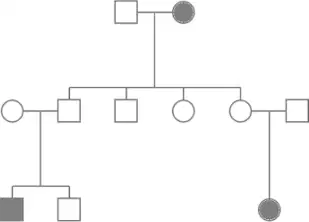
The pedigree shows the inheritance of a human biochemical disorder called alkaptonuria in which affected individuals accumulate a dark-colored substance (alkapton) in urine and certain tissues. Shaded symbols indicate affected individuals. Based on the pedigree, what is the most likely inheritance pattern for alkaptonuria?
Autosomal dominant
X-linked dominant
Autosomal recessive
X-linked recessive

Your class obtains three corn cobs and counts the number of purple and yellow kernels on each cob as summarized:
If corn kernel color is controlled by a single gene with two alleles (R = dominant purple, r = recessive yellow), which parental cross could have produced these cobs as offspring?
RR × RR
Rr × Rr
rr × rr
Rr × rr
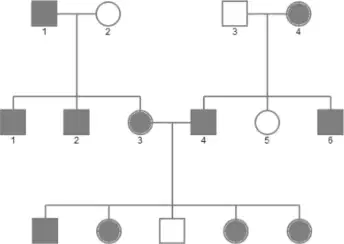
A pedigree for a bobcat population indicates the occurrence of long claws, a trait controlled by a single autosomal gene with two alleles (B = dominant allele, produces long claws; b = recessive allele, produces short claws). Which of the following represents an individual female bobcat with long claws in the pedigree?
I-4
II-5
III-1
III-3

In the bobcat pedigree where long claws are dominant (B) and short claws are recessive (b), which of the following represents an individual male bobcat with short claws?
I-4
II-5
III-1
III-3
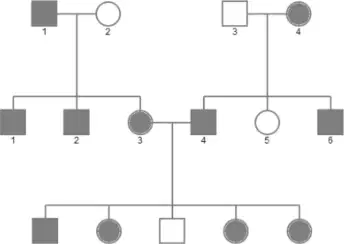
In the bobcat pedigree where long claws are dominant (B) and short claws are recessive (b), what is the genotype of individual I-4?
BB
Bb
bb
Unable to determine from the pedigree
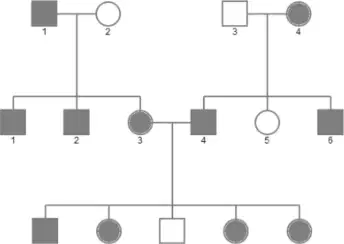
In the bobcat pedigree where long claws are dominant (B) and short claws are recessive (b), what is the genotype of individual II-3?
BB
Bb
bb
Unable to determine from the pedigree
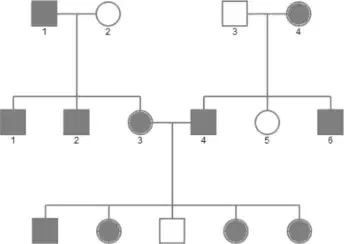
In the bobcat pedigree where long claws are dominant (B) and short claws are recessive (b), what is the genotype of individual II-5?
BB
Bb
bb
Unable to determine from the pedigree
Tay-Sachs disease is a fatal genetic disorder caused by a mutation in an autosomal gene coding for a lysosomal enzyme. A couple, neither of whom suffer from the disorder, have three children; one child was diagnosed with Tay-Sachs at birth, while the other two have normal phenotypes. Determine the genotypes of the parents and indicate the pattern of inheritance displayed by the disorder (T = dominant allele, t = recessive allele).
Parents: TT × Tt; Pattern: autosomal dominant
Parents: TT × TT; Pattern: autosomal dominant
Parents: Tt × Tt; Pattern: autosomal recessive
Parents: Tt × tt; Pattern: autosomal recessive
In fruit flies, grey body color is dominant over black body color, and long wings are dominant over short wings (G = grey body color allele, g = black body color allele; L = long wing allele, l = short wing allele). You perform a cross with two parental flies, each of which has a grey body color and long wings. You obtain the following results when you analyze the phenotypes of the offspring: 18 with grey bodies and long wings, 6 with black bodies and long wings, 6 with grey bodies and short wings, and 2 with black bodies and short wings. Based on this information, what are parental genotypes?
GgLl X GgLl
GgLl X ggll
GGLL X ggll
GgLl X GGLL
What was the most significant conclusion that Gregor Mendel drew from his experiments with pea plants?
Traits are inherited in discrete units and are not the result of "blending."
Recessive genes occur more frequently in the F1 generation than do dominant ones.
Genes are composed of DNA.
There is considerable genetic variation in garden peas.
Mendel continued some of his experiments into the F2 or F3 generation in order to:
distinguish which alleles were segregating
obtain a larger number of offspring on which to base statistics
observe whether or not the dominant trait would reappear
observe whether or not a recessive trait would reappear
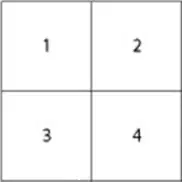
Use the following description and the Punnett square to answer. In a particular plant, leaf color is controlled by gene locus D. Plants with at least one allele D have dark green leaves, and plants with the homozygous recessive dd genotype have light green leaves. A true-breeding, dark-leaved plant is crossed with a light-leaved one, and the F1 offspring is allowed to self-pollinate. The predicted outcome of the F2 is diagrammed in a Punnett square in which the four boxes are labeled 1, 2, 3, and 4 to represent the genotypes produced. Which of the boxes marked 1-4 correspond to plants with dark leaves?
2 and 3
1, 2, and 3
1 only
4 only
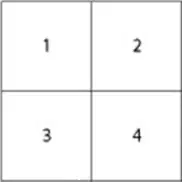
Use the following description and the Punnett square to answer. In a plant where gene locus D controls leaf color, D produces dark green leaves and dd produces light green leaves. A true-breeding dark-leaved plant crossed with a light-leaved plant yields F1 plants that self-pollinate, producing an F2 shown in a Punnett square with boxes labeled 1, 2, 3, and 4 for the genotypes. Which of the boxes marked 1-4 correspond to plants with a heterozygous genotype?
2 and 3
1
1, 2, and 3
2, 3, and 4
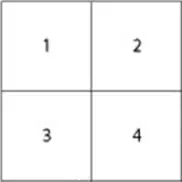
Use the following description and the Punnett square to answer. In a plant where allele D produces dark leaves and dd produces light leaves, a true-breeding dark-leaved plant crossed with a light-leaved plant yields F1 plants that self-pollinate, producing an F2 shown in a Punnett square with boxes labeled 1, 2, 3, and 4. Which of the boxes marked 1-4 correspond to plants that will be true-breeding?
1 and 4 only
2 and 3 only
1 only
1, 2, 3, and 4
Mendel crossed yellow-seeded and green-seeded pea plants and then allowed the offspring to self-pollinate to produce an F2 generation. The results were as follows: 6,022 yellow and 2,001 green (8,023 total). Which of the following statements correctly describes the relationship of the allele for green seeds to the allele for yellow seeds?
The two alleles exhibit incomplete dominance.
The two alleles are codominant.
The green allele is recessive to the yellow allele.
The green allele is dominant to the yellow allele.
Which of the following statements is true?
Organisms interact but do not affect their environment
A typical human liver cell has one set of chromosomes
RNA is the only type of genetic material found in the living system
All forms of life employ the same genetic code (DNA)
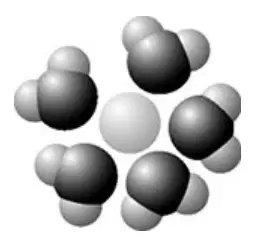
Use your knowledge of the polarity of water molecules and how they dissolve other substances to answer the question. What is the best explanation of the solute molecule (in the center), given the orientation of water molecules around it?
negatively charged
nonpolar
without charge
positively charged
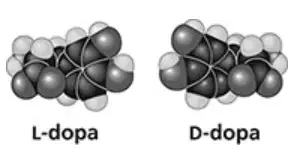
Thalidomide and L-dopa are examples of pharmaceutical drugs that occur as enantiomers. L-dopa is the effective drug used to treat Parkinson's disease. The other enantiomer, D-dopa, is biologically inactive. Which of the following correctly describes enantiomers?
have identical three-dimensional shapes allowing both to be effective in treating Parkinson's disease
are mirror images of one another, causing one to become inactive and not function properly due to incorrectly facing functional groups
are cis-trans isomers, caused by a double bond
are mirror images of one another and have the same biological activity

An example of a Hydrogen Bond is the bond between
the two hydrogen atoms in a molecule of hydrogen gas (H2)
Na+ and Cl- in salt
the H of one water molecule is attracted to the O of another water molecule
C and H bonded in Methane (CH4)
How do phospholipids interact with water molecules?
The polar heads interact with water; the nonpolar tails do not.
Phospholipids do not interact with water because water is polar and lipids are nonpolar.
The polar heads avoid water; the nonpolar tails attract water (because water is polar and opposites attract).
Phospholipids dissolve in water.

Organelle that contains digestive enzymes
nuclear pore
peroxisome
lysosome
vesicle
nuclear envelope
The liver is involved in detoxification of many poisons and drugs. Which of the following structures is primarily involved in this process and, therefore, abundant in liver cells?
smooth endoplasmic reticulum
rough endoplasmic reticulum
nuclear envelope
Golgi apparatus
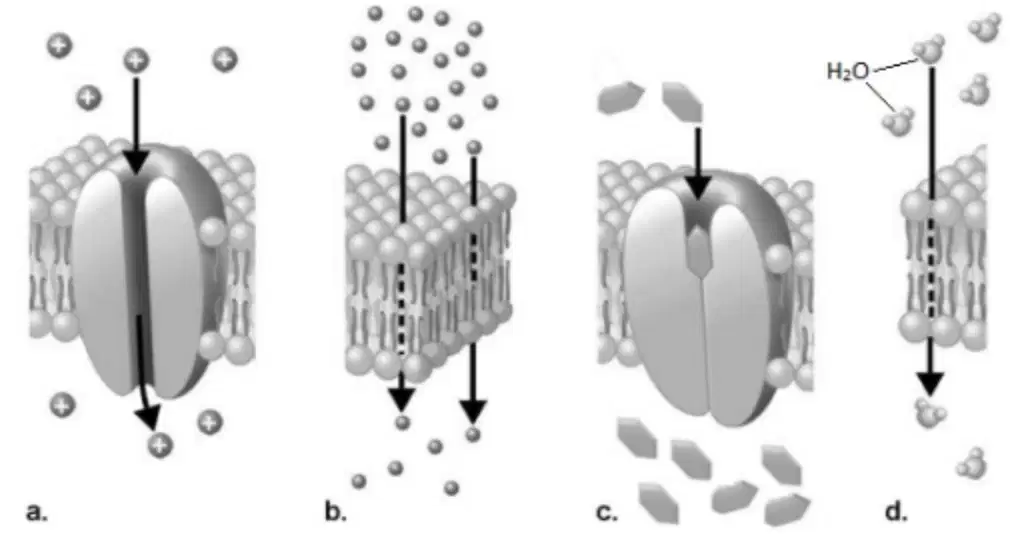
Which illustration best represents active transport?
a
b
c
d
White blood cells engulf bacteria using ________.
pinocytosis
phagocytosis
osmosis
receptor-mediated exocytosis
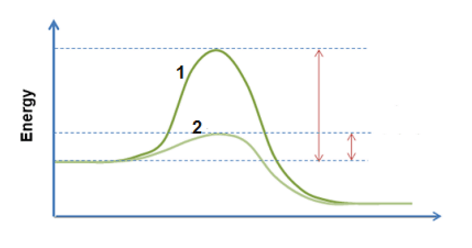
Which line represents an enzyme-catalyzed reaction?
Line 1
Line 2
A weightlifter is using heavy weights in short bursts for a competition. Because his muscle cells are not able to take in enough oxygen to make very much ATP the weightlifter begins to get fatigue in his muscles. Which of the following processes is most likely going on in the muscles of the weightlifter as he competes in his event?
As the cells run out of oxygen they switch to anaerobic respiration (fermentation), which allows the cell to make small amounts of ATP in the absence of oxygen.
As the cells run out of oxygen, they die off gradually and the weightlifter's muscles have fewer contracting muscle cells.
The cells will never run out of oxygen if the weightlifter is breathing.
As the cells run out of oxygen, they will continue to make the same amount of ATP, since oxygen is not required to make ATP.
Which of the following is a product of the Electron Transport Chain?
CO2
O2
C6H1206
H2O
Which of the following are products of the light reactions of photosynthesis that are utilized in the Calvin Cycle?
CO2 and glucose
ATP and NADPH
ADP, P and NADP+
H2Oand O2

A series of enzymes catalyzes the above reaction. Product Z binds to enzyme 1 (which converts W to X). It binds at a location far from the active site. This binding decreases the activity of enzyme 1.
The mechanism in which the end product of a metabolic pathway (such as Product Z above)
temporarily inhibits an earlier step in the pathway is known as
Feedback inhibition, in which the end product binds to an earlier enzyme and temporarily decreases its activity to regulate the pathway.
Irreversible inhibition, in which the product permanently binds and deactivates the enzyme in the pathway.
Metabolic activation, in which the product increases the activity of an earlier enzyme to speed up the pathway.
Allosteric activation, in which the product binds to an enzyme at a site other than the active site and increases its activity.
What type of biological molecule is Rubisco?
A carbohydrate substrate, which is acted upon by another enzyme to produce G3P.
An enzyme, which catalyzes the fixation of CO₂ to RuBP in the Calvin cycle.
A coenzyme, which transfers electrons or functional groups during photosynthesis.
An inorganic cofactor, such as Mg²⁺, required for enzyme activity

What is the function of Rubisco in this cycle shown here?
Rubisco is the enzyme that catalyzes the fixation of carbon dioxide to RuBP, initiating the conversion of CO₂ into organic molecules like G3P.
Rubisco splits water molecules during the light reactions to produce electrons, protons, and oxygen.
Rubisco regenerates ATP from ADP and phosphate during chemiosmosis in the Calvin cycle.
Rubisco converts G3P directly into glucose in a single step after carbon fixation.
The reaction shown below is performed by baker's yeast (S. cerevisiae). Which of the following is true about this reaction?
C6H12O6 --> 2C2H5OH + 2 CO2 + 2ATP
Glucose --> Ethanol
This process requires O₂, which acts as the final electron acceptor in the formation of ethanol and CO₂.
Yeast cells do not produce carbon dioxide during this reaction, as CO₂ is not a byproduct of fermentation.
Human muscle cells also perform this reaction to produce ethanol and CO₂ during exercise.
This process occurs anaerobically, allowing yeast to regenerate NAD⁺ so glycolysis can continue in the absence of oxygen.
Which of the following is true for anabolic reactions?
They are spontaneous and breakdown molecules.
They are nonspontaneous and breakdown molecules.
They are spontaneous and build molecules.
They are nonspontaneous and build molecules.
Where are ATP synthase complexes located in plant cells?
thylakoid membrane only
thylakoid membrane and plasma membrane
thylakoid membrane and inner mitochondrial membrane
inner mitochondrial membrane only
The hydrolysis of ATP to ADP + Pi can best be described as an ________________ reaction that ______________ energy.
exergonic; releases
endergonic; requires
exergonic; requires
endergonic; releases

