
 Worksheets
Chapter 22: (Study guide and SB q&a)
Total questions: 108
Worksheet time: 55mins
Differentiate the two types of immunity. Categorize them as specific or non-specific, whether they have memory, and their type of response to subsequent exposure to antigen.
Which of the following best describes innate (nonspecific) immunity?
A. Highly specific; remembers prior exposures
B. Nonspecific; attacks all pathogens the same way
C. Activated by vaccines only
D. Develops only after infection
Differentiate the two types of immunity. Categorize them as specific or non-specific, whether they have memory, and their type of response to subsequent exposure to antigen.
Does innate immunity have memory?
A. Yes
B. No
Differentiate the two types of immunity. Categorize them as specific or non-specific, whether they have memory, and their type of response to subsequent exposure to antigen.
How does innate immunity respond to repeat exposure?
A. Response becomes faster each time
B. Same response each time
C. Slower each time
D. Only works once
Differentiate the two types of immunity. Categorize them as specific or non-specific, whether they have memory, and their type of response to subsequent exposure to antigen.
Which of the following is an example of innate immunity?
A. B cells
B. T cells
C. Skin, mucus, macrophages, natural killer cells
D. Antibodies
Differentiate the two types of immunity. Categorize them as specific or non-specific, whether they have memory, and their type of response to subsequent exposure to antigen.
Which of the following best describes adaptive (specific) immunity?
A. Attacks all pathogens the same
B. Has no memory
C. Highly specific; targets particular antigens and remembers them
D. Works only at physical barriers
Differentiate the two types of immunity. Categorize them as specific or non-specific, whether they have memory, and their type of response to subsequent exposure to antigen.
Which cells are examples of adaptive immunity?
A. B cells and T cells
B. Skin and mucus
C. Neutrophils and NK cells
D. Complement proteins
Identify the 4 general categories of components of innate (nonspecific) immunity.
A. Physical and chemical barriers, cells, chemical mediators, inflammatory response
B. B cells, T cells, cytokines, antibodies
C. Skin, spleen, thymus, bone marrow
D. Antigens, enzymes, blood, tissues
Describe the first line of defense.
Which structures act as physical barriers in the first line of defense?
A. Skin, mucus membranes, cilia in the respiratory tract
B. Spleen and thymus
C. Antibodies
D. Cytokines
Describe the first line of defense.
Which are examples of chemical barriers in the first line of defense?
A. Saliva, sweat, stomach acid, lysozyme enzymes
B. Cytotoxic T cells and interferons
C. B cells and antibodies
D. Complement proteins
Describe the first line of defense.
What is the main action of the first line of defense?
A. Kill infected cells
B. Prevent pathogens from entering the body
C. Produce antibodies
D. Promote fever
Describe in general how the cells of the innate immune system work compared to those of the specific immune system.
A. Innate cells respond quickly and non-specifically; adaptive cells respond slower but are specific and form memory
B. Both respond at the same speed
C. Adaptive cells act first and nonspecifically
D. Innate cells are slower but more specific
Describe the effects of complement and interferon.
What is the function of the complement system?
A. Chemical barrier that prevents entry
B. Group of plasma proteins that destroy pathogens and enhance immunity
C. Cells that release histamine
D. Hormone that regulates temperature
Describe the effects of complement and interferon.
Which is NOT an effect of complement?
A. Forming membrane attack complexes
B. Enhancing phagocytosis (opsonization)
C. Stimulating inflammation
D. Producing antibodies directly
Describe the effects of complement and interferon.
What is the function of interferons?
A. Trigger fever
B. Warn neighboring cells to produce antiviral proteins
C. Stimulate red blood cell production
D. Promote inflammation
Identify the cells of the innate immune system and the general functions for each.
Function: Phagocytize bacteria; first responders
Neutrophils
Macrophages
Dendritic cells
NK cells
Identify the cells of the innate immune system and the general functions for each.
Function: Large phagocytes; present antigens to adaptive cells
Eosinophils
Macrophages
Dendritic cells
NK cells
Identify the cells of the innate immune system and the general functions for each.
Function: Capture antigens; activate adaptive immunity
Eosinophils
Basophils & Mast cells
Dendritic cells
NK cells
Identify the cells of the innate immune system and the general functions for each.
Function: Destroy virus-infected or abnormal cells
Eosinophils
Basophils & Mast cells
Dendritic cells
NK cells
Identify the cells of the innate immune system and the general functions for each.
Function: Fight parasites; moderate allergies
Eosinophils
Basophils & Mast cells
Dendritic cells
NK cells
Identify the cells of the innate immune system and the general functions for each.
Function: Release histamine → inflammation
Eosinophils
Basophils & Mast cells
Dendritic cells
NK cells
Identify the cells of the innate immune system and the general functions for each.
Which cell is the first responder to bacterial infection?
A. Neutrophil
B. Macrophage
C. NK cell
D. B cell
Identify the cells of the innate immune system and the general functions for each.
Which cells release histamine to trigger inflammation?
A. Basophils and mast cells
B. Macrophages
C. NK cells
D. Eosinophils
Describe inflammation.
What are the signs of inflammation?
A. Redness, heat, swelling, pain, sometimes loss of function
B. Pale skin, fatigue, low body temperature
C. High blood pressure and fever
D. Cold skin and chills
Describe inflammation.
What are the functions of inflammation?
A. Brings immune cells to the site, removes pathogens and damaged tissue, begins repair
B. Cools the affected area
C. Prevents oxygen flow
D. Reduces circulation
Describe the role of fever, its stimulus, benefits of low-grade fever, and danger of high-grade fever.
What causes fever?
A. Pyrogens acting on the hypothalamus to raise body temperature
B. Complement proteins
C. Antibodies binding to viruses
D. NK cell activity
Describe the role of fever, its stimulus, benefits of low-grade fever, and danger of high-grade fever.
What are the benefits of a low-grade fever?
A. Slows metabolism
B. Speeds up immune response and metabolism
C. Destroys antibodies
D. Prevents inflammation
Describe the role of fever, its stimulus, benefits of low-grade fever, and danger of high-grade fever.
Why is a high-grade fever dangerous?
A. Causes tissue and protein damage
B. Strengthens immune cells
C. Prevents pathogen destruction
D. Lowers body temperature too much
Define and describe antigens (include foreign vs. self-antigens).
What is an antigen?
A. A molecule that triggers an immune response
B. A type of antibody
C. A blood protein
D. A cytokine
Define and describe antigens (include foreign vs. self-antigens).
What are foreign antigens?
A. Normal self molecules
B. Found on pathogens or toxins, recognized as “not self”
C. Produced by red blood cells
D. Found only on antibodies
Define and describe antigens (include foreign vs. self-antigens).
What are self-antigens?
A. Found on pathogens
B. Molecules on our own cells; ignored by immune system unless autoimmune disorder occurs
C. Produced by macrophages
D. Same as antibodies
Identify the 2 types of T-lymphocytes and the CD marker of each.
A. Helper T cells (CD4+): coordinate immune response
B. Cytotoxic T cells (CD8+): kill infected or abnormal cells
C. Both A and B
Describe positive selection. This ensures T-cells are able to ____________.
A. Recognize and bind MHC molecules
B. Attack self-antigens
C. Avoid binding MHC molecules
D. Produce antibodies
Describe negative selection. This ensures T-cells are unable to ____________.
A. Recognize MHC
B. Bind strongly to self-antigens
C. Attack pathogens
D. Leave the thymus
Identify the antigen-presenting cells (APCs), which cells they present to, and MHC expression.
Which are the main antigen-presenting cells?
A. Dendritic cells, macrophages, B cells
B. NK cells and neutrophils
C. RBCs and platelets
D. T cells and eosinophils
Identify the antigen-presenting cells (APCs), which cells they present to, and MHC expression.
Which MHC type is found on all nucleated cells?
A. MHC I
B. MHC II
C. Both
D. Neither
Identify the antigen-presenting cells (APCs), which cells they present to, and MHC expression.
Which MHC type is found only on antigen-presenting cells?
A. MHC I
B. MHC II
C. Both
D. Neither
Identify the types of cells that express MHC I and MHC II and the type of antigen they present.
MHC I molecules present:
A. Intracellular (viral or tumor) antigens
B. Extracellular antigens
C. Antibodies
D. Hormones
Identify the types of cells that express MHC I and MHC II and the type of antigen they present.
MHC II molecules present:
A. Intracellular antigens
B. Phagocytized (foreign) antigens
C. Cytokines
D. Antibodies
Describe helper T-cell activation.
A. APC presents antigen on MHC II to a CD4+ helper T cell → helper T cell releases cytokines to activate B cells, cytotoxic T cells, and macrophages.
B. Helper T cells attack directly without MHC recognition.
C. APC uses MHC I only.
D. Cytokines are not involved.
Describe cytotoxic T-cell activation.
A. MHC I presents antigen to CD8+ cytotoxic T cell; helper T cells release cytokines to fully activate it → targets intracellular antigens.
B. MHC II presents antigen to CD4+ cell.
C. Activation occurs without helper T cells.
D. Targets only extracellular bacteria.
Describe how cytotoxic T cells destroy other cells.
A. Release perforin and granzymes to induce apoptosis in target cells.
B. Engulf bacteria directly.
C. Produce antibodies.
D. Neutralize toxins.
Describe B-cell activation.
A. B cell binds antigen → helper T cell confirms → cytokines activate B cell → forms plasma and memory cells; targets extracellular antigens.
B. B cell activates without helper T cells.
C. B cells destroy infected cells directly.
D. Produces only cytokines.
Describe the basic function of T-helper cells.
A. Activate B and cytotoxic T cells, release cytokines, coordinate immune response.
B. Destroy infected cells directly.
C. Produce antibodies.
D. Absorb fats.
Identify the basic actions of antibodies.
Which is NOT a basic action of antibodies?
A. Neutralization
B. Agglutination
C. Complement activation
D. Cytokine secretion
Identify the basic actions of antibodies.
Which antibody action makes soluble antigens fall out of solution?
A. Precipitation
B. Agglutination
C. Opsonization
D. Neutralization
Describe and be able to apply the 4 methods of acquiring immunity.
Description: From infection; body makes antibodies &
Example: Recovering from chickenpox
Active Natural
Active Artificial
Passive Natural
Passive Artificial
Describe and be able to apply the 4 methods of acquiring immunity.
Description: From vaccination &
Example: Flu shot
Active Natural
Active Artificial
Passive Natural
Passive Artificial
Describe and be able to apply the 4 methods of acquiring immunity.
Description: From mother (placenta or milk) &
Example: Maternal antibodies
Active Natural
Active Artificial
Passive Natural
Passive Artificial
Describe and be able to apply the 4 methods of acquiring immunity.
Description: From injection of antibodies &
Example: Rabies antiserum, antivenom
Active Natural
Active Artificial
Passive Natural
Passive Artificial
Describe and be able to apply the 4 methods of acquiring immunity.
Which type of immunity results from a vaccine?
A. Active artificial
B. Active natural
C. Passive natural
D. Passive artificial
Describe and be able to apply the 4 methods of acquiring immunity.
Which type of immunity is temporary and comes from the mother?
A. Active artificial
B. Passive natural
C. Active natural
D. Passive artificial
Describe and be able to apply the 4 methods of acquiring immunity.
Which type of immunity results from an injection of antibodies?
A. Passive artificial
B. Active artificial
C. Passive natural
D. Active natural
Select all that apply Identify the five major categories of infectious agents. Multiple select question.
multicellular parasites
Viruses
fungi
bacteria
protozoans
Multiple Choice Question Choose the location of leukocyte formation. Multiple choice question.
thymus gland
red bone marrow
yellow bone marrow
thyroid gland
trachea
Multiple Choice Question Which is not an example of an antigen?
plasma
cell wall of fungi
bacterial toxins
Multiple Choice Question Identify the immune cell that is part of innate immunity.
T cell
plasma cell
B cell
natural killer cell
Multiple Choice Question Innate immunity is Blank______.
specific
nonspecific
The five major categories of infectious agents include bacteria, protozoans, multicellular parasites, viruses, and ____
fungi
Toxins
Hair-like extensions of plasma membranes that in the respiratory system, function to sweep mucus upward so that it can be expectorated or swallowed are ____
cilia
fungi
Multiple Choice Question Natural killer cells are a type of Blank______. Multiple choice question.
lymphocyte
granulocyte
monocyte
Multiple Choice Question Vesicles with infectious agents that formed during phagocytosis merge with Blank______.
mitochondria
ribosomes
lysosomes
Multiple Choice Question Antigens are usually a Blank______.
small polysaccharide or lipid
protein or large polysaccharide
nucleic acid or protein
lipid
Multiple Choice Question Examples of antimicrobial proteins of the innate immune system are Blank______.
B cells
interferons and complement
T cells
antibodies
Multiple Choice Question Natural killer cells provide Blank______ immunity.
specific
nonspecific
Multiple Choice Question During inflammation, more fluid immune cells, and proteins Blank______ the capillaries.
leave
enter
Multiple Choice Question Skin and mucous membranes provide what type of immunity?
innate immunity
specific immunity
An abnormal elevation of core body temperature is called ____.
fever
Allergy
Multiple Choice Question Identify the name for the hairs in the nose that trap microbes.
cilia
sebum
normal flora
vibrissae
Multiple Choice Question T-lymphocytes are a part of Blank______ immunity. Multiple choice question.
cellular
humoral
Multiple Choice Question Phagocytic cells Blank______.
engulf unwanted infectious
agents produce viruses
produce antibodies
Multiple Choice Question CD8 cells are also called Blank______.
helper T-cells
cytotoxic T-cells
complement deactivaters
antibodies
Multiple Choice Question Interferons and complement are categories of Blank______.
digestive enzymes
antimicrobial proteins
antibodies
Select all that apply Identify all the antigen-presenting cells. Multiple select question.
macrophages
dendritic cells
hepatic cells
B-lymphocytes
Multiple Choice Question Which occurs during inflammation?
vasoconstriction
vasodilation
Fill in the Blank Question Fill in the blank question. T-lymphocytes mature in the ___.
thymus
Lymph nodes
Multiple Choice Question Pyrexia is the presence of Blank______. Multiple choice question.
pus
a fever
chills
inflammation
Multiple Choice Question T-lymphocytes that can bind with thymic epithelial cells that have MHC molecules have passed a test called Blank______.
negative selection
positive selection
Fill in the Blank Question Fill in the blank question. Antibody-mediated immunity is also called ____ immunity.
humoral
cellular
Multiple Choice Question Where are foreign antigens found in the blood usually taken?
spleen
lymph node
tonsils
Multiple Choice Question Helper T-lymphocytes are also referred to as Blank______.
CD8 cells
CD6 cells
CD4 cells
CD2 cells
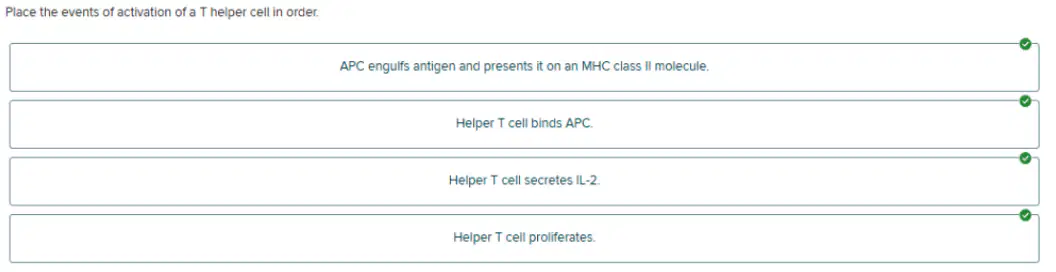
True or false: the events of activation of a T helper cell in correct order.
true
false
Multiple Choice Question Antigen presentation is the display of an antigen on a cell's Blank______.
nucleus
ribosomes
plasma membrane
nucleolus
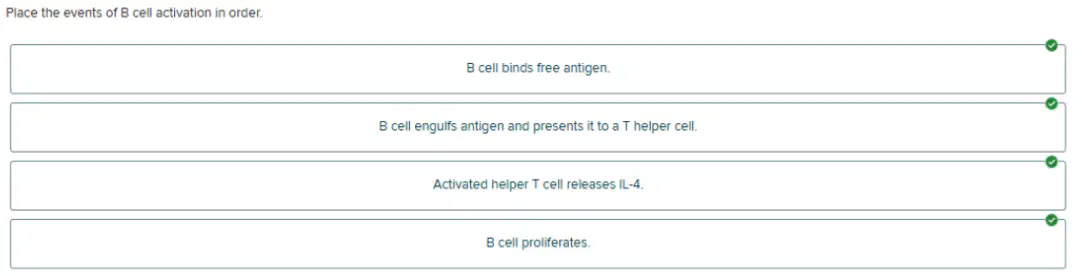
true or false: are the events in correct order?
true
false
T-lymphocytes originate in the ____ bone marrow.
red
yellow
match the effector response with the correct cell type
effector response: destroys infected cells via apoptosis
cytotoxic T cell
plasma cell
helper T cell
match the effector response with the correct cell type
effector response: produces antibodies
cytotoxic T cell
plasma cell
helper T cell
match the effector response with the correct cell type
effector response: releases interleukins and cytokines to stimulate other cells
cytotoxic T cell
plasma cell
helper T cell
Multiple Choice Question Positive selection tests to see if the Blank______ of a T-lymphocyte can recognize and bind to an MHC molecule.
BAR
BCR
TCR
TAR
Multiple Select Question Select all that apply Activated helper T cells are required to activate which two of the following?
NK cells
cytotoxic T cells
antigen presenting cells
B cells
Multiple Choice Question Lymphocytes usually first encounter their foreign antigen in Blank______.
the red pulp of the spleen
the bone marrow
a secondary lymphatic structure
the thymus
Multiple Choice Question Antibodies are Blank______.
immunogens
antigens
lymphocytes
immunoglobulins
Multiple Choice Question A helper T cell is first stimulated by binding to antigen presented on an Blank______.
MHC class I molecule presented by an infected cell
MHC class II molecule presented by an APC
MHC class II molecule presented by an infected cell
MHC class I molecule presented by an APC
Multiple Choice Question An antibody monomer is made of Blank______.
two heavy chains and two light chains
two heavy chains and one light chain
one heavy chain and one light chain
one heavy chain and two light chains
Multiple Choice Question A B cell is first stimulated by Blank______.
Antigens outside of cells
Antigens presented on an MHC class I molecule of an infected cell
C. Antigens presented on an MHC class II molecule of an APC
D. Antigen presented on an MHC class I molecule of an APC
Multiple Choice Question An antibody covers the region of a virus used to bind to a host cell. This is an example of Blank______.
precipitation
neutralization
complement
fixation
agglutination
Multiple Choice Question The various ways that activated lymphocytes combat an antigen are collectively referred to as the Blank______ response.
receptor
antigen
effector
recirculation
Multiple Choice Question When antibodies cross link viral particles, they become insoluble, or Blank______, and drop out of body fluids.
precipitated
agglutinated
opsonized
neutralized
Select all that apply Activated helper T cells release which two of the following to stimulate other immune cells? Multiple select question.
membrane attack complexes
perforins
interleukins
granzymes
cytokines
Multiple Choice Question Which antibody region is responsible for stimulating NK cells?
antigen binding site
Fc
hinge
variable
Multiple Choice Question Antibodies Blank______. tag pathogens for destruction by other cells lyse infected cells with perforins destroy pathogens directly produce granzymes that puncture bacterial cell membranes
Tag pathogens for destruction by other cells
Lyse infected cells with perforins
Destroy pathogens directly
Produce granzymes that puncture bacterial cell membranes
Multiple Choice Question The first exposure to an antigen is called the Blank______.
A. Anamnestic response
B. Antigen challenge
C. Memory response
Y-shaped immunoglobulin molecule is made of four polypeptide chains and referred to as a(n) ____ monomer.
antibody
polymer
Multiple Choice Question The type of immunity that lasts longer is Blank______ immunity. Multiple choice question.
active
passive
Multiple Choice Question When antibodies completely cover the surface of a virus so it can no longer infect a cell, it is said to be Blank______.
opsonized
agglutinated
neutralized
precipitated
Multiple Choice Question Which region of an antibody helps activate complement?
precipitation
variable
Fc
Multiple Choice Question The process of antibodies coating a bacterium, making it easier for macrophages to engulf it, is called Blank______.
fragmentation
respiration
opsonization
precipitation
Multiple Choice Question The secondary response of immunologic memory is often called the memory response or Blank______ response.
integrated
immunologic
anamnestic
anaphylactic
Multiple Select Question Select all that apply Identify all the true statements regarding active immunity.
Active immunity includes the development of memory cells
Active immunity may result from the transfer of breast milk from mother to child.
Active immunity may result from direct exposure to an antigen.

