
 Worksheets
Ch 5 & 6 Practice
Total questions: 109
Worksheet time: 1hrs 15mins
Identify all processes that are of passive diffusion.
small, nonpolar molecules moving across membrane
all carrier proteins
osmosis
all channel proteins
Which types of molecules cannot be transported directly across the phospholipid membrane?
Nonpolar
Polar
Small
Large
Some protist organisms like paramecium can resist bursting by osmosis with the help of what kind of internal structure?
Contractile ring
Central Vacuole
Contractile vacuole
Cilia and Flagella
Intestinal cells commonly have a type of membrane carrier protein that transports Na+ and glucose into the cell. What could this protein be called?
A symport/symporter
An active transport pump
A facilitated channel protein
An antiport/antiporter
What type of endocytosis is for fluids?
Pinocytosis
Phagocytosis
Receptor-Mediated Endocytosis
Hydrocytosis
Which type of molecule forms the basic structure of the cell membrane?
Phospholipids
Carbohydrates
Proteins
Nucleic acids
What is the main function of cholesterol in the cell membrane?
Regulate fluidity and stability
Provide energy for cellular processes.
Act as a structural component of the cell membrane.
Facilitate cell communication.
What are glycoproteins and what is their function in the cell membrane?
Glycoproteins are proteins without carbohydrates attached to them and their function in the cell membrane includes cell-cell recognition, cell signaling, and immune response.
Glycoproteins are proteins with carbohydrates attached to them and their function in the cell membrane includes cell-cell recognition, cell signaling, and immune response.
Glycoproteins are proteins with lipids attached to them and their function in the cell membrane includes cell-cell recognition, cell signaling, and immune response.
Glycoproteins are carbohydrates with proteins attached to them and their function in the cell membrane includes cell-cell recognition, cell signaling, and immune response.
Which subtopic of the cell membrane is involved in cell signaling?
lipid bilayer
receptor proteins
cytoskeleton
nucleus
What happens to the fluidity of the cell membrane at low temperatures?
The fluidity of the cell membrane decreases.
The fluidity of the cell membrane increases.
The fluidity of the cell membrane remains the same.
The fluidity of the cell membrane fluctuates.
What is the role of proteins in the cell membrane?
Proteins play no role in the cell membrane.
Proteins in the cell membrane act as channels and transporters, helping substances move across the cell membrane.
Proteins in the cell membrane provide structural support but do not assist in substance transport.
Proteins in the cell membrane only assist in the transport of water molecules.


Which of the following statements about diffusion is true?
It is very rapid of long distances.
It requires an expenditure of energy by the cell.
It is an active process in which molecules move from a region of lower concentration to a region of higher concentration.
It is a passive process in which molecules move from a region of higher concentration to a region of lower concentration.

Which cell is in a hypertonic environment?
A
B
C
None of them are hypertonic


Assuming that the purple molecules are too large to pass through the membrane, what would happen to the water level as a result of osmosis?
The water level would rise on the A side
The water level would rise on the B side
The water level would remain constant
The water level would drop on the A side.


The Na/Glucose pump is an example of a
Uniport
Symport
Antiport
The Na/K pump is an example of a
Uniport
Symport
Antiport
Polar groups in plasma membrane situated to the.....
Outer region of both lipid layers
Inner region of both lipid layers
Both outer and inner region of lipid layers
None of above
Non-polar groups of plasma membrane organized in the....
Middle region of two lipid layers
Inner region of lipid layers
Outer region of lipid layers
None of above
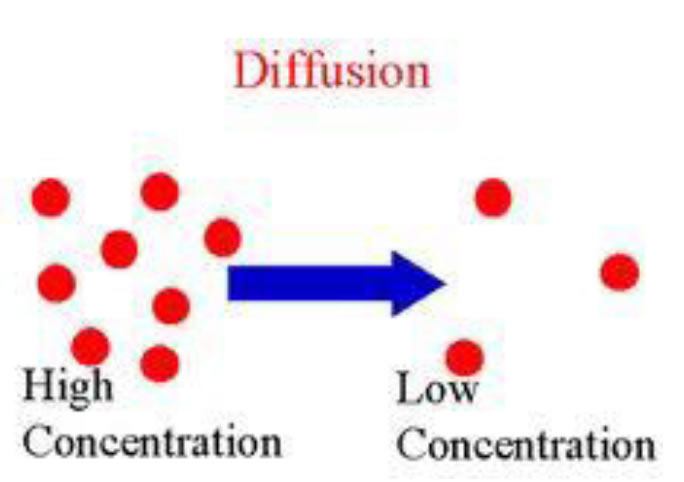
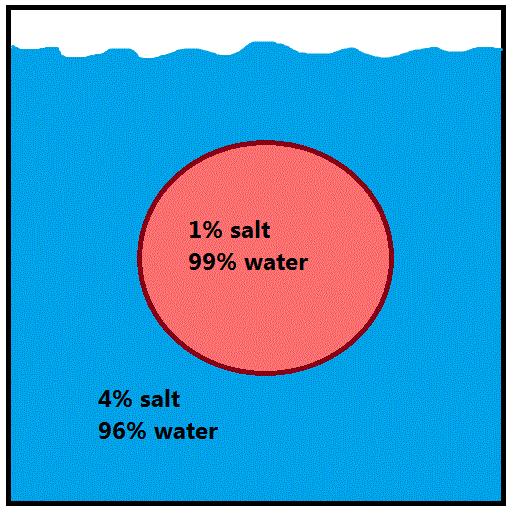
Where will the water go?
Into the cell
Out of the cell
Equally in & out - it's isotonic
There is no water

What type of solution is this cell in?
Isotonic
Hypertonic
Hypotonic
Diffused
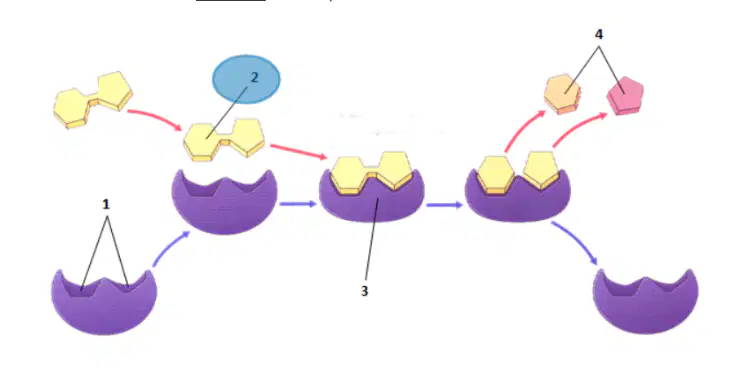
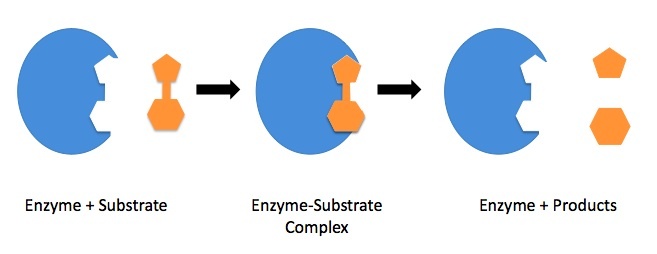
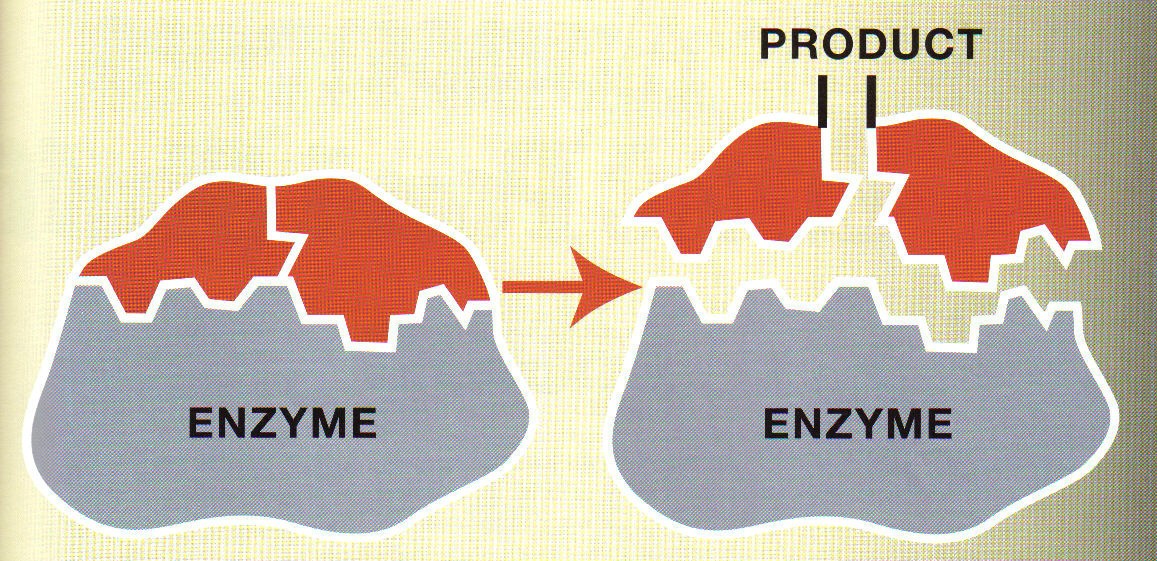
Select the correct NUMBER that represents the products
(a)
The enzyme lipase breaks down lipids into which of the following molecules?
Glycerol and fatty acids
Sugars and glycerol
Fatty acids and amino acids
Amino acids and sugars
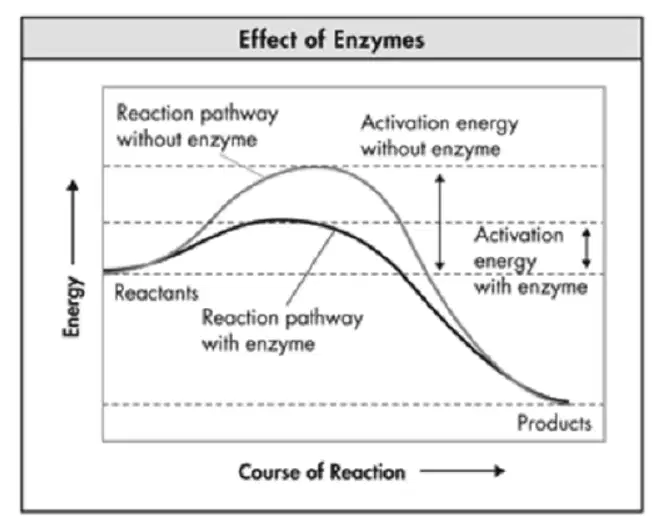
The graph shows how enzymes effect reactions in cells. Which statement best summarizes the information shown in the graph?
Enzymes decrease the energy level of the products
Enzymes increase the energy of the reactants
Enzymes decrease the activation energy of the reaction
Enzymes reverse the direction of the reaction
Enzymes will make a reaction go ______ and use ______ energy.
slower, more
faster, less
slower, less
faster, the same
What is the root word/suffix for enzyme
(a)
What is the meaning of the root word hydro-
(a)

What is the function of an enzyme?
enzymes break themselves into small pieces
they slow down chemical reactions
they control the rate of chemical reactions
enzymes combine products to form reactants
What is a cataylst?
A substance that speeds up a rate of chemical reaction.
Molecules that make enzymes work harder and faster
reaction of an enzyme
A substance that slows down a rate of chemical reaction.
Enzymes are made of
nucleic acids
proteins
lipids
carbohydrates
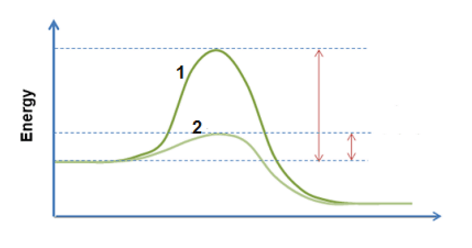

The graph shows how enzymes affect reactions in cells. Which statement best summarizes the information shown in the graph?
Enzymes increase the energy of the reactants.
Enzymes decrease the energy level of the products.
Enzymes decrease the activation energy of the reaction.
Enzymes reverse the direction of the reaction.
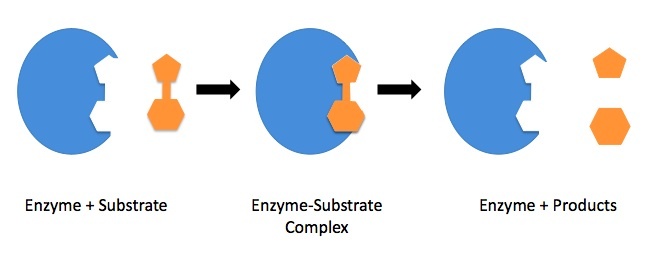

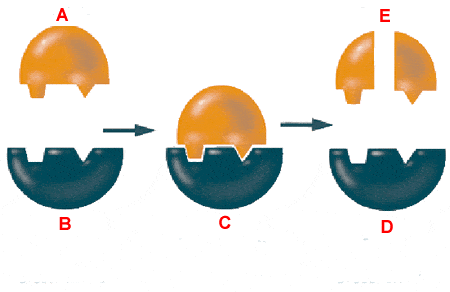
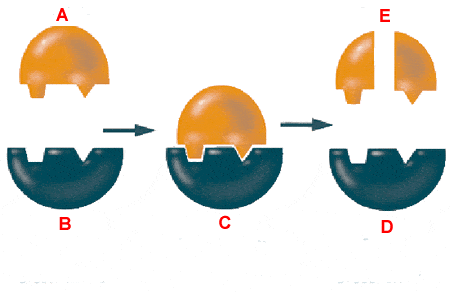
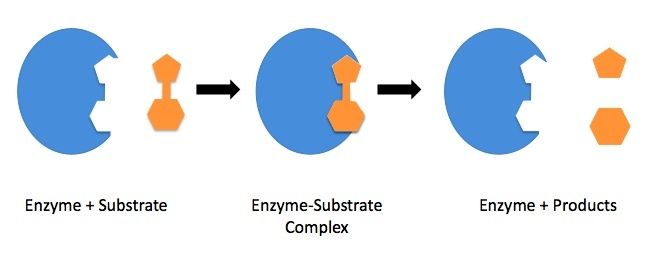
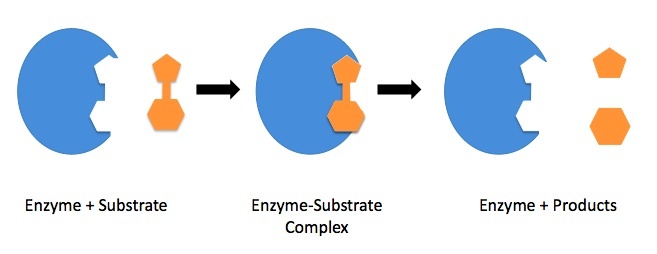
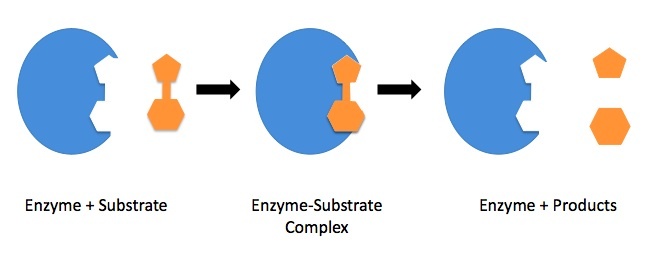
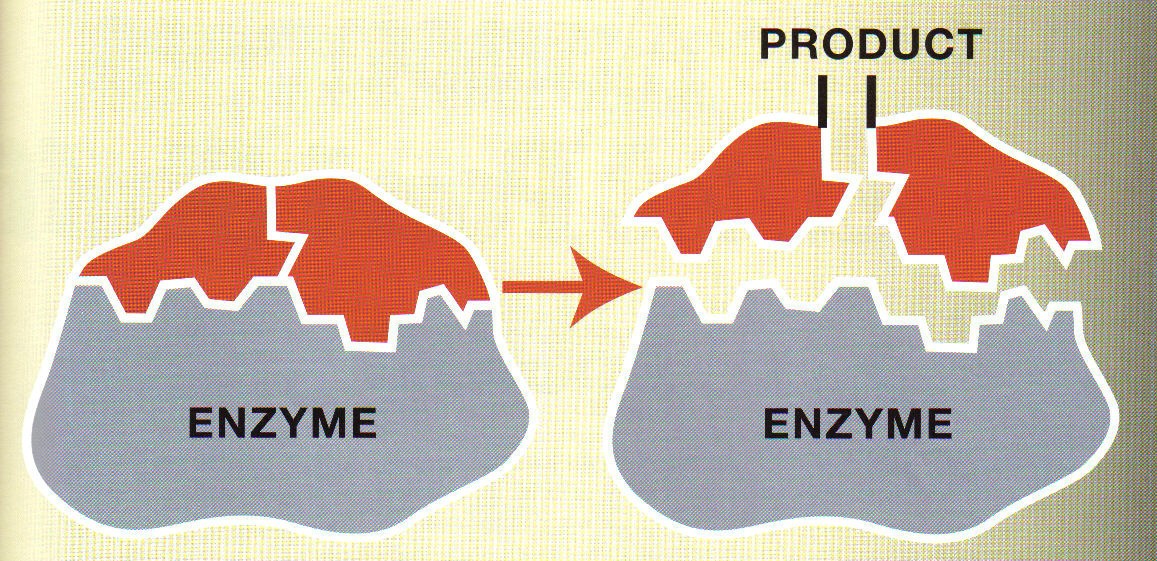
Letter E is the..
active site
enzyme
substrate
products

Letter D is the...
active site
enzyme
substrate
products

Letter B is the ...
active site
enzyme
substrate
products

Letter C is the
active site
enzymes
substrate
products

Letter E is the
active site
enzyme
substrate
products

Letter C is the
active site
enzymes
substrate
products
Letter B is the ...
active site
enzyme
substrate
products
Letter D is the...
active site
enzyme
substrate
products
The graph shows how enzymes affect reactions in cells. Which statement best summarizes the information shown in the graph?
Enzymes increase the energy of the reactants.
Enzymes decrease the energy level of the products.
Enzymes decrease the activation energy of the reaction.
Enzymes reverse the direction of the reaction.
Enzymes are made of
nucleic acids
proteins
lipids
carbohydrates
What is a cataylst?
A substance that speeds up a rate of chemical reaction.
Molecules that make enzymes work harder and faster
reaction of an enzyme
A substance that slows down a rate of chemical reaction.
Which of the following statements about allosteric enzymes is true?
Allosteric enzymes have only one active site.
Allosteric enzymes are not regulated by the presence of other molecules.
Allosteric enzymes often have multiple active sites.
Allosteric enzymes always follow Michaelis-Menten kinetics.
In a biochemical pathway, the end product of the pathway often acts as an inhibitor of an enzyme earlier in the pathway. This type of regulation is known as:
Competitive inhibition
Non-competitive inhibition
Allosteric inhibition
Feedback inhibition
Feedback inhibition is a regulatory mechanism commonly found in:
Enzyme cofactors
Anabolic pathways
Spontaneous reactions
Competitive inhibitors
Which enzyme is responsible for the unwinding of the DNA double helix during DNA replication?
Helicase
Ligase
Polymerase
Kinase
In feedback inhibition, the end product of a metabolic pathway typically acts as:
A substrate for an earlier enzyme in the pathway
An activator for the rate-limiting enzyme
A coenzyme for the final enzyme in the pathway
An inhibitor of an earlier enzyme in the pathway
Which of the following statements about enzymes is true?
Enzymes are specific in their actions.
Enzymes are consumed during chemical reactions.
Enzymes only function in acidic environments.
Enzymes alter the equilibrium of chemical reactions.
What is the primary function of enzymes in biological systems?
To transport molecules across cell membranes.
To provide structural support to cells.
To store energy for future use.
To regulate metabolic reactions by speeding them up.
Which of the following statements best describes feedback inhibition?
It is primarily observed in catabolic pathways.
It prevents the accumulation of excess end products.
It activates enzymes at the beginning of a pathway.
It speeds up metabolic pathways to produce more products.
Which type of molecule is often used to lower the activation energy of a chemical reaction in biological systems?
Catalyst
Substrate
Inhibitor
Enzyme
Which term describes the region of an enzyme where the substrate binds and undergoes a chemical reaction?
Catalyst site
Allosteric site
Active site
Inhibitory site
Activation energy is defined as the:
Energy released during a chemical reaction.
Energy required to maintain a reaction at equilibrium.
Energy needed to initiate a chemical reaction.
Energy stored in the products of a reaction.
Which of the following factors can affect the activity of enzymes?
Enzyme concentration
Temperature and pH
Substrate concentration
All the above
Enzymes facilitate chemical reactions by:
Increasing the activation energy required for the reaction.
Stabilizing the products of the reaction
Decreasing the activation energy required for the reaction.
Increasing the concentration of reactants.
Which type of enzyme inhibition occurs when the inhibitor binds to the enzyme at a site other than the active site, altering the enzyme's conformation and reducing its activity? a) Competitive inhibition
Competitive inhibition
Feedback inhibition
Non-competitive inhibition
Allosteric inhibition
Enzymes are considered highly specific in their action because of:
Their resistance to denaturation
Their ability to work on a wide range of substrates
The unique shape and chemical properties of their active sites
Their ability to function at any pH or temperature
Which of the following statements about allosteric enzymes is true?
Allosteric enzymes have only one active site.
Allosteric enzymes are not regulated by the presence of other molecules.
Allosteric enzymes often have multiple active sites.
Allosteric enzymes always follow Michaelis-Menten kinetics.
Feedback inhibition is a regulatory mechanism commonly found in:
Enzyme cofactors
Anabolic pathways
Spontaneous reactions
Competitive inhibitors
Which process involves the synthesis of complex molecules from simpler molecules and it requires energy input?
Anabolism.
Catabolism.
_______________ hypothesis suggested that the active site is flexible and is not exactly complementary to the shape of the substrate.
Lock-and-key
Induced-fit
The higher the Km value, the __________ the affinity of an enzyme to bind with its substrate.
higher
lower
Trypsin works best at pH of _____.
2.0
6.8
7.8
9.0
NADH is an example of _______________.
prosthetic groups.
coenzymes.
enzyme activators.
Malonate is an example of _______________ inhibitor.
competitive
non-competitive
Cyanide is an example of _______________ inhibitor.
competitive
non-competitive
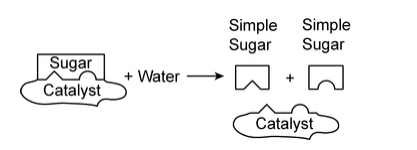
All of the following affect the functioning of an enzyme EXCEPT:
pH
temperature
metabolism
enzyme concentration, substrate concentration, inhibitor molecules
Once a new product leaves an enzyme, the enzyme is unchanged and ready for the next substrate. What is this called?
fragile
reusable
specific
catalyst
What is the purpose of an enzyme?
control how many reactions occur
raise activation energy
give permission for the reaction
speed up chemical reactions
Where do substrates bind to an enzyme?
calcium channels
active site
receptor molecules
voltage-gated channels
The _____________________ mechanism describes how an enzyme changes shape once the substrate is bonded.
hammer and nail
induced fit
jigsaw puzzle
lock and key
The ____________________ mechanism describes how each substrate must fit into the enzyme.
lock and key
hammer and nail
jigsaw puzzle
seesaw
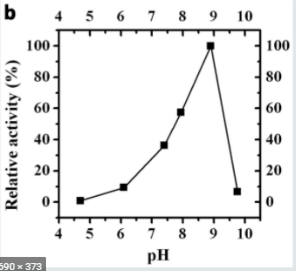
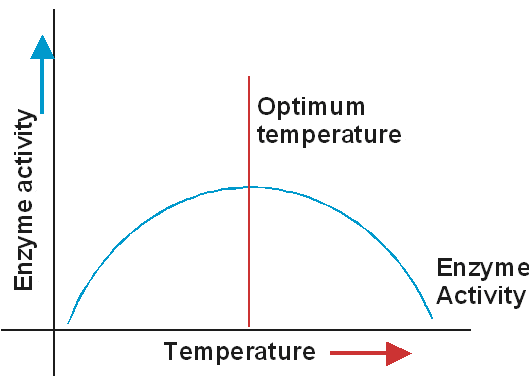
What is the optimal pH for this enzyme?
6
10
9
7
Changes in pH and temperature can ___________________ an enzyme which causes it to lose its shape and affects its function.
puncture
denature
double
delete
Most coenzymes may be included in classes of foodstuffs known as:
Minerals
Fats
Vitamins
Metallic ions
What impedes enzymatic reactions by binding to the enzyme and causes conformational changes of the active site?
non-competitive inhibitor
competitive inhibitor
coenzymes
cofactors
Which type of transport requires energy input from the cell?
Passive Transport
Facilitated Diffusion
Active Transport
Osmosis
What is the role of carbohydrates in the cell membrane?
They provide structural support to the membrane.
They are involved in cell recognition and signaling.
They transport ions across the membrane.
They act as enzymes to speed up reactions.

