
 Worksheets
Mid-Term Synoptic Assessment-Y10-Biology-
Total questions: 111
Worksheet time: 2hrs 33mins

Which cells contain Ribosomes?
Prokaryotic
Eukaryotic
Both
Which type of cell has DNA IN A NUCLEUS?
Prokaryotic
Eukaryotic
Where in the cell does protein synthesis occur?
Nucleus
Ribosome
Mitochondria
Chloroplast
Where in the cell does aerobic respiration occur?
Nucleus
Ribosome
Mitochondria
Chloroplast
Which cell structure contains DNA in plant and animal cells?
Nucleus
Ribosome
Cytoplasm
Chloroplast
Which of the following organelles is involved in photosynthesis?
Nucleus
Ribosome
Cytoplasm
Chloroplast
Which of these is the correct sequence for levels of organization in an organism?
Tissue → Organ → Organism → Organ system → Cell
Cell → Tissue → Organ → Organ system → Organism
Cell → Organ → Organ system → Tissue → Organism
System → Organ → Tissue → Cell → Organism
What is the main function of the vacuole in plant cells?
To produce proteins
To store cell sap and maintain cell rigidity
To protect the cell from pathogens
To control the cell's activities
In a multicellular organism, cells with similar structures and functions form what?
Organs
Tissues
Organelles
Organisms
Which statement correctly describes the cell wall in plant cells?
It is made of protein
It regulates the movement of substances in and out of the cell
It is made of cellulose and provides structural support
It is made of chitin and provides structural support
Which three types of organisms have a cell wall?
animals
plants
bacteria
fungi
viruses
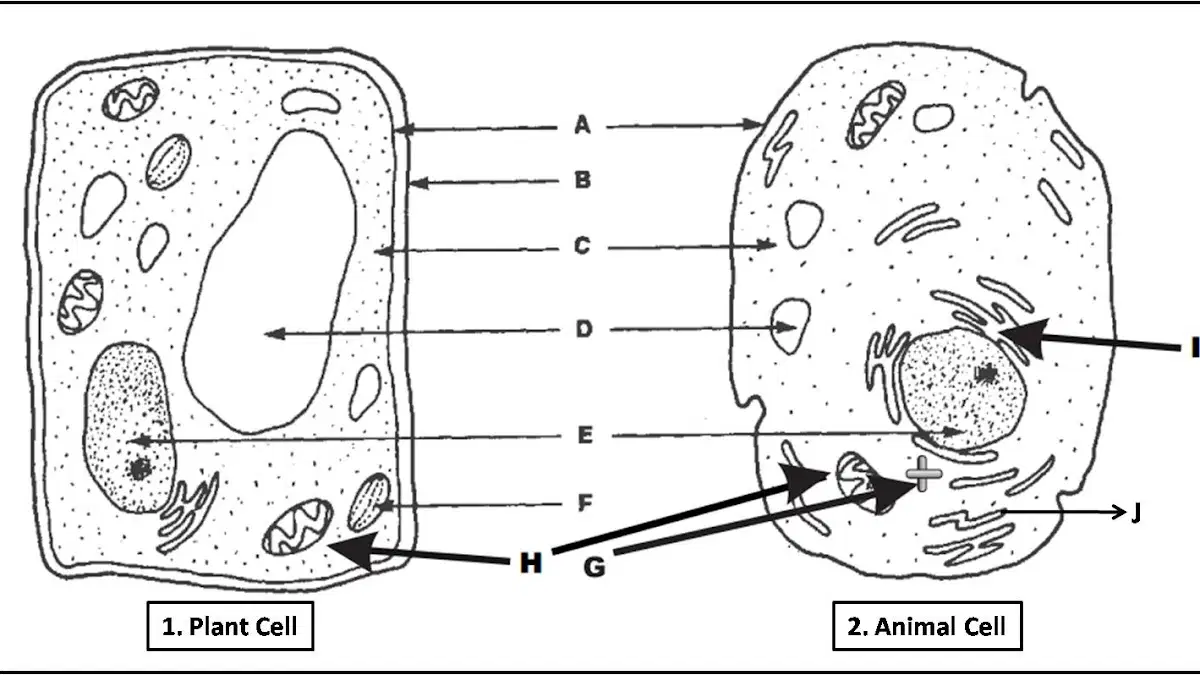
What is C?
chloroplasts
cytoplasm
vacuole
nucleus
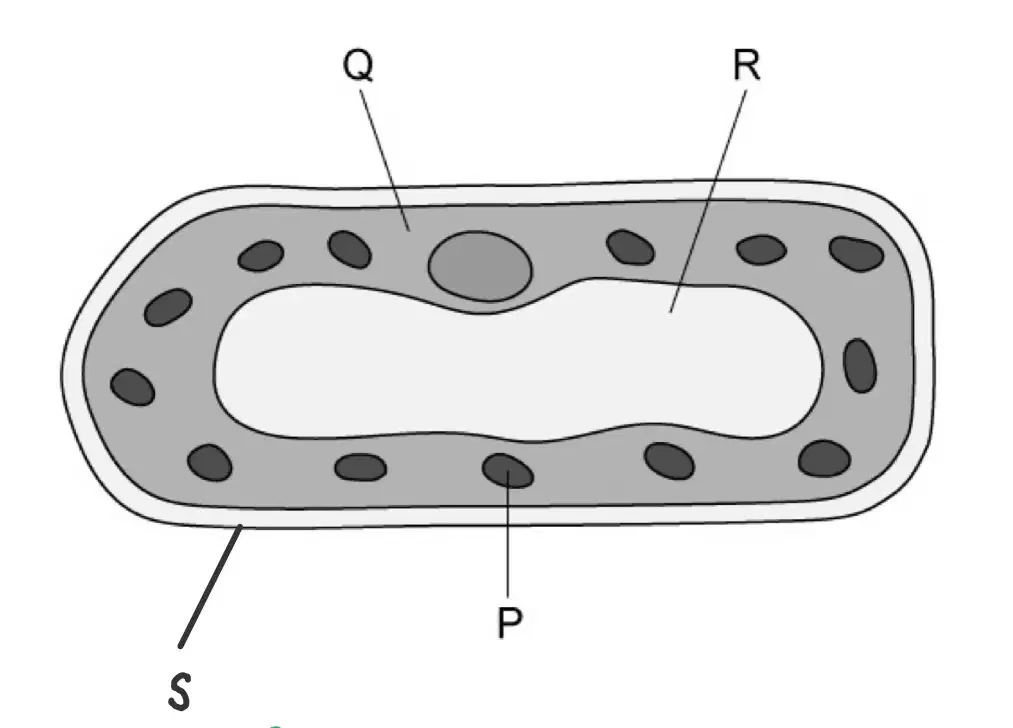
Which part of the cell labelled in the diagram is where most chemical reactions happen in a cell?
P
Q
R
S

Which of these organisms is NOT MULTICELLULAR?
Pine Tree
Amoeba
Mushroom
Earthworm
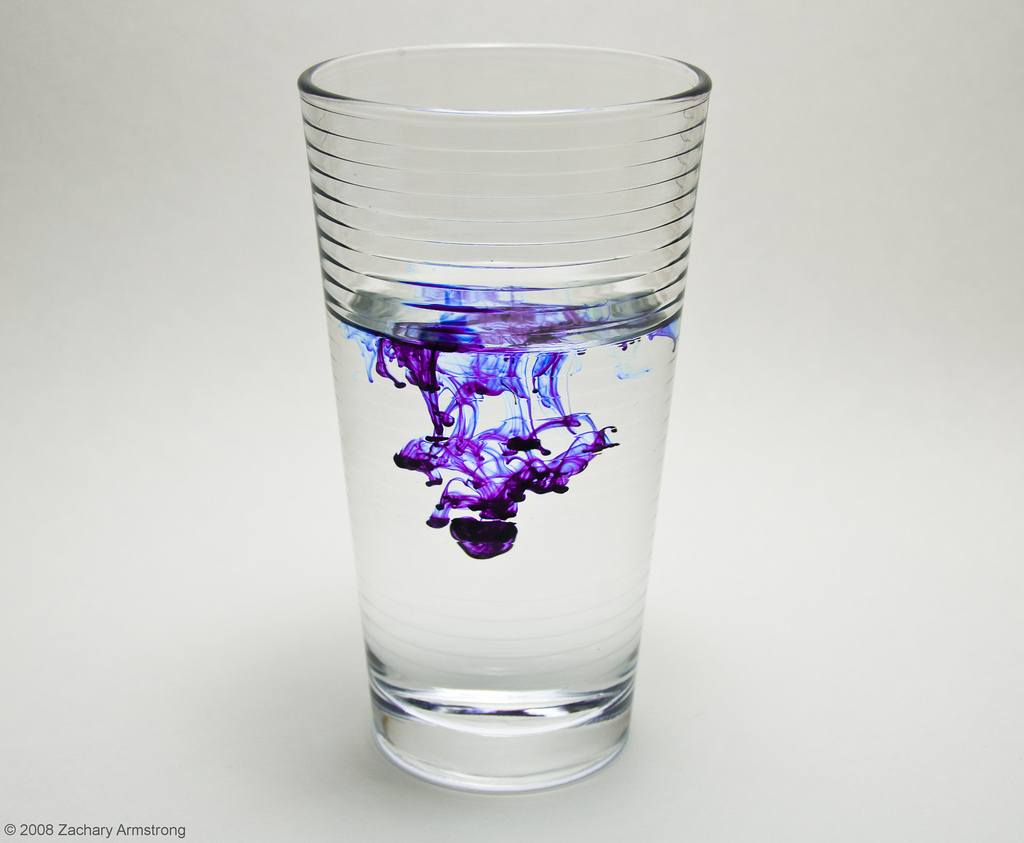
Where is there a low concentration of dye?
at the bottom of cup
in the dye
at the top of cup
at the sides of the cup
Dissolved gases move between the blood and body cells by which process?
absorption
respiration
diffusion
osmosis
Which of the following statements about diffusion is true?
substances move from high to low concentration
diffusion only happens across a partially permeable membrane
water moves from high to low water potential
substances move from low to high concentration
What happens during osmosis?
water molecules moves from high to low concentration without the use of energy
water molecules moves from high to low concentration with the use of energy
water molecules moves from high to low water potential without the use of energy
water molecules move from high to low water potential with the use of energy

What is the direction of osmosis?
From left side to right side.
From right side to left side.
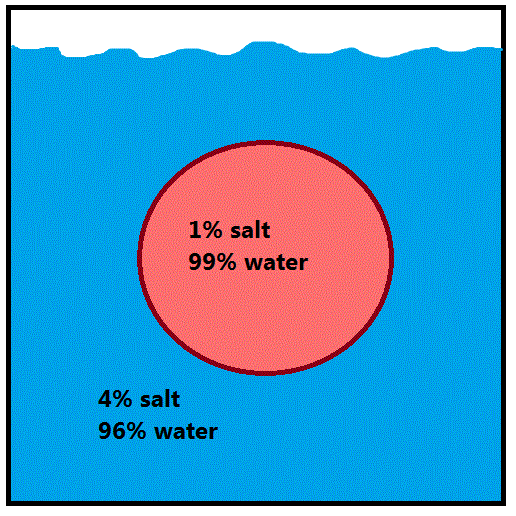
Where will the water go?
Into the cell
Out of the cell
Equally in & out - it's isotonic
There is no water
Which one is the definition of active transport?
movement of particles through the cell membrane from a region of lower concentration to a region of higher concentration using energy in the form of ATP.
passage of water molecules from a region of their higher concentration to a region of their lower concentration through a partially permeable membrane
net movement of molecule from a region of higher concentration to region of lower concentration. Molecule down a concentration gradient
net movement of molecule from a region of lower concentration to region of higher concentration. Molecule down a concentration gradient


Which of the following categories do most molecules in living organisms fall into?
Carbohydrates, Proteins, Nucleic Acids
Carbohydrates, Proteins, Lipids
Proteins, Lipids, Nucleic Acids
Carbohydrates, Nucleic Acids, Lipids

What are the basic units of most fats (lipids) in the body?
Glycerol molecule chemically bonded to 3 fatty acid chains
Glycerol molecule chemically bonded to 1 fatty acid chain
Glycerol molecule chemically bonded to 2 fatty acid chains
Glycerol molecule chemically bonded to 4 fatty acid chains

How many different amino acids are there?
25
20
15
10

What is the molecule that contains the instructions for the growth and development of all organisms?
DNA
Lipid
Protein
RNA
The building blocks of proteins are ....
glycerol and water
glucose
amino acids
triglycerides

State of fats at room temperature.
solids
liquids
gases
An example of simple sugar (monosaccharide).
glucose
sucrose
starch
glycogen
Basic units of cabohydrates.
simple sugars
amino acids
fatty acids and glycerol
nucleotides
Which one is NOT an organic molecule?

Glycogen is an example of
a fat
a protein
a complex carbohydrate
none of these
Which chemical element is only found in proteins ?
Carbon
Nitrogen
Oxygen
Hydogen


Which biological molecule provides insulation ?
Protein
Glycogen
Starch
Lipid
Benedict's solution test for the presence of
reducing sugars, e.g. glucose
proteins
fats
starch
Biuret solution test for the presence of
reducing sugars, e.g. glucose
proteins
fats
starch

What shows that a solution contains protein?
A
B
C
D
Which food substance would produce a brick red precipitate when boiled with Benedict’s solution?
fat
protein
reducing sugar
starch
A food containing fats is tested with ethanol emulsion test. what would be the positive result?
remains clear
cloudy white emulsion forms

A food substance is tested with three reagents.
Iodine solution remains brown.
The biuret test gives a purple colour.
The ethanol test gives an emulsion.
Which nutrient(s) does the food substance contain?
A
B
C
D

The diagram shows cells from a storage organ of a plant.
The structures X are stained blue-black by iodine solution. (Hint: Plants photosynthesise to produce glucose. Excess glucose is stored as _____?)
What does X contain?
glycogen
starch
fat
amino acids

Lipase digests fats (substrate) into fatty acids and glycerol (products).
According to the lock and key hypothesis, which is the lock and which is the key for the enzyme lipase?
Note: Fats are also called lipids.
A
B
C
D
Which of the following are proteins and increase the rate of biochemical reactions?
Enzymes
Genes
Hormones
Vitamins
What kind of molecule could be an enzyme?
fat
glucose
protein
starch
Which statement is true for an enzyme?
It absorbs the sun's energy during photosynthesis.
It catalyses biological reactions.
It is destroyed by temperatures below 20 °C.
It slows down reactions in a cell.

The graph shows the effect of temperature on the digestion of starch.
At which temperature are starch molecules broken down most rapidly?
10 °C
30 °C
40 °C
50 °C
Main source of energy in most organisms.
Carbohydrate
Protein
Nucleic Acid
Lipid
Deficiency of __________ causes Night blindness.
Vitamin B1
Vitamin D
Vitamin A
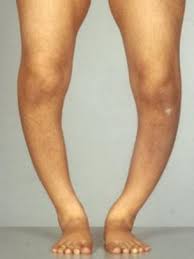
Deficiency of which nutrient leads to this disease?
Vitamin A
Vitamin D
Vitamin C
Lack of exposure to sunlight may lead to deficiency of this ______________.
Vitamin D
Vitamin K
Vitamin E
Infection and bleeding of gums can be prevented by having foods rich in ___________.
Iron
Calcium
Vitamin C
Males usually require more energy than females because they
are more aggressive
lose heat more easily
are stronger
more active


You consume 2 servings of ice cream, how many calories are you consuming?
150
275
300
350

what is the deficient nutrients shown in the picture?
Calcium (Ca) Deficiency
Iron (Fe) Deficiency
Potassium (K) Deficiency
Nitrogen (N) Deficiency
The essential nutrients are the chemical compounds necessary for the growth and metabolic activities of an organism.
TRUE
FALSE

what is the deficient nutrients shown in the picture?
Nitrogen (N) Deficiency
Magnesium (Mg) Defficiency
Calcium (Ca) Deficiency
Phosphorous (P) Deficiency

Purpling/Reddening of lower leaves/stalk
(a)

Which of the following shows the balanced chemical symbol equation for photosynthesis?
A
B
C
D
What is the main energy change that happens in photosynthesis?
chemical --> light
light --> kinetic
light --> chemical
kinetic --> light
Where is chlorophyll found in plant cells?
cytoplasm
chloroplast
mitochondria
vacuole
What substance can glucose be converted to, which is the transport carbohydrate of plants?
starch
cellulose
sucrose
amino acids
What substance can glucose be converted into, which is the energy storage carbohydrate of plants?
cellulose
sucrose
amino acids
starch
Which substance can glucose be converted to, which strengthens plant cell walls?
starch
cellulose
amino acids
sucrose
All of the definitions below are descriptions of a 'limiting factor'.
Which of these is the IGCSE Biology definition?
a factor in the environment that runs out
something present in the environment in such short supply that it restricts life processes
a factor in the environment that is in short supply
something present in the environment in such short supply that it stops life processes

Click on the picture to make it larger.
Which of the following can you conclude about point X from this graph alone?
I. light intensity limits the rate of photosynthesis
II. as light intensity increases, rate of photosynthesis increases
III. CO2 concentration limits the rate of photosynthesis
I and II only
I and III only
II and III only
I, II and III
Click on the picture to make it larger.
Which of the following can you conclude about point Y from this graph?
I. light intensity does not limit the rate of photosynthesis
II. the plant has stopped photosynthesising
III. the rate of photosynthesis could be limited by a shortage of water or CO2
I and II only
I and III only
II and III only
I, II and III

Click on the picture to make it larger.
What do curves C and D suggest is limiting the rate of photosynthesis?
light intensity
carbon dioxide concentration
temperature
water
Click on the picture to make it larger.
What do curves B and D suggest is limiting the rate of photosynthesis?
light intensity
carbon dioxide concentration
temperature
water

Supplying extra heat and carbon dioxide is more expensive, but may be worth it if the rate of photosynthesis greatly increases.
Click on the graph to make it larger.
Which of the following would it not be worth doing for a plant grower?
increasing the CO2 from 0.03% to 0.1% at a temperature of 20oC.
increasing the CO2 from 0.03% to 0.1% at a temperature of 25oC.
increasing the temperature from 20oC to 25oC at a CO2 concentration of 0.03%
increasing the temperature from 20oC to 25oC at a CO2 concentration of 0.1%
All of the statements below are correct definitions of photosynthesis.
Which of these is the IGCSE Biology definition of photosynthesis?
the process that produces glucose and oxygen, using CO2, water, light and chlorophyll
the process that converts light energy into chemical energy
the process by which plants produce carbohydrates from raw materials using light energy
the process that converts inorganic compounds into organic compounds

Use the figure below to answer - Which of the following is indicated by X in the figure.
Guard cell
Mesophyll cell
Stomata
Vein
This is the outer most layer of some leaves, providing a waxy protective layer
Epidermis
Cuticle
Mesophyll
Skin
This layer is found just below the waxy layer if present, and is the "skin" of the leaf
Cuticle
Epidermis
Mesophyll
Stomata
What are the two main reactants for the process of Photosynthesis ( select 2 )
Oxygen
Carbon Dioxide
Water
Sunlight


A student looks at the image of a cross-section of a leaf in her Biology textbook. The actual thickness of this leaf is 450 um, but the image in the textbook has a thickness of 83 mm.
What would be the correct magnification of the image?
X 5
X 184
x 0.184
x 500
How do you calculate actual specimen size from magnification and image size?
Actual = Magnification / Image Size
Actual =Image Size / Magnification
Actual = Image Size x Magnification



