wayground logo

Free Printable Worksheets

Font size

S
M
L
XL
Worksheets

Spring Practice Final 2022

Total questions: 100

Worksheet time: 1hrs 17mins

Name
Class
Date
1.

Large particles (or large quantities of smaller particles) are moved across the cell membrane with the use of energy.

a)

pump transport

b)

osmosis

c)

bulk transport

d)

CO2 + O2 Transport

2.

A general term for the various types of active transport that move particles into a cell by enclosing them in a vesicle made out of plasma membrane.

a)

Endocytosis

b)

Exocytosis

c)

Osmosis

d)

Diffusion

3.

A form of bulk transport in which materials are transported from the inside to the outside of the cell in membrane-bound vesicles that fuse with the plasma membrane.

a)

Endocytosis

b)

Exocytosis

c)

Osmosis

d)

Diffusion

4.

white blood cells engulfing invading bacteria is an example of

a)

Endocytosis

b)

Exocytosis

c)

Diffusion

d)

Facilitated Diffusion

5.
Which of the following is the correct equation for PHOTOSYNTHESIS?
a)
CO+ light + H2O --> O+ Sugar
b)
CO+ sugar + H2O --> O+ light
c)
O2 + light + H2O --> CO+ Sugar
d)
CO+ O2 + H2O --> Light+ Sugar
6.
What is the ultimate ORIGINAL source of energy for living things
a)
Sugar
b)
Sun
c)
Moon
d)
Carbon Dioxide
7.
What is the pigment in chloroplasts that performs photosynthesis?
a)
Chlorosynthesis
b)
Chlorophyll
c)
ADP
d)
Electron Transport
8.
Which gas is removed from the atmosphere during photosynthesis?
a)
hydrogen
b)
oxygen
c)
nitrogen
d)
carbon dioxide
9.
Which of the following is an example of a HETEROTROPH?
a)
Grass
b)
Algae
c)
Lemon Tree
d)
Bear
10.

Which product is "waste" and mostly released by the producer (plant)?

a)

oxygen

b)

carbon dioxide

c)

sugar

d)

glucose

11.
What is the correct equation for cellular respiration?
a)
6O2 + C6H12O6 -> 6CO2 + 6H2O + Energy
b)
6O2 + C6H12O6 + Energy -> 6CO2 + 6H2O
c)
6CO2 + 6H2O -> 6O2 + C6H12O6 + Energy
d)
6CO2 + 6H2O + Energy -> 6O2 + C6H12O6
12.

Which organism go through cellular respiration?

a)

animals

b)

plants

c)

both animals and plants

d)

none

13.

The Electron Transport Chain is a series of chemical reactions in which energy is transferred to form a large amount of what molecule?

a)

glucose

b)

oxygen

c)

pyruvic acid

d)

ATP

14.

Which of the following structures is where cellular respiration (Kreb's Cycle and Electron Transport Chain) occurs in the cell?

a)

nucleus

b)

cytoplasm

c)

mitochondria

d)

vacuoles

15.
Which one of these does not add CO2 to the atmosphere?
a)
cooking with gas
b)
planting trees
c)
burning wood
d)
riding in a bus
16.
How do living organisms return carbon to the atmosphere in the carbon cycle?
a)
respiration and photosynthesis
b)
 decomposition and respiration
17.
How does the carbon in grass become part of a lion?
a)
The lion eats the grass
b)
Carbon from grass doesn't end up in a lion. 
c)
The carbon ends up in the lion's food chain. 
d)
The lion breathes in carbon given out by the plant
18.
Which of the following removes carbon from the atmosphere?
a)
Combustion
b)
Respiration
c)
Photosynthesis
d)
Death
19.
What is the process of combining nitrogen gas with other elements to make nitrogen into usable compounds?
a)
nitrogen composition
b)
ammonia 
c)
nitrogen fixation
d)
denitrification
20.
How much of the atmosphere is composed of nitrogen gas?
a)
87%
b)
38%
c)
78%
d)
21%
21.
Organisms that break down dead plants & animals and release nitrogen back into atmosphere...
a)
bacteria
b)
plants
c)
animals
d)
producers
22.
After plants and animals contain nitrogen, what puts it back into atmosphere and soil?
a)
decomposition
b)
precipitation
c)
condensation
d)
bacteria
23.
Nitrification happens in the ______
a)
Air 
b)
Soil 
c)
Ground Water 
d)
Plants 
24.
What does DNA stand for?
a)
Deoxyribose Nucleic Acid
b)
Denatured Natural Acid
c)
Do Not Accept
d)
I Don't Know
25.
What does DNA do?
a)
a.  It carries genetic codes from parents to offspring.
b)
a.  It carries oxygen from the lungs to the body.
c)
a.  It tells you who you are.
d)
a.  It defines the organism.
26.
What is the shape of a DNA?
a)
Double Helix
b)
Base Pairing
c)
The shape of you
d)
Hydrogen Bonding
27.
Adenine, Cytosine, Guanine and Thymine are examples of
a)
DNA structure
b)
DNA bases
c)
DNA double helix
d)
Paired bases
28.
The rules of DNA pairing states that Adenine (A) always pairs up with
a)
Thymine
b)
Cytosine
c)
Adenine
d)
Guanine
29.
What is a DNA molecule made of?
a)
Base, sugar, phosphate
b)
Base, sugar, coffee
c)
Base, roof, height
d)
DNA, sugar, phosphate
30.
Which nucleic acid is single stranded?
a)
RNA
b)
DNA
31.
The mRNA codon UGA would correspond with which tRNA anticodon?
a)
ACT
b)
ACU
c)
UCU
d)
ACA
32.
A long chain of amino acids is a/an
a)
protein
b)
nucleic acid
c)
tRNA
d)
mRNA
33.
If a DNA molecule consists of 29% Guanine, how much cytosine will it contain?
a)
29%
b)
58%
c)
21%
d)
I have no idea.
34.
Where does transcription take place?
a)
ribosome
b)
cytoplasm
c)
nucleus
d)
protein
35.
Any change in the DNA is called a/an
a)
mistake
b)
exon
c)
mutation
d)
intron
36.
Where does mRNA meet up with tRNA to translate the code into amino acids?
a)
ribosome
b)
nucleus
c)
cytoplasm
d)
ribose sugar
37.
What will the matching sequence be on a strand that reads AAGCTAT?
a)
AACGATA
b)
TTCGTTA
c)
CCTGATA
d)
TTCGATA
38.
the process of making a copy of DNA
a)
transcription
b)
double helix
c)
DNA replication
d)
replication fork
39.
DNA Replication is the process of turning 1 DNA molecule into...
a)
1 DNA molecule
b)
2 DNA molecules
c)
3 DNA molecules
d)
4 DNA molecule
40.
Before DNA can replicate it has to...
a)
Separate the two strands
b)
Find 4 new strands
c)
Ask its mom
41.

STRUCTURE: What Nitrogenous Base does RNA contain that DNA does not?

a)

Thymine

b)

Uracil

c)

Adenine

d)

Love

42.

PROCESSES: DNA making RNA is called:

a)

Translation

b)

Transcription

c)

Transference

d)

Translocation

43.

PROCESSES: RNA making a protein is called:

a)

Transmutation

b)

Transferrance

c)

Transcription

d)

Translation

44.
Fruit fly body cells have 8 chromosomes. After mitosis, you would expect a resulting fruit fly daughter cell to have ...
a)
16 chromosomes.
b)
46 chromosomes.
c)
8 chromosomes.
d)
4 chromosomes.
45.
What is the purpose of the cell cycle?
a)
To create new daughter cells
b)
To prevent cancer from developing
c)
To help the body fight viruses and bacteria
46.

Uncontrolled cell division which usually leads to tumors and disease is called:

a)

Metaphase

b)

Cytokinesis

c)

Cancer

d)

Diabetes

47.
During which parts of the cell cycle does the cell grow?
a)
G1 and G2
b)
G1 and S
c)
M phase and cytokinesis
48.

The correct sequence of mitosis:

a)

metaphase, anaphase, telophase, prophase

b)

prophase, metaphase, anaphase, telophase

c)

prophase, anaphase, metaphase, telophase

d)

telophase, metaphase, prophase, anaphase

49.

Issues that refer to people’s moral values or the code of conduct by which they live

a)

Social issues

b)

Legal issues

c)

Cultural issues

d)

Ethical issues

50.
the creation of genetically identical organisms
a)
Bioremediation
b)
Cloning
c)
Gene Therapy
d)
Tissue Culturing
51.

Which of the following involves ethics?

a)

Passing a law to allow more crops to be grown per acre in a given area.

b)

Passing a law to allow doctors to euthanize humans who are terminally ill.

c)

Passing a law to increase fines for people texting while driving.

d)

Passing a law to decrease speed limits in an area of frequent accidents.

52.
During interphase the cell ___________.
a)
divides into two cells
b)
divides its nucleus
c)
replicates its DNA
d)
replicates the organelles within the cell
53.
Mitosis is made up of how many phases?
a)
4
b)
5
c)
6
d)
7
54.
What is one half or one rod of the condensed chromatin called?
a)
DNA
b)
chromatin
c)
chromatid
d)
chromosome
55.
The following describes ________  during mitosis. The chromosomes line up along the center of the cell and the spindle fibers attach to each chromosome at the centromere.
a)
prophase
b)
metaphase
c)
anaphase
d)
telophase
56.

If the daughter cells each have 16 chromosomes after cell division, what was the number of chromosomes in the parent cell? See Figure M-2.

a)

16

b)

6

c)

32

d)

4

57.

During meiosis, how many haploid daughter cells are produced?

a)

2

b)

4

c)

23

d)

46

58.

The teacher tells her class that some cells undergo meiosis and form haploid cells. Which group of cells are formed by meiotic division?

a)

sperm cells

b)

muscle fiber cells

c)

skin cells

d)

erythrocytes (red blood cells)

59.

During meiosis, homologous chromosomes can exchange DNA in a process known as — See Figure M-10.

a)

crossing over

b)

replication

c)

cytokinesis

d)

internal fertilization

60.

What is a trait?

a)

Your DNA

b)

The things that make an individual unique

c)

Common characteristics in a species

d)

Chromosomes

61.

How do we write DOMINANT alleles?

a)

Capital letters

b)

Lower case

62.

An individual has the phenotype Bb. Will they express the dominant or recessive trait?

a)

Recessive

b)

Dominant

63.

Which of the following is homozygous recessive

a)

Rr

b)

RR

c)

rr

d)

all of them

64.

Which term describes the different forms of a gene

a)

Chromosome

b)

Allele

c)

DNA

d)

Punnett Squares

65.

This image shows a_____

a)

Punnett Squre

b)

PHenotype

c)

Pedigree

d)

Homozygous Dominate genotype

66.

A phenotype is

a)

Dominance

b)

Physical appearance

c)

Recessiveness

d)

Letter Combinations

67.

Having two of the same genes for the same trait

a)

heterozygous

b)

chromosome

c)

protein

d)

homozygous

68.

Which of the following genotypes would be considered heterozygous?

a)

BB

b)

gg

c)

Ff

d)

TT

69.
What would the ratio for genotypes be for this Punnett Square?
a)
2Bb:2bb
b)
2BB:2Bb
c)
1BB:2Bb:1bb
d)
4Bb
70.
G = dominant green and y = recessive yellow
A fish has a Gy genotype, what will its phenotype be?
a)
yellow
b)
green
c)
greenish-yellow
d)
red
71.
He is known as the father of modern day genetics.
a)
Gregory Mendel
b)
Greg Mendel
c)
Gregor Mendel
d)
Grace Mendel
72.
In pea plants, the tall allele is dominant to the short allele. What key would demonstrate this?
a)
Tall = T
Short = S
b)
Tall = T
Short = t
c)
Tall = t
Short = T
d)
Tall = TT
Short = tt
73.
A heterozygous long-tusked elephant is crossed with a homozygous recessive short-tusked elephant. What is the probability of the offspring having short tusks?
a)
0%
b)
25%
c)
50%
d)
75%
74.
What phenotype would result from crossing a homozygous dominant purple-flowered pea plant with a homozygous recessive white-flowered pea plant?
a)
Pp
b)
Purple
c)
White
d)
PP and pp
75.
If this pedigree shows an autosomal recessive disorder, what MUST the genotype of individual II-3 be?
a)
HH
b)
Hh
c)
hh
d)
None of the above
76.
How are individuals III-2 and II-4 related?
a)
Cousins
b)
Dad and Daughter
c)
Uncle and Niece
d)
Grandpa and Granddaughter
77.

If this pedigree shows a recessive disorder, what MUST the genotype of individual 4 be?

a)

HH

b)

Hh

c)

hh

78.
How many generations are shown in this pedigree?
a)
1
b)
2
c)
3
d)
4
79.
How many kids did the mother and father from the first generation have?
a)
2
b)
4
c)
5
d)
6
80.
What do half colored symbols represent?
a)
The individual is a carrier (heterozygous).
b)
The individual expresses the trait.
c)
The individual has both recessive alleles.
d)
The individual has both dominant alleles.
81.
Which of the following is a factor in natural selection?
a)
Individuals of species compete with one another to survive.
b)
All species are genetically diverse.
c)
Individuals better able to adapt to changes leave more offspring.
d)
All are correct 
82.
The fossil record provides evidence that 
a)
Fossils cannot be dated.
b)
All species were formed during Earth’s formation and have changed little since then.
c)
The fossilized species have no connection to today’s species.
d)
Older species gave rise to more-recent species.
83.
Individuals that are better able to cope with the challenges of their environment tend to  
a)
Decrease in population over time.
b)
Leave more offspring than those less suited to the environment.
c)
Leave fewer offspring than those less suited to the environment.
84.
European rabbits were introduced to Australia in 1859. The rabbits reproduced rapidly in their new habitat, displaced other animals, and overgrazed vegetation. In an attempt to reduce the rabbit population, a virus was introduced in 1951. This virus is usually deadly to European rabbits. When the virus was first introduced, the rabbits died in large numbers, but the death rate decreased over time. Which of the following best explains the decrease in the rabbit death rate? 
a)
Young rabbits learned to avoid being infected with the virus.
b)
The lifespan of the virus was too short to affect rabbits over a long period of time.
c)
Natural selection favored rabbits that were resistant to the virus. 
d)
No correct choices.
85.
Which of the following statements gives the most likely explanation for the presence of two very similar species of squirrels living on opposite sides of the Grand Canyon?
a)
One squirrel traveled across the canyon and started a new population on the other side.
b)
One squirrel traveled across the canyon and interbred with a different population on the other side.
c)
Members of one single squirrel species were geographically separated by the formation of the canyon.
d)
Members of two different squirrel species migrated from two different places to opposite sides of the canyon. 
86.
Structures that share a common ancestry or are similar because they are modified versions of structures from a common ancestor that contain the same basic bone structure are
a)
Not related.
b)
Not homologous. 
c)
Homologous.
d)
Young in origin.
87.
The process in which organisms with traits well suited to an environment are more likely to survive and to produce offspring is
a)
Natural Selection
b)
Origin of Species
c)
Genetic Principles
d)
Trait Mechanism
88.
Comparing human hemoglobin of chimpanzees, horses, kangaroos, and chickens, reveal that humans have the fewest amino acid differences with 
a)
Kangaroos
b)
Horses
c)
chickens
d)
chimpanzees
89.
The hypothesis that evolution of a species occurs gradually over time as a slow and constant process is known as
a)
speciation
b)
punctuated equilibrium
c)
gradualism
d)
microevolution
90.
Which of the following phrase best describes how Thomas Malthus influenced Charles Darwin’s idea of natural selection?
a)
The number of resources available can limit the survival of a species. 
b)
The survival of a species depends on the traits they acquire in their lifetime.
c)
The survival of a species is determined by how many offspring they leave behind.
d)
The Earth is constantly changing; seashell fossils were found at the top of the Andes Mountains. 
91.
Which of the following statements best reflects the evolutionary importance of the figures pictured?
a)
New genetic instructions have been disregarded in the evolution of vertebrates.
b)
Early in development, vertebrate embryos show no evidence of common ancestry.
c)
All adult vertebrates retain pharyngeal pouches (gills).
d)
The evolutionary history of organisms is seen in the way embryos develop.
92.
What is the term for a feature that allows an organism to survive better in its environment?
a)
variation
b)
adaptation
c)
homologous structure
d)
vestigial structure
93.
Which statement is part of Darwin’s theory of evolution by natural selection? 
a)
More offspring are produced than can possibly survive.
b)
The organisms that are the fittest are always largest and strongest. 
c)
The number of offspring is not related to fitness.
d)
Acquired characteristics that are inherited are the cause of evolution.
94.

By looking at the genes of some animals we can determine which living species are most closely related to each other. This also reveals which species most recently diverged from their common ancestor.

Based on the partial gene segments shown, which pair of animals are genetically most closely related and therefore most recently diverged from their common ancestor?

a)

Chimpanzee and Mouse

b)

Rat and Mouse

c)

Rat and Chimpanzee

95.

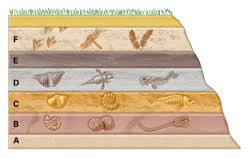
Which rock layer contains the newest fossils?

a)
F
b)
E
c)
B
d)
C
96.
Charles Darwin’s observation that finches of different species on the Galápagos Islands have many similar physical characteristics supports the hypothesis that these finches 
 
a)
have the ability to interbreed.
b)
acquired traits through use and disuse.
c)
all eat the same type of food.
d)
descended from a common ancestor.
97.

If a new trait DOES help an organism survive, what may happen to it?

a)

It dies and its DNA is not passed on

b)

It survives and its DNA is passed on

c)

It changes its traits to adapt and survive

98.
The scientific name for humans is _______ ____
a)
Homo sapiens
b)
Homo neandertal
c)
homo Sapiens
d)
homo sapiens
99.

how well an organism can survive and reproduce in its environment

a)

fossil

b)

fitness

c)

inherited trait

100.

the gradual change in a species over time

a)

natural selection

b)

evolution

c)

adaptation