
 Worksheets
Quiz: Natural Selection
Total questions: 110
Worksheet time: 2hrs 7mins
A population of rabbits grows rapidly from one year to the next. Then one year, a disease strikes approximately one fourth of the adult rabbits. The disease remains with the population in the years that follow.
As explained by Darwin’s theory, which of these conditions allows the rabbit population to evolve by natural selection?
The disease affects adult and juvenile rabbits equally.
The disease reduces the ability of the rabbits to reproduce.
Some rabbits are resistant to the disease, and they pass the resistance to their offspring.
No rabbits are resistant to the disease, and all die when the disease strikes them.

The graphs below show the changes in crab color at one beach.
Which of the following is most likely to have caused the change in the distribution?
A new predator arrived that preferred dark-tan crabs.
A new predator arrived that preferred light-tan crabs.
A change in beach color made medium-tan crabs the least visible to predators.
A change in beach color made medium-tan crabs the most visible to predators.

The figure shows how natural selection of a single-trait gene affects lizard survival.
Which of the following most likely causes the changes in allele distribution?
The allele for light gray coloration disappears from the population. This may be because light gray lizards are more visible to predators and therefore they might be less likely to survive and reproduce.
The allele for black coloration decreases fitness and becomes less common. This may be because black coloration keeps the lizards cool during hot summer temperatures.
Medium gray coloration in lizards appears to be a neutral mutant allele that allows the lizards to hide better from predators. This leads to increases in phenotype and allele frequency of gray coloration.
Because black and medium gray lizards are less visible to predators, these alleles are neutral to natural selection and therefore will not disappear from the population of lizards.
Darwin observed many finch species on the Galapagos Islands. To explain these observations, he
proposed that each species evolved from the same common ancestor, which was a finch species
that migrated to the islands from the mainland. What additional evidence did Darwin use to support
his explanation?
The finch populations were very numerous, and different species often bred with one another.
The finch species lived in different habitats on different islands, which isolated them from one another.
The finch species were distributed evenly among all of the islands, but did not interbreed.
The beaks of the finches were identical, allowing them to eat the same foods on any of the islands.
A population of rabbits grows rapidly from one year to the next. Then one year, a disease strikes approximately one fourth of the adult rabbits. The disease remains with the population in the years that follow.
As explained by Darwin’s theory, which of these conditions allows the rabbit population to evolve by natural selection?
The disease affects adult and juvenile rabbits equally.
The disease reduces the ability of the rabbits to reproduce.
Some rabbits are resistant to the disease, and they pass the resistance to their offspring.
No rabbits are resistant to the disease, and all die when the disease strikes them.
Which of the following is a situation that could cause evolutionary change that is NOT due to natural selection?
A volcano erupts and kills many individuals in a population.
A mutation produces sea stars that are less visible to predators.
An insecticide is sprayed in a community to combat mosquitoes.
Cattle are treated with antibiotics to prevent the spread of infections.
The graphs below show the changes in crab color at one beach.
Which of the following is most likely to have caused the change in the distribution?
A new predator arrived that preferred dark-tan crabs.
A new predator arrived that preferred light-tan crabs.
A change in beach color made medium-tan crabs the least visible to predators.
A change in beach color made medium-tan crabs the most visible to predators.
A population that is isolated in a remote environment is still able to experience genetic variation. How could genetic variation that contributes to evolution occur in such a population?
A mutation in a liver cell produces liver cancer.
Lateral gene transfer occurs that produces an organism that is less resistant to drought.
A mutation in an egg cell causes a change in DNA that produces an organism that is more sensitive to sunlight.
A mistake in DNA replication before meiosis produces an organism that is better able to outrun predators.
The figure shows how natural selection of a single-trait gene affects lizard survival.
Which of the following most likely causes the changes in allele distribution?
The allele for light gray coloration disappears from the population. This may be because light gray lizards are more visible to predators and therefore they might be less likely to survive and reproduce.
The allele for black coloration decreases fitness and becomes less common. This may be because black coloration keeps the lizards cool during hot summer temperatures.
Medium gray coloration in lizards appears to be a neutral mutant allele that allows the lizards to hide better from predators. This leads to increases in phenotype and allele frequency of gray coloration.
Because black and medium gray lizards are less visible to predators, these alleles are neutral to natural selection and therefore will not disappear from the population of lizards.
Grass plants in a population range in height from 6 cm to 25 cm. The short plants receive little sunlight, and the tall plants are eaten by grazing animals. Which statement best describes the effect of natural selection on the grasses?
Because average height grass plants are favored, stabilizing natural selection is occurring.
Because average height grass plants are favored, disruptive natural selection is occurring.
Because tall grass plants are favored by the animals that eat grass, directional selection is occurring.
Because short and tall grass plants are favored, normal natural selection is occurring.
Scientists use several concepts to explain patterns of evolutionary change. Which evidence would be most useful for identifying a pattern of punctuated equilibrium in an evolutionary lineage?
Similar bone structures among mammal species alive today
An identical genetic code in use among all species alive today
Fossil sequences that show gradual changes over long spans of geologic time
Fossil sequences that show rapid changes over brief spans of geologic time
Which of the following best illustrates natural selection?
An organism with favorable genetic variations will tend to survive and breed successfully.
A population monopolizes all of the resources in its habitat, forcing other species to migrate.
A community whose members work together utilizing all existing resources and migratory routes.
The largest organisms in a species receive the only breeding opportunities.
Which of the following is NOT part of the that mechanisms of natural selection?
Organisms produce more offspring than can survive.
Disease and natural disaster will limit population growth.
Species today descended with modifications from ancestral species.
Organisms with advantages will survive and reproduce.
Before the invention of the light bulb, Americans burned oil in lamps for light. Whale oil was popular bio-fuel for these
lamps. Ship crews would hunt whales for their oil. They searched for the largest whales they could find so that they could obtain as much whale oil as possible. How mighty decades of whale hunting possibly affect the natural selection of the species?
The whales lost their legs.
The whales became slower.
The whales became smaller.
The whales changed their calls.

What is the most likely explanation of the data shown below?
There has been a drought in the area that is affecting all life forms.
The population of natural predators of the moths has gotten smaller.
The moths are living in an environment with light trees.
The moths are living in an environment with dark trees.

Which of the following statements best describes what will most likely occur to the moth populations in the image above?
The light moths will be captured by predators more easily than the dark moths, and the population of dark moths will rise.
The light moths will be captured by predators more easily than the dark moths, and the population of light moths will rise.
The dark moths will be captured by predators more easily than the light moths, and the dark moths will probably go extinct.
The light moths will change their wing color to match that of the dark moths.

The pair of population graphs below display the results of two different five-year hunting cycles, one on light trees and one on dark trees. The population of light-colored moths is shown by the light gray dots, and the population of dark moths is shown by the dark gray dots. How do these results demonstrate natural selection?
The moth populations shown here demonstrate random fluctuations over time that are not explained by tree color.
On light trees, individual moths tried to become lighter in color to match the tree background. On dark trees, individual moths tried to become darker in color.
The moths that were the same color as their background were more likely to survive and reproduce. Over time, the populations of these well-adapted moths increased.
Small particles of tree bark became embedded in the moth’s wings, causing the moths to become darker on the dark trees and lighter on the light trees. These acquired traits were then passed down to the next generation of moths, causing the populations to change color over time.
Suppose a certain species of insect lives in the lush green canopy of the rain forest. Some of the insects are bright green in color, and some are bright yellow. Assume there is a natural predator of the insect in the area. What do you expect to happen to the populations of the green and the yellow insects over time?
The green insect population will increase and the yellow insect population will decrease.
The green insect population will decrease and the yellow insect population will increase.
Both insect populations will remain constant over time.
Both insect populations will increase over time.
Why are advantageous traits more likely to be passed onto offspring?
Because they are more likely to survive and reproduce.
Because they come from dominant alleles.
Because they come from recessive alleles.
Because the organism knew it needed that trait, survives, and passes it on.
Mutations are a change in what?
DNA
tRNA
protein
rRNA

Where do adaptations come from?
The individual organism decides to adapt
Mutations that give an organism an advantage in its environment
Genetic recombination during meiosis
Both mutations and genetic recombination are sources of adaptation
"Organisms that are better adapted to the environment survive to pass traits to their offspring" is the definition of
Natural Selection
Evolution
Selective Breeding
Artificial Selection
Which best describes the role of mutations in natural selection?
Mutations help an organism to better survive in their environment
An organism may acquire a helpful mutation by interacting with the environment
A mutation may result in a beneficial trait that makes an organism more likely to survive and reproduce
Organisms with certain traits are more likely to win competitions for mutations

All rabbits of the same species living in a particular area would be an example of a(n)
population
species
community
ecosystem
The more genetic variation a population has,
the more likely it is for some individuals to
evolve
migrate
survive
mutate
Mutations are important because they bring about
death of the organism in which they develop
genetic variation needed for a population to evolve
benefits for the individual, not for the population
changes in genotype, but not phenotype


Why is competition important for natural selection?
It shows which variations are more successful, allowing the organisms with those variations to survive.
It causes organisms, regardless of which traits they have, to die out, reducing the population size.
It causes organisms to get stronger due to having to outcompete other species.
Competition is not important for natural selection.

Natural selection explains HOW organisms change over time. What is the process in which populations are changed over time?
Digestion
Elimination
Evolution
Adaptation
Another term for Natural Selection is:
Breeding
Commensulism
Communism
Survival of the fittest
What word describes a trait that helps an organism survive in its environment?
natural selection
mutation
camouflage
adaptation
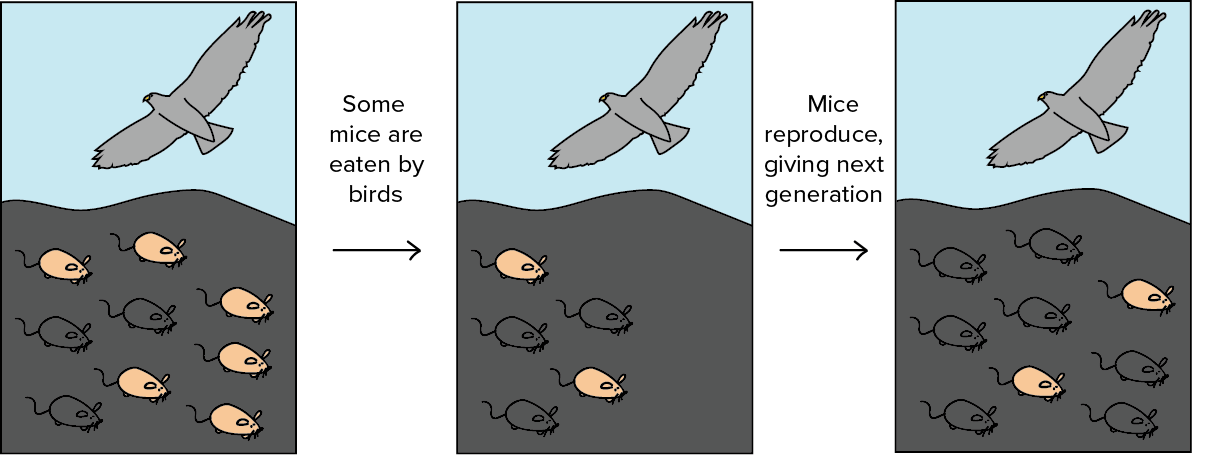
Why is the mouse population changing over time? (You can enlarge the picture by placing your cursor on it.)
The light mice can reproduce more successfully than the dark mice
The hawks eat more dark mice than light mice because the dark mice taste better
The hawks eat more light mice than dark mice because they can see the light mice more easily
The hawks eat more dark mice than light mice because they can see the dark mice more easily
Which organisms are most likely to survive?
the best adapted (best fit)
the fastest
the strongest
the most domesticated (tamed)
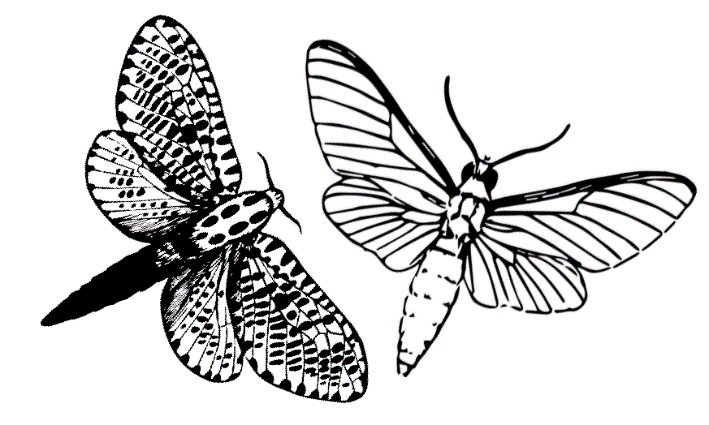
According to natural selection, light colored tree trunks would favor ___________________________.
light colored moths
dark colored moths
red colored moths
red and light colored moths
Why are advantageous (better fit) traits more likely to be passed onto offspring?
They are more likely to survive and reproduce.
They are more likely to die and not reproduce.
They are able to reproduce more offspring.

A slight difference in an inherited trait between individual members of the same species. (Example: Some rabbits have white fur and some have black fur.)
variations
adapatations
homologous structures
analogous structures
The passing of genetic traits (DNA) from parent to offspring is __________.
Survival of the fittest
Heredity
Evolution
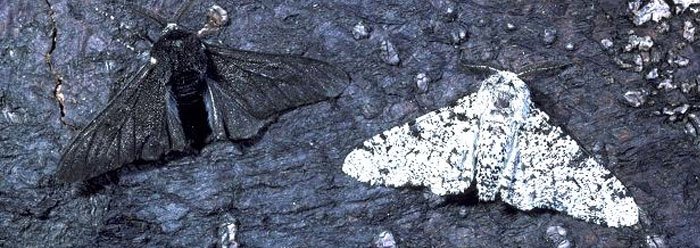
The trees these moths used to live on were white, but have been covered in soot from coal factories. Which moth will be more successful in this environment?
Dark moth
Light moth
Both will be equally successful
Neither will be successful

Which trait(s) would be considered an adaptation for a moth? (Check all that apply.)
Flies very slow.
Wings camouflaged within its environment
The catepillar stage camouflages within its environment.
Flies very fast.
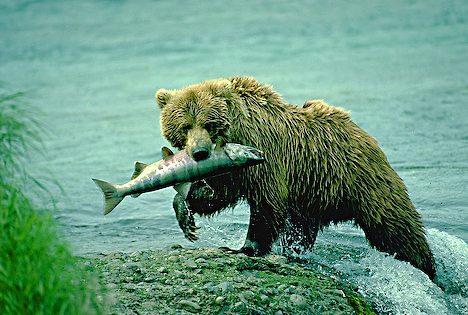
A grizzly bear survives because he is well-adapted (best fit) to his environment. When he reproduces he passes on those traits to his offspring. this process is called
Natural Selection
Selective Breeding
Random mutations
Variations in a species
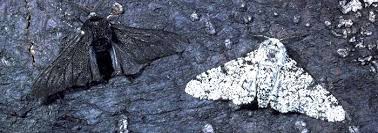
Predict which moth would increase in population over time.
light colored
dark colored

What is the best claim for this image?
The grey wolves are best adapted to the Arctic
The brown rabbits are best adapted to the Arctic.
The white rabbits are best adapted to the Arctic.

If Easter eggs were living species of organisms, their different colors would be considered:
Adaptations
Variations
Different species
Extinct species

The peppered moth's color camouflaged it on the light colored tree bark. It's color was an example of a/n
Variation
Dominant trait
Recessive trait
Adaptation
What word describes a trait that helps an organism survive in its environment?
natural selection
mutation
camouflage
adaptation

Who's theory would support the idea that the faster prey survived at a greater rate than slower prey?
Lamarck
Darwin
Change over time?
Evolution
Homeostasis

Evidence of Evolution
Fossils
Embryological Comparison
Vestigial Organs
Homologous Structures

Evidence of Evolution
Homologous Structure
Vestigial Organ
Biochemical Analysis
Embryological Comparison

Example of Evolution
Biochemical Analysis
Fossils
Vestigial Organ
Homologous Structure
Who is credited with the theory of evolution by natural selection?
Darwin
Mendel
Darwin's ship?
HMS Finch
HMS Beagle
What series of islands off the coast of South America did Darwin spend considerable amount of time and greatly influence Darwin's work.
Hawaiian Islands
Galapagos Islands
Which can be used as evidence for evolution (change over time)?
Fossils
Homologous Structures
Embryo Similarities
Biochemical Analysis
All are examples of evidence of evolution
Darwin collected what type of evidence on his voyage?
Fossil & Specimen Evidence
DNA & Biochemical Evidence
What is the result of "Survival of the Fittest"?
Evolution (populations change over time)
Genetic Equilibrium (populations remain unchanged over time)
Do populations or individuals evolve?
Individuals
Populations

Populations are controlled by war, disease & famine.
Malthus
Hutton
Lyell
Lamarck
Wallace

Sent Darwin and essay with similar ideas as what Darwin proposed.
Malthus
Hutton
Lyell
Lamarck
Wallace

Wrote "Principles of Geology". Geologic events that occurred in the past will continue to occur in the future.
Malthus
Hutton
Lyell
Lamarck
Wallace

One of the first theories of evolution. Organisms can acquire traits over their lifetime.
Malthus
Hutton
Lyell
Lamarck
Wallace

Stated earth is millions of years old.
Malthus
Hutton
Lyell
Lamarck
Wallace

Example of evolution
Biochemical Analysis
Homologous Structure
Vestigial Organ
Embryological Similarities
Fossil
Example of Evolution
Biochemical Analysis
Fossils
Vestigial Organ
Homologous Structure
Evidence of Evolution
Homologous Structure
Vestigial Organ
Biochemical Analysis
Embryological Comparison
Evidence of Evolution
Fossils
Embryological Comparison
Vestigial Organs
Homologous Structures
Wrote the book "On the Origin of Species"
Charles Lyell
Charles Darwin
The female peahen continues to choose the male peacock with the brightest, most beautiful feathers. This is an example of?
Natural Selection
Artificial Selection
Change over time?
Evolution
Homeostasis
Who's theory would support the idea that the faster prey survived at a greater rate than slower prey?
Lamarck
Darwin
Who said... Organisms evolve within their own lifetime.
Both
Darwin
Lamarck
Who said...There was variation in a population.
Both
Darwin
Lamarck
Which scientist thought that if you used a specific body part it would get stronger?
Darwin
Lamarck
Which scientist supported the theory of Use and Disuse?
Darwin
Lamarck
Our ape-like ancestors started making _______________. Our hands changed shape and our brains got bigger.
fire
tools
How is the scientific theory of evolution supported by the comparison of the skulls and skeletons of modern humans and extinct hominids?
By making the hip, spine, and skull comparisons, the age of different hominid specimens can be determined.
Comparison of skull and skeletons provides evidence that humans and different hominid species interacted.
Similarity in skull shapes, hands, and hips between extinct hominids and humans supports a common ancestry.
Skull and skeleton comparisons can explain why hominids were inferior and became extinct while humans evolved.
Scientists have found evidence that about 2.4 million years ago a gene regulating jaw muscles mutated and may have led to the more graceful human jaw we see today. The diagram below shows the skulls of 3 hominid species.
Which statement below most closely explains the link between jaw size and hominid evolution?
The jaws of hominids evolved to be smaller and less protruding over time.
The jaws of hominids evolved to be larger and more protruding over time.
There appears to be no change in the jaws of hominids over time.
The jaws of hominids changed over time due to a change in brain size.

