
Font size
 Worksheets
Earth: An Introduction to Physical Geology and Time Scales
Total questions: 125
Worksheet time: 1hrs 3mins
Which statement best captures why a geologic time scale is essential in physical geology?
It organizes rock types without chronological order for clarity
It provides temporal context that gives geologic events meaningful sequence
It replaces fossil evidence by estimating rock compositions precisely
It eliminates uncertainty by producing exact ages for all formations
Rocks record both geologic processes and (a) changes throughout Earth’s history.
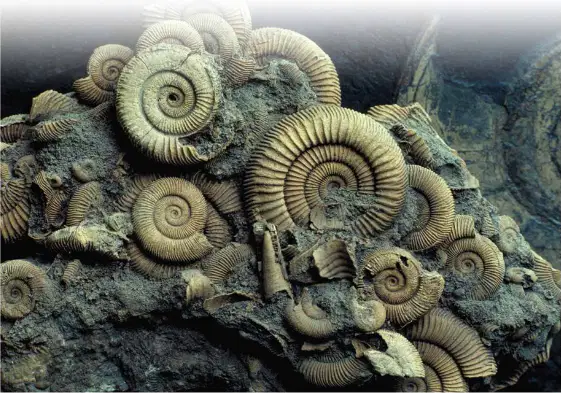
A fossil-bearing layer is found above a volcanic ash bed with a known numerical date. Which reasoning most appropriately constrains the fossil layer’s age?
It must be the same age as the ash because both contain minerals
It must be younger than the ash because it lies stratigraphically above
It must be older than the ash because fossils predate eruptions
It cannot be related in time because fossils lack radioactive isotopes
Which pairing correctly distinguishes relative dates from numerical dates in building Earth’s time scale?
Relative dates assign exact years; numerical dates infer event order only
Relative dates place events in sequence; numerical dates give quantified ages
Relative dates rely on isotopes; numerical dates rely on fossil succession
Relative dates ignore fossils; numerical dates ignore radioactive decay
Which statement best contrasts numerical dates and relative dates in geology?
Numerical dates assign specific years; relative dates order events
Numerical dates order events; relative dates assign specific years
Both assign specific years using fossils only
Both order events using cross-beds only
In an undeformed sequence of sedimentary rocks, where is the oldest bed located?
At the bottom of the sequence
At the top of the sequence
In the middle layers generally
Adjacent to igneous intrusions
A vertical dike cuts across several sedimentary layers. Which feature is younger?
The dike is younger than the layers
The layers are younger than the dike
Both formed simultaneously during burial
Relative age cannot be determined here
BLANK: Fragments of one rock unit enclosed within another rock unit are called (a) .
A sandstone contains rounded pebbles of shale. Which relative age relationship is valid?
The shale clasts are older than the sandstone
The sandstone is older than the shale clasts
Both are the same relative age overall
The clasts must be metamorphic fragments
Which description defines an angular unconformity?
Tilted rocks overlain by flat-lying layers
Parallel strata separated by a surface
Sediments overlying metamorphic basement
Flat beds faulted by a normal fault
Which scenario best illustrates a nonconformity?
Sedimentary strata resting on eroded igneous rocks
Flat beds over tilted older strata
Parallel sedimentary beds with a time gap
A lava flow intruding through sandstone
Place these events in a reasonable order to form a disconformity between two sedimentary units.
Deposition, uplift and erosion, renewed deposition
Intrusion, metamorphism, rapid deposition
Erosion only, followed by intrusion
Metamorphism first, then parallel bedding
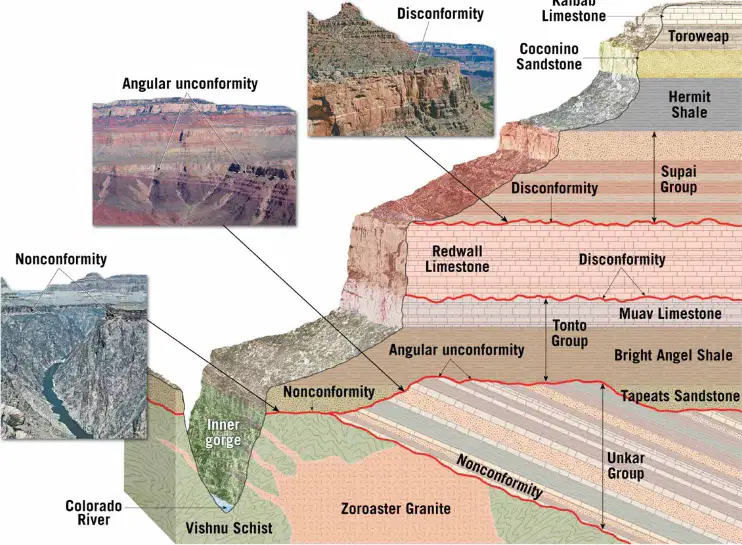
In the diagram, which surface represents an angular unconformity?
Tilted older beds truncated by flat younger beds
Parallel beds separated by an erosional surface
Sedimentary layers resting on crystalline basement
Cross-bedded sandstone interfingering with shale
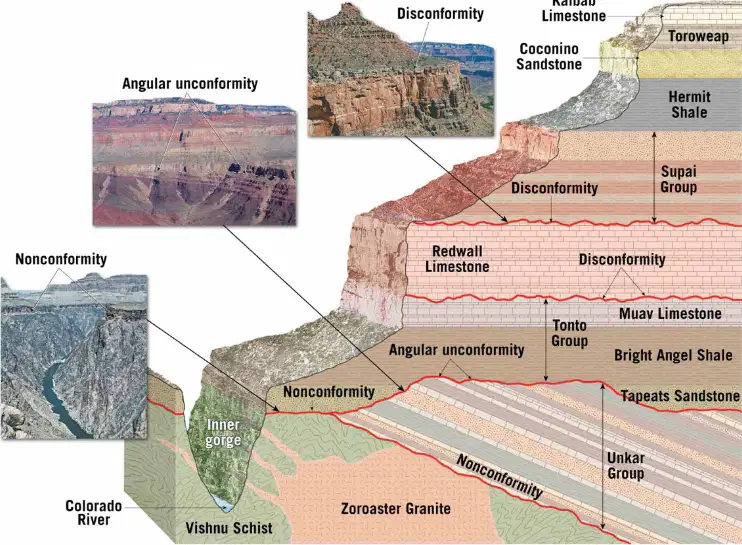
A nonconformity is best identified where sedimentary strata overlie which type of rock in the diagram?
Metamorphic basement such as Vishnu Schist
Gently dipping mudstone and siltstone
Horizontally layered Redwall Limestone
Cross-bedded Coconino Sandstone
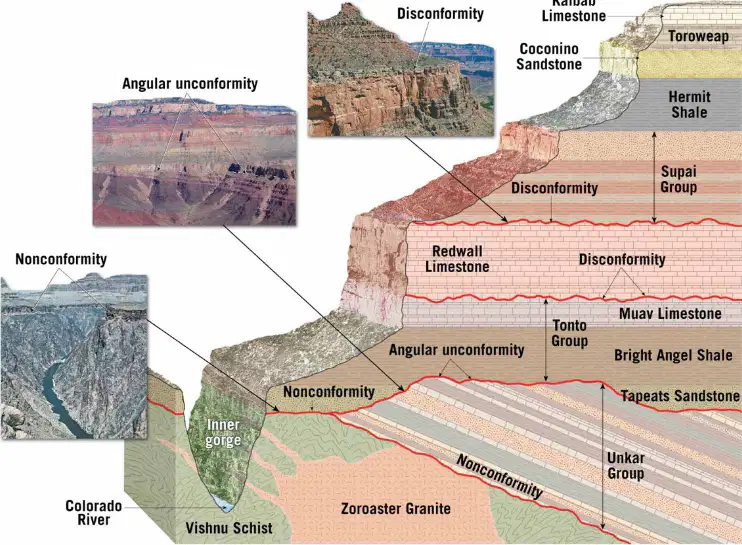
Which statement distinguishes a disconformity from other unconformities shown?
It separates parallel sedimentary layers with missing time
It truncates tilted beds beneath flat overlying layers
It places sediments directly on igneous or metamorphic rocks
It forms only during regional metamorphism of strata
Fill in the blank: A fossil is the (a) preserved in rocks of prehistoric life.
During permineralization, what is the immediate mechanism that preserves porous tissues?
Mineral-rich groundwater precipitates within pore spaces
Rapid burial by ash halts biological decay entirely
Compression drives off volatiles leaving carbon films
Replacement by silica after total dissolution occurs
Which pair correctly matches fossil type with its formation process?
Mold: shell dissolves leaving cavity; Cast: cavity later filled
Mold: cavity filled with sediment; Cast: original shell dissolves
Mold: carbon film remains; Cast: mineral replacement occurs
Mold: recrystallized shell; Cast: pressure solution features
A shale layer contains leafy silhouettes with thin carbon films. Which fossilization pathway most likely produced these?
Carbonization and impressions during burial
Permineralization by silica-rich fluids
Nonconformity-related metamorphic overprint
Formation of external molds and internal casts
Which process best explains how delicate leaves become preserved as a thin film on rock surfaces?
Permineralization of cellular spaces by silica solutions
Carbonization after burial and compression expelling fluids
Recrystallization of calcite shells during diagenesis
Encasement in ice with minimal chemical alteration
Amber fossils are most likely to preserve which type of organism with high fidelity?
Large vertebrates with robust skeletons
Insects trapped in hardened tree resins
Soft-bodied algae in deep-sea ooze
Burrowing worms within sandy substrates
Trace fossils provide indirect evidence of prehistoric life. Which example fits this category?
A mineralized dinosaur femur bone
A shell replaced entirely by pyrite
A trackway showing repeated three-toed prints
A leaf compressed into a carbon film
Rapid burial and the presence of hard parts increase preservation potential primarily because they
accelerate organic decay by promoting oxidation
shield remains from scavenging and physical disturbance
enhance metamorphism that stabilizes mineral structure
prevent lithification and compaction of sediments
Fill in the blank: (a) is the scientific study of fossils used to infer past life and environments.
A researcher finds similar-aged sandstone beds in two distant basins and aligns them to build a regional timeline. This practice is called
stratigraphic correlation across different regions
petrographic analysis of thin sections
radiometric dating of zircon crystals
paleomagnetic reversal chronology
Which statement best describes the value of correlating rock layers across regions?
It limits the rock record to one local section only
It provides a more comprehensive view of the rock record
It replaces fossil evidence with geochemical proxies
It eliminates the need for field mapping entirely
Impressions differ from carbonized fossils because impressions
retain original organic films after compression
remain as outlines when the carbon film is lost
form only within amber from ancient trees
record behaviors rather than body structures
Which statement best defines an index fossil used in rock correlation?
A fossil widespread geographically but short in geologic duration
A fossil rare geographically and long in geologic duration
A fossil restricted geographically and short in human history
A fossil widespread in oceans and long in human history
Arrange the fossil groups to represent fossil succession from oldest to youngest in a generalized Paleozoic–Cenozoic sequence.
Trilobites → fishes → reptiles → mammals
Mammals → reptiles → fishes → trilobites
Reptiles → trilobites → mammals → fishes
Fishes → mammals → trilobites → reptiles
A geologist matches a sandstone bed in two distant regions by identifying the same short‑lived ammonite species in both. What principle is the geologist applying?
Correlation using index fossils across regions
Superposition within a vertical stratigraphic column
Cross‑cutting relationships with igneous intrusions
Original horizontality of sedimentary strata
Fill in the blank: A fossil assemblage is a (a) used to determine a rock’s age.
Which observation would most strongly support correlating two layers over a continent‑scale distance?
Presence of the same short‑range index fossil species
Similar grain size and sandstone color only
Identical bed thickness regardless of fossils
Occurrence of generic marine shells without dating
Shells from ancient organisms can reveal what kind of paleoenvironmental information most directly?
Positions of ancient shorelines and seawater temperature
Rates of mantle convection under ocean basins
Exact radiometric ages of volcanic ash layers
Seasonal rainfall in distant continental interiors
Before applying radiometric dating to a rock sequence, which step improves the reliability of age interpretations?
Correlate layers using fossil succession and assemblages
Ignore fossils and date every grain individually
Assume all sandstone beds are the same age regionally
Use only color similarities to match strata
Which statement best describes isotopes of the same element?
Same protons, different neutrons
Same neutrons, different protons
Different electrons, same neutrons
Different charges, same electrons
During alpha emission, how do atomic number and mass number change for the parent nucleus?
Atomic number −2, mass number −4
Atomic number −1, mass number −0
Atomic number +1, mass number 0
Atomic number +2, mass number +4
In beta minus emission, what happens to a neutron inside the nucleus?
It converts to proton and electron
It splits into two electrons
It absorbs an alpha particle
It converts to proton and neutron
Fill in the blank: The atomic number equals the number of (a) in the nucleus.
A mineral initially contains only a radioactive parent isotope. After one half-life, what is the parent-to-daughter ratio?
1:1 parent to daughter
2:1 parent to daughter
1:2 parent to daughter
3:1 parent to daughter
Which change occurs to mass number during beta minus emission?
No change in mass number
Decrease by four units
Increase by two units
Increase by one unit
A zircon crystal forms with 100 units of a parent isotope and no daughter product. After two half-lives, how many units of parent remain?
25 units of parent
50 units of parent
75 units of parent
12 units of parent
Which combination correctly matches particle charge and location in an atom?
Electrons negative, orbit nucleus
Protons negative, orbit nucleus
Neutrons positive, orbit nucleus
Electrons neutral, inside nucleus
Radiometric dating determines the age of a rock by measuring what primary process?
Decay of isotopes over time
Cooling rate of magma
Compaction of sediments
Weathering of minerals
In radiometric dating, what happens to the proportion of daughter atoms with each successive half-life?
Daughter atoms decrease by half each half-life
Daughter atoms double only in the first half-life
Daughter atoms increase as parent atoms decay
Daughter atoms remain constant over time
Potassium-argon dating relies on the decay of potassium-40 into which primary gaseous daughter product present in rocks?
Neon-20 gas within mineral lattices
Argon-40 gas trapped in crystals
Helium-3 gas from alpha decay
Nitrogen-14 gas from beta decay
What is the approximate half-life used for potassium-argon dating of geological materials?
(a)
A rock sample has experienced groundwater infiltration that added daughter isotopes after formation. Which principle best explains why its radiometric age may be invalid?
Open system allows isotope gain or loss
Decay rates change with temperature
Half-lives shorten in metamorphism
Parent isotopes convert to multiple gases
Which scenario is most suitable for obtaining a reliable radiometric date from a volcanic rock?
Weathered surface with soil alteration layers
Fresh, unweathered crystals in a closed system
Hydrothermally altered rock with fractures
Metamorphosed rock with fluid exchange
Some radioactive parents do not decay directly to a single stable daughter. Which statement aligns with this complexity?
All parents decay in one step to argon-40
Uranium-238 ultimately yields lead-206 after many steps
Potassium-40 decays only to neon-20 in two steps
Stable daughters always form without intermediates
During analysis, why must quantities of both parent and daughter isotopes be measured precisely?
To calibrate seismograph amplitudes for earthquakes
To compute age from known decay relationships
To identify fossil assemblages in sedimentary rocks
To estimate plate velocities from magnetic stripes
Where are Earth’s oldest rocks predominantly found, and what age do such rocks exceed on all continents?
Ocean basins; older than 4.6 billion years
Continents; older than 3.5 billion years
Mid-ocean ridges; older than 2.0 billion years
Island arcs; older than 1.0 billion years
Which statement best describes the primary use of radiocarbon dating in geology?
Determining ages of recent organic remains
Measuring formation time of igneous rocks
Dating earliest Archean crustal minerals
Estimating ages of metallic ore deposits
Carbon-14 is continually formed in the upper atmosphere by interactions with which source of radiation?
Cosmic-ray bombardments in the atmosphere
Solar wind trapped in the magnetosphere
Ultraviolet radiation during daylight
Infrared emissions from volcanic gases
Fill in the blank: The half-life of carbon-14 is (a) years.
A charred wooden beam from a historic structure is an ideal candidate for which geochronology method?
Radiocarbon dating of organic material
U-Pb dating of zircon crystals
K-Ar dating of basaltic flows
Rb-Sr dating of ancient gneiss
Which range best characterizes the time span over which carbon-14 can reliably date events?
Historic past to around seventy thousand years
Up to several hundred million years
Only the last few decades of growth
From two to three billion years ago
Which statement correctly defines an eon within the geologic time scale?
The greatest expanse of geologic time units
A subdivision smaller than an epoch
A unit defined by a single fossil species
A time span limited to regional events
Match each Phanerozoic era with its descriptive meaning.
Paleozoic — ancient life; Mesozoic — middle life; Cenozoic — recent life
Paleozoic — recent life; Mesozoic — ancient life; Cenozoic — middle life
Paleozoic — middle life; Mesozoic — recent life; Cenozoic — ancient life
Paleozoic — plant life; Mesozoic — insect life; Cenozoic — fish life
Which statement about the Phanerozoic eon is accurate?
It began roughly 542 million years ago
It ended before the Cambrian period
It excludes divisions into epochs
It represents the earliest Precambrian
Which statement best describes life during the Archean portion of Precambrian time?
Complex animals with shells were widespread
Simple soft-bodied life-forms predominated
Plants with woody tissues dominated continents
Abundant vertebrate fossils are continuously found
Fill in the blank: The term metamorphic grade refers to the degree to which the parent rock changes during (a) .
Which combination most clearly indicates a high metamorphic grade in a rock sample?
Low temperatures and low pressures
Low temperatures and high pressures
High temperatures and low pressures
High temperatures and high pressures
Why are many Precambrian rocks highly deformed metamorphic rocks? Choose the most defensible explanation given Earth’s early history.
Early Earth had stable, cool crustal conditions
Early Earth experienced intense heat and pressure
Fossilization processes deformed soft organisms
Sedimentation rates were exceptionally constant
Fossil evidence is sparse in Archean rocks. Which reasoning most directly explains this scarcity?
Archean organisms lacked hard parts for fossilization
Archean rocks formed only in deep-sea settings
Erosion removed all Archean sedimentary layers
Fossils cannot form under any metamorphic conditions
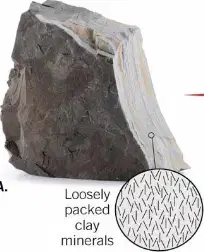
Which change best represents low-grade metamorphism of shale as shown in the diagram?
Loosely packed clay becomes tightly packed chlorite and mica
Randomly oriented grains melt into interlocking quartz and feldspar
Tightly packed biotite layers recrystallize into coarse garnet porphyroblasts
Mafic minerals exsolve to form banded pyroxene and olivine
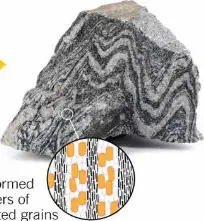
During high-grade metamorphism of granodiorite, what texture forms according to the diagram?
Foliated bands with deformed, segregated layers
Massive glass with vesicular textures
Unfoliated, clastic fragments with pore spaces
Radial crystals with botryoidal surfaces
Fill in the blank: Metamorphism occurs while the rock remains essentially (a) .
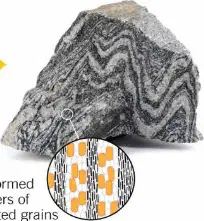
Which combination of conditions most likely drives the transition from granodiorite to folded gneiss in the figure?
Strong compressional forces, high temperatures and pressures
Low temperatures, low pressures, minimal compression
Rapid cooling at surface with hydrostatic pressure
Partial melting followed by explosive degassing
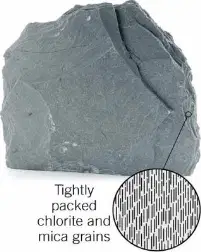
A student observes slate with aligned mica grains. Using the diagram, which prior rock and process best explain this texture?
Shale compacted and recrystallized at low grade
Basalt weathered into clay-rich soil profiles
Granodiorite partially melted into rhyolitic magma
Sandstone cemented by silica in groundwater
Fill in the blank: In structural geology, (a) refers to all changes in the shape or position of a rock body in response to stress.
Which statement best defines stress in rocks during deformation?
Force per area acting on a rock body
Permanent shape change in a rock body
Temperature increase within a rock mass
Time-dependent flow of molten rock
What is the term for stress applied uniformly in all directions within a rock?
Shear differential stress
Confining pressure
Compressional tectonics
Tensional loading
Strain in geology most directly refers to which outcome?
A change in shape of a rock
The magnitude of applied force
The speed of plate motion
A rise in geothermal gradient
Fill in the blank: When the applied stress is removed and a rock returns to nearly its original shape, the rock experienced (a) .
A rock exceeds its elastic limit at depth with elevated temperature and pressure. Which deformation is most likely?
Rapid brittle failure with wide open fractures
Ductile bending or flowing of rock layers
No deformation due to confining pressure
Instantaneous melting and magma formation
Which scenario most likely produces earthquakes by releasing stored elastic strain?
Shallow depth, low temperature, low pressure
Great depth, high temperature, high pressure
Uniform confining pressure at all depths
Slow ductile creep of mantle rocks
Folding and faulting can occur together under which general conditions in layered rocks?
Moderate depths with compressional regimes
Very shallow levels with high tension
Oceanic crust under pure shear
Volcanic arcs during rapid melting
A field geologist maps folds without pervasive fracturing across a region. What is the most reasonable inference about the deformation environment?
High temperature and pressure favored ductile behavior
Extremely low stress prevented any measurable strain
Repeated earthquakes caused widespread brittle failure
Only confining pressure acted with no differential
Which statement best describes strike and dip when mapping a planar rock layer?
Strike is compass direction, dip is angle and direction
Strike is angle of tilt, dip is compass bearing only
Strike is vertical thickness, dip is horizontal extent only
Strike is GPS location, dip is satellite imagery resolution
What primary method helps extend limited outcrop observations across a region during geologic mapping?
Aerial photography and satellite imagery with GPS
Excavating continuous trenches across terrain
Measuring groundwater chemistry at many wells
Collecting volcanic ash from distant eruptions
Fill in the blank: Dip is the (a) of the surface of a rock unit measured from a horizontal plane and has an associated direction toward which the rock is inclined.
Most folds develop under which stress condition, and what crustal effect typically results?
Compressional stress, shortening and thickening
Tensional stress, thinning and extension
Shear stress, lateral translation only
Hydrostatic stress, uniform expansion
In an anticline, which strata occupy the core of the fold?
Oldest beds in the center of the structure
Youngest beds in the center of the structure
Metamorphic rocks only at the hinge zone
Igneous intrusions concentrated at the core
A field geologist observes V-shaped outcrop patterns of sedimentary layers in a valley and measures a dip of 25° toward the southeast. Which additional measurement completes a standard strike and dip notation?
The strike azimuth perpendicular to the dip direction
The bed thickness at the fold hinge line
The seismic reflection profile depth value
The GPS elevation above mean sea level
Which pairing correctly distinguishes anticlines from synclines in terms of fold geometry and age relationships?
Anticlines arch upward, oldest center; synclines trough, youngest center
Anticlines trough downward, youngest center; synclines arch, oldest center
Anticlines are faults with displacement; synclines are joints without movement
Anticlines require tensional stress; synclines require hydrostatic stress
Which statement best distinguishes a fault from a joint in rock?
Fault shows displacement; joint shows no displacement
Fault forms at depth; joint forms at surface only
Fault is ductile; joint is brittle deformation
Faults occur alone; joints occur randomly spaced
Sudden movement along faults primarily produces which geologic event?
Most earthquakes recorded globally
Most volcanic eruptions worldwide
Most mountain building episodes
Most metamorphic aureoles
Slickensides on a fault surface indicate what key information?
Direction of movement along the fault
Absolute age of the faulted rock
Magnitude of the largest earthquake
Porosity changes after faulting
In a dip-slip fault, how is motion oriented relative to the fault plane?
Parallel to the dip inclination
Perpendicular to the dip inclination
Parallel to the strike direction
Oblique to both strike and dip
In a normal fault, the hanging wall moves in which direction relative to the footwall?
Downward relative to the footwall
Upward relative to the footwall
Horizontally to the right
Horizontally to the left
Which stress regime is most associated with normal faulting?
Tensional stress pulling rocks apart
Compressional stress shortening crust
Shear stress sliding blocks laterally
Thermal stress expanding minerals
Which pair correctly matches block names in fault-block mountains?
Uplifted blocks are horsts; down-dropped blocks are grabens
Uplifted blocks are grabens; down-dropped blocks are horsts
Both uplifted and down-dropped blocks are horsts
Both uplifted and down-dropped blocks are grabens
Which description best characterizes a reverse fault?
Hanging wall moves up relative to footwall
Hanging wall moves down relative to footwall
Blocks slide laterally with no vertical motion
Both vertical and horizontal offset combined
Thrust faults differ from typical reverse faults primarily by what geometric attribute?
Lower dip angle less than about 45 degrees
Greater displacement rate per year
Rougher, unpolished fault surfaces
Association only with divergent margins
Large lateral faults that cut the crust to accommodate plate motion are specifically called what?
Transform faults accommodating plate motion
Detachment faults between rock units
Oblique-slip faults with mixed motion
Half grabens forming tilted blocks
Facing a strike-slip fault, the opposite side appears to move to your right. What type is this?
Right-lateral strike-slip motion
Left-lateral strike-slip motion
Reverse dip-slip motion
Normal dip-slip motion
What term names the low cliffs formed by displacement along a fault?
(a)
Which statement best describes elastic rebound in earthquakes?
Rocks bend, store elastic energy, then rupture
Rocks melt slowly and flow like magma
Plates stop moving and pressure disappears
Seismic waves push faults permanently closed
Place the missing term: Small earthquakes that follow a major earthquake are called (a) .
A sequence of small earthquakes occurring days to years before a large event is termed what?
Foreshocks
Aftershocks
Seiches
Liquefaction
On parts of the San Andreas fault, slow, gradual displacement without major earthquakes is known as what?
Fault creep
Surface folding
Plastic flow
Subduction drag
Which scenario best applies the elastic rebound concept to predict strain accumulation?
Locked fault storing energy for centuries
Fault fully lubricated by fluids
Plate interior unaffected by stress
Volcanic conduit relieving all strain
Segments of the San Andreas that store elastic energy for hundreds of years are most associated with which behavior?
Stick-slip motion leading to great earthquakes
Continuous aseismic ductile deformation
Permanent widening of the fault zone
Complete prevention of seismic waves
A field team maps a 150-kilometer stretch of the San Andreas with frequent small slips but no large ruptures in decades. What is the most reasonable interpretation?
Segment experiencing regular small earthquakes
Segment locked by frictional welding
Area dominated by magmatic intrusions
Zone of stable continental rifting
Which statement best distinguishes P waves from S waves in Earth’s interior?
P waves travel through solids, liquids, and gases
P waves travel only through solids in the mantle
S waves travel faster than primary body waves
S waves compress material parallel to propagation
A seismograph primarily records ground motion relative to a stationary mass on what type of system?
A rotating drum or magnetic system
A hydraulic piston oscillation system
A laser interferometer vacuum system
A gyroscopic pendulum vacuum system
Fill in the blank: The location on Earth’s surface directly above the hypocenter is the (a) .
Which sequence correctly orders the typical arrival of seismic waves at a station?
P waves first, S waves second, surface waves last
Surface waves first, P waves second, S waves last
S waves first, surface waves second, P waves last
P waves first, surface waves second, S waves last
Why are three seismic stations required to locate an earthquake epicenter using travel-time differences?
Three distances intersect uniquely at one point
Two distances always intersect at two points
One distance is sufficient for unique location
Four distances are needed to reduce measurement error
Which property most explains why surface waves produce the greatest destruction in urban areas?
They have greatest amplitudes and longest periods
They travel 1.7 times faster than other waves
They propagate only through Earth’s deep interior
They are unaffected by near-surface geology
A station measures the time between the first P-wave and first S-wave arrivals. What does this time difference determine for that station?
Its distance to the epicenter from travel-time graph
The earthquake’s magnitude on the moment scale
The depth to the hypocenter beneath the station
The fault’s average rupture velocity during slip
Which pattern correctly pairs earthquake focus depth with tectonic setting?
Shallow foci common along oceanic ridge systems
Deep foci common beneath stable continental interiors
Intermediate foci clustered at transform fault stepovers
Shallow foci predominant landward of deep ocean trenches
Compared with S waves, primary waves change the volume of intervening material because they involve which particle motion?
Push–pull motion parallel to propagation
Shear motion perpendicular to propagation
Retrograde elliptical surface motion
Transverse rolling along the ground
Approximately what proportion of global earthquake energy is released within narrow belts rather than uniformly across plates?
About ninety-five percent worldwide
About fifty percent worldwide
About ten percent worldwide
About one percent worldwide
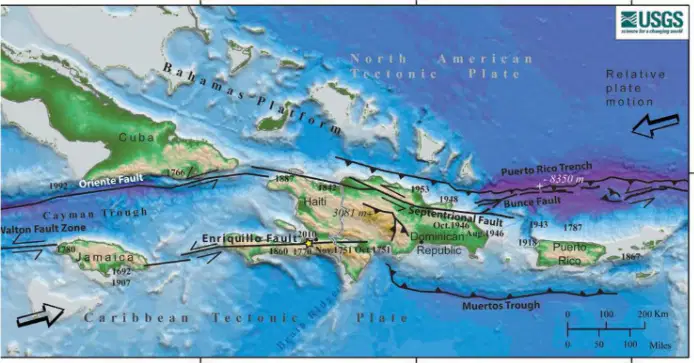
Which statement best describes the overall motion of the Caribbean Plate relative to its neighbors as shown in the diagram?
Small plate slowly moving northeastward
Large plate rapidly moving southwestward
Small plate stationary between larger plates
Large plate drifting quickly northwestward
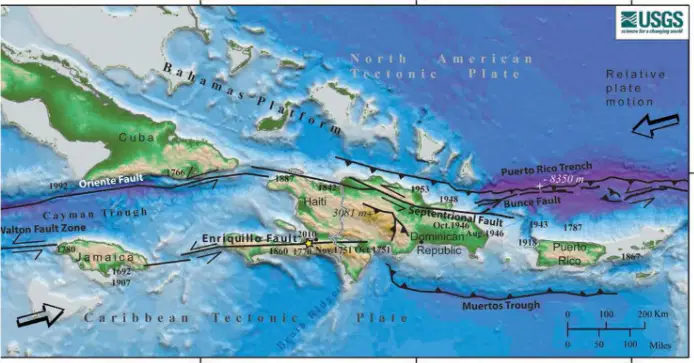
On the western boundary of the Caribbean Plate, what tectonic process dominates according to the diagram?
Subduction of the fast-moving Cocos Plate
Rifting within the Caribbean interior
Transform sliding of the North American Plate
Collision of two buoyant continental blocks
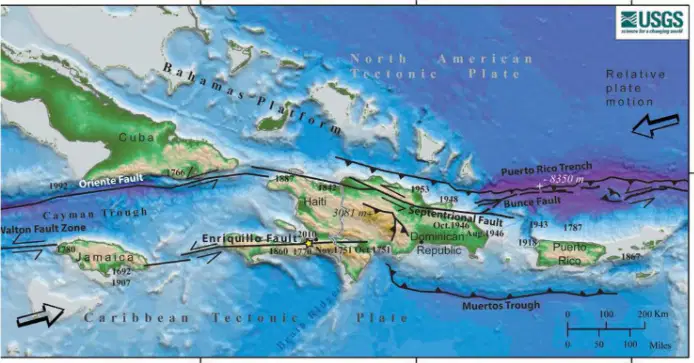
Fill in the blank: The PRVI Platform lies astride the (a) , the deepest part of the Atlantic Ocean in this region, reaching over 8 km deep.
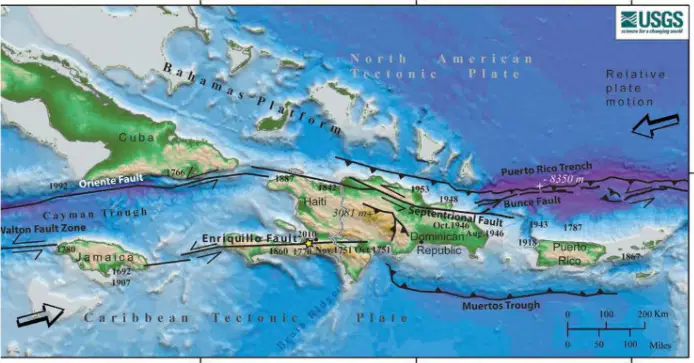
Why do the northern and southern Caribbean boundaries favor sliding rather than subduction in several segments? Use evidence from the boundary types shown.
Buoyant continental margins resist sinking and promote lateral motion
Oceanic lithosphere there is denser and sinks rapidly
Mantle plumes force plates apart causing rifting
Cold slabs pull plates vertically with great force
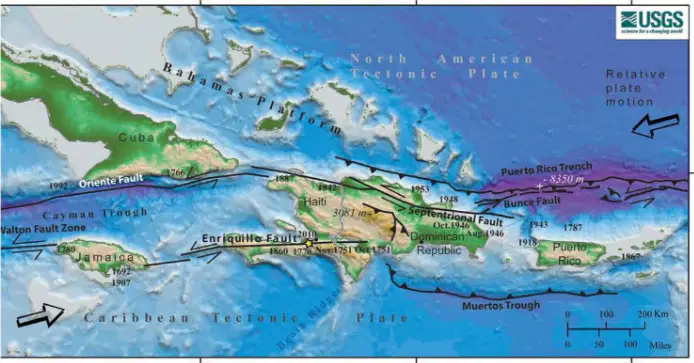
Where does the diagram indicate a transition from subduction to predominantly strike-slip sliding along the Caribbean margins?
Near Puerto Rico and Hispaniola region
Along the Mid-Atlantic Ridge zone
South of the Galápagos hotspot track
In the central Amazon craton area
Which statement best describes the original Richter magnitude scale?
It is based on the largest seismic wave amplitude
It measures fault rupture area and slip directly
It ranks earthquakes by reported human damage only
It calculates energy using moment times rigidity
Each whole-number increase on the Richter scale corresponds to what change in seismic wave amplitude?
A tenfold increase in recorded wave amplitude
A threefold increase in recorded wave amplitude
A thirtyfold increase in recorded wave amplitude
A twofold increase in recorded wave amplitude
Fill in the blank: Moment magnitude is BLANK from the amount of displacement that occurs along a fault.
(a)
Why was the moment magnitude scale developed for very large earthquakes?
Richter-like scales underestimate large-event sizes
Seismographs cannot detect small local quakes
Energy release is identical for all magnitudes
Amplitude decreases with distance too slowly
A Wood–Anderson seismograph recorded an 8.9 for the largest event. What reasoning explains why smaller events may go unfelt by people?
Magnitudes below 2.0 are generally not felt by humans
Amplitude increases with distance from the epicenter
Moment magnitude ignores surface wave effects
Richter values directly measure perceived shaking
A local earthquake’s largest recorded seismic wave at a station is ten times larger than another event recorded at the same station and distance. What is the magnitude difference between the two events on the Richter scale?
One magnitude unit higher for the larger wave
Two magnitude units higher for the larger wave
Zero difference because distance is constant
Three magnitude units higher for the larger wave

