
 Worksheets
REVIEW SOUND
Total questions: 99
Worksheet time: 2hrs 14mins
What type of wave are sound wave?
longitudinal
transverse
electromagnetic
sea wave
In which medium sound can't travel?
solid
liquid
gas
vacuum
What is an echo
deflected sound
refracted sound
reflected sound
diffracted sound
In which medium speed of sound are fastest?
vacuum
solid
liquid
gas
What is the range of frequencies audible to the human ear
lower than 20 Hz
20 Hz - 20.000 Hz
higher than 20.000 Hz
0 Hz - infinite Hz
What is ultrasound?
Sound with a frequency higher than 20.000 Hz
Sound with a frequency lower than 20 Hz
Sound with a frequency 20 Hz
sound with a frequency 20.000 Hz

look at the picture. There are 4 sound wave with different amplitude and wavelength. Which sound wave has loudest sound?
A
B
C
D

look at the picture. There are 4 sound wave with different amplitude and wavelength. Which sound wave has highest pitch?
A
B
C
D
The delay time between light of thunder and sound of thunder is 2 seconds. If the speed of sound at the air is 340 m/s, how far the thunder from you?
680 m
170 m
342 m
338 m
A boat is using echo-sounding equipment to measure the depth of the water underneath.
The equipment in the boat sends a short pulse of sound downwards and detect the echo after a time interval 4 seconds. The speed of sound in water is 1500 m/s. Calculate the depth of water!
6000 m
5800 m
3000 m
2600 m
Sound is a form of energy produced by ______________.
Vibrations
Distances
Prisms
Forces
An object that does not vibrate cannot produce
Sound
Light
Heat
Electricity
A place where no sound exists is...
in the air.
under water.
space.
all of the above
Why do we see lightning before we hear the thunder?
Our eyes trick us.
Light travels faster than sound.
they're two separate things.
When people speak their ________ vibrate.
Ear drums
Vocal chords
Ears
Tongue
What is Pitch?
How loud or soft a sound is.
Muscle that holds vocal cords.
Movement back and forth.
How high or low a sound is.

Which device measures sound waves?
Oscilloscope
Stethoscope
Radio
None of the above
________ describes how LOUD a sound is.
Amplitude
Frequency

____________ is determined by sound's frequency
Compression
Pitch
A sound with a high frequency has a _____ pitch. A sound with a ____ frequency has a low pitch.
high, low
low, high
medium, high
high, medium
______________ sounds have a larger amplitude
Quiet
Loud
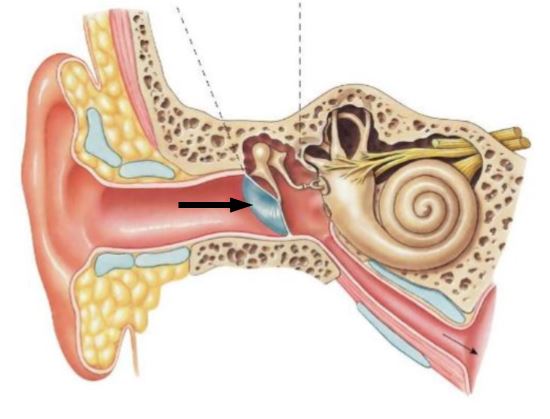
What is this?
Ear Drum
Ear Canal
Nerve
Cochlea
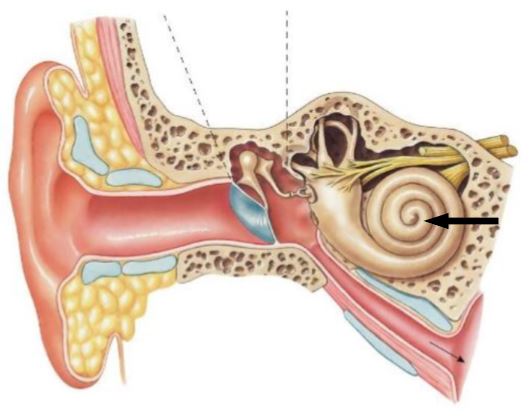
What is this?
Nerve
Ear canal
Cochlea
Ear Drum

__________ means to move back and forth quickly.
Pitch
Amplitude
Vibration
The volume of a sound is measured in units called ________
decibels
liters
sound waves
Why is sound able to travel faster through a solid than a gas?
Gas molecules are packed tightly.
Sound does not travel faster through a solid than a gas.
Solid molecules are packed tightly.
Sound does not travel in space because
Space is too far away.
There is no matter in space.
Space is the final frontier
Which of these is NOT a medium?
light
air
wood
How can I produce a sound?
heating an object
hitting an object
moving the mouth
If a sound has a high amplitude then it also has a ____________!!!
fast echo
slow pitch
high volume
__________ is the loudness or softness of a sound.
Which of the following sound wave produces the highest pitch of sound?


Choose the correct statements. (2 answers)
P - The loudness increases
Q - The pitch decreases
R - The loudness decreases
S - The pitch increases

Diagram shows 3 types of sound waves generated from speaker. Which of the following statements is true?
P has a higher pitch than Q
Q has a higher pitch than R
R has the highest pitch
P, Q and R have the same pitch

Which waveform has the lowest frequency?
(a)
(b)
(c)
(d)
(e)

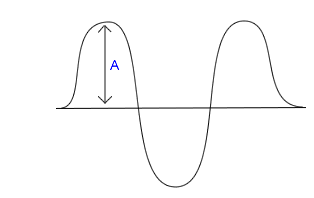
If the distance represented by the letter A (the amplitude) were increased, how would it change the sound?
The sound would be higher.
The sound would be softer.
The sound would be lower.
The sound would be louder.

What is changed in the second picture?
Someone is talking louder in picture 2
Someone is talking softer in picture 2
Someone is talking lower pitch in picture 2
Someone is talking higher pitch in picture 2

What is changed in the second picture?
Someone is talking louder in picture 2
Someone is talking softer in picture 2
Someone is talking lower pitch in picture 2
Someone is talking higher pitch in picture 2
Frequency is measured in the unit of
Ampere (A)
Hertz (Hz)
Mole (mol)
Meter (m)
Which of the following statement is true?
The higher the amplitude, the higher the pitch of sound
The lower the amplitude, the louder the sound
The higher the frequency, the higher the pitch
The lower the frequency, the louder the sound
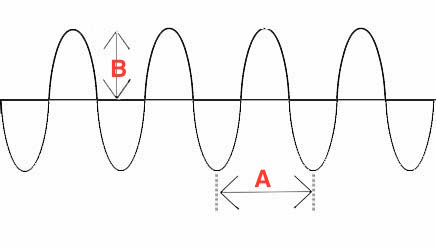
What property of this wave is represented by the letter "A"?
amplitude
crest
trough
wavelength
People with the nerve deafness is due to permanent damage to a nerve ending in the ______________
ear canal
eardrum
cochlea
anvil, stirrup, hammer (three bones)

When something vibrates, it passes the vibration to...
its surrounding environment
your ears
your hands
itself
Sound is produced when an object...
Moves
Makes a noise
Vibrates
Falls
Sound energy travels in...
Longitudinal waves
Transverse waves
When objects vibrate, they create regions of space in which the air particles are bunched together called...
Conductions
Compressions
Rarefactions
Close vibrations
When objects vibrate, they create regions of space in which the air particles are spread out called...
Conductions
Compressions
Rarefactions
Loose vibrations
In a longitudinal wave, the particles move...
In an up and down motion
In the same direction that the wave is moving
True or False:
Sound energy needs a medium (solid, liquid or gas) to travel through.
True
False
True or False:
Sound energy can travel through outer space (a vacuum).
True
False
Which two materials will absorb sound?
Wooden or tiled floors
Cushions/pillows
Fabric curtains
Glass
Which two materials will reflect sound, creating echoes?
Wooden or tiled floors
Cushions/pillows
Fabric curtains
Bare walls

What type of noise would this sound wave make?
Loud noise
Quiet noise
High pitch noise
Low pitch noise

What type of noise would this sound wave make?
Loud noise
Quiet noise
High pitch noise
Low pitch noise

What type of noise would this sound wave make?
Loud noise
Quiet noise
High pitch noise
Low pitch noise
Elephants can hear a range of frequencies lower than our own hearing range called...
Infrasound frequencies
Ultrasound frequencies
Dogs can hear a range of frequencies higher than our own hearing range called...
Infrasound frequencies
Ultrasound frequencies
Sound waves that are beyond the range of human ear are known as ----
Infrasonic waves
Ultrasonic waves
If you want to change the pitch of a sound, you have to change the ___
speed
amplitude
volume
frequency
This is what you get when sound waves are reflected, or bounce back, off of a hard surface.
Amplitude
Pitch
Volume
Echo
Bats use ________ to locate mosquitoes in the air
solar
ecology
echolocation
refraction
When a sound is louder what measurement gets bigger?
Frequency
Amplitude
Wavelength
Crest
Sound waves move more quickly through _________________ matter
dense
light
A rarefaction is generated when particles move ______.
Closer
In circles
Back and forth
Apart
Which temperature causes sound to travel more slowly?
Cold
Hot
Loudness of waves is measure in ______
Hz
dB
Watts
m/s
Frequency of waves is measure in _____.
Hz
dB
Watts
m/s
High frequency sounds have ______ pitch.
High
Low
In a ________________________ wave, the particles vibrate in the same direction that the wave travels, or parallel to the wave.
light wave
microwave
water wave
longitudinal wave
A ____________________ is a longitudinal wave that is caused by vibrations and travels through a medium.
light wave
sound wave
microwave
water wave
_____________________ is how high or low you think a sound is.
volume
amplitude
pitch
frequency
______________________ is a measure of how well sound can be heard.
loudness
pitch
volume
frequency
A(n)_________________________ is a reflected sound wave.
echo
Arc
vibration
rarefaction
________________________ is the use of echos, or reflected sound, to find objects.
ultrasound
sonography
echolocation
reflexology
__________________________ waves have frequencies over 20,000 Hz.
infared
Light
Echo
ultrasound
Sound is a form of energy produced by ______________.
Vibrations
Distances
Prisms
Forces
Sound waves travel the FASTEST through _____________.
Gases
Liquids
Solids
What is the range of frequencies audible to the human ear
lower than 20 Hz
20 Hz - 20.000 Hz
higher than 20.000 Hz
0 Hz - infinite Hz

The correct pairs of instrument and how they are played are shown by numbers …
1 and 3
2 and 4
2 and 3
1 and 4

The animals that can hear ultrasonic sound are numbers …
1 and 3
2 and 4
1 and 2
2 and 3
The following animal that makes sound by rubbing its wings against its wings is … .
elephant
bee
cow
male grasshopper

Based on the picture above, the type of sound that uses to capture live images from the inside of our body is … .
audiosonic
infrasonic
ultrasonic
videosonic
A sound which has frequency 20-20.000 Hz and audible to humans is called … .
Audiosonic
Infrasonic
Ultrasonic
Videosonic
A characteristic of sound is ...
sound can travel in a vacuum
sound can be reflected
sound cannot travel through gas
sound cannot be absorbed

