
Font size
 Worksheets
Page 1
Total questions: 77
Worksheet time: 39mins
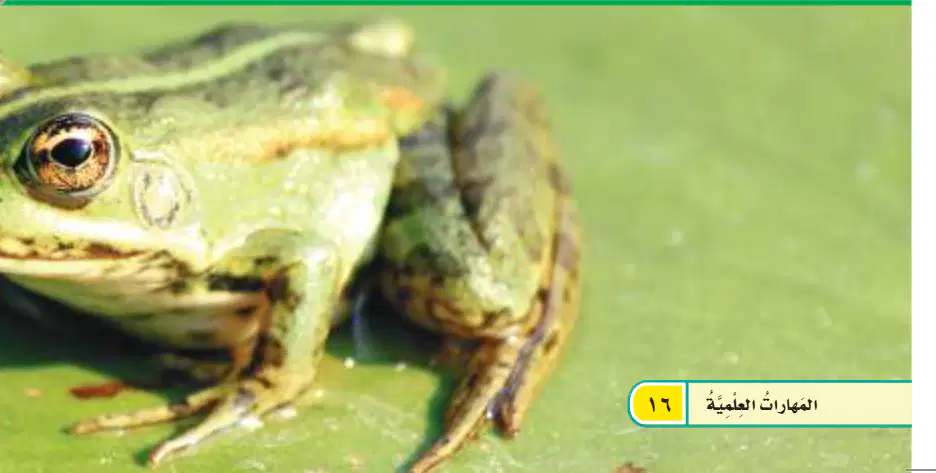
Think and ask: In the photo of a frog sitting on a floating water lily leaf, how is this frog able to sit on the leaf of the water lily plant?
The broad, floating leaf provides buoyancy that distributes and supports the frog’s weight.
The frog breathes underwater through its skin, allowing it to hover above the surface.
The frog’s sticky toes create suction that lifts it off the leaf.
The frog has hollow, air-filled bones that make it lighter than air.
The investigation question asks about how the frog can sit on what part of the water lily plant.
A leaf of the water lily plant
A rock beside the pond
A tree branch over the pond
Under the water surface
In building the model, which material is used to color the paper plate green so it resembles the plant leaf.
A green wax crayon
A black marker
Blue watercolor paint
A graphite pencil
Which object is colored green to represent the plant leaf in the model.
A paper plate
A plastic lid
A piece of cardboard
A sponge pad
A small slit is cut in the paper plate and a piece of string is inserted. What is the specified length of that string.
10 cm
15 cm
20 cm
30 cm
When the paper plate is placed in the water tub, what does the string represent in the model.
The stem of the plant
The root of the plant
The frog’s leg
A floating reed
Which safety instruction is emphasized when preparing the model.
Use the scissors carefully
Wear rubber gloves at all times
Keep the water tub covered
Do not color the plate fully
Which item is used as the frog in the materials list for the activity.
A rubber frog model
A paper cutout of a frog
A wooden frog figurine
A digital image of a frog
Which container is used to hold the water during the activity.
A water tub
A metal pot
A glass beaker
A sealed bottle
From the passage titled "What do scientists do?" which action is described as something scientists perform during their work: scientists build models that show how things appear in reality.
Building models to represent real-world phenomena
Ignoring real-world observations to avoid bias
Relying on guesswork instead of careful methods
Avoiding the use of any models in investigations
According to the note beneath the photograph labeled "Wetland plants," what characteristics do scientists observe in plants near a swamp.
Length only
Color only
Structure only
Length, color, and structure
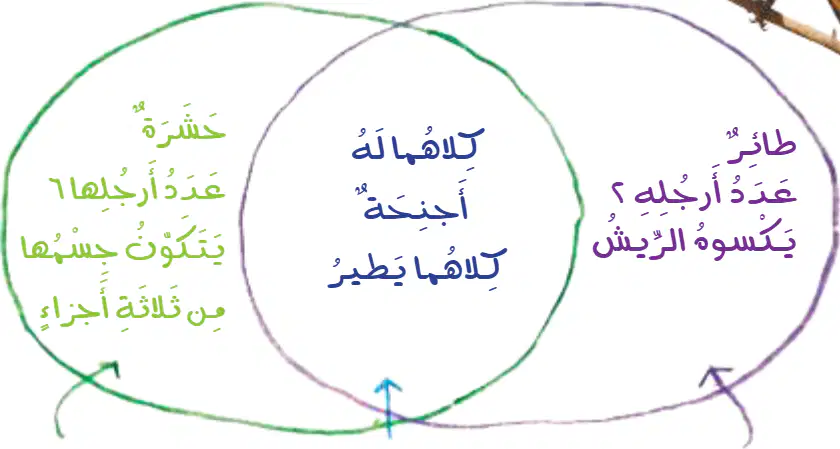
Scientists compare things by identifying similarities and differences. Based on the illustration of a bee and a bird with overlapping circles, which diagram is being used to compare them?
Venn diagram
Bar chart
Timeline
Map
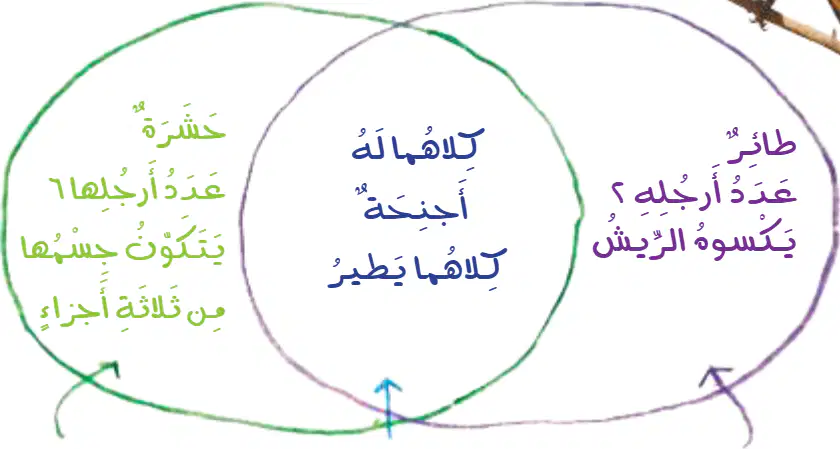
According to the comparison diagram of the bee and the bird, which feature is shared by both animals?
Have wings
Have feathers
Have three body segments
Have six legs
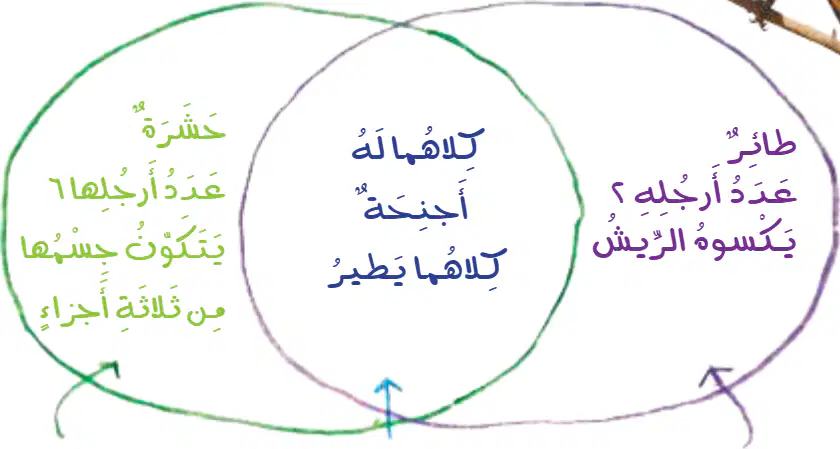
Select all features that the diagram shows as shared by both the bee and the bird.
Have wings
Can fly
Covered with feathers
Body has three segments
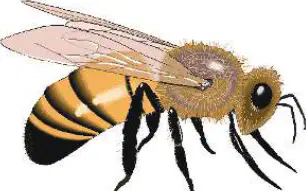
Select all characteristics of the insect (bee) shown in the diagram.
Has six legs
Body is made of three segments
Covered with feathers
Has a beak
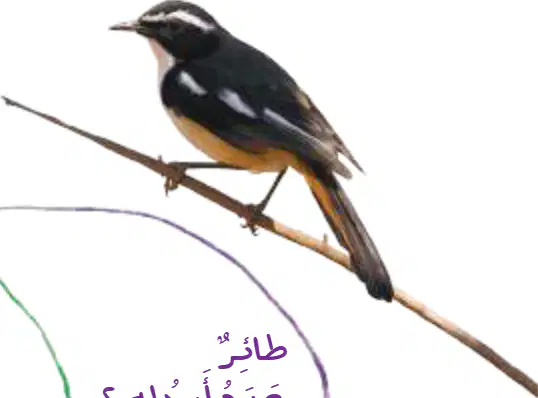
Select all characteristics of the bird shown in the diagram.
Covered with feathers
Has six legs
Body is made of three segments
Has two legs

What method do scientists use to group living things, as described near the diagram comparing a bee and a bird?
Classification
Speculation
Random listing
Magnification
Read the passage: Scientists may measure the size of an egg or its weight. When they touch an object, they can find its length or its temperature. The facts that scientists gather are called data, and when they record observations, they are writing down what they notice. Which term do scientists use for the facts they gather?
data
theories
laws
hypotheses
Read the passage: Scientists may measure the size of an egg or its weight. When they touch an object, they can find its length or its temperature. The facts that scientists gather are called data. Which measurement is explicitly mentioned in the passage?
the size of an egg or its weight
the distance an egg travels
the color of an egg shell
the sound an egg makes
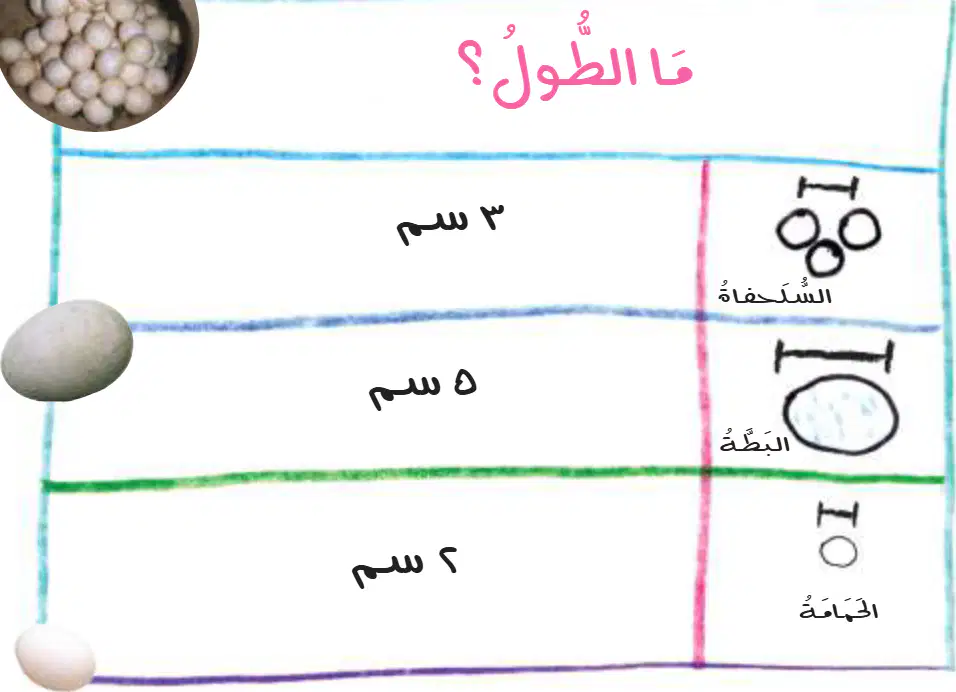
Refer to the diagram labeled What is length? showing a hand-drawn chart with three rows next to pictures of eggs and the entries 3 cm, 5 cm, and 2 cm. What unit is used to record length in the diagram?
cm
m
mm
inches
Read the passage: Scientists may measure the size of an egg or its weight. When they touch an object, they can find its length or its temperature. The facts that scientists gather are called data, and when they record observations, they are writing down what they notice. What action is described as writing down what scientists notice?
recording observations
predicting outcomes
debating hypotheses
ignoring measurements
Use inference with the pictured animals to determine which are birds. The image shows a duck, a frog, a turtle, and a dove, each labeled in Arabic.
Duck
Frog
Turtle
Dove
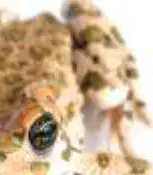
Use inference with the pictured animals to identify the amphibian.
Duck
Frog
Turtle
Dove
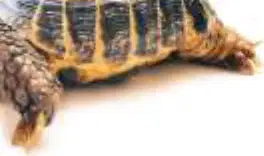
Use inference with the pictured animals to identify the reptile.
Duck
Frog
Turtle
Dove
Arrange the eggs laid by these animals from smallest to largest: duck, frog, turtle, dove. Choose the ordering that best reflects typical egg sizes.
Frog < Dove < Turtle < Duck
Frog < Turtle < Dove < Duck
Dove < Frog < Duck < Turtle
Frog < Dove < Duck < Turtle
According to the passage, after scientists ask a question, what is the next step they take based on what they already know?
Make a prediction based on prior knowledge
Record answers without analysis
Avoid planning to investigate
Skip testing to save time
The images show a sequence of frog development with labels: Abu Dhaniba (tadpole), Small Frog, and a box marked with a question mark. Which label correctly completes the sequence for the large final image of the frog?
Adult Frog
Frog Egg
Salamander
Fish
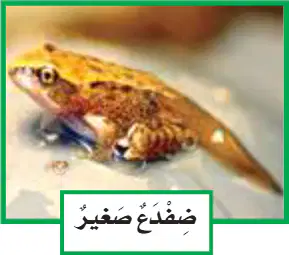
Based on the sequence depicted, which stage comes immediately after the tadpole?
Small Frog
Adult Frog
Frog Egg
Fish Larva
Which skill helps scientists place things into groups?
Observing carefully
Classifying items
Measuring length and mass
Predicting outcomes
Imagine you are a scientist. Which topic would you choose to study to learn more about it?
Frog life cycle and metamorphosis
Designing new sports equipment
Ancient poetry styles
How stars and planets form
Look and ask: This frog can swim well; scientists ask a question, then follow steps to find the answer. Which question is being asked about the frog?
How does it move?
Why is the water green?
What does the frog eat today?
Where do frogs live in winter?
Look and ask: This frog can swim well; scientists ask such a question, then follow steps to find the answer. Which first action of the scientific method is highlighted here?
Asking a question
Analyzing data
Drawing conclusions
Publishing a paper
Observe the pictures on this page and think: How does the frog move? Select all that apply.
Leaping on land using powerful hind legs
Swimming by propelling with webbed hind feet
Walking upright on two legs like a human
Gliding through the air using skin flaps
Record data: Which are different ways the frog moves? Select all that apply.
Leaping across the ground
Swimming through water
Flying with wings
Burrowing underground as primary locomotion
Draw conclusions: Which body parts does a frog primarily use when swimming?
Hind legs and webbed feet
Front legs only
A muscular tail
Wings and forelimbs
Communicate: Which statement best describes how frogs move, based on the pictures?
They mainly leap on land and swim using powerful hind legs.
They primarily fly short distances with wing-like membranes.
They move only by crawling slowly with their front legs.
They usually walk upright on two legs over long distances.

Investigation topic: Identify the main question being studied on this page about frogs.
The distance a frog can jump
The speed a frog can swim
What a frog eats
How a frog changes color
Khalid’s question: Choose the statement that best matches the specific question Khalid asks about frogs.
Does the size of a frog affect the distance it jumps?
Do frogs prefer wetlands over forests?
Does the temperature determine a frog’s color?
Do frogs make louder sounds at night?
Khalid’s prediction: Based on the page, what did Khalid predict would happen regarding frog size and jump distance?
A larger frog jumps farther than a smaller frog
A smaller frog jumps farther than a larger frog
Frog size does not affect jump distance
Frogs do not jump
Reasoning for prediction: What reason did Khalid give to support his prediction about the larger frog’s jump distance?
Because the larger frog has longer legs
Because the larger frog is lighter
Because the larger frog has bigger eyes
Because the larger frog can hold its breath longer

In Khalid’s frog jump plan, what is the purpose of placing a ruler next to the jumping area as shown in the diagram of the frog’s sequential jumps beside a ruler and a start line?
To measure the time of the jump
To measure the distance of the jump
To weigh the frog
To mark the starting line
According to the frog jump plan, what should Khalid do immediately after the frog lands?
Feed the frog
Draw a mark where the frog landed
Refill the pool
Draw another frog
If Khalid does not reach a result, what should he do with his plan?
Abandon the plan entirely
Change some of the steps in his plan
Repeat the plan without any changes
Switch to a different animal without planning
Which scientific skill is Khalid using when he watches the movement and jumping of frogs in the pool?
Observing
Predicting
Classifying
Calculating
At the beginning of the frog jump plan, what setup step does Khalid perform on the ground?
Draw a starting line
Fill the area with water
Heat the room
Draw a tree
When Khalid repeats the steps, which variable does he change according to the frog jump plan?
The size of the frog
The color of the start line
The type of ruler
The time of day
Before the frog jumps, where is it placed relative to the start line in the frog jump plan?
Behind the start line
On top of the ruler
At the landing mark
Next to the pool wall
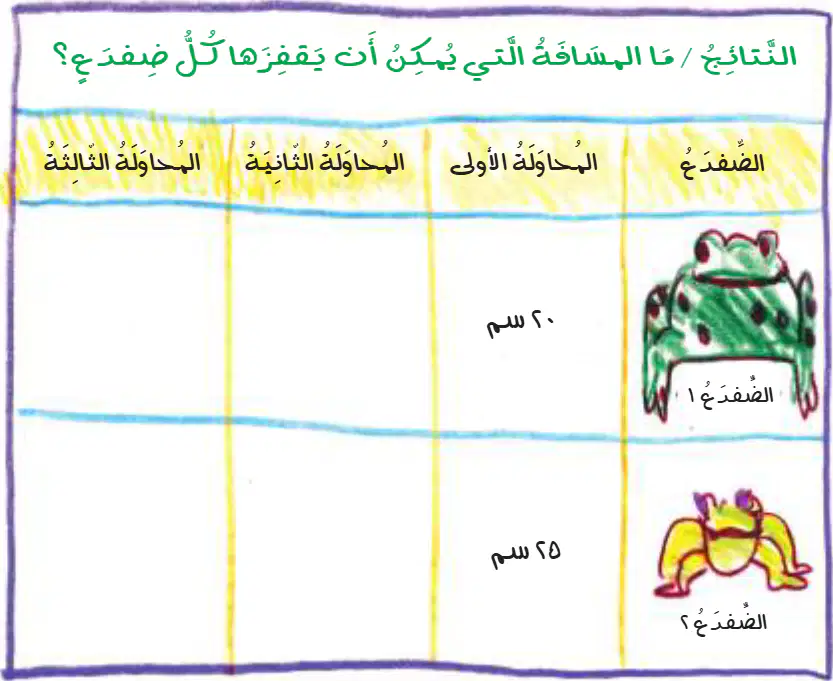
Record the results: Khalid drew a table to show the distance each frog jumps in three attempts. In the visible first recorded trial, what distance is written in the table?
20 cm
25 cm
30 cm
15 cm
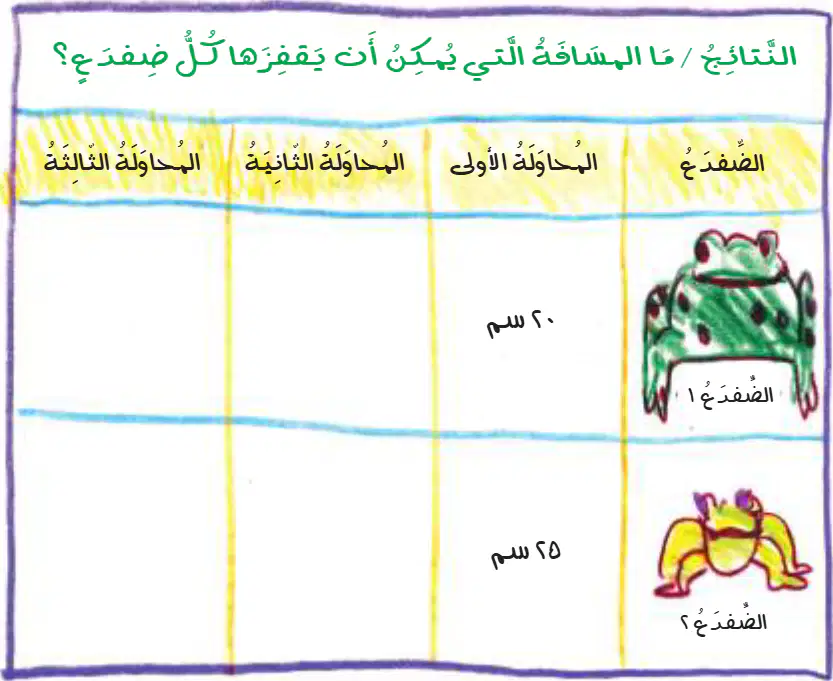
Record the results: Khalid’s table also shows another measured distance in a different cell. What is the distance written there?
25 cm
20 cm
35 cm
10 cm
Challenge: What is the investigation question Khalid is answering with his table of frog jumps across three attempts?
What distance each frog can jump
How many frogs are in the pond
What color each frog is
How long frogs take to climb a tree
Repeat the plan: Khalid made each frog jump three times, and that helped him know whether the results he reached were correct. What is the purpose of repeating each frog’s jumps three times?
To verify the accuracy of the results
To teach the frogs a new skill
To make the frogs jump farther through practice
To measure how fast the frogs can run
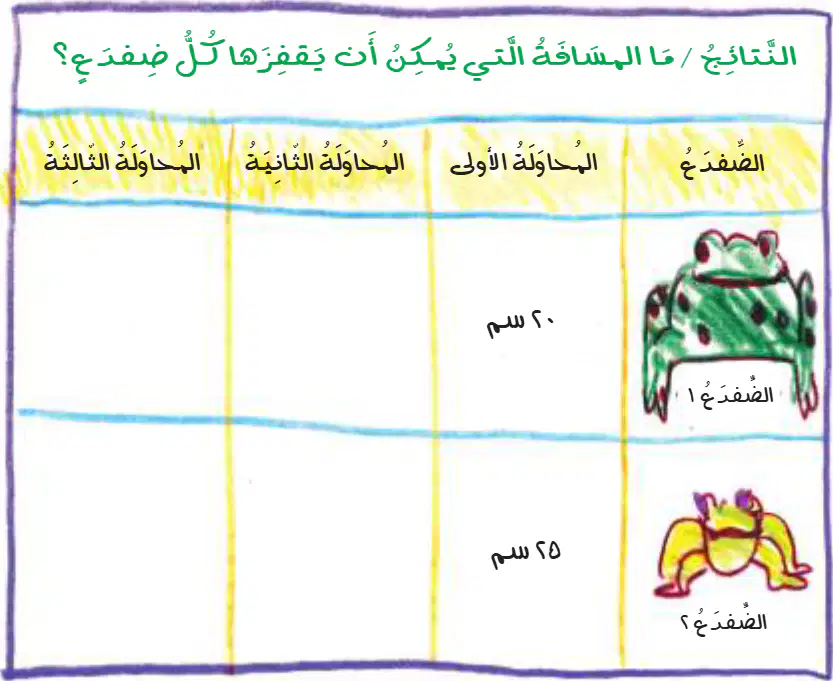
Record the results: The table has columns labeled first attempt, second attempt, and third attempt for each frog. What do these three columns represent in the investigation?
Repeated trials of each frog’s jump distance
Different frogs being tested
Different days of the week
Portions of food given to each frog
Think, talk, and write: What is the importance of scientists making a plan?
It organizes steps and resources so an investigation can be carried out efficiently and safely.
It guarantees the hypothesis is true before any data are collected.
It lets scientists skip recording data during the investigation.
It eliminates the need for safety precautions or supervision.
Think, talk, and write — Write: Why do scientists record their plans?
To make the procedure replicable and to evaluate results against the planned steps.
To keep their work secret and prevent others from using it.
To avoid making predictions or setting expectations.
To replace the need to conduct the experiment at all.
Which skill do scientists use to solve the problems they face?
Design skill
Memorization skill
Guessing skill
Observation alone
According to the text about learning the design skill, what is the first thing you should do?
Define the problem
Buy all materials
Start building immediately
Ask the teacher to finish the work
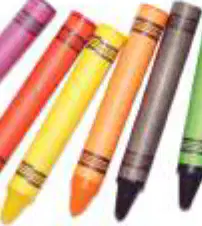
If you face a problem obtaining materials you need at school, how can you continue your design according to the passage?
Use available pencils, wax crayons, and other materials
Stop the project until every material is available
Discard the plan and start a new topic
Wait without making any changes
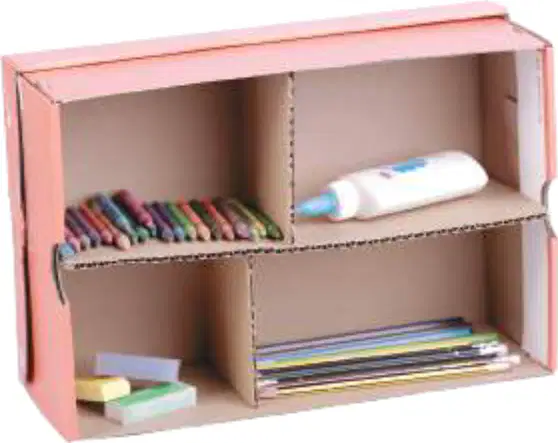
When comparing your storage organizer with Abdullah’s box described as having separate sections for pencils, crayons, glue, eraser, and papers, which statement best reflects the intended comparison?
Both designs aim to organize school supplies by separating items into dedicated compartments.
My organizer is for cooking utensils, whereas Abdullah’s box is for school supplies.
Abdullah’s box is designed for outdoor transport with wheels, while mine is a stationary bookshelf.
My organizer stores only one item type, unlike Abdullah’s box which holds nothing.
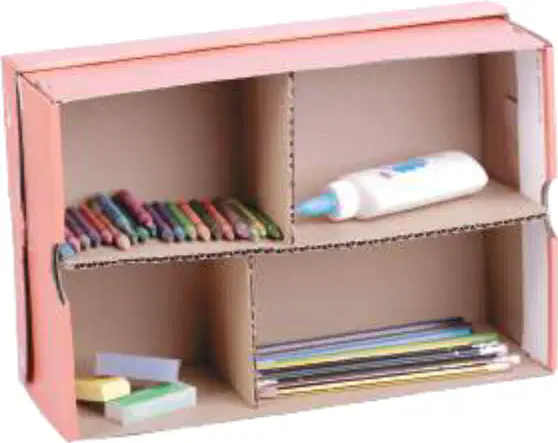
Based on the description of Abdullah’s box that stores school tools in divided sections, did his design solve the stated storage problem?
Yes, it organizes school tools in dedicated sections.
No, it leaves items mixed together without any compartments.
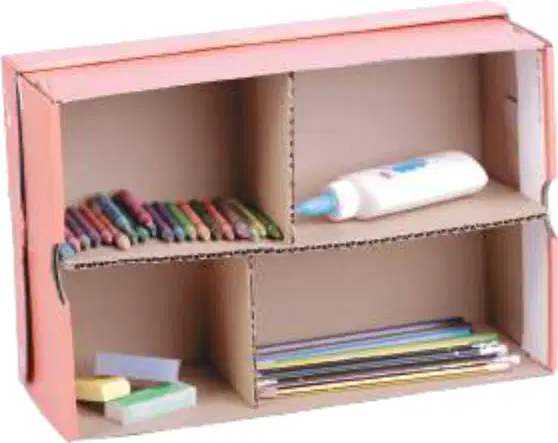
To improve a school-supplies organizer as advised to test and modify the design, which change would most likely enhance its usability?
Add clearly sized compartments for pencils, crayons, glue, eraser, and papers.
Remove all dividers to create one large, undifferentiated space.
Use flimsy materials and avoid marking dimensions.
Skip testing and keep the design unchanged.
When you see a warning sign, what should you do?
Follow the safety instructions.
Ignore it and continue working.
Cover the sign so others don’t notice.
Ask a friend what it means and keep working without changes.
If a liquid spills during an activity, what is the first action you should take?
Inform the teacher at once.
Wipe it up quietly without telling anyone.
Continue the activity and ignore the spill.
Hide the spill so you can finish faster.
What must you do when using sharp or glass tools?
Use them with care.
Pass them quickly between classmates.
Leave them on the edge of the table.
Wave them to get attention.
When the teacher asks you to wear protective goggles, what should you do?
Put on the goggles.
Wear regular sunglasses instead.
Refuse because they are uncomfortable.
Close your eyes briefly and continue.
What is required for your work area during activities?
Keep it clean and organized.
Scatter materials across the table.
Leave spills until later.
Pile equipment randomly to save time.
When should you wash your hands well?
Before and after every activity.
Only before lunch.
Only if they look dirty.
At the end of the day.

Lesson one essential question: How do you tell if something is a living thing?
It grows and can reproduce
It is shiny
It is very large
It is made of metal
Lesson two essential question: How do plants produce other plants?
They reproduce using seeds, spores, or vegetative parts
They create new plants through photosynthesis alone
They absorb minerals until new plants appear
They release water vapor that turns into new plants
According to the vocabulary list, which term means a small plant at the beginning of seed growth?
Seedling
Flower
Seed
Pollen grains
According to the vocabulary list, which plant part has different colors and forms both seeds and fruits?
Flower
Seedling
Seed
Pollen grains
According to the vocabulary list, which plant part germinates and becomes a new plant?
Seed
Flower
Pollen grains
Seedling
According to the vocabulary list, which powder is formed inside the flower and contributes to producing seeds?
Pollen grains
Seed
Flower
Seedling
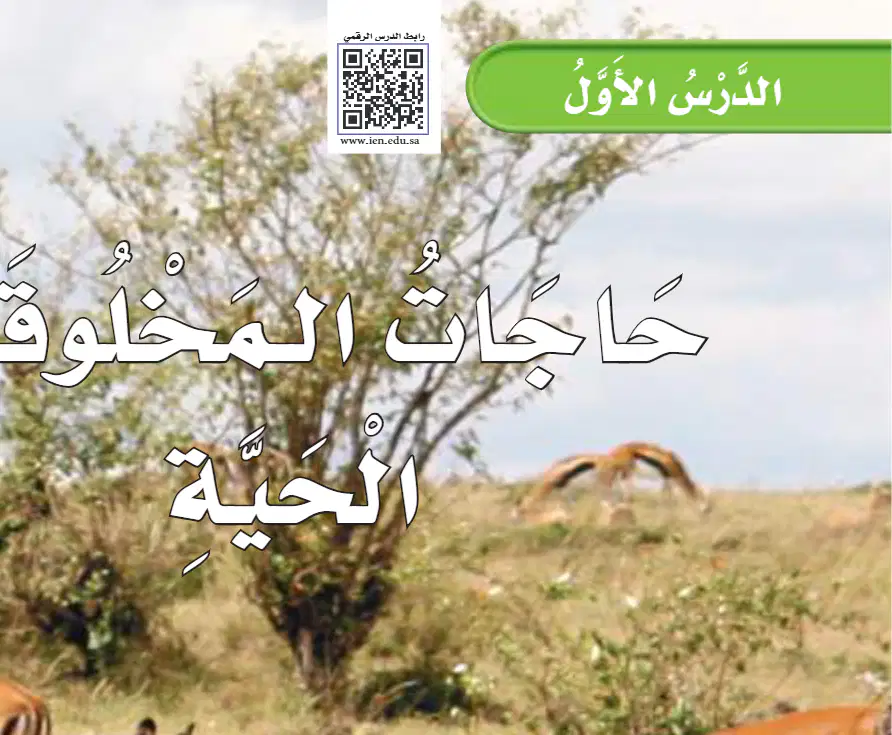
Look at the photograph of antelopes grazing in a grassy savanna with scattered trees. Which choice lists only living creatures visible in the picture?
Antelopes only
Antelopes and the grasses/trees
Grasses/trees only
Rocks and soil
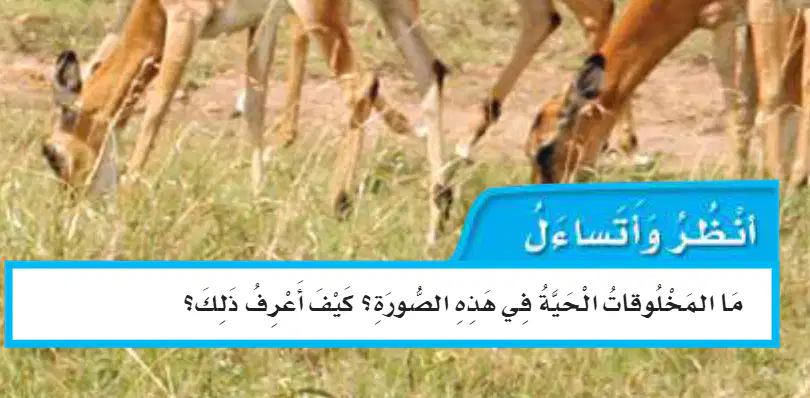
Using the same photograph of antelopes in the savanna, which observation best explains how you know the organisms are living?
They move and feed in the environment
They reflect sunlight like shiny objects
They are brown and tan in color
They appear in the foreground of the scene
What is the primary reason frogs are considered amphibians?
They are cold-blooded reptiles
They can fly short distances
They have feathers for insulation
They can live both in water and on land
During which stage of development does a frog lose its tail?
As an egg
As an adult frog
As a tadpole
As a small frog
What adaptation helps frogs to catch their prey effectively?
Sharp claws
Bright colors
Long sticky tongues
Fast running legs

