
 Worksheets
Chapter 7 – Electrodynamics
Total questions: 47
Worksheet time: 47mins
The rate at which electric charges flow is called:
Voltage
Current
Resistance
Capacitance
Electrodynamics is primarily concerned with:
Charges at rest
Magnetic domains
Charges in motion
Electromagnetic radiation only
The unit of electric potential difference is the:
Ohm
Coulomb
Ampere
Volt
The resistance of a conductor is measured in:
Watts
Ohms
Volts
Henries
What is the unit for electric current?
Ampere
Volt
Ohm
Watt
According to Ohm’s law, current is directly proportional to:
Voltage
Resistance
Power
Charge
Which equation correctly expresses Ohm’s law?
P=IV
V=IR
E=mc2
P=I2R
Which property of a conductor increases resistance?
Greater cross-sectional area
Lower temperature
Longer length
Shorter length
A high-resistance conductor will produce ________ heat.
No
Less
More
The same amount of
The opposition to electron flow in a circuit is:
Voltage
Conductance
Resistance
Inductance
A material that strongly resists the flow of electrons is a(n):
Conductor
Semiconductor
Insulator
Alloy
Which of the following is a conductor?
Rubber
Glass
Copper
Air
Increasing the temperature of a conductor generally:
Decreases resistance
Increases resistance
Leaves resistance unchanged
Eliminates resistance
Which device inhibits electrical current?
Transformer
Resistor
Battery
Capacitor
A component that stores electric charge temporarily is the:
Inductor
Capacitor
Diode
Rheostat
Power in an electric circuit is measured in:
Joules
Amperes
Watts
Volts
The formula for electrical power is:
P=V/R
P=I2R
P=R/I
P=V2/R
If voltage increases and resistance stays constant, current will:
Decrease
Increase
Remain zero
Oscillate randomly
When electrons move through a conductor, they generate:
A magnetic field
Electrostatic charge only
Nuclear radiation
Sound waves only
The unit of electrical charge is the:
Tesla
Coulomb
Farad
Weber
Which of the following is an example of direct current (DC)?
Wall outlet
Battery
Transformer output
Radio broadcast
Alternating current changes:
Magnitude only
Direction only
Both direction and magnitude
Neither direction nor magnitude
Which of the following uses alternating current?
Household outlets
Flashlight battery
Car battery terminals
Solar panel output
The number of times AC reverses direction per second is the:
Period
Frequency
Amplitude
Phase
The U.S. electrical frequency standard is:
50 Hz
60 Hz
100 Hz
120 Hz
Electrical power companies deliver:
DC
AC
Pulsed DC
Static electricity
Electric circuits require:
Only a source of voltage
Only a conducting path
A source, a closed conducting path, and a load
Only a load
The force that pushes electrons through a conductor is:
Resistance
Voltage
Capacitance
Inductance
Water flowing through a pipe is often compared to:
Voltage
Power
Current
Resistance
In a series circuit, if one component fails, current will:
Increase in the remaining components
Bypass the failed component
Stop
Divide among the remaining components
In a parallel circuit, if one branch opens, the remaining branches:
Stop conducting
Continue functioning
Short to ground
Double in voltage
A ground is used to:
Increase circuit voltage
Provide a safe path for fault current to earth
Eliminate all resistance
Store excess electrons for later use
Electrons flow because of:
Thermal gradient
Electrical potential difference
Magnetic flux
Mechanical pressure
Which of the following increases current?
Decreased voltage
Increased voltage
Increased resistance
An open circuit
Copper is often used in wiring because it:
Has low resistivity
Is magnetic
Has high resistivity
Is a good insulator
Electrical work done is measured in:
Newtons
Joules
Amperes
Ohms
A transformer operates on:
AC only
DC only
Both AC and DC equally
Static electric fields only
Electrons flowing in only one direction describes:
AC
DC
Electromagnetic radiation
Ground fault
The product of current and resistance gives:
Voltage
Power
Charge
Inductance
What is the definition of electrical current?
The opposition to the flow of electrons
The rate of flow of charge
The work done on each coulomb of charge
Electrons moving around
A conductor has _____ resistance. An insulator has ______ resistance.
Low; high.
Negative; positive.
Positive, negative.
High, low.
Resistance is
Measured using an ammeter
Units are 'volts'
How difficult it is for electrons to move through an object
The continuous movement of electrons in a wire
An electric current is
A continuous flow of electric charge
An irregular flow of electric charge
Only found using insulators
Just wires connected to a magnet
Resistance is ___________________.
The build up of electrical charges in one place
how much a material opposes, or resists, the flow of electric current
a conductor
when the electric current can flow freely through a circuit
A circuit has a 24V battery and the resistor is 8Ω. How many amps are running through the circuit?
3A
192A
2A
4A
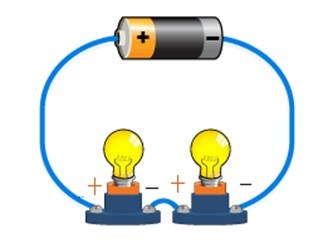
What will happen when you remove a bulb from the circuit pictured?
The other bulb will become brighter.
The other bulb will turn off.
The other bulb will become dimmer.
It will remain a closed circuit.

An electric current can move along more than one path in a.....
Series circuit
Parallel circuit

