
 Worksheets
Outcomes for Confined Space Work
Total questions: 150
Worksheet time: 1hrs 15mins
Which step best ensures regulatory compliance before entry into a confined space?
Ask the standby person for verbal permission
Notify the team by radio of intent to enter
Post a warning sign at the access point
Confirm entry permit meets regulatory requirements
When planning a confined space task, what is the primary purpose of interpreting the environmental management plan?
Reduce the number of required workers
Ensure the work activity remains compliant
Eliminate the need for rescue planning
Avoid conducting a site risk assessment
Which action should occur before tools are used inside a confined space?
Issue tools after entry to save time
Disable all tags to prevent delays
Check tools for serviceability and rectify faults
Store tools near the rescue tripod
What is the most appropriate control to prevent inadvertent energization during entry?
Apply correct tagging and lock-out procedures
Assign an additional spotter inside
Use battery-powered tools exclusively
Wear high-visibility clothing only
During work inside a confined space, which practice maintains situational safety with the external team?
Maintain ongoing communication with the standby person
Communicate only at scheduled breaks
Use hand signals instead of any radios
Allow the entrant to manage communications
Which monitoring action is necessary before and during entry to manage atmospheric hazards?
Check oxygen only and ignore other gases
Rely on previous test results from last shift
Estimate air quality using visual indicators
Test and monitor the atmosphere for harmful elements
A worker has completed the task inside a confined space. What sequence best reflects proper exit activities?
Exit correctly, recover tools, conduct inspection
Conduct inspection, exit quickly, leave tools
Remove tags first, then exit, then inspect
Exit later, secure access while still inside
What is the purpose of positioning rescue equipment by the entry point during planning?
Avoid the need for a standby person nearby
Comply with housekeeping expectations only
Enable immediate response if an incident occurs
Reduce the weight carried by entrants
Which action correctly secures the confined space after work is completed?
Disable locks so maintenance can re-enter
Secure access to prevent unauthorized entry
Leave the access open for ventilation
Remove all barriers to speed egress
Which clean-up step demonstrates environmental responsibility after the job?
Leave waste for the next scheduled crew
Dispose of or recycle materials appropriately
Wash residues into nearby drains
Burn packaging to minimize volume
You discover a damaged gas detector during pre-entry checks. What is the most appropriate action?
Rectify or report the fault and replace the device
Start work and test again after entry
Share a detector between two entrants
Proceed while relying on visual indicators
Time on the entry permit has nearly expired while work continues. What should the team do?
Stop work and adhere to the allocated entry time
Continue if tools are already in position
Ignore the time limit if conditions seem fine
Extend time verbally with the entrant only
Which feature best defines a confined space under the Code of Practice?
A large open area with active ventilation
A space with unrestricted entry and multiple exits
An enclosed space at normal atmospheric pressure
Primarily designed for continuous human occupancy
Which condition typically makes entry and exit in a confined space more hazardous?
Multiple wide doors and ramps
Restricted means of entry and exit
Continuous open roof access
Elevated walkways with guardrails
Which atmospheric condition would classify an area as a confined space hazard?
Fresh air supplied by natural breeze
Oxygen level within safe range limits
An atmosphere without a safe oxygen level
Normal air free of contaminants
Which example would most likely be considered a confined space in industrial settings?
Outdoor scaffolding platform
Storage tank or process vessel
Open warehouse loading bay
Spacious mechanical workshop
You must plan a task requiring a permit to enter a tank through a small hatch. Which step should be part of your preparation?
Choose and check safety equipment
Skip equipment checks to save time
Rely on natural ventilation only
Invite spectators for observation
Which risk is commonly associated with confined spaces due to airborne contaminants?
Minor discomfort without injury risk
Injury from fire or explosion
Improved air quality and comfort
Reduced need for respiratory PPE
A crew needs to determine if a pit qualifies as a confined space at normal atmospheric pressure. What is the most appropriate action?
Rely solely on the supervisor’s memory
Proceed if two people agree verbally
Assume it is safe if it is shallow
Use a decision chart to assess criteria
Which item is NOT typically listed as a confined space example?
Pipes and inactive sewer mains
Culverts and storm water systems
Shafts, ducts, and access chambers
Outdoor storage yards and pads
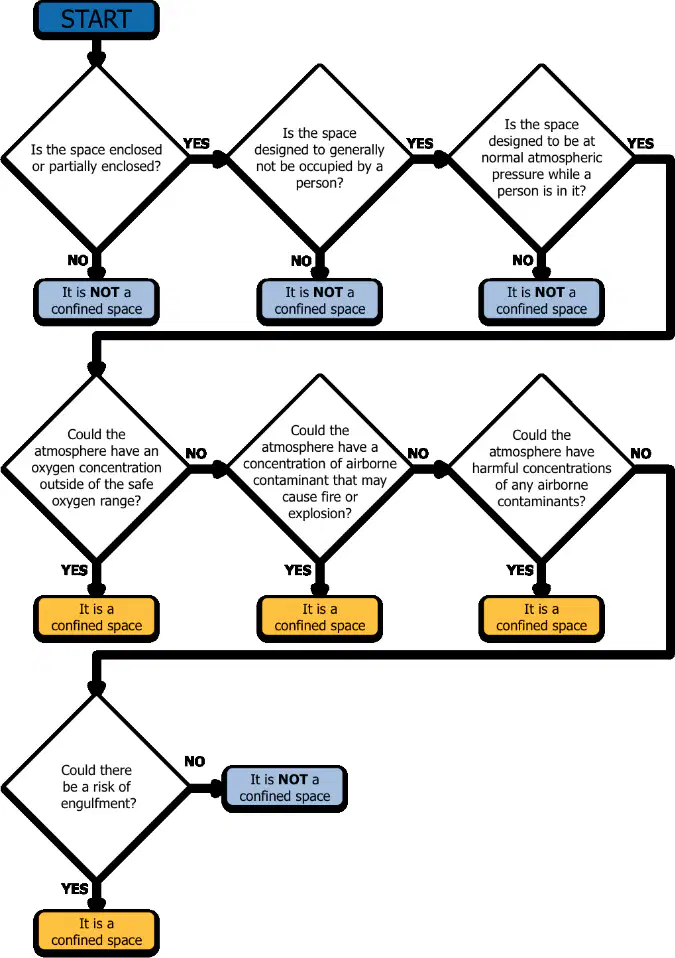
Which initial criterion must be satisfied before evaluating other confined space hazards in the flowchart?
The space has mechanical ventilation installed
The space is enclosed or partially enclosed
The space is fully open to outdoors
The space is used for routine storage only
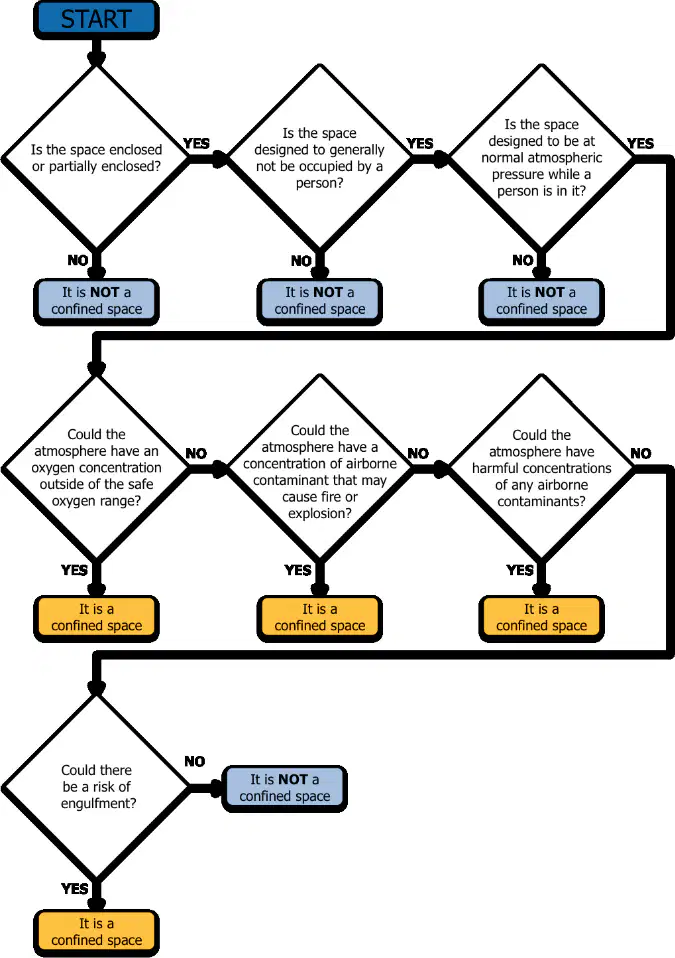
According to the flowchart, what design intent indicates the area is not a confined space at an early step?
Designed for handling materials under pressure
Designed for temporary equipment access only
Designed with multiple egress routes available
Designed to generally be occupied by a person
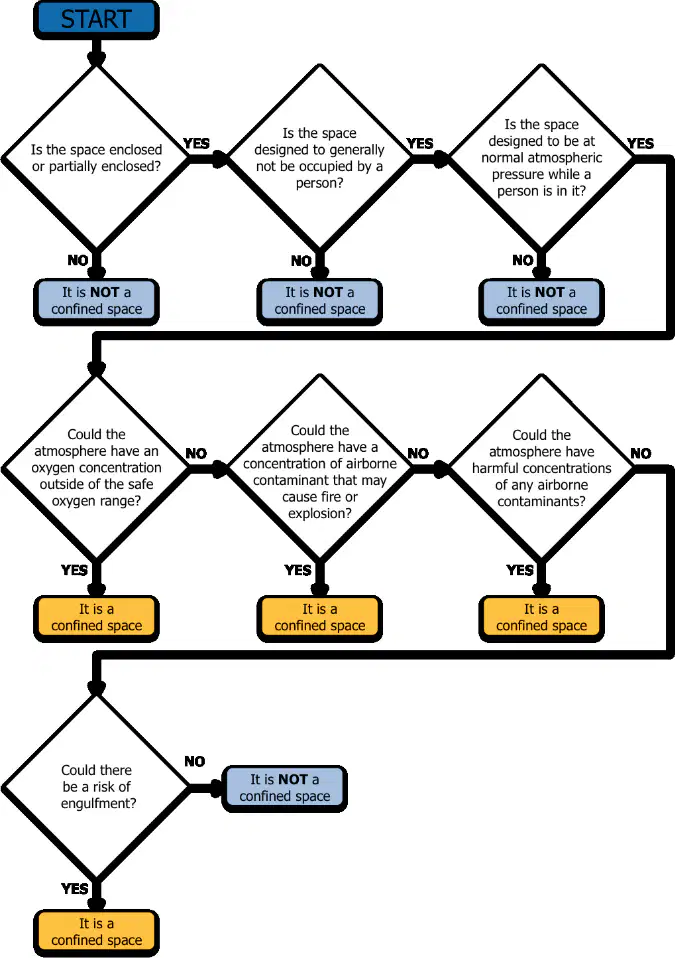
What atmospheric condition must be true while a person is in the space to avoid classification as a confined space at the top row?
Atmospheric pressure is controlled by inert gas
Atmospheric pressure is slightly below ambient
Atmospheric pressure varies with process cycles
Atmospheric pressure is normal while occupied
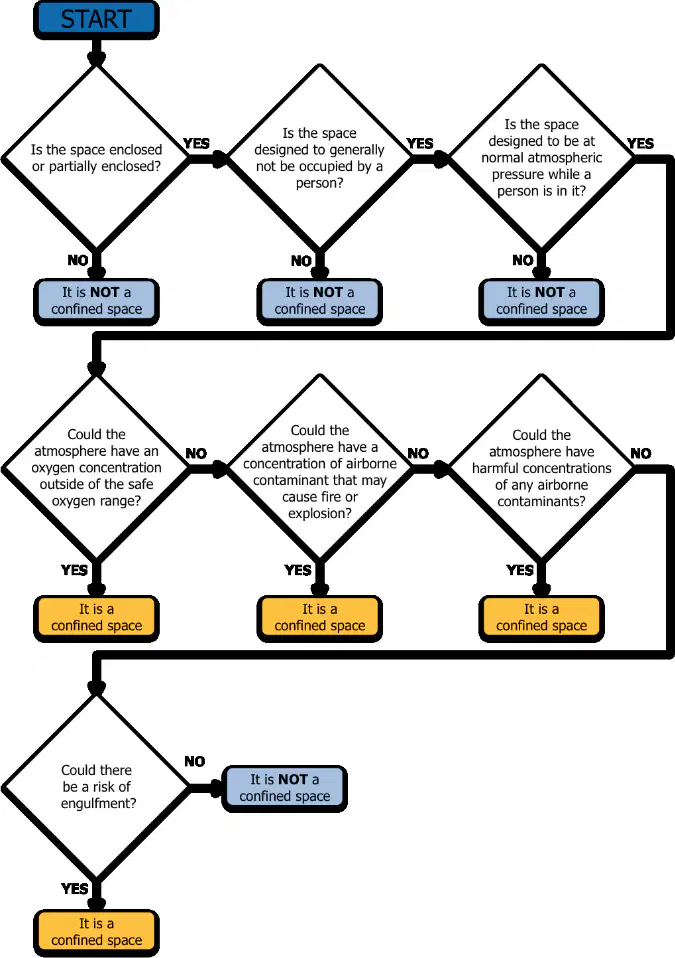
If the atmosphere could have oxygen concentration outside the safe range, how does the flowchart classify the space?
It is a hot work location
It is a restricted area only
It is a ventilation-required area
It is a confined space
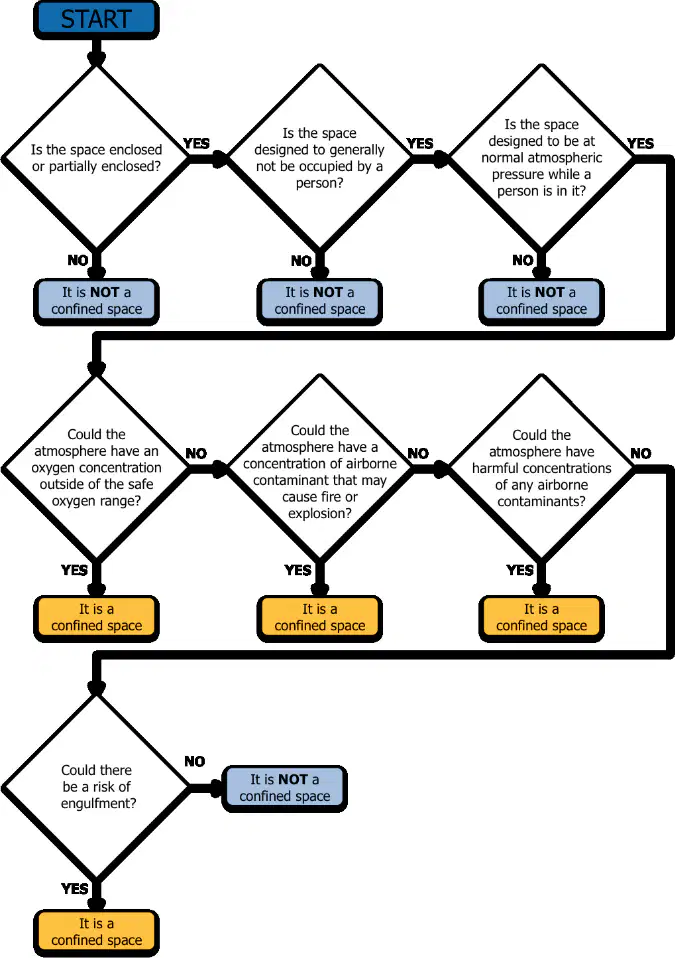
Which atmospheric hazard specifically triggers confined space classification due to fire or explosion potential?
Airborne contaminant concentration may cause fire or explosion
Noise level above ninety decibels
Relative humidity below twenty percent
Temperature above 40 degrees Celsius
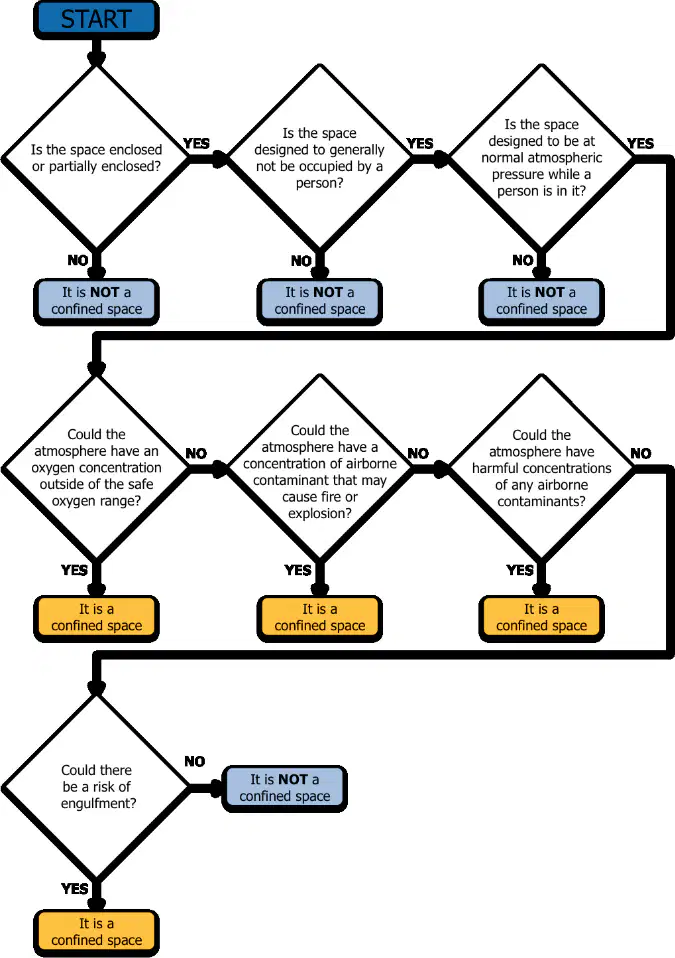
A tank is enclosed and not designed for occupancy. Pressure will be normal when occupied. No oxygen deviation or fire/explosion risk exists. Harmful airborne contaminants are possible. How is it classified?
Not a confined space due to normal pressure
Confined space due to harmful airborne contaminants
Restricted space requiring signage only
Permit-required area due to noise exposure
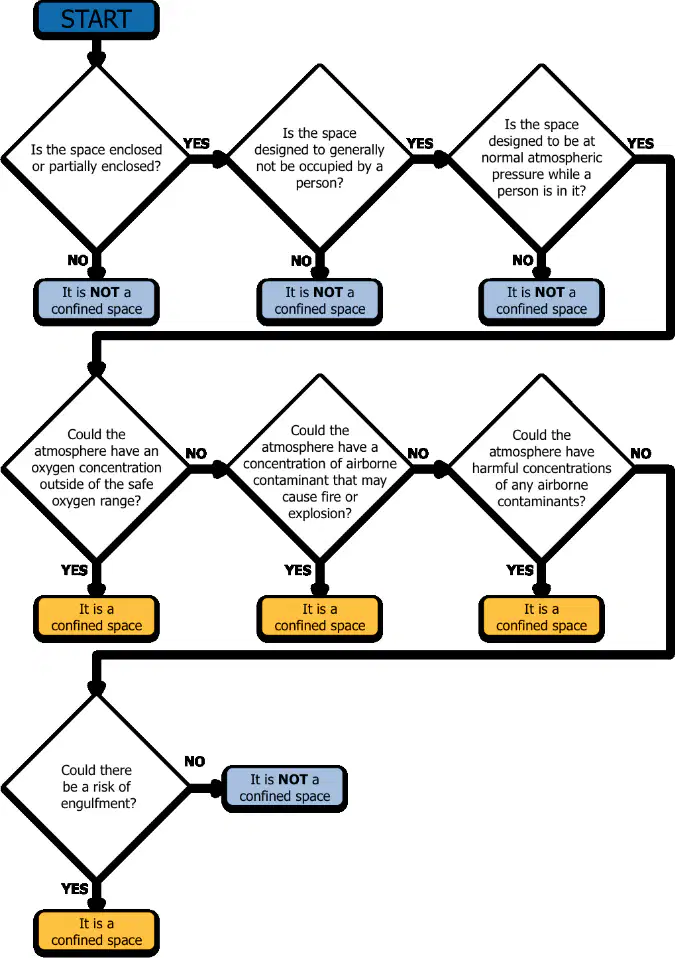
If none of the atmospheric hazards are present, what remaining hazard could still make the space a confined space in the flowchart?
Risk of inadequate lighting
Risk of engulfment from materials
Risk of electrical arc flash
Risk of slips on wet floors
Which oxygen concentration range is considered unsafe in a confined space due to being too low or too high?
Below 19.5% or above 23.5%
Below 18.0% or above 25.0%
Below 20.9% or above 22.0%
Below 16.0% or above 24.0%
Which process can reduce oxygen levels in a confined space by consuming oxygen during heat-generating work?
Combustion of flammable materials during welding
Condensation of vapors during nighttime
Evaporation of clean water during cooling
Absorption of humidity by desiccant packs
Which is a likely reason oxygen may be displaced in a confined space, creating a breathing hazard?
Nitrogen purging to remove toxic fumes
Sunlight entering through an opening
Vibration from nearby machinery
Increased airflow from outdoor winds
Which best describes how slow bacterial reactions in organic matter can affect confined space safety?
They consume oxygen and reduce safe breathing levels
They neutralize toxic gases through oxidation
They increase visibility by clearing mists
They cool the air and prevent heat stress
Which situation most increases fire or explosion risk during hot work in a confined space?
Using battery lanterns with fresh cells
Ventilating with clean outside air
Thermal cutting generating sparks and heat
Painting surfaces with water-based paint
Which source can ignite flammable atmospheres by producing frictional sparks?
A metal tool striking another object
A plastic bottle resting on a shelf
A rubber mat placed on the floor
A cotton glove touching a wall
Which electrical condition can ignite vapors in a confined space?
Certified explosion-proof lighting fixtures
Properly grounded static discharge straps
Incorrectly installed wires or overloaded fittings
Fully rated intrinsically safe equipment
Which everyday item can be an ignition source in a confined space with flammable gases?
A mobile phone or flashlight producing heat
A stainless steel mirror reflecting light
A wool hat worn for warmth
A wooden clipboard used for notes
Combustible dust hazards are most likely in which confined space scenario?
Cold rooms storing sealed drums
Wet wells containing standing water
Concrete vaults with clean air
Storage bins or silos holding dry grain
Which atmospheric contaminants commonly threaten workers in confined spaces?
Pollen, fog, breezes, and sunlight
Dusts, gases, fumes, mists, and vapors
Noise, vibration, glare, and heat
Rain, snow, hail, and humidity
Which work activity can generate hazardous vapors inside a confined space?
Tightening bolts with a wrench
Measuring distance with a tape
Hand sweeping with dry brooms
Spray painting surfaces with solvents
Which mechanism can draw external exhaust gases into a confined space and create an exposure hazard?
Ventilation fans pulling in nearby emissions
Heavy covers blocking outdoor airflow
Closed hatches sealing the chamber tightly
Sun-warmed air rising out of the entry
Which condition best defines an asphyxiating atmosphere in a confined space?
Any presence of flammable gas regardless of level
Carbon dioxide above 1 percent by volume only
Humidity levels exceeding typical indoor ranges
Oxygen concentration below 19.5 percent by volume
Which statement accurately describes toxic atmospheres in confined spaces?
They exist only when oxygen drops below safe limits
They occur when any toxins reach harmful concentrations
They are limited to irritants with localized effects
They are caused only by welding fumes and smoke
Primary versus secondary irritant atmospheres are distinguished by which feature?
Secondary irritants never have systemic effects
Secondary irritants only affect the skin surface
Primary irritants always cause unconsciousness
Primary irritants have limited systemic effects
Which oxygen range is generally considered safe for normal breathing in confined spaces?
Below 17.0 percent oxygen concentration
Between 19.5 percent and 23.5 percent oxygen
Above 25.0 percent oxygen at all times
Exactly 21.0 percent oxygen always required
Which scenario most likely creates air contaminated with smoke or suspended particles?
When oxygen levels rise above normal outdoors
After rain increases humidity inside a vault
After a nearby fire leaves soot-laden air inside
When a fan increases ventilation significantly
Which symptom is a common sign of hypoxia for a worker in a tank?
Increased appetite and normal skin color
Confusion and rapid breathing during exertion
Decreased breathing with improved focus
Sweating only without breathing changes
What is the most appropriate immediate control when work must occur in an irrespirable atmosphere?
Use an appropriate breathing apparatus for entry
Open the access hatch and proceed without testing
Rely on cloth masks to filter all hazardous gases
Schedule shorter shifts without other protections
Which statement best explains why smoke-laden air is unbreathable?
Particles neutralize toxins and raise oxygen levels
Particles reduce oxygen intake by settling in lungs
Particles increase lung capacity beyond safe limits
Particles convert oxygen directly into carbon dioxide
A worker enters a grain bin and becomes submerged within seconds. Which hazard category fits this event?
Asphyxiation due to low humidity
Toxic atmosphere from solvent vapors
Engulfment hazard causing rapid entrapment
Psychological hazard without physical risk
Which factor can increase breathing rate even in healthy individuals during confined space work?
Stressful conditions or poor atmospheres present
Perfectly clean air with normal oxygen
Exposure to bright light without fumes
Resting quietly in a ventilated office
Which risk is associated with psychological hazards like stress or claustrophobia during entry?
Reduced need for communication or rescue
Faster oxygen use that can worsen the situation
Immediate toxin neutralization in the bloodstream
Improved decision-making and calm responses
Which monitoring priority is essential before entering a confined space to avoid irrespirable atmospheres?
Test for dangerous gases and unsafe oxygen levels
Check for pests and general housekeeping first
Measure humidity and ambient noise exclusively
Confirm tool inventory and lighting layout only
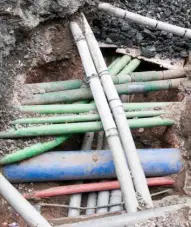
Which hazard is most likely when excavating near a confined space that contains buried utilities?
Damage to underground services causing rupture
Heat stress from enclosed high temperatures
Restricted egress due to narrow entry points
Exposure to rotating equipment vibrations
A worker enters a tank where moving parts are present. Which control is the most appropriate immediate action before entry?
Add signage to warn about restricted access
Isolate mechanical hazards by lockout and tagout
Increase lighting to reduce poor visibility
Wear high-visibility vest for traffic safety

Which statement best describes the purpose of a Safe Work Method Statement (SWMS) for confined spaces?
Documents steps and controls to manage task risks
Provides emergency contact numbers for responders
Lists personal preferences of the site supervisor
Schedules worker breaks and lunch periods
You discover an unfamiliar chemical being introduced into a confined space. What is the best sequence of actions?
Wait for shift change, report later, resume work
Stop introduction, identify substance, consult SWMS
Notify peers only, keep working, add warning tape
Proceed carefully, rely on past experience, continue

Which pair correctly matches the hazard with an example?
Entrapment—narrow tunnel causing stuck worker
Traffic—slippery surfaces from water spills
Biological—exposure to strong mechanical vibration
Electrical—poor lighting causing trip hazards
Which statement best describes Acts and Legislation in workplace safety frameworks?
They are permit templates for specific job tasks
They are minimum product performance benchmarks
They are voluntary guidance developed by industries
They are laws that must be followed by workplaces
What is the primary role of Regulations within the safety hierarchy?
Set voluntary industry best practices
List approved contractors for projects
Explain what the law means in practice
Specify testing methods for equipment
Which option best defines a Code of Practice for confined spaces?
Instructions on following the law using industry standards
Mandatory legal penalties for rule violations
Company-specific branding and communication rules
Procurement procedures for safety equipment suppliers
What do Australian Standards such as AS2865 mainly provide for confined space work?
Daily toolbox talk scripts for supervisors
Minimum requirements for jobs, products, or hazards
Detailed legal penalties for non-compliance
Recruitment rules for safety personnel selection
Before starting work in a confined space, which action is most appropriate regarding information needs?
Confirm all technical and safety information for the job
Rely on personal experience to judge hazards
Wait for emergency services to brief the team
Proceed if signage appears clear and visible
Which item is MOST likely included under Site Details in technical and safety information?
Workplace environment requirements and isolation of services
A list of past incidents across the industry
Personal medical history of each worker
Calibration records for all national labs
Hazard Details for a confined space should typically include which content?
Hazards present and instructions for handling dangerous materials
Salary bands for technicians and supervisors
Marketing plans for the safety department this quarter
Travel itineraries for visiting auditors and trainers
Which description best matches Task Details for confined space work?
A checklist of vehicle fleet maintenance invoices
Schedules for cafeteria catering and deliveries
A summary of company annual financial statements
Instructions of the work to be done, including permits
Manufacturers’ Guidelines and Specifications primarily help workers do what?
Use and maintain tools, equipment, and safety systems
Negotiate enterprise bargaining employment agreements
Design new buildings and civil infrastructure projects
Write legal contracts for supplier partnerships
What should procedures for faulty equipment most directly address in confined space operations?
Ignoring faults if visual inspection seems fine
Isolation steps to follow or forms to complete
Replacement with any available spare immediately
Delaying action until weekly safety meetings
What is the main purpose of signage requirements related to confined space work areas?
Display employee recognition and awards program
Warn others that areas are unsafe or work is occurring
Show daily weather forecasts for the site
Advertise equipment brands used on the project
Which task most likely requires a confined space entry permit before starting the job?
Calibrating tools at a bench station
Reading meters on an outdoor board
Delivering parts to a warehouse dock
Painting inside an industrial boiler shell
What is the primary purpose of a Safe Work Method Statement (SWMS)?
To assign payroll and shift rotations
To schedule weekly toolbox meetings
To list steps and controls for high‑risk work
To record equipment purchase histories
Which action should come FIRST when filling out a SWMS for a confined space job?
Select PPE for the entire crew
Break the job into steps for each phase
Allocate a rescue team leader by name
Print copies for signature and filing
A worker is installing a pump inside a tank. Which duty of care behavior best meets WHS requirements?
Ignore unclear procedures to finish quickly
Report hazards and follow site rules
Use any equipment available without checks
Rely on memory instead of instructions
You must identify who is responsible for hazard controls and who supervises the job. Where should this be documented?
On the purchase order attachment
On the after‑action review notes
On the contractor invoice footer
On the SWMS responsibilities section
Which information would you expect to find on a Safety Data Sheet (SDS) for a solvent used during tank cleaning?
Employee onboarding and training dates
Chemical properties and health hazards
Weekly production targets and KPIs
Company picnic schedule and catering
A crew will sand‑blast internal surfaces of a vessel. Plan the safest sequence to set up controls.
Start work, request SDS, fit PPE later
Brief crew, begin work, write the SWMS
Identify hazards, select controls, brief crew
Issue permit, start blasting, review hazards
Which document set best helps workers understand how to work safely in confined spaces?
Expense claims, fuel cards, and receipts
Marketing flyers, client letters, brochures
Timesheets, rosters, and travel approvals
Signage, SDS, SOP/JSA, and site procedures
Which job would most likely require a hot work permit rather than a cold work permit?
Grinding steel that produces ignition sources
Inspecting a space with battery lighting
Measuring gas levels with a detector
Cleaning a tank with non-sparking tools only
What is the primary purpose of a confined space work permit before entry begins?
To schedule maintenance and allocate budgets
To document job scope and required safety controls
To record employee annual medical checkups
To assign disciplinary actions for violations
Which item must be included on a confined space permit to verify atmospheric safety?
Visitor log and parking locations
Atmospheric test requirements and results
Cafeteria break times for the crew
Weekly toolbox talk agendas
A team plans a four-hour valve replacement inside a sump. Which combination best demonstrates adequate planning for permit content?
Social media updates, photo permissions, hashtags
Travel routes, hotel options, meal vouchers
Tool inventory, brand preferences, purchase dates
Job duration, hazard controls, emergency rescue
How long must a confined space work permit be kept after the related work is completed, if no notifiable incident occurs?
Until the supervisor leaves the site
At least two years after completion
Until the next audit cycle only
Exactly six months after completion
Which action must be completed before any confined space work begins?
Notify neighboring work sites about possible noise levels
Conduct a full evacuation drill for the entire facility
Order additional rescue equipment for future incidents
Finalize the emergency response plan with roles defined
What is the primary location requirement for a stand-by person during confined space operations?
At the gate coordinating site deliveries
As close as possible to the confined space
In the control room monitoring cameras
Inside the confined space with entrants
Which combination best describes key ongoing duties of the stand-by person?
Training scheduling and visitor escorting
Continuous communication and hazard monitoring
Equipment maintenance and tool calibration
Permit renewal and inventory management
A worker plans an entry but the opening is partially blocked by stored materials. What should be verified or adjusted before proceeding?
The stand-by person can briefly assist with relocation
Entrants should carry extra tools to move obstacles
The permit can be post-approved after the entry
Emergency access and egress must be clear and large enough
During an emergency, which immediate action aligns with the stand-by person’s responsibilities?
Initiate emergency procedures without entering the space
Enter the space to assist before backup arrives
Pause to complete non-critical paperwork first
Leave the area to find a supervisor offsite
Which statement best reflects the communication requirement between the stand-by person and entrants?
Maintain continuous communication and, if possible, visual contact
Check in at the start and end of each work shift
Rely on periodic texts from entrants’ mobile phones
Communicate only when gas monitors alarm
Which task is explicitly prohibited for the stand-by person while personnel are inside the confined space?
Performing any other work unrelated to the entry
Reviewing the rescue plan for future updates
Observing atmospheric readings at the entry point
Confirming the roster of authorized entrants
You are assigned as a stand-by person. The supervisor asks you to operate a nearby forklift while monitoring the entry. What is the best response?
Decline and explain you cannot perform other work
Agree and switch between tasks as needed
Operate the forklift only during low-risk periods
Ask an entrant to step out and help with driving
Which preparation best ensures you understand your role if conditions deteriorate during entry?
Confirm your emergency role and training before starting
Plan to improvise actions based on previous jobs
Rely solely on the entrants for guidance during crises
Wait for instructions after an incident has escalated
A permit was issued but new hazards were identified mid-task. What is the correct procedural step?
Ignore changes if controls seem adequate
Continue work and note hazards after completion
Cancel and re-issue the permit to reflect updates
Proceed but restrict access to senior staff only
Which combination best isolates a confined space from unauthorized entry before work begins?
Locked tool cabinet away from the entry area
Single caution cone near the closest manhole
Warning emails and toolbox talks for nearby crews
Site safety signage and barricades at access points
A standby person manages Personal Danger Tags (PDT). What is the correct sequence of PDT handling for one entry?
Verify details, place on board at entry, retrieve on exit
Place on board, verify details after entry, retrieve next day
Give to entrant, leave on harness, discard after exit
Attach to gate, let entrant remove, keep for future use
You arrive to find signs posted but no barriers around a confined space opening near pedestrian traffic. What is the best immediate action?
Proceed since signage already warns pedestrians
Ask the entrant to monitor the opening alone
Install physical barricades to control access now
Remove signs until barricades can be delivered
Which statement best describes the purpose of a guideline in confined space work?
A measuring tape for marking distances underground
A small line keeping teams together in poor visibility
A thick cable supplying power to communication sets
A heavy rope for hoisting heavy loads vertically
How are main guideline tallies typically identified on confined space lines?
Triangle tags labeled IN or OUT on tips
Round tags marked A or B on both sides
Rectangular tags with barcodes on faces
Square tags numbered one to five on edges
Portable radios have what limitation when used with breathing apparatus in confined spaces?
Limited usefulness and range due to conditions
High battery drain causing frequent shutdowns
Incompatibility with integrated microphone units
Signal interference only when outdoors in wind
What is a communication set in the context of confined space entry?
A visual hand signal chart carried by the entrant
A single handheld radio without external accessories
A complete unit with mic, battery, cables, amplifier, speakers
A spare battery pack for extended radio operation
What feature is common to most Distress Signal Units (DSUs)?
Single-use cartridge that deploys a rescue line
GPS tracking that maps underground tunnel routes
Voice recognition that calls for external assistance
Dual activation triggering an alarm after no movement
Which practice is essential when using hand signals for confined space tasks?
Avoid practice to prevent signal confusion
Use only signals standardized for road traffic
Rely on improvised signals during operations
Be familiar and practice them before entry
When setting up a tripod and harness, which WHS check is required?
Confirm ropes are decorative and brightly colored
Ensure tripod is level and leg pins are locked
Set tripod height to maximum for all users
Place tripod on uneven ground for flexibility
What is the typical lifespan of a safety harness used for confined space entry?
Ten years and then remove from service
Two years or until first exposure to rain
Unlimited if stored indoors after use
Five years unless color remains vibrant
Which item is standard firefighting equipment for initial response to small fires?
Deluge system for fixed plant protection
Fire blanket for smothering small flames
Tower ladder for elevated water streams
Foam tender for large fuel spill incidents
Which PPE item primarily protects against liquid splash to the eyes during entry preparation?
Hard hat with chin strap
Chemical goggles with indirect venting
Hearing muffs with high NRR
Steel-toe boots with metatarsals
Which list best represents core elements of personal protective equipment for confined space support?
First-aid kits, stretchers, blankets
Eye protection, gloves, helmets, safety footwear
Hi-vis vests, radios, tripods, barricades
Harnesses, winches, trip lines, anchors
Air Filtering Breathing Apparatus provides limited protection because the wearer still breathes what?
Recycled exhaled air with added oxygen
Remote air supplied via hose line
The surrounding atmosphere through a filter
Compressed breathing air from a cylinder
Which respiratory option is appropriate when there is a known hazardous environment that cannot be made safe?
Cloth face covering with valve
Disposable half-mask respirator
Self-contained Breathing Apparatus (SCBA)
Air filtering elastomeric respirator
What is a key limitation of open-circuit SCBA for confined space work?
Limited duration due to tank capacity
No protection from airborne particles
Inability to add oxygen to exhaled air
Dependence on an external compressor
A supplied airline respirator is limited in confined spaces primarily because of what factor?
Inability to deliver air for long durations
Excessive weight of large onboard cylinders
Reliance on hose routing and fixed air source
Lack of any facepiece or regulator controls
Before using an electronic gas monitor for entry, what must be confirmed by a calibration check?
The monitor reads accurately against a test gas
The monitor casing has no cosmetic scratches
The sampling hose length matches the permit
The battery indicator shows full charge only
What is the primary purpose of a bump test performed before each use?
Determine precise concentration accuracy
Adjust the instrument’s span calibration
Measure long-term drift over several days
Verify sensor response and alarm function
A fresh-air field check involves sampling air known to be free of gases. What is the goal of this procedure?
Replace sensors nearing end-of-life
Calibrate the instrument’s span and zero
Confirm the instrument is operating properly
Document alarm setpoints for the permit
Which property best differentiates hydrogen sulfide from carbon monoxide during detection by portable gas monitors?
Irritates eyes before any toxicity
Distinct foul odor at low concentrations
Lighter than air buoyant behavior
Bright color visible in poor light
A confined space monitor alarms for methane. Which primary hazard classification should you consider first for immediate controls?
Flammable gas with explosion risk
Asphyxiant with pungent odor
Corrosive agent causing burns
Oxidizer that accelerates fires
Rescue planning for confined space work requires equipment staged near the entry point. Which item is most critical for non-entry retrieval of an unconscious worker?
Absorbent pads for minor spills
Tripod with winch and full-body harness
Fire blanket and dry chemical unit
Portable generator and area lights
During pre-entry checks, the oxygen reading is 23.5%. What is the best interpretation and response?
Oxygen-enriched atmosphere; remove ignition sources
Normal safe range; proceed with hot work
Oxygen deficiency; add supplied air lines
Monitor error; disable oxygen channel
Which combination correctly matches gas to typical confined space description and hazard class emphasis?
Oxygen—rotten egg odor; narcotic and irritant
Methane—greenish color; corrosive and oxidizer
Hydrogen sulfide—sweet aroma; noncorrosive and inert
Carbon monoxide—colorless, odorless; toxic and flammable
What is the first action when you find a damaged gas detector during a pre-entry check?
Keep using it carefully until a replacement arrives
Hand it to a coworker without any documentation
Record it later after the shift in the logbook only
Tag and isolate the device immediately to prevent use
A crew plans confined space work near a storm drain. Which measure most directly protects water quality?
Schedule work at night to reduce public exposure to noise
Increase ventilation to dilute airborne contaminants quickly
Use spill containment to prevent runoff from entering drains
Store tools farther from the entry point for better access
Before starting a confined space task, how should environmental protection requirements be integrated into planning?
Defer planning because permits cover all impacts fully
Begin work first and update plans if an issue is observed
Rely on personal judgment for environmental decisions only
Confirm applicable management plans and controls are in place
During cleanup after confined space maintenance, which action best aligns with waste management requirements?
Segregate waste streams and dispose per site procedures
Mix all waste types to reduce container usage overall
Rinse residues into the nearest drain for dilution
Leave non-hazardous debris for routine sweeping later
Which condition must be verified before anyone enters a confined space?
Oxygen is variable but feels comfortable
Oxygen is above 25% for safe breathing
Oxygen is exactly 21.0% at all times
Oxygen is between 19.5% and 23.5%
Work paused for 90 minutes. What should the entry team do before re-entry?
Retest the atmosphere for current conditions
Add more lighting to reduce risks
Resume work using the last gas readings
Increase ventilation after entering space
A meter shows 6% of the Lower Explosive Limit for flammable gas. What is the correct action?
Proceed with hot work using guards
Enter if wearing standard hard hats
Prevent entry and reduce gas concentration
Ignore because below ignition temperature
Initial testing shows toxic contaminants at unsafe levels. Which control is most appropriate before entry?
Increase team size for faster completion
Purge or exhaust the space to safe levels
Assign an additional standby attendant
Switch to smaller entry access equipment
You must reach a high entry point to access a confined space. What is the safest planning step?
Climb using improvised stacked materials
Select suitable platforms or rope systems
Jump to the hatch with assistance
Enter from below through any opening
Which action best ensures your personal protective equipment will protect you during confined space work?
Select equipment with the highest price tag
Choose the newest model available on site
Rely on a coworker’s previous successful use
Confirm proper fit and good condition before use
You notice a crack in your face shield before entry. What should you do first?
Use it this time and replace it later
Tape over the crack and continue work
Report it and isolate the faulty face shield
Borrow any shield without checking it
Atmospheric testing returns inconsistent readings for oxygen and flammables. What is the most appropriate next step?
Proceed because some readings looked acceptable
Ignore results and follow the original schedule
Start ventilation while entering the space
Repeat testing with calibrated or different equipment
Which combination describes correct energy control before confined space entry?
Isolate sources, de-energize pressure, apply lock-out/tag-out
Mark hazards, brief team, bring extra lighting
Post signs, set barriers, assign a standby attendant
Wear gloves, inspect ladders, record toolbox minutes
A pipeline connected to the space could introduce residual product. What preparation reduces this hazard?
Blind or blank the line as required before entry
Open the valve to relieve product into the space
Assume the upstream pump is switched off
Rely only on atmospheric testing after entry begins
Which control best prevents stored energy from harming entrants during confined space work?
Only purging the space before starting work
Widening access points for easier movement
Isolating, tagging, and locking out energy sources
Posting a standby person with a radio nearby
Before entry, what confirms the atmosphere is acceptable for work?
A schedule indicating short job duration
A signed work order from the supervisor
A gas test showing safe atmospheric conditions
A visual check for dust and vapors
Which item is part of safe access requirements for confined space entry?
Access points must be decorative and labeled
Access points must be large enough for equipment
Access points must be hidden to reduce tampering
Access points must be locked during occupancy
A space has no ladders or platforms and the opening is obstructed by hoses. What should the entry team do next?
Report deficiencies and delay entry until corrected
Continue work because obstruction is temporary
Enter but request ladders after initial inspection
Proceed carefully while moving the hoses inside
What is the primary purpose of purging or ventilating a confined space before entry?
To dry surfaces for painting activities
To reduce noise for effective communication
To remove or dilute hazardous atmospheres
To cool equipment for maintenance tasks
A team completed isolations and atmosphere tests, but safe exit methods are not yet in place. What is the most appropriate decision?
Enter quickly to finish before conditions change
Do not enter until exit methods are established
Enter only with additional personal protective gear
Proceed with limited work under close supervision
Which condition must be satisfied before anyone may enter a confined space?
Tools and PPE are staged near the entry
Only atmospheric hazards are evaluated first
All identified hazards have been addressed
An oral approval has been provided by peers
What does the written authority to enter a confined space typically include?
Only the names of the entry team members
A verbal briefing with no documentation
Relevant hazard control measures and precautions
General advice without specific precautions
A worker records point and time of entry before going into a tank. What requirement is this action fulfilling?
Record of presence is made for entries
Permit is not required for low-risk work
Only emergencies require time logging
Supervisor replaces the entry log entirely
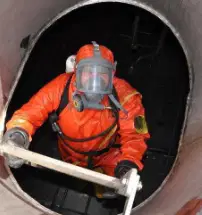
During entry, which access-cover practice best prevents entrapment?
Remove covers only after full descent
Partially close covers to reduce debris
Secure covers so they cannot fall back down
Leave covers leaning loosely on the rim
Which method ensures continuous contact with the stand-by person when radios fail inside a confined space?
Sending text messages when it is quiet
Occasional shouting through the access hatch
Waiting for hourly check-in from site office
Prearranged hand signals practiced before entry
What should the stand-by person do if they lose contact with a worker inside a confined space?
Initiate the emergency plan without delay
Wait ten minutes for contact to resume
Enter the space to look for the worker
Switch off monitoring to save battery
While working inside a confined space, which action best applies permit conditions during the job?
Reassess hazards and request permit re-issue if conditions change
Finish the task quickly even if conditions change
Ignore minor deviations to avoid delays
Transfer the permit to another crew without review
A gas monitor alarm activates during entry. What is the correct immediate response for all workers?
Silence the alarm and continue for five minutes
Leave the confined space immediately and account for all persons
Ask the stand-by person to retest after completion
Remove PPE to improve sensor readings
Time limits are listed on the confined space work permit. How should workers manage this requirement during the task?
Track elapsed time and stop work when the limit is reached
Ignore the time limit if ventilation feels adequate
Extend time informally with verbal approval
Reset the clock after every short break
When a new hazard is identified during confined space work, which action best ensures the permit reflects current risks?
Proceed under the original permit without change
Note the hazard in a personal notebook only
Resume work after a brief verbal warning
Organize re-validation or re-issue of the work permit
Which step is the immediate priority in any emergency to enable a timely rescue?
Wait for supervisor to arrive
Collect personal tools first
Raise the alarm without delay
Finish the current task quickly
Which example best demonstrates isolating a confined space after a new hazard emerges?
Turning up lighting to improve visibility
Inviting more workers to assist quickly
Erecting barriers and preventing further entry
Leaving the access hatch open for ventilation
A worker becomes trapped in a confined space while on breathing apparatus. What is the correct sequence of initial actions?
Activate DSU, relocate, resume strenuous work
Stop strenuous activity, activate DSU, relocate
Relocate, stop strenuous activity, activate DSU
Call 000, continue work, wait to relocate
Why should strenuous activity be stopped when entrapped while using breathing apparatus?
It improves muscle strength for self-rescue
It prevents the DSU from activating automatically
It helps calm breathing and conserves air supply
It reduces heat stress but increases air use

