
Font size
 Worksheets
CHAPTER 15 PERSONAL FINANCE REVIEW
Total questions: 82
Worksheet time: 41mins
Describe the features, advantages, and unique services of investing through mutual funds.
Mutual funds offer diversification, professional management, liquidity, and access to unique investment services.
Mutual funds guarantee fixed returns and no risk to investors.
Mutual funds only allow investment in government bonds and do not provide professional management.
Mutual funds require investors to manage their own portfolios without any assistance.
Differentiate mutual funds by investment objectives.
Growth funds, income funds, balanced funds, and money market funds
Equity funds, bond funds, real estate funds, and commodity funds
Short-term funds, long-term funds, index funds, and sector funds
Government funds, private funds, hybrid funds, and pension funds
Summarize the fees and charges involved by buying and selling mutual funds.
Entry and exit loads, management fees, and transaction charges
Only entry loads are charged
No fees or charges are involved
Only exit loads and taxes are applicable
Establish strategies to evaluate and select mutual funds that meet investment goals.
Analyze fund performance, fees, and alignment with investment objectives.
Choose funds based solely on past returns.
Select funds with the highest expense ratios.
Pick funds randomly without research.
Fill in the blank: Match investment philosophy and financial goals to a low-fee, ______ mutual fund.
no-load
front-load
back-load
high-fee
Fill in the blank: Invest regularly in the lowest cost mutual funds or exchange traded funds (_____) through individual or employer’s retirement plan.
ETFs
Bonds
Stocks
REITs
Fill in the blank: Save additional amounts regularly and invest in mutual funds that match ______.
goals
colors
brands
prices
Fill in the blank: Use the criteria in investment plan to screen mutual fund investments using ______ tools.
online
manual
paper-based
offline
Fill in the blank: Sign up for automatic reinvestment of fund ______.
dividends
loans
fees
statements
What is a mutual fund? Fill in the blank: A ________ is an investment company that pools funds from investors and makes investments to achieve the financial goal of income or growth, or both.
mutual fund
bank
insurance company
credit union
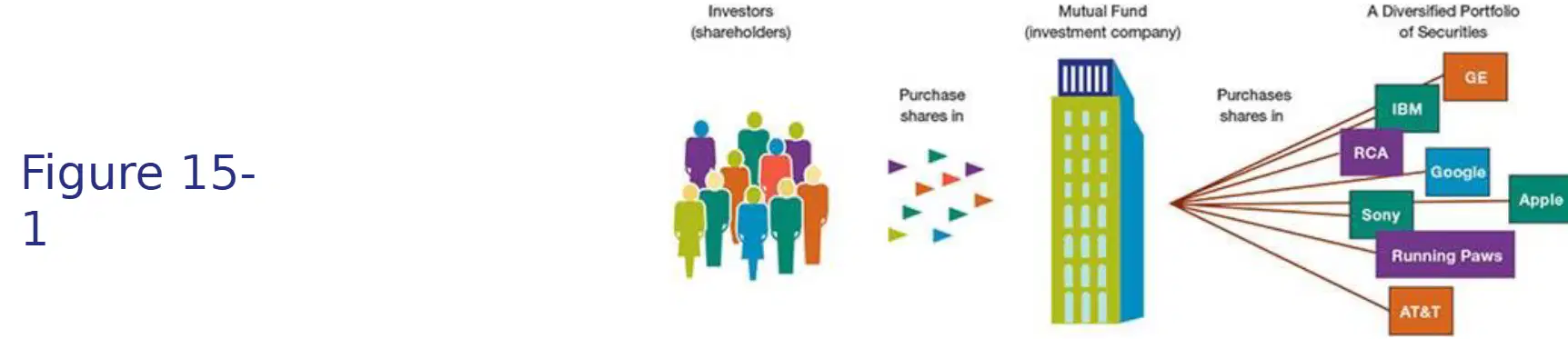
Based on the diagram, what does a mutual fund do with the money pooled from investors?
Keeps the money in a bank account
Invests in a diversified portfolio of securities
Gives the money back to investors
Uses the money for charity
What is the Net Asset Value (NAV) of a mutual fund? Fill in the blank: The Net Asset Value is _________.
The per-share value of a mutual fund, calculated as the assets of the fund minus its liabilities, divided by the number of shares outstanding.
The total value of all assets held by the mutual fund, regardless of liabilities or shares outstanding.
The annual profit generated by the mutual fund, divided by the number of investors.
The market price of the mutual fund shares as determined by stock exchange trading.
Current income from a mutual fund comes from which of the following?
Ordinary income dividend distributions
Capital gains distributions
Both A and B
None of the above
Capital gains occur when you sell your shares for a higher price than when purchased.
True
False
What type of income does a mutual fund receive from dividends from stocks and interest from bonds in its portfolio, which are passed on to you every three months (quarterly)?
Ordinary Dividend Income Distributions
Capital Gains Distributions
Tax-Free Income Distributions
Return of Capital Distributions
When a mutual fund occasionally sells stocks and bonds in its portfolio and receives more from the sale than it paid for the securities, what type of gain is achieved and passed along to you each year (annually)?
Capital Gains Distributions
Dividend Income
Interest Payments
Management Fees
When you sell your share in a mutual fund and the NAV of the share at its current market price is higher than the price you paid at purchase, what type of gain do you have due to the increase in NAV?
Capital Gain (returns received when you sell your share)
Dividend Income (returns received periodically)
Interest Income (returns from fixed deposits)
Bonus Issue (additional shares allotted)
Fill in the blank: One advantage of mutual funds is __________.
Diversification
High risk concentration
Lack of professional management
No liquidity
Fill in the blank: Mutual funds offer __________ for investors.
Convenience
Risk-free returns
Guaranteed profits
Tax evasion
Fill in the blank: An advantage of mutual funds is __________, allowing investors to easily access their money.
Liquidity
Taxation
High Risk
Illiquidity
Fill in the blank: Mutual funds are known for their __________ transaction costs.
Low
High
Variable
Hidden
Fill in the blank: Mutual funds provide __________ investment choices.
Uncomplicated
Complicated
Risky
Limited
Fill in the blank: Mutual funds can have an automatic __________ program.
investment
withdrawal
savings
loan
Fill in the blank: Mutual funds allow for effortless establishment of __________ plans.
retirement
travel
education
health
Fill in the blank: Mutual funds offer ease of buying and selling __________.
shares
bonds
commodities
real estate
Fill in the blank: Mutual funds allow for check writing and electronic __________.
transfers
deposits
withdrawals
payments
Fill in the blank: Mutual funds provide automatic reinvestment of income and capital gains __________.
distributions
expenses
withdrawals
fees
Fill in the blank: Mutual funds offer online and telephone __________ privileges.
exchange
withdrawal
deposit
transfer
Fill in the blank: Mutual funds allow for beneficiary __________.
designation
withdrawal
taxation
allocation
Fill in the blank: Mutual funds provide various __________ options.
withdrawal
deposit
borrowing
insurance
What is a mutual fund family?
A group of investors who pool their money together
An investment management company that offers a large number of mutual funds to the investing public
A government agency that regulates mutual funds
A type of mutual fund with high returns
It is easy to switch funds within a family of funds.
True
False
A very beneficial service of mutual funds is the __________.
automatic reinvestment of dividends
guaranteed returns on investment
fixed interest payments
no risk of loss
What is the main advantage of reinvesting dividends compared to not reinvesting them?
It allows your investment to grow faster through compounding.
It reduces the risk of your investment.
It guarantees a fixed return every year.
It eliminates taxes on your dividends.

Based on the chart titled 'Advantage of reinvesting dividends,' which investment strategy resulted in a higher value by 2020?
Dividends reinvested
Dividends not reinvested
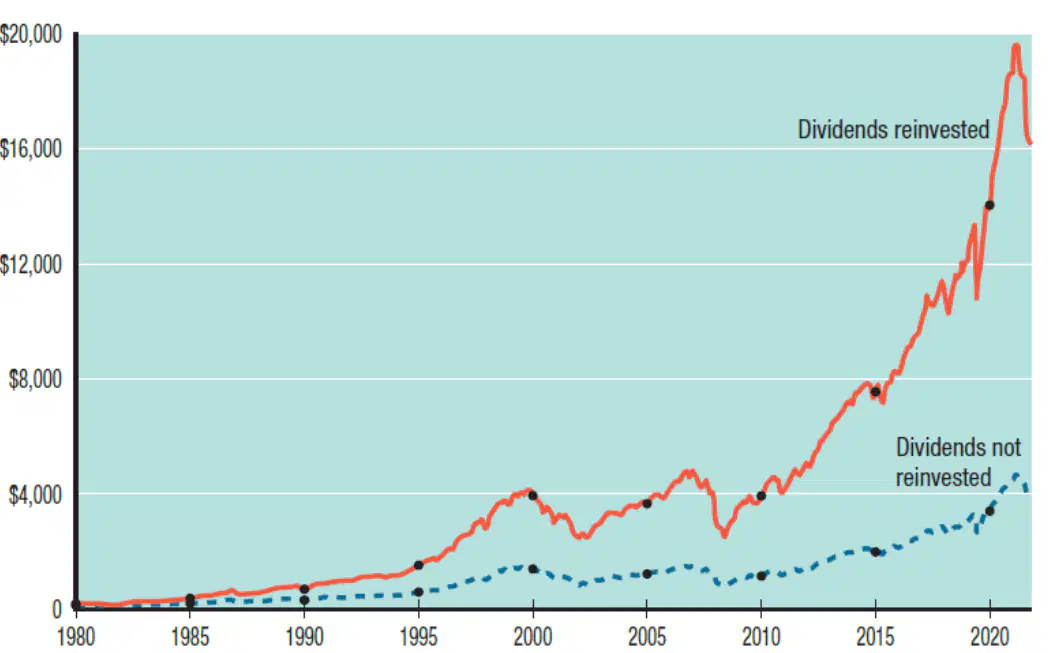
Fill in the blank: According to the chart titled 'Advantage of reinvesting dividends,' by 2020, the value of investments with dividends reinvested was ______ compared to investments with dividends not reinvested.
much higher
much lower
about the same
slightly lower
How many funds are offered by each family of funds?
Each family of funds offers a different number of funds.
All families of funds offer the same number of funds.
Each family of funds offers only one fund.
No family of funds offers any funds.
Work in three groups. Each group should find a different family of funds. Which family has the most funds?
The family with the largest number of funds
The family with the smallest number of funds
The family with the average number of funds
All families have the same number of funds
Work in three groups. Each group should find a different family of funds. How does each family of funds position itself in the market of funds?
By targeting different investor needs and risk profiles.
By offering identical investment strategies across all families.
By focusing only on short-term gains for all funds.
By ignoring market trends and investor preferences.
Which of the following statements is true?
Mutual funds are purchased and sold via an exchange market.
Exchange traded funds are purchased and sold directly with the mutual fund company.
Mutual funds are purchased and sold directly with the mutual fund company.
Both A and B.
Exchange traded funds are purchased and sold via an ______ market much like stocks on the stock market.
exchange
retail
auction
wholesale
Which of the following is NOT a type of investment company listed in the image?
Closed-End Mutual Fund
Real Estate Investment Trust (REIT)
Unit Investment Trust (UIT)
Hedge Fund
Mutual funds and exchange traded funds are similar.
True
False
Fill in the blank: Real Estate Investment Trust is also known as ______.
REIT
ROI
RBI
REM
Fill in the blank: Unit Investment Trust is also known as ______.
UIT
ETF
REIT
SIP
Net asset value is calculated and used by mutual funds in which of the following ways?
It is calculated by subtracting liabilities from total assets and is used to determine the price per share of the mutual fund.
It is calculated by adding liabilities to total assets and is used to determine the fund's annual return.
It is calculated by dividing total assets by the number of investors and is used to set management fees.
It is calculated by multiplying total assets by liabilities and is used to allocate dividends.
Which of the following is an advantage of investing in mutual funds?
Professional management
High risk due to lack of diversification
Limited investment options
No liquidity
Name five services that are unique to mutual funds.
Professional management, diversification, liquidity, convenience, and regulatory oversight
Insurance coverage, fixed interest rates, tax-free withdrawals, and guaranteed returns
Direct stock trading, personal financial planning, private equity investment, and real estate management
Online banking, ATM services, credit card issuance, and loan approval
What are index funds?
These funds are actively managed.
These funds are unmanaged.
These funds only invest in bonds.
These funds guarantee returns.
Index funds track the market as a whole for the particular market covered by the ______ used.
index
stock
bond
currency
Which of the following is a type of Money Market Fund with an income objective?
Tax-exempt money market funds
Bond (or fixed-income) funds
Equity funds
Real estate funds
Funds with an income objective include Money Market Funds and _________?
Bond Funds
Equity Funds
Index Funds
Balanced Funds
Which type of fund aims for maximum capital gains?
Aggressive growth (maximum capital gains) funds
Income funds
Balanced funds
Index funds
Name a type of fund that focuses on increasing value over time.
Growth funds
Income funds
Index funds
Money market funds
Which type of fund combines growth and income objectives?
Growth and income funds
Index funds
Bond funds
Money market funds
Which type of fund seeks undervalued investments?
Value funds
Growth funds
Index funds
Sector funds
Name the types of funds based on company size.
Large-cap, midcap, small-cap, and microcap funds
Equity, debt, hybrid, and liquid funds
Growth, value, income, and balanced funds
Sectoral, thematic, index, and international funds
Which type of fund invests in a specific industry or sector?
Sector funds
Index funds
Balanced funds
Money market funds
Which type of fund focuses on a particular geographic area?
Regional funds
Sector funds
Index funds
Global funds
Which type of fund invests in precious metals and gold?
Precious metals and gold funds
Equity funds
Bond funds
Real estate funds
Which type of fund invests in companies around the world?
Global funds
Index funds
Sector funds
Bond funds
Which type of fund invests outside the investor's home country?
International funds
Index funds
Sector funds
Balanced funds
Which type of fund invests in developing economies?
Emerging markets funds
Index funds
Money market funds
Government bond funds
Which type of fund is included in funds with a Growth and Income Objective?
Equity-income funds
Money market funds
Index funds
Real estate funds
Which type of fund is included in funds with a Growth and Income Objective?
Balanced funds
Hedge funds
Commodity funds
Bond funds
Which type of fund is included in funds with a Growth and Income Objective?
Asset allocation funds
Exchange-traded funds
Sector funds
Municipal funds
Which type of fund is included in funds with a Growth and Income Objective?
Target-date retirement funds (life-cycle) funds
Private equity funds
Growth funds
International funds
Which type of fund is included in funds with a Growth and Income Objective?
Target-risk (lifestyle) funds
Money market funds
Index funds
Real estate funds
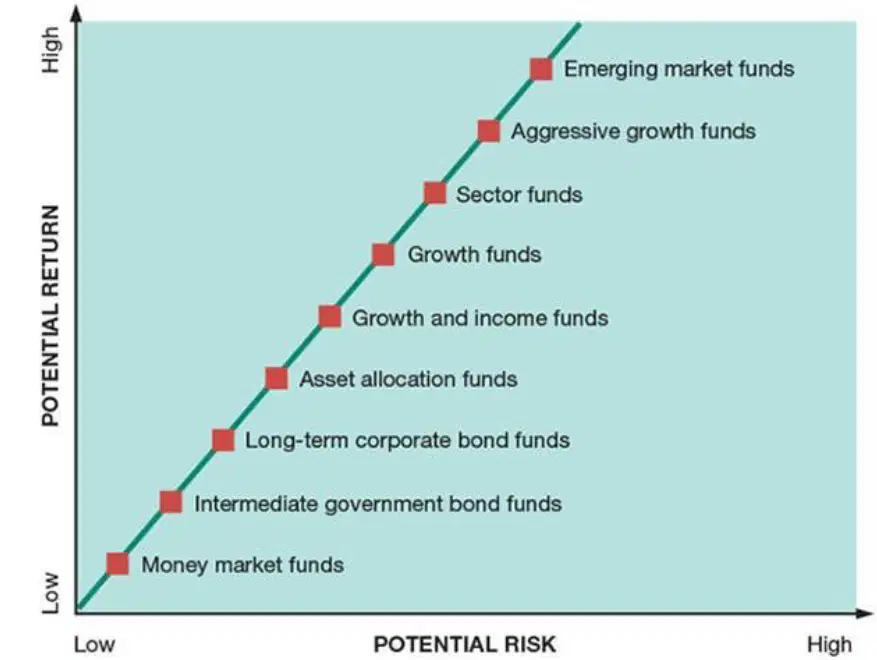
Based on the diagram 'Risk and return of various funds', which type of fund has the lowest potential risk and return?
Money market funds
Growth funds
Emerging market funds
Sector funds
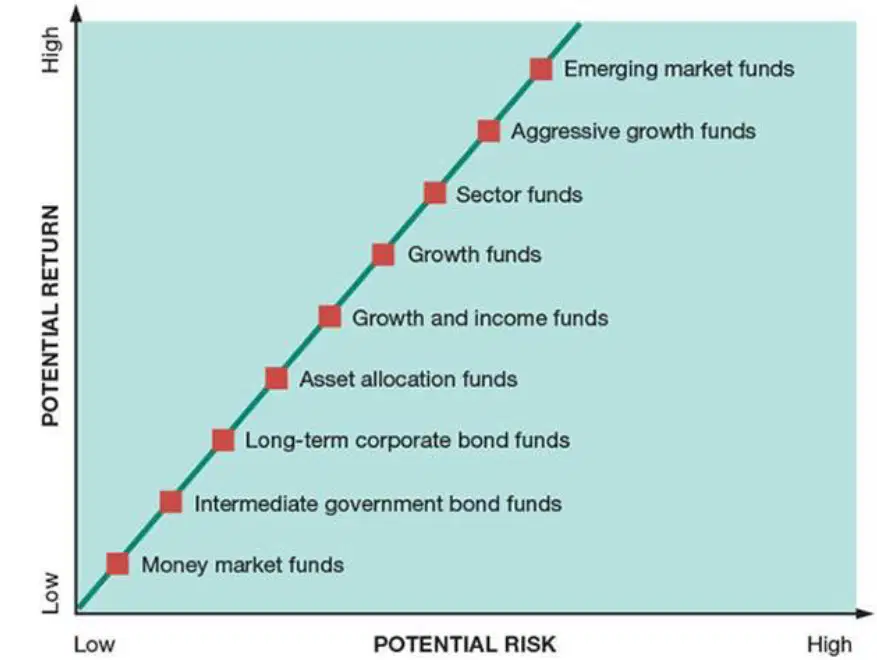
Based on the diagram 'Risk and return of various funds', which type of fund has the highest potential risk and return?
Asset allocation funds
Intermediate government bond funds
Emerging market funds
Growth and income funds
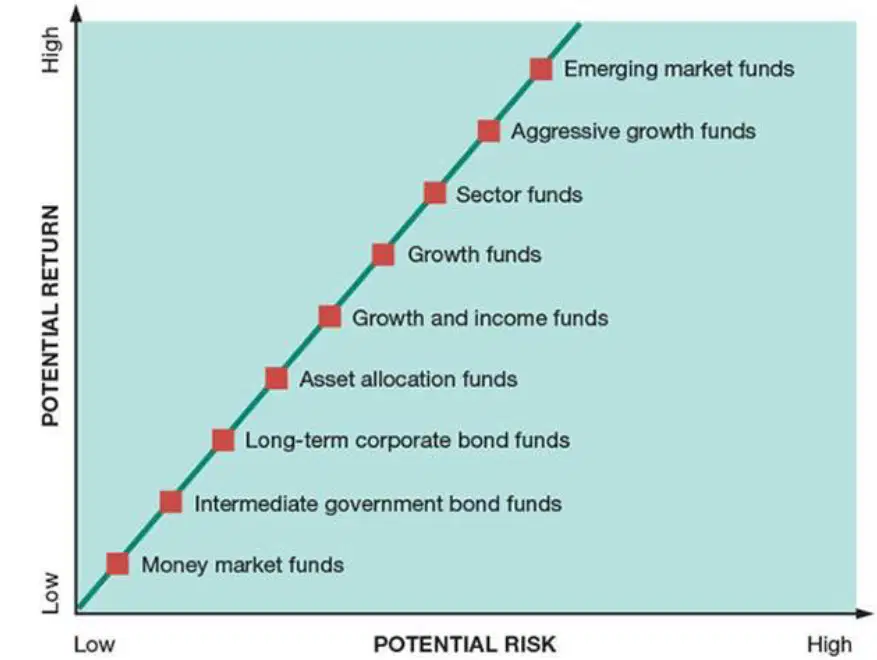
Fill in the blank: According to the diagram 'Risk and return of various funds', ________ funds are positioned between growth funds and growth and income funds in terms of risk and return.
Sector funds
Index funds
Bond funds
Money market funds
Distinguish between a managed mutual fund and an unmanaged mutual fund.
A managed mutual fund is actively overseen by a professional manager, while an unmanaged mutual fund tracks a market index without active management.
A managed mutual fund is only available to institutional investors, while an unmanaged mutual fund is open to the public.
A managed mutual fund guarantees higher returns than an unmanaged mutual fund.
A managed mutual fund invests only in government bonds, while an unmanaged mutual fund invests in stocks.
Distinguish among mutual funds with an income objective, growth objective, and growth and income objective.
Mutual funds with an income objective focus on generating regular income, growth objective funds aim for capital appreciation, and growth and income objective funds seek both income and capital appreciation.
Mutual funds with an income objective only invest in stocks, growth objective funds only invest in bonds, and growth and income objective funds invest in real estate.
Mutual funds with an income objective avoid dividends, growth objective funds avoid capital gains, and growth and income objective funds avoid both.
Mutual funds with an income objective focus on short-term gains, growth objective funds focus on long-term losses, and growth and income objective funds focus on neither.
Investors like index mutual funds and exchange traded funds because:
They offer diversification and typically lower fees.
They guarantee high returns.
They are only available to wealthy investors.
They require active management.
What is included in a fund's expense ratio?
Ongoing expenses
One-time expenses
Only trading fees
Only management fees
Turnover rate is a measure of a mutual fund’s ________ activity.
trading
marketing
fundraising
advertising
Fees are measured in basis points, which are one hundredth of 1 percent.
True
False
A fund with a 1 percent fee would have a fee of how many basis points?
1
10
100
1000
What do load funds always charge?
Transaction fees
Interest rates
Annual bonuses
Late payment fees
Front-end load funds charge a fee that is: Choose the correct option.
A fixed dollar amount
A percentage of the amount invested
A monthly subscription
No fee
Low-load funds have a load of ______ percent or less.
3
1
5
10
Many funds may also assess which of the following fees? Choose the correct option.
Deferred load
Redemption charge
Both A and B
None of the above

