wayground logo

Free Printable Worksheets

NEW

Font size

S
M
L
XL
Worksheets

Heat and Matter

Total questions: 58

Worksheet time: 1hrs 5mins

Name
Class
Date
1.
Which example below is an example of convection?
a)
Standing on a hot metal bridge
b)
The attic is warmer than the basement
c)
The Sun heating the Earth
d)
Touching hot sand with your feet
2.
The baby chickens are kept warm from the heat lamps.  This demonstrates what kind of heat transfer? 
a)
conduction
b)
convection
c)
radiation
3.
Energy that travels as electromagnetic waves is called ______
a)
conduction
b)
convection
c)
radiation
4.
Radiation is how energy from the sun is transferred to Earth.
a)
true
b)
false
5.
The transfer of thermal energy through a substance by direct contact is called___.
a)
conduction
b)
insulation
c)
convection
d)
radiation
6.
The transfer of thermal energy from one place to another by the the movement of fluids is
a)
convection
b)
conduction 
c)
radiation
d)
thermal energy
7.
As you touch a hot stove the heat transfers -
a)
from your hand to the stove
b)
from the stove to your hand
c)
It doesn't transfer
8.
The Gulf Stream is a current that brings warm ocean water from the equator to the north. What type of heat transfer is this?
a)
conduction
b)
convection
c)
radiation
d)
Insolation 
9.
______ occurs when a cooler, denser mass of a liquid or gas replaces a warmer, less dense mass of a gas or liquid
a)
Convection
b)
Conduction
c)
Radiation
10.
What happens to particles as they heat up?
a)
They slow down
b)
Nothing
c)
They don't move
d)
They speed up
11.
Thermal energy ALWAYS moves from _____ to _____.
a)
solid to liquid
b)
ice to water
c)
hot to cold
d)
solid to gas
12.
Warm air rises and the cool air sinks demonstrates this type of heat transfer. 
a)
conduction
b)
convection
c)
radiation
d)
Insolation 
13.
The heat from a hot burner to a pot is transferred by ______.
a)
convection
b)
insulation
c)
radiation
d)
conduction
14.
Which of the following are kinds of heat transfer.
a)
Conduction
b)
Convection
c)
Radiation
d)
All of the above
15.
What would be the effect on the particles if more heat is supplied to the system?
a)
They would slow down
b)
They would stop moving
c)
They would speed up
d)
There would be no effect
16.

_____________ is the form of energy that is transferred between systems or objects with different temperatures.

a)

Temerature

b)

Heat

c)

Specific Heat

d)

Mechanical Energy

17.
Heat transfers from an area of ____temperature to an area of ___ temperature.
a)
high to low
b)
low to high
c)
high to high
d)
It can travel high to low and low to high. 
18.

Movements of water in a pot, molten mantle in the earth's crust and hot air rising in the atmosphere are examples of

a)

Sublimation

b)

Convection

c)

Conduction

d)

Radiation

19.
The sun warming your skin is an example of heat transfer through 
a)
conduction
b)
convection
c)
radiation
d)
thermal electricity
20.
What happens to particles as they cool down?
a)
They slow down
b)
Nothing
c)
They don't move
d)
They speed up
21.
The amount of energy required to raise the temperature 1ºC for every kilogram is called____?
a)
Thermal Energy
b)
Specific Heat
c)
Temperature
d)
Kinetic Energy
22.
Water has a specific heat of 4184 J/KgºC.  Wood has a specific heat of 1760 J/KgºC.  What material needs more energy to raise the temperature 1ºC
a)
Wood
b)
Water
c)
Both are the same
23.
Copper, Stainless Steel, Carbon Steel, and Zinc were all heated using the same thermal energy.  What material would be the coolest after being heated?
a)
Copper
b)
Carbon Steel
c)
Zinc
d)
Stainless Steel
24.
A high specific heat means...
a)
It requires less energy to change temperature
b)
It requires more energy to change temperature
c)
It heats up very quickly
25.
Specific heat is....
a)
The measure of kinetic energy of an objects particles
b)
A measure of the energy needed to increase the average kinetic energy of the particles
c)
The heating caused by the motion of flluid due to temperature difference
d)
The transfer of energy by electromagnetic radiation
26.
There are four cups of hot cocoa. The cup sizes are shown. The temperature of the cocoa in each cup is 25 degrees celsius. Which cup has the MOST thermal energy?
a)
Large cup (Trenta)
b)
Small cup (Tall)
c)
Medium cup (Venti)
d)
All three are the same temperature so they have the same thermal energy
27.
Copper, Stainless Steel, Carbon Steel, and Zinc were all heated using 10,000 JOULES of thermal energy.  What material would be have the LARGEST change in temperature?
a)
Copper
b)
Carbon Steel
c)
Zinc
d)
Stainless Steel
28.
Copper, Stainless Steel, Carbon Steel, and Zinc were all heated using 10,000 JOULES of thermal energy.  Based on the chart, which material would be have the SMALLEST change in temperature?
a)
Copper
b)
Carbon Steel
c)
Zinc
d)
Stainless Steel
29.
There are 2 pans of water, one has 100 mL in it and one has 1000mL. You add 4000 joules of energy,  which one has the bigger change in temperature?
a)
100 mL
b)
1000 mL
c)
They the same material so they both heat to the same temperature
d)
They both will cool down.
30.
If I have 2 blocks of Aluminium (one of 1kg and one of 10 kg) and heat them up with 6,000 Joules of energy.
Which one will have the SMALLEST change in temperature?
a)
1 kg
b)
10 kg
c)
They both heat up  to the same temperature
d)
It depends on the temperature of the room
31.

What would heat up the fastest if left out in the sunlight on a clear, summer day?

a)

Liquid Water

b)

Dry Air

c)

Lead

d)

Granite

32.

If the same amount of heat is added to each sample, the smallest change in temperature will occur in the

a)

Iron

b)

Dry Air

c)

Granite

d)

Water

33.

Hot air balloon rises.

a)

Conduction

b)

Convection

c)

Radiation

34.

The particles in the left image are sitting still. The particles in the right image are moving quickly. What would explain this?

a)

air was added to the system

b)

heat was added to the system

c)

water was added to the system

d)

particles were added to the system

35.

Mrs. Plata likes to collect river rocks on her daily walk. She picked up a rock and placed it in her pocket. If the rock is 10 degrees Celsius and Mrs. Plata is 31 degrees Celsius, which of the following BEST describes the transfer of energy?

a)

Thermal energy will flow from Mrs. Plata to the rock.

b)

Thermal energy will flow from the rock to Mrs. Plata.

c)

Thermal energy will flow from Mrs. Plata into the air.

d)

Thermal energy will flow into the air and to the rock.

36.

When particles in a substance are moving slower, temperature =

a)

hotter

b)

colder

c)

the same

37.

Which of the following statements is true regarding heat energy?

a)

The quicker a molecule moves, the colder it is.

b)

The slower a molecule moves, the warmer it is.

c)

The quicker a molecule moves, the warmer it is.

d)

The faster you dance, the quicker you get tired.

38.

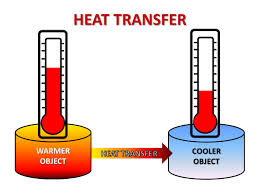
Heat transfers between two substances until they both reach

a)

different temperatures

b)

the same temperatures

39.

Which number on the diagram is convection

a)

Number 1

b)

Number 2

c)

Number 3

d)

Number 4

40.

Which number on the diagram is conduction

a)

Number 1

b)

Number 2

c)

Number 3

d)

Number 4

41.

Which number on the diagram is thermal radiation

a)

Number 1

b)

Number 2

c)

Number 3

d)

Number 4

42.

If you added ice (0oC) to a glass of water (25oC) how would the heat move between the ice & water?

a)

from the ice to the water

b)

from the water to the ice

43.

In this experiment, energy will flow from the ________ to the _______.

a)

from the metal to the water

b)

from the water to the metal

44.

The greater the mass of the heat source, the ____________ the amount of heat energy that can be transferred to the heat sink.

a)

greater

b)

lower

45.

If the same amount of heat energy is added to two buckets of water with different masses, which will heat up more?

a)

Bucket # 1; The bucket with less mass

b)

Bucket # 2; The bucket with more mass

c)

They both heat up at the same rate

d)

They cool down.

46.
The amount of force pushing on an area is the definition of....
a)
Fluid
b)
Viscosity
c)
Barometer
d)
Pressure
47.

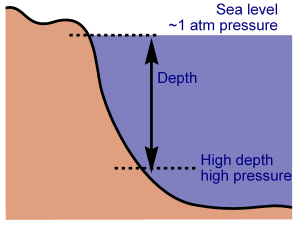
When you increase your depth under water, the water pressure on your body...

a)

increases

b)

decreases

c)

stays the same

48.

When your attitude increases, the air pressure...

a)

increases

b)

decreases

c)

stays the same

d)

Could you repeat the question?

49.

Which of the following correctly shows the direction of convection currents in water?

a)

A

b)

B

c)

C

d)

D

50.

What is true of molecules of gas that are exposed to heat in a fixed volume container?

a)

They move faster and they cause the pressure to increase

b)

They move slower and pressure will decrease

c)

The volume increases and pressure increases

d)

The volume decreases and the pressure decreases.

51.

Which box has the most pressure?

a)

The one to the far right, since it is the most dense and more chance of collisions

b)

The one to the far left, since it has more space to move and collide with the walls.

c)

All of them has the same pressure

52.
As you climb up a mountain what happens to the air pressure?
a)
decreases
b)
increases
c)
stays the same
53.
If density of air is low, pressure is:
a)
high
b)
low
54.
If density of air is high, pressure is:
a)
high
b)
low
55.
Fewer molecules further apart, means density is:
a)
high
b)
low
56.
Which of the following would increase the (gas) pressure of a system?
a)
Increase the Temperature
b)
Pump in more gas
c)
Decrease the volume
d)
All of these
57.
Which container shows air particles experiencing higher pressure?
a)
Left Container
b)
Right Container
c)
Both Containers
d)
Neither Containers
58.
LT3: If two objects have different temperatures, heat will flow from the warmer object to the cooler one UNTIL ____________
a)
one reaches a temperature of zero
b)
they both have an equal temperature
c)
one runs out of energy