wayground logo

Free Printable Worksheets

NEW

Font size

S
M
L
XL
Worksheets

Continental Drift and Earth's Structures Practice

Total questions: 75

Worksheet time: 55mins

Name
Class
Date
1.

Who developed the theory of Continental Drift?

a)

Albert Einstein

b)

Alfred Wegener

c)

Isaac Newton

d)

Charles Darwin

2.

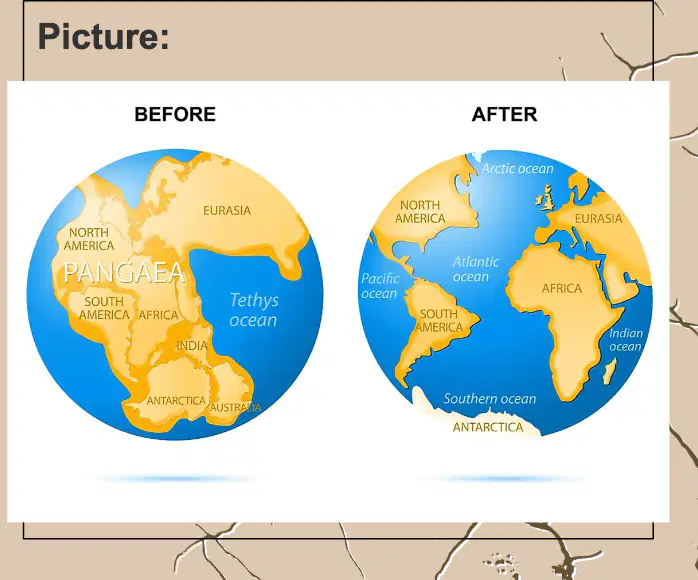
What was the name of the supercontinent mentioned in the diagram?

a)

Gondwana

b)

Laurasia

c)

Pangaea

d)

Atlantis

3.

What is the main evidence for Continental Drift?

a)

Identical fossils found on different continents

b)

Weather patterns

c)

Ocean currents

d)

Mountain ranges

4.

Approximately how many years ago were Earth's continents joined together in Pangaea?

a)

100-200 million years ago

b)

200-300 million years ago

c)

300-400 million years ago

d)

400-500 million years ago

5.

What is a continent?

a)

A small island surrounded by water

b)

A large, continuous area of land separated by oceans

c)

A mountain range

d)

A large body of water

6.

How many continents are there on Earth?

a)

Five

b)

Six

c)

Seven

d)

Eight

7.

The process by which oceanic crust sinks beneath a deep-ocean trench and back into the mantle at a convergent plate boundary.

a)

mid-ocean ridge

b)

ocean trench

c)

sea-floor spreading

d)

subduction

8.

A string of volcanoes and sites of seismic activity, or earthquakes, around the edges of the Pacific Ocean.

a)

hypothesis

b)

theory

c)

Pangea

d)

Ring of Fire

9.

ancient supercontinent

a)

hypothesis

b)

theory

c)

Pangea

d)

Ring of Fire

10.

The process by which molten material adds new oceanic crust to the ocean floor.

a)

mid-ocean ridge

b)

ocean trench

c)

sea-floor spreading

d)

subduction

11.

An undersea valley that represents one of the deepest parts of the ocean.

a)

mid-ocean ridge

b)

ocean trench

c)

sea-floor spreading

d)

subduction

12.
Which of the following is evidence that supports continental drift?
a)
the presence of penguins at both the equator and Antarctica
b)
fossils of the same plant have been found on several continents
c)
the presence of glacial features in Antarctica
d)
the presence of volcanic rock in Antarctica
13.

The boundary where two plates move against each other and ultimately one is pushed under another. This is where volcanoes and mountains form and earthquakes can be felt.

a)

Convergent

b)

Divergent

c)

Transform

14.

The boundary where two plates move away from each other.

a)

Divergent

b)

Convergent

c)

Transform

15.

The boundary where two plates move against each other. This can cause large earthquakes.

a)

Transform

b)

Divergent

c)

Convergent

16.
Name this boundary
a)
Convergent
b)
Divergent
c)
Transform
d)
Sergent
17.
Name the boundary
a)
divergent
b)
convergent
c)
transform
d)
sergent
18.
Name the boundary
a)
convergent
b)
transform
c)
divergent
d)
sergent
19.
A subduction zone is formed....
a)
when one tectonic plate sinks below another
b)
at all plate boundaries
c)
when plates diverge
d)
at transform boundaries
20.

The process by which molten material adds new oceanic crust to the ocean floor.

a)

Sea-Floor Spreading

b)

Deep-Ocean Trench

c)

Mid-Ocean Ridge

d)

Subduction

21.

_________ is scientific information that shows the Earth's climate is changing.

a)

Climate Evidence

b)

Erosion

c)

Weathering

d)

Tectonic Plate

22.

the theory that Earth's continents move relative to each other over geologic time

a)

Climate Evidence

b)

Fault

c)

Pangaea

d)

Continental Drift

23.

fracture or zone of fractures between two blocks of rock

a)

fault

b)

mid[-ocean ridge

c)

pangaea

d)

seafloor spreading

24.

the remains of plants, animals, and bacteria that lived in the past

a)

fault

b)

fossil evidence

c)

rift valley

d)

oceanic crust

25.

What is the Theory of Continental Drift?

a)

Earth's continents do not move.

b)

Earth's continents moved in the past and continue moving today.

c)

Earth's continents will eventually fall off the planet.

26.

The remains or traces of ancient life are called ____________.

a)

bones

b)

remanents

c)

fossils

d)

none of the above

27.

What two specific continents fit together most noticeably?

a)

Africa and North America

b)

South America and Europe

c)

South America and Africa

d)

Antarctica and Africa

28.
The Theory of Continental Drift states that Pangaea broke apart and the continents "drifted" away from each other
a)
True
b)
False
29.

___________ is a fossil fern that helped support Wegener's hypothesis of continental drift.

a)

Gondwanaland

b)

Kannemeyerid

c)

Mesosaurus

d)

Glossopteris

30.

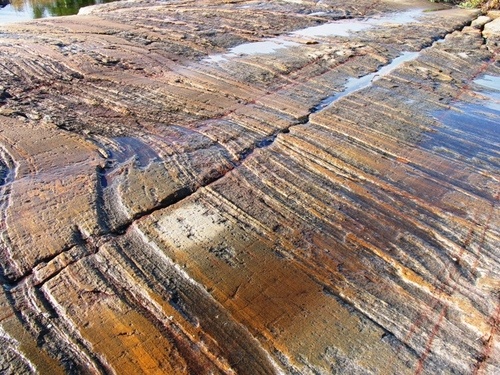
This is a picture is found in Africa.  What are these ?

a)

Human made scars

b)

glacier scars

c)

Fossils

d)

sea floor

31.
The continents move very slowly, only a few __________per year.
a)
meters
b)
kilometers
c)
centimeters
d)
miles
32.
The east coast of South America seems to fit into the wet coast of Africa, this evidence for Continental Drift is called...
a)
fit/shape of continents
b)
fossil evidence
c)
geologic evidence
d)
climate evidence
33.
India, Australia, South America, and Africa all have deep grooves or scratches in rocks which is climate evidence of ....
a)
erosion
b)
dinosaurs
c)
glaciers
d)
aliens
34.
Wegner's geologic evidence for Continental Drift comes from the Caledonian and Appalachian mountains which are made of the same __________ and are the same ________.
a)
rock; trees
b)
volcanic rock; age
c)
oceanic rock; age
d)
volcanic rock; size
35.
Which of the following orders the rock layers accurately from oldest to youngest?
a)
A, B, C, D, E, F, G, H
b)
B, F, G, C, D, H, A, E
c)
B, G, C, D, E, H, A, F
d)
F, A, H, E, D, C, G, B
36.
Which of the following orders the rock layers accurately from youngest to oldest?
a)
1, 2, 3, 4, 5
b)
5, 4, 3, 2, 1
c)
2, 3, 4, 5, 1
d)
1, 2, 3, 5, 4
37.
Which of these rock layers is relatively the newest?
a)
Kaibab formation
b)
Zoraster Granite
c)
Redwall limestone
d)
Unkar group
38.
Which fossil is relatively the oldest?
a)
Trilobite
b)
Ammonite
c)
Crinoid
d)
Gastropod
39.

The Law of Superposition helps scientists to determine what?

a)

The absolute age of rock layers

b)

The age of fossils

c)

The relative age of rock layers

d)

the super powers of squirrels

40.
According to the law of superposition, the oldest fossils are found 
a)
At the top of the rock layers
b)
Near the bottom of the rock layers
c)
In the middle of the rock layers
d)
Somewhat near the surface
41.
Which of the following does the law of superposition tell scientists?
a)
Absolute age
b)
Relative age
c)
Exact age
d)
All of the answer choices
42.
Which animal is the youngest in site 1?
a)
bird
b)
ammonite 
c)
shell
43.
Which of the following rock layers is relatively the oldest?
a)
H
b)
P
c)
L
d)
M
44.
The law of superposition states:
a)
each rock layer is older than the one above it
b)
each rock layer is younger than the one above it
c)
each rock layer is the same as the one above it
45.
Which rock layer in the diagram seems to be the oldest?
a)
F
b)
E
c)
B
d)
A
46.
The ______ is the layer of the Earth under the crust.
a)
core
b)
mantle
c)
magma
d)
none of the above
47.
Which of these is NOT a type of plate boundary?
a)
convergent
b)
divergent
c)
bivergent
d)
transform
48.
This is the process of warm liquids rising while cooler liquids sink.
a)
convection
b)
subduction
c)
boiling
d)
uplift
49.
This type of plate boundary is when two plates slide past each other.
a)
convergent
b)
transform
c)
divergent
d)
subductive
50.
This type of plate boundary is when two plates crash into each other.
a)
convergent
b)
transform
c)
divergent
d)
subductive
51.
This type of plate boundary is when two plates move apart.
a)
convergent
b)
transform
c)
divergent
d)
subductive
52.
This is when two plates converge but one slides under the other due to density.
a)
uplift
b)
subduction
c)
trench
d)
none of the above
53.
When plates converge and form mountains, scientists call it _______.
a)
uplift
b)
subduction
c)
elevation
d)
none of the above
54.
This scientist built most of the evidence for continental drift.
a)
Alfred Wegener
b)
Sean Carroll
c)
Fred Calfred
d)
John Williams
55.
Which of these is a key piece of evidence of contiental drift?
a)
continent shapes
b)
fossil record
c)
rock layers
d)
all of the above
56.

Plates slide past each other at _________________ boundaries.

a)

divergent

b)

convergent

c)

transform

d)

universal

57.

Plates slide apart along _____________ boundaries.

a)

convergent

b)

divergent

c)

transform

d)

universal

58.

Which boundary collides?

a)

Convergent

b)

Divergent

c)

Transform

59.

A __________ forms where plates diverge on land.

a)

rift valley

b)

mid-ocean ridge

c)

mountain

d)

trench

60.

Which feature forms at convergent boundaries?

a)

trench

b)

rift valley

c)

mountain range

d)

mid-ocean ridge

61.

a)

divergent boundary

b)

convergent boundary

c)

transform boundary

62.

a)

divergent boundary

b)

convergent boundary

c)

transform boundary

63.

a)

divergent boundary

b)

convergent boundary

c)

transform boundary

64.

New crust is formed at this type of boundary

a)

divergent

b)

convergent

c)

transform

65.

Subduction means.....

a)

one plate goes under another plate

b)

two plates slide past each other

c)

two plate collide and form folded mountains

66.
There are three types of plate boundaries. Which choice is NOT a type of plate boundary?
a)
convergent
b)
thrust
c)
divergent
d)
transform
67.

This type of boundary can be found along the San Andreas fault in California....

a)

divergent

b)

convergent

c)

transform

68.
What kind of plate boundary is shown here?
a)
divergent
b)
convergent
c)
transform
d)
submerged
69.
What kind of plate boundary is shown here?
a)
divergent
b)
convergent
c)
transform
d)
subducting
70.
What are the puzzle pieces of the Earth's surface called?
a)
Tectonic plates
b)
Puzzles
c)
Earthquakes
71.
What are the two types of crust
a)
continental and oceanic
b)
ocean and upper
c)
lower and upper
d)
pizza and subway
72.

What type of plate boundary lies on the west coast of South America?

a)

Convergent

b)

Divergent

c)

Transform

d)

Uncertain

73.

Which type of tectonic plate boundary is found between the South American Plate and the Scotia Plate?

a)

transform

b)

convergent

c)

divergent

d)

complex or uncertain

74.
The type of plate boundary where two plates come together is a .....
a)
Convergent Boundary
b)
Divergent Boundary
c)
Transform Boundary
d)
Plate Boundary
75.
Which of the following causes Earth's tectonic plates to move?
a)
Energy from the Sun
b)
Magnetic Pole Reversal
c)
Convection currents in the mantle
d)
Faults in Mountain Ranges