
 Worksheets
Mitosis & Differentiation - HS-LS1-4, HS-LS-3-1
Total questions: 150
Worksheet time: 5hrs 0mins

List the phases of mitosis in the correct order beginning with interphase.
interphase
prophase
metaphase
anaphase
telophase

The picture depicts which process?
Meiosis
Mitosis
DNA replication
Fertilization
During normal mitosis & cytokinesis, a parent cell that has 4 chromosomes will produce two daughter cells, each containing
2 chromosomes
4 chromosomes
8 chromosomes
16 chromosomes

The image shows a chromosome.
What is the name of the structure labeled A?
chromatid
nucleus
cell membrane
centromere

Which phase of the cell cycle is the longest?
interphase
mitosis
metaphase
cytokinesis

Look at the diagram.
A: Interphase
B: Prophase
The cell labeled E is in ___.
Metaphase
Prophase
Cytokinesis
Telophase
What is happening during interphase?
Cell develops a second nucleus
The cell is preparing for division
The cell shrinks and breaks apart
The cell divides into two new cells
The growth phase of the cell cycle is called
Interphase
Telophase
Prophase
Anaphase
Cancer is defined as the
uncontrolled division of mutated cells
normal division of cells
normal DNA replication
abnormal ATP synthesis
This diagram represents the time a cell spends during steps of the cell cycle.
Identify when cells make a full copy of their DNA before they can divide.
Organisms undergo cell reproduction for ___, ___, and ___.
*Select THREE purposes of cell reproduction.
growth
repair
passing on genetic information
apoptosis
photosynthesis

Which phase is this in?
Interphase
Metaphase
Anaphase
Telephase
When you skin your knee, what do the cells need to do to repair your skin?
Mitosis - divide and copy
Fragmentation - break off and make a new organism
Meiosis -- make gametes
Apoptosis

How many total chromosomes would be in LIVER, STOMACH, and SKIN CELLS of a Australian Shepherd?
1
2
17
34
How many total chromosomes would be in LIVER, STOMACH, and SKIN CELLS of a Corgi?
1
22
17
34

How many total chromosomes would be in a BODY CELL of a Corgi ?
1
2
11
22
How many total chromosomes would be in a BODY CELL of a Great Dane ?
34
22
11
44
68

An egg cell has 23 chromosomes. A sperm cell has 23 chromosomes.
A human zygote has _____ chromosomes.
What is Cancer?
uncontrolled cell division
when a cell touches another cell and stops growing
mutations in the DNA of cells
a contagious disease
How do masses of cancer cells affect normal cells?
They deprive normal cells of nutrients.
They provide normal cells with nutrients.
Cancer cells are the same as stem cells.
Cancer cells do not affect normal cells.
Stem cells are ____________________.
cells that grow uncontrollably
undifferentiated cells that can turn into other types of cells
the first cells of a new living organism (fertilized egg)
specialized cells that do one job
The cells produced by mitosis are
Identical
Different
How many daughter cells are created during mitosis?
1
2
3
4
Numbers -- chromosomes & reproduction
Humans have ___ chromosomes in body cells
46
Humans have ___ chromosomes in gametes (sex cells).
23
How many cells are made during mitosis?
2
How many cells are made during meiosis?
4
A male shark has 40 chromosomes in each of its sex cells.
How many would be present in its body cells?
If a person had "XY" chromosomes, their gender would be:
male
female
cannot be determined
If a person had "XX" chromosomes, their gender would be:
male
female
cannot be determined
Mitosis occurs in a
sex cell (gamete)
somatic (body) cell
What is the genetic material called in cells?
RNA
a nucleus
DNA
cell membrane
Only requires one parent
asexual reproduction
sexual reproduction
requires two parents
asexual reproduction
sexual reproduction
offspring are unique from the parent and each other
asexual reproduction
sexual reproduction
organisms are clones of parent
asexual reproduction
sexual reproduction
What is the correct sequence of structures from smallest to largest?
DNA, Gene, Nucleus, Chromosome, Cell
Gene, DNA, Chromosomes, Nucleus, Cell
Why is DNA important?
DNA produces lipids and lysosomes.
It carries the instructions for our cells.
DNA transports oxygen to capillaries.
It is a molecule.
DNA is important.
Why is DNA important?
It teleports cookies to my locker.
It carries the instructions for our cells.
It allows a cell to be invisible.
It makes energy (ATP) for a cell.
DNA = deoxyribonucleic acid
Sex cells are gametes (sperm & eggs)
Body cells include all other cell types, including liver, skin, and blood cells.
Sex cells have ____ of the DNA found in body cells.
all
none
half
a little bit

cell cycle labeling
telophase
interphase
prophase
metaphase
anaphase
Label the following phases.
metaphase
cancer
telophase
cytokinesis
prophase
anaphase
interphase
Chromosomes are made of
DNA
genes
proteins
traits
What do genes do?
They make chromosomes
Allow some things in the cell but not others
Control the production of proteins
Cytokinesis
Bundles of tightly coiled DNA
Chromosome
Genes
Traits
Nucleus
The material that exists in every cell in your body that holds your genetic code. It Is like your body’s cookbook.
Gene
DNA
Chromosome
Trait
Sections of DNA that contain the set of instructions that control how our body grows and works and controls many of our characteristics.
Chromosome
Nucleus
Genes
Cell
Label the following terms: Cell, DNA, Chromosome, Nucleus, Gene
Gene
DNA
Chromosome
Nucleus
Cell
Identify the image that best represents a gene.
Identify the image that best represents the structure of DNA.

What do each of the colored bands on the chromosome diagram represent?
DNA
Cells
Genes
Chromosomes
Mitosis
Where are chromosomes located in the cell?
DNA
Humans have (a) of cells in our bodies.
Categorize mitosis and DNA terms/phrases.
prophase
metaphase
anaphase
telophase
chromosome
chromatin
contains genes
this must be copied before prophase
Cells must make ____ of their DNA before they can divide.
a full copy
more
part
new kinds
Cells reproduce asexually through a process known as ____.
mitosis
meiosis
interphase
cytoplasm
Mitosis passes on genetically identical materials via _____.
replication
meiosis
calculations
digesting
In multicellular organisms, individual cells grow and then divide via a process called mitosis allowing the organism to ____.
produce ATP
grow
convert CO2 to O2
read
What TWO processes produce and maintain a complex organism?
Select TWO!
Cellular division
differentiation
photosynthesis
Plate tectonics
What TWO processes produce and maintain a complex organism?
Select TWO!
Cellular division
differentiation
cellular respiration
ossification
What TWO processes produce and maintain a complex organism?
Select TWO!
Cellular division
differentiation
backdoor
cut
Mitosis is a form of asexual reproduction that produces new cells for growth and ___.
healing
cut
backdoor
growth
making ATP

Cells spend most of their lives in which phase?
Interphase
Prophase
Telophase
Metaphase

The G1, S, and G2 are parts of which phase of the cell cycle?
Prophase
Interphase
Telophase
Anaphase

Why do cells go through mitosis?
to make food from sunlight
to get air into the cells
to create proteins
to reproduce, grow, and repair/replace cells

Is interphase a part of Mitosis?
Yes, it happens after prophase
No, it happens before mitosis
Which type of tumor causes more damage?
malignant
benign

Cancer is defined as the
uncontrolled division of mutated cells
normal division of cells
normal DNA replication
abnormal ATP synthesis
A benign tumor differs from a malignant tumor in that a benign tumor
is cancerous
spreads from the original site
does not metastasize
never causes health problems
A ________________is a critical point where stop and go signals can regulate the cycle
tumor
checkpoint
growth factor
oncogene
always disrupt homeostasis
usually cause defective genetic info to be passed to the next generation of cells
commonly contribute to the development of cancer
The invasion of the bloodstream by a malignant cell that takes up residence in a new location is called.
Metastasis
Metaphase
Any substance that is known to cause cancer is called a
Pathogen
Biopsy
Carcinogen
Retrovirus
Cell programmed self destruction is called
Atopic
Apoptosis
Antiparallel
Anticellular
Which of the following are checkpoints that the cell must pass before dividing?
**CHOOSE THREE
Have enough nutrients
Have correctly copied all DNA
Be large enough to divide
Be a skin cell
Perform photosynthesis
Which of the following are checkpoints that the cell must pass before dividing?
**CHOOSE THREE
Have enough nutrients
Have correctly copied all DNA
Be large enough to divide
cut and backdoor
Be eight days old
Which of the following are known carcinogens?
CHOOSE ALL THAT APPLY!
UV rays
X-rays
Certain viruses
Eating fruits
Smoking
Common treatments for cancer include:
CHOOSE THREE!
chemotherapy
immunotherapy
radiation therapy
psychotherapy
multivitamins
Elephants have 20 different copies of a tumor-suppressing gene known as p53.
This gene encodes a protein, also known as p53, which serves as a crucial cell protector from ____.
cancer
growing old
mitosis
meiosis
In general, the bigger an animal gets, the more its cancer risk increases. This is not always the case though. Which animals rarely get cancer? Pick TWO.
humans
dogs
elephants
whales
Although researchers know that cancer risk increases as a person ages and gains weight, whales, the world’s largest mammals, _____ experience this correlation.
do not
do

According to the graph, which cells have the longest lifespan?
Select TWO
Brain
Bone
Taste Buds
Lungs
Muscle
According to the graph, which cells live for about 2 months only?
Select ONE
Brain
Bone
Taste Buds
red blood cells
skin
According to the graph, which cells have the shortest lifespan?
Select TWO
Brain
Bone
Taste Buds
intestine
Muscle

Approximately how many cells can you see in this photo?
About _____
60
6,000
3 million
4
8
Approximately how many cells in this photo are undergoing mitosis?
all of them
6,000
3 million
4
1
Most of the cells in this image are in what stage of the cell cycle?
interphase
mitosis
What are cells in interphase doing?
Select THREE
mitosis
duplicating DNA
duplicating organelles
transporting nutrients through out the cell
prophase
What are cells in interphase doing?
Select THREE
mitosis
duplicating DNA
growing
transporting nutrients through out the cell
prophase
What are cells in interphase doing?
Select THREE
mitosis
duplicating DNA
growing
synthesizing more organelles
telophase
What are cells in interphase doing?
Select THREE
mitosis
performing cell functions like transporting oxygen and sending signals
growing
synthesizing more organelles
telophase

In which image do you think this plant has more cells?
A
B
D
F
Explain how this picture is related to mitosis.
In order to grow, more cells must be created.
The picture relates to mitosis.
This doesn't relate to mitosis.
Mitosis is not a part of interphase.
In order to grow, more cells must be created.
Would you expect to see more cells undergoing mitosis in a child or an adult?
Explain your answer.
Children are growing, so you would expect to see more mitosis in their bodies than an adult who is done growing.
The picture relates to mitosis.
Children eat more candy and drink more milk than an adult who is done growing.
Adults
Children

What might these pictures have to do with mitosis?
Mitosis forms new cells.
Mitosis = PMAT
Mitosis is the same as differentiation.
The person's skin changes into heart cells.

Based on the graphs, what is the major difference between non-cancerous and cancerous skin cells?
Cancerous cells spend less time in interphase.
Cancerous cells spend more time in interphase.
Cancerous cells spend equal time in interphase as normal cells.
There is a difference.
Cancer cells are constantly replicating without control.
What phase do cancer cells spend less time in than normal cells?
interphase
prophase
metaphase
There is no difference.
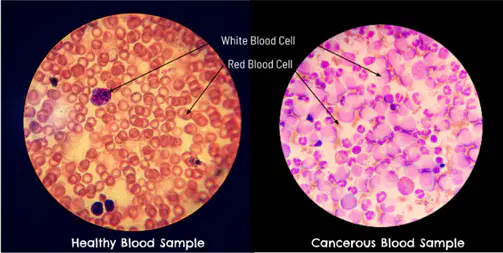
Compare the microscope slides of a healthy blood sample and a cancerous blood sample. Look closely.
Which cell type (red or white) would you say has cancer?
white blood cells
red blood cells
What process does a multi-cellular organism use to replace its damaged body cells?
mitosis
meiosis
replication
transcription

The model shows a segment of DNA with five different genes.
Look carefully.
Two genes have been identified for you.
Identify possible labels for other segments of DNA.
**Select THREE possibilities.
skin cells
eye color
number of fingers
ability to play piano
travel to Europe
The model shows a segment of DNA with five different genes.
What is a gene?
segment of DNA that codes for a particular trait
a chromosome
something in a cell
DNA and mitosis in a cell
a protein that is made faster using an enzyme
Which cells in your body contain a complete set of DNA?
all body cells
just skin cells
just liver cells
all except neurons and muscles
Your _____ contains the complete set of instructions to build your body.
DNA
idea
ribosome
protein

Do these cells have the same structure and function?
EXPLAIN!!
No, they are all found in different places, look different, and have different jobs.
No.
Yes, they are all found in the same places, look the same, and have the same jobs.
Yes.
Stem cells are pluripotent, while specialized cells are _____.
unipotent
pluripotent
stem cells
all the same
Stem cells vs. Specialized cells
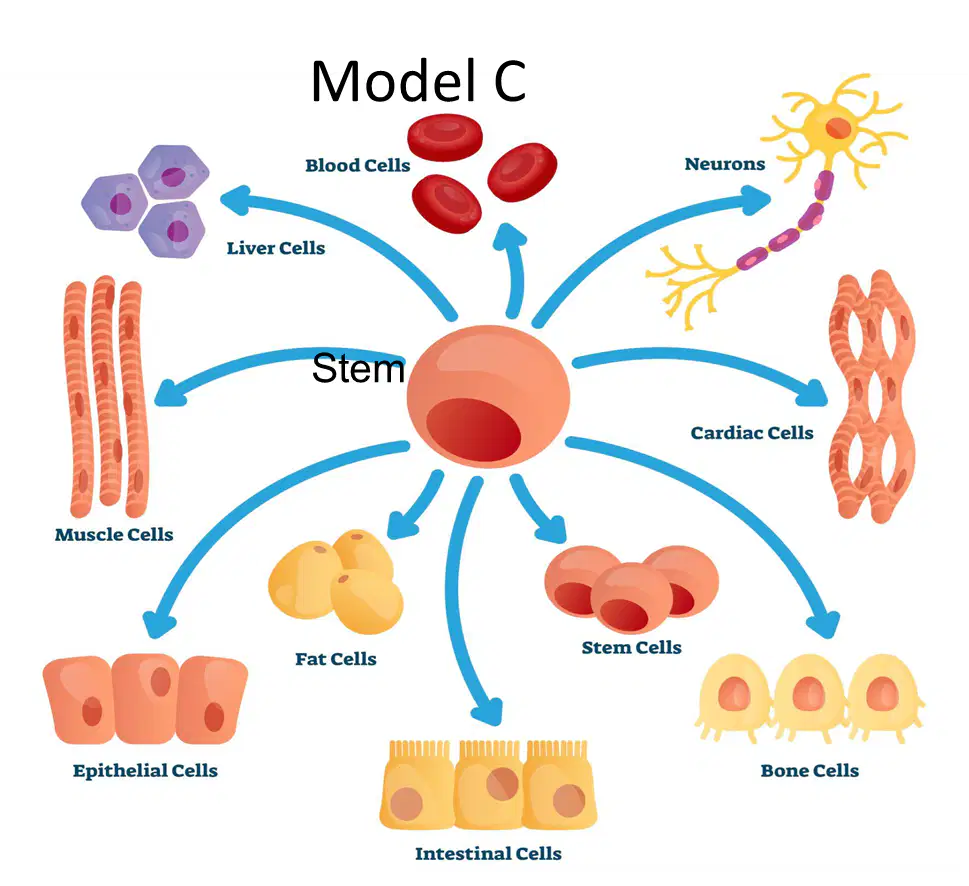
stem cell and the possible cells formed

red blood cells (RBCs) form more RBCs

intestine cells (ICs) form more ICs

A pluripotent cell has the potential to give rise to any other cell type. Based on the models, which type of cell would you consider to be pluripotent? Why?
The model that shows stem cells are able to create many types of other cells
The model that shows the red blood cell making more red blood cells.

Specialized cells are unipotent. Based on models D & E, come up with a definition of unipotent:
Stem cells are able to create many types of other cells
Unipotent cells can only give rise to one type of cell.
Unipotent cells are only found in the intestine.
Unipotent cells make cells that are different.
After a baby is born, there is still blood left in the umbilical cord and placenta. Many parents are freezing their child’s umbilical cord blood because it contains haematopoietic (blood) _____ cells.
stem
heart
skin
lung
After a baby is born, there is still blood left in the umbilical cord and placenta. Many parents are freezing their child’s umbilical cord blood because it contains haematopoietic (blood) stem cells.
These cells can _______.
make every type of blood cell
just make heart cells
definitely live forever when unfrozen
pay for college
Many parents are freezing their child’s umbilical cord blood because it contains haematopoietic (blood) stem cells. Why are parents doing this?
These healthy cells can be used to treat many different diseases the child might get or make new tissues for the child.
Haematopoietic stem cells are full of protein and nutrients.
Their child’s umbilical cord blood will definitely live forever when unfrozen and they could become an immortal and have super powers.
It will clearly pay for college.

USE YOUR PAPER COPY in order to read the graphs ---
According to the graphs, what do all of the cell types have in common?
They have the same number of genes.
They have a different number of genes.
They are all stem cells.
They are all skin cells.
USE YOUR PAPER COPY in order to read the graphs ---
According to the graphs, what are some differences?
They have different genes activated at different amounts.
They have a different number of genes.
They are all stem cells.
They have the same genes activated in the same amounts.
USE YOUR PAPER COPY in order to read the graphs ---
Compare the stem cell genes to the other cell types.
Stem cells have very few genes activated, compared to other cell types.
They have a different number of genes.
Stem cells have very many more genes activated, compared to other cell types.
They have the same genes activated in the same amounts.
USE YOUR PAPER COPY in order to read the graphs ---
According to the data, why do skin cells look and act like skin cells? Where are they getting their information from?
Skin cells have different genes activated, specifically 4, 5, and 10. No other genes are activated.
They have a different number of genes.
Skin cells have different genes activated, specifically 1, 5, and 8, with small amounts of other genes activated.
They have the same genes activated in the same amounts.
USE YOUR PAPER COPY in order to read the graphs ---
According to the data, How would you turn a stem cell into a skin cell?
Activate genes 9 and 10 above 75%.
There is no difference between a skin cell and stem cells.
Activate genes 1 and 5 above 75%.
Activate genes 3 and 4 above 75%.
USE YOUR PAPER COPY in order to read the graphs ---
According to the data, How would you turn a stem cell into a small intestine cell?
Activate genes 9 and 10 above 75%.
There is no difference between an intestine cell and stem cells.
Activate genes 1 and 5 above 75%.
Activate genes 3 and 4 above 75%.
USE YOUR PAPER COPY in order to read the graphs ---
According to the data, activating different genes produces different ____ in each cell.
chromosomes
traits
DNA
stem cells

USE YOUR PAPER COPY in order to read the model ---
The model shows the same segment of DNA found in a skin cell, heart cell, and ____ cell of the same person.
brain
pancreas
red blood
bone
USE YOUR PAPER COPY in order to read the model ---
Based on the DNA samples, do skin, heart, and pancreas cells all have the same amount of DNA?
yes
no
USE YOUR PAPER COPY in order to read the model ---
Based on the DNA samples, each one has the same genes, promoters, and enhancers in _____.
different places
the same places
USE YOUR PAPER COPY in order to read the model ---
Based on the DNA samples, the transcription factors are specific to each cell. How is this shown on the model?
same shapes and colors for the specific transcription factors
different shapes (triangle, circle, drop-shapes) and colors for the specific transcription factors
same shades/colors of lines on the DNA strip.
different shades/colors of lines on the DNA strip.
USE YOUR PAPER COPY in order to read the model ---
Based on the DNA samples -- AND -- knowing that structure determines function, will all three DNA samples create the same proteins?
NO -- Each gene is creating a different protein.
The shapes of the proteins made are all exactly the same on all three DNA samples, so yes. Look closely at the model. This is the wrong answer.
structure determines function
Chromosomes are made of DNA.
USE YOUR PAPER COPY in order to read the model ---
Based on the DNA samples, what seems to start the process of creating a protein?
Proteins begin forming right before gene 1 on all of the samples.
Specific transcription factors bind to the enhancers in front of the gene that is going to be transcribed.
Specific transcription factors bind to all the genes on all of the samples.
Genes are sections of DNA that code for certain proteins.
USE YOUR PAPER COPY in order to read the model ---
Based on the DNA samples, how is this a model of gene expression.
Gene expression is the same for all types of cells.
Gene expression is activating (producing proteins) for specific segments of DNA (genes).

THINK -- The arctic fox inhabits northern areas of North America. The same artic fox is shown in the drawing at different times of the year. What causes the change in fur color?
The alleles for fur color change as the arctic fox grows older.
Gene expression for fur color is regulated by the color of food eaten.
The white fur arctic fox hibernates in the summer.
Gene expression for fur color is regulated by temperature
Why do stomach cells function differently than skin cells?
They contain entirely different DNA
They use different genes in the DNA
THINK -- What is one goal of cellular differentiation?
To create many identical copies of cells.
To make stem cells for use in the future.
To make single-celled organisms.
To make specialized cells to maintain homeostasis.
How did the immortal cell line, known as HeLa, impact medical research?
It revolutionized medical research by enabling countless scientific discoveries and advancements.
It had no impact on medical research
It caused a decline in medical research
It led to the destruction of scientific discoveries
What are some of the ethical concerns surrounding the use of Henrietta Lacks' cells?
Lack of scientific value
Issues of copyright infringement
Issues of consent, privacy, and profiting without knowledge or consent
Violation of medical confidentiality
In what ways has Henrietta Lacks' story influenced discussions about patient consent and medical ethics?
It has no impact on patient consent or medical ethics
It has sparked discussions about the importance of informed consent, patient rights, and the ethical use of human tissues in medical research.
It has led to increased patient exploitation in medical research
It has resulted in decreased awareness of patient rights
What are some of the key contributions made by researchers using HeLa cells?
Contributions in agriculture and farming
Space exploration
Contributions in culinary arts
Contributions in cancer research, virology, genetics, and cell biology
Who was Henrietta Lacks?
A scientist who discovered cancer cells
A woman whose cells were used for research
A doctor who worked on vaccines
A researcher who studied DNA
Why were Henrietta’s cells unique?
They kept dividing in the lab when others died
They were bigger than normal cells
They could glow under light
They had no DNA
What name was given to Henrietta’s cells?
HeLa cells
H-L cells
Lacks cells
DNA cells
How are cancer cells different from normal ones?
They divide without stopping
They don’t have a nucleus
They divide only once
What ethical issue came from Henrietta’s story?
Her cells were used without her consent
Her DNA was destroyed
She refused treatment
Scientists hid her name on purpose
What have HeLa cells been used to study?
Vaccines and cancer
Plant growth
Space travel
Earth’s atmosphere
Henrietta Lacks’ story is connected to DNA replication and cancer because her cells were the first immortal human cells used for research, which helped scientists study how cancer cells replicate uncontrollably.
Her cells were the first immortal human cells used for research, helping scientists study how cancer cells replicate uncontrollably.
She discovered the process of DNA replication in cancer cells.
Her story led to the discovery of chemotherapy.
She was the first person to be cured of cancer using DNA technology.
The incidence of cancer in humans is much _____ than the incidence of cancer in whales, despite a whale having about 1000 times more cells than a human.
higher
lower
The TP53 gene contains the instructions for making a protein called tumor protein 53, or P53.
When the TP53 gene changes, the body doesn’t make properly functioning P53 protein.
Without properly functioning P53 proteins, cells can divide uncontrolled and become _____.
cancers
influenza
small pox
warts
The TP53 gene contains the instructions for making a protein called tumor protein 53, or P53.
When the TP53 gene changes, the body doesn’t make properly functioning P53 protein.
Without properly functioning P53 proteins, cells can divide uncontrolled and become cancers.
Which organism has MORE P53?
whale
human
The TP53 gene contains the instructions for making a _____, which helps control cells from becoming cancerous.
protein
virus
lipid
wart
sugar
What is apoptosis?
A cancer-causing substance
A protein that regulates cell division
A stage of cell division
Programmed cell dealth

