wayground logo

Free Printable Worksheets

NEW

Font size

S
M
L
XL
Worksheets

5.3 Comparing Compounds and Metals

Total questions: 34

Worksheet time: 40mins

Name
Class
Date
1.
Elements combine to form __________.
a)
compounds
b)
atoms
c)
positive ions
d)
negative ions
2.
What part of an atom is involved in chemical bonding?
a)
protons
b)
neutrons
c)
electrons
d)
nucleus
3.
Compounds made from only nonmetals are _________________ compounds.
a)
ionic
b)
covalent
c)
metallic
d)
chemical
4.
A covalent bond involves a __________ of electrons.
a)
sharing
b)
borrowing
c)
exchanging
d)
switching
5.
A chemical bond resulting from the electrostatic attraction between positive and negative ions is called a(n)
a)
covalent bond.
b)
ionic bond.
c)
charged bond.
d)
dipole bond.
6.
How many valence electrons does a bromine atom have?
a)
1
b)
2
c)
6
d)
7
7.
AgF
a)
silver fluoride
b)
silver fluorine
c)
monosilver monofluoride
d)
silver monofluorine
8.
If my charge becomes 2+ what does that say about me?
a)
I am stealing 2 electrons
b)
I am losing 2 electrons
c)
I am in period 2
d)
I have an atomic # of 2
9.
If I gain electrons I become
a)
Positive because I've added to my atom
b)
negative because I've added electrons
c)
same because i'm balanced
d)
equal because now I have electrons
10.

What is an allotrope?

a)

Same element, different structural arrangement

b)

When an element combines with another substance

c)

When a compound breaks apart

d)

A mixture of elements

11.

Graphite and diamond are two forms of solid carbon at STP. These forms have

a)

different molecular structures and different properties

b)

different molecular structures and the same properties

c)

the same molecular structures and different properties

d)

the same molecular structures and the same properties

12.

Which of the following is NOT an allotrope of carbon?

a)

Graphite

b)

Diamond

c)

Fullerenes (bucky balls)

d)

Silicon

13.
What is the basis of a metallic bond?
a)
the attraction of neutral metal atoms.
b)
the attraction between protons and neutrons.
c)
the attraction between positive metal ions and interlocking electrons.
d)
the attraction between positive metal ions and free floating electrons.
14.
There are more metals than non metals in the periodic table.
a)
True
b)
False
15.
What does malleable mean?
a)
able to be shaped
b)
will break easily
c)
can be used for wire
d)
is shiny
16.
Which of these is NOT an alloy?
a)
bronze
b)
copper
c)
brass
d)
stainless steel
17.
What is the ability of a substance to be pulled into a thin strand?
a)
Malleability
b)
Ductility 
c)
Conductivity
d)
Solubility
18.
Why do metals conduct
a)
They are shiny
b)
The electrons are held tightly within the lattice
c)
The electrons are delocalised and able to move
d)
The electrons are shared between two metal ions
19.
A mixture of two or more metals is called:
a)
mixture
b)
solution
c)
compound
d)
alloy
20.
Electrons that are free to move in metals
a)
delocalized electrons
b)
oxidation number
c)
chemical bond
d)
salts
21.
What is the ability of a substance to be rolled or pounded into a thin sheet?
a)
Malleability
b)
Ductility
c)
Conductivity
d)
Solubility
22.
What is the ability of a substance to allow heat, sound, or electricity to flow through it?
a)
Malleability
b)
Ductility
c)
Solubility
d)
Conductivity
23.
At room temperature, most metals are
a)
liquid
b)
solid
c)
gas
d)
an alloy
24.
Why are alloys generally used to make everyday objects?
a)
Alloys are often stronger and less active than pure metals.
b)
Alloys have higher melting point than pure metals.
c)
Alloys are less expensive to produce than pure metals.
d)
Alloys have ionic bonds instead of metallic bonds.
25.
How light reflects off of a mineral is called the mineral's 
a)
luster
b)
streak
c)
cleavage
d)
fracture
26.
Which of the following is a physical characteristic of a nonmetal?
a)
texture
b)
malleable
c)
brittle
d)
semi-conductor
27.
Which of the following is a physical characteristic of a metalloid?
a)
texture
b)
malleable
c)
brittle
d)
semi-conductor
28.
An element has properties of both metals and nonmetals. Where would it be found in the periodic table? 
a)
To the right 
b)
To the left 
c)
on the zig zag line
29.
What does luster mean?
a)
Breaks into pieces
b)
can be hammered into thin sheets
c)
No shine
d)
reflects light shiny 
30.
What does brittle mean?
a)
Breaks into pieces
b)
can be hammered into thin sheets
c)
No shine
d)
reflects light shiny 
31.
How would this element be classified?
a)
Metal
b)
Nonmetal
c)
Metalloid
d)
Metamorphic
32.

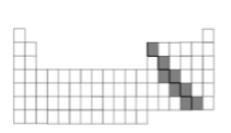
Elements in the shaded area can best be described as -

a)

Malleable

b)

Brittle

c)

Dull

d)

Insulators

33.

Elements in the shaded area can best be described as -

a)

Semi-conductors

b)

Insulators

c)

Ductile

d)

Siny

34.

Elements in the shaded area can best be described as -

a)

Shiny and brittle

b)

Insulators

c)

Good conductors