
 Worksheets
Molecular Biology Review
Total questions: 35
Worksheet time: 19mins
Name
Class
Date
1.
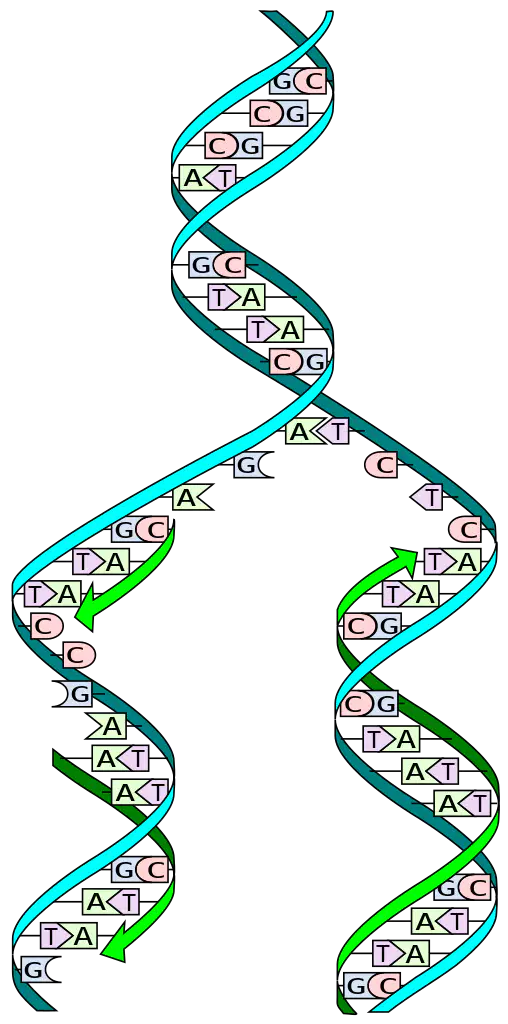
The process of DNA replication is shown below. This process keeps one of the original strands in each of the new ones. What is this called?
a)
Antiparallel
b)
Mitosis
c)
Semi-Conservative Replication
2.
What process occurs in the S phase of the cell cycle when DNA is copied?
a)
DNA Replication
b)
Transcription
c)
Translation
3.
What process occurs in when RNA is made from DNA?
a)
DNA Replication
b)
Transcription
c)
Translation
4.
What process occurs when converting the genetic code in RNA into the amino acid sequence of a protein?
a)
DNA Replication
b)
Transcription
c)
Translation
5.
A scientist is studying the relationship between biochemical and molecular interactions within the cell. What branch of biology is this?
a)
Ecology
b)
Evolutionary Biology
c)
Molecular Biology
d)
Technology
6.
DNA and RNA are both made of of long chains of molecules called nucleotides. What category of macromolecules do they fall into?
a)
Carbohydrate
b)
Lipid
c)
Nucleic Acid
d)
Protein
7.
What macromolecule is an organic compound composed of one or more chains of polypeptides which in turn are formed from amino acids?
a)
Carbohydrate
b)
Lipid
c)
Nucleic Acid
d)
Protein
8.
What is the formation of proteins using information coded on DNA and carried by RNA?
a)
Chargaff's rules
b)
DNA Replication
c)
Protein Synthesis
d)
Photosynthesis
9.
What organic acid and polymer is composed of four nitrogenous bases (adenine, thymine, cytosine, guanine). It is the genetic material of most organisms, existing as a double stranded molecule that is held together by hydrogen bonds?
a)
Amino Acid
b)
DNA (deoxyribonucleic acid)
c)
RNA (ribonucleic acid)
d)
Enzyme
10.
What organic acid and polymer is composed of a single strand of nucleotides that consist of four nitrogenous bases (adenine, uracil, cytosine, guanine). It acts as a messenger between DNA and ribosomes and carries out the process of protein synthesis?
a)
Amino Acid
b)
DNA (deoxyribonucleic acid)
c)
RNA (ribonucleic acid)
d)
Enzyme
11.
What is the shape of the DNA molecule, resembling a spiral staircase?
a)
Double Helix
b)
Primary Structure
c)
Quaternary Structure
d)
Single Helix
12.
What is the building block of DNA and RNA that consists of a nitrogenous base, five-carbon sugar, and phosphate group?
a)
Amino Acid
b)
Codon
c)
Nucleotide
d)
Phospholipid
13.
What is a pair of complementary nitrogenous bases in a DNA molecule?
a)
Anticodon
b)
Base pair
c)
Codon
d)
Phosphate-Sugar
14.
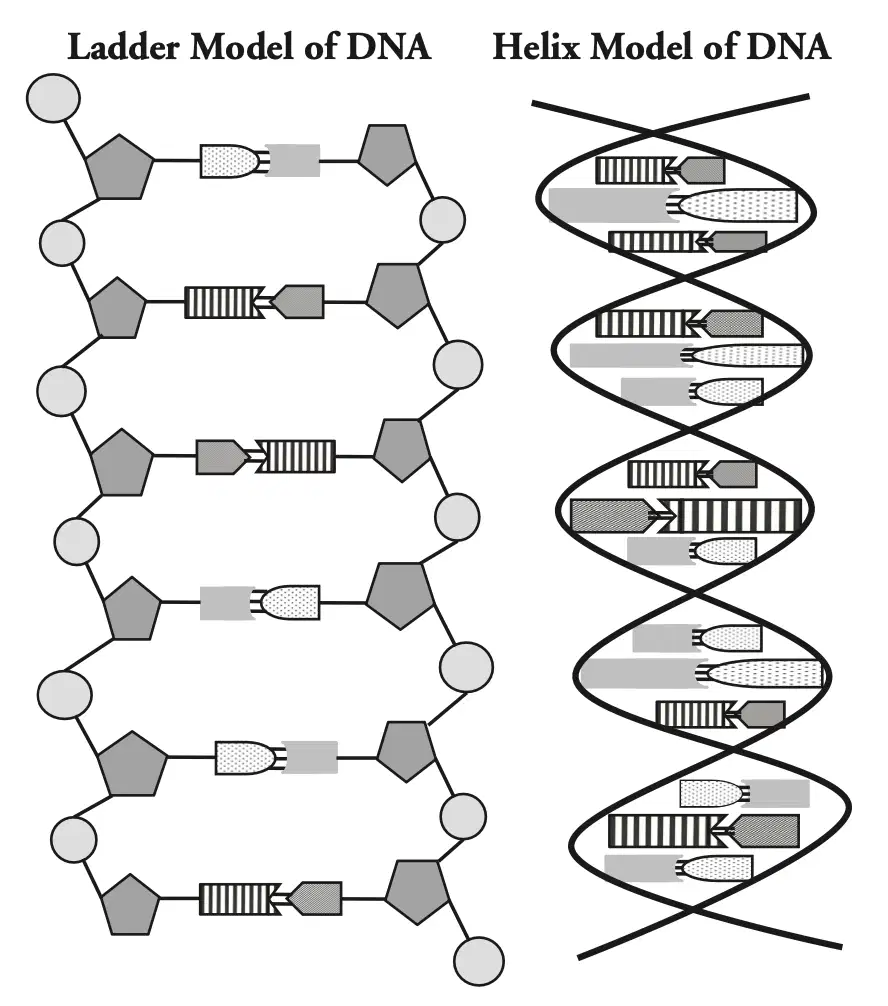
Below is a model of DNA. What type of bonds hold the molecule together?
a)
Hydrogen
b)
Water
c)
Sugar
15.
What type of bond holds together the nitrogenous bases on DNA?
a)
Hydrogen
b)
Oxygen
c)
Phosphate
16.
What is a change in the DNA code or sequence of a gene?
a)
Base Pair
b)
Mutation
c)
Protein
17.
Which type of RNA copies genetic instructions from DNA in the nucleus and carries instructions to the cytoplasm?
a)
messenger RNA (mRNA)
b)
ribosomal RNA (rRNA)
c)
transfer RNA (tRNA)
18.
Which type of RNA brings amino acids to the ribosomes where they are joined in the correct order to make proteins?
a)
messenger RNA (mRNA)
b)
ribosomal RNA (rRNA)
c)
transfer RNA (tRNA)
19.
Which type of RNA helps to form the structure of a ribosome?
a)
messenger RNA (mRNA)
b)
ribosomal RNA (rRNA)
c)
transfer RNA (tRNA)
20.
Where does transcription take place?
a)
nucleus
b)
cytoplasm
c)
ribosome
21.
What are the sections of code that do NOT code for a protein?
a)
exon
b)
codon
c)
intron
22.
What is the complementary sequence on tRNA that reads the mRNA in sets of three bases?
a)
amino acid
b)
anticodon
c)
exon
23.
Where does translation take place?
a)
nucleus
b)
cytoplasm
c)
ribosome
24.
All living organisms use the same genetic code. This means it is ______.
a)
Redundant
b)
Unambiguous
c)
Universal
25.
Each codon only codes for one amino acid. This means the genetic code is ______.
a)
Redundant
b)
Unambiguous
c)
Universal
26.
Each of the 64 codons only codes for one amino acid. This means the genetic code is ______.
a)
Redundant
b)
Unambiguous
c)
Universal
27.
Most of the 20 amino acids have more than one codon. This means the genetic code is ______.
a)
Redundant
b)
Unambiguous
c)
Universal
28.
If one strand of DNA was coded with the bases ACTGCCAGT, what would be the bases on the opposite strand of DNA according Chargaff's rules of base pairing?
a)
ACTGCCAGT
b)
ACUGCCAGU
c)
TGACGGTCA
d)
UGACGGUCA
29.
If one strand of DNA was coded with the bases ACTGCCAGT, what would be the bases on the complementary strand of mRNA after transcription?
a)
ACTGCCAGT
b)
ACUGCCAGU
c)
TGACGGTCA
d)
UGACGGUCA
30.
What are the characteristics of DNA? (choose all that apply)
a)
found in nucleus
b)
has ribose sugar
c)
is a double helix
d)
contains the bases ACGT
31.
What are the characteristics of RNA? (choose all that apply)
a)
found in nucleus
b)
has ribose sugar
c)
is a single helix
d)
contains the bases ACGU
32.

If the mRNA codon is AUG, what amino acid would the tRNA bring?
a)
Met
b)
GLu
c)
Ala
d)
Phe
33.

Which phase of which process does this picture show?
a)
Transcription
b)
Translation
c)
Replication
34.

The principle shown in the image is called what?
a)
Transcription
b)
The Central Dogma
c)
Translation
d)
The Principle of Proteins
35.

Use your codon chart to match the DNA sequence TGA to the correct amino acid.
a)
Thr
b)
Ala
c)
Val
d)
Gly
100 %

