
 Worksheets
Skull and Facial
Total questions: 52
Worksheet time: 26mins
On recumbent patients (lateral projection), a pillow may be placed underneath the head for patients that are
asthenic
hyposthenic
yousthenic
hypersthenic
Well demonstrated sella turcica, dorsum sellae, anterior and posterior clinoid processes means the patient is in
PA projection
AP Projection
Superoinferior Projection
Lateral projection
Which is not in profile on a PA caldwell method skull?
orbits filled by petrous ridges
crista galli
ethmoid sinus
sella turcica
Petrous ridges are in upper third of orbit on PA Axial skull
True
False
Which projection requires a 15 degree cephalic CR that enters the nasion
AP
Townes
Reverse Caldwell
Caldwell
Which projection puts the occipital bone in profile?
Reverse Caldwell
Caldwell
Towne
PA
Which projection has the dens in profile?
SMV
Towne
Caldwell
Reverse Caldwell
Which projection has the MML perpendicular to the IR?
Modified waters
Waters
Towne
SMV
Which projection has the petrous ridges completely outside the maxillary sinuses?
Modified waters
Waters
Caldwell
PA
Which projection sees the orbital floor perpendicular to the IR and parallel to the CR?
Modified waters
Waters
Caldwell
SMV
Which projection rounds out the orbits?
Caldwell
Towne
SMV
Lateral
For a lateral facial bone the MSP is parallel with the IR and the OML is perpendicular to the front edge of the IR
True
False
There should be some slight superimposition of the gonion and cervical spine on a lateral facial bone
True
False
The CR enters the EAM for a lateral facial bone
True
False
Select the 2 that apply for a PA (Caldwell Method):
OML perpendicular to IR
IR centered to nasion
CR enters the EAM
CR enters midway between the EAM and outer canthus
The CR enters midway between the EAM and outer canthus for a lateral facial bone.
The CR enters midway between the EAM and outer canthus for a lateral facial bone.
The CR enters at the glabella for a lateral facial bone.
The CR enters at the nasion for a lateral facial bone.
The CR enters at the mental point for a lateral facial bone.
True
True
False
Which projection rounds out the orbits?
Caldwell
Waters
AP
SMV
Well demonstrated sella turcica, dorsum sellae, anterior and posterior clinoid processes means the patient is in
Lateral projection
PA projection
AP axial projection
Towne's projection
All of the following should be seen on a lateral image of the skull, except
Mandible overlapping cervical spine
Sella turcica
Frontal sinus
Occipital bone
There should be some slight superimposition of the gonion and cervical spine on a lateral facial bone
True
False
Which of the following line is placed perpendicular to the IR plane for the AP Axial (Towne) projection when using a 30 degree caudal angle?
IOML
OML
Which projection requires a 15 degree cephalic CR that enters the nasion
Reverse Caldwell
Waters
SMV
PA
Petrous ridges are in upper third of orbit on PA Axial skull
True
False
For a lateral facial bone the MSP is parallel with the IR and the OML is perpendicular to the front edge of the IR
True
False
Which projection has the petrous ridges completely outside the maxillary sinuses?
Waters
Modified Waters
On a lateral skull projection, which of the following should be perpendicular to the IR?
IPL
OML
IOML
MML
Which is not in profile on a PA caldwell method skull?
Petrous ridges
Frontal sinus
Nasal septum
Zygomatic arch
What is the anatomical structure referred to as 'sella turcica'?
sella turcica
optic chiasm
foramen magnum
crista galli
petrous part of temporal bone
The CR enters approximately __ inch(es) above the glabella on an AP Axial (Towne Method).
2 1/2
1
3
4
What are the CR angles for the following positioning lines in an AP Axial (Towne Method) projection?
A: 30 B: 37
A: 20 B: 27
A: 25 B: 32
A: 15 B: 22
Which line should be placed parallel to the plane of the IR for the SMV projection?
IOML
OML
MML
AML
Which projection has the dens in profile?
SMV
AP Open Mouth
Lateral Cervical
Oblique Cervical
Often a patient cannot be turned into the prone position for a Caldwell method. What CR angle would be used if an AP projection is used instead?
15 degrees cephalad
30 degrees caudad
0 degrees (perpendicular)
45 degrees cephalad
For a PA Axial (Caldwell Method) projection, the CR is angled
15 degrees caudad
30 degrees cephalad
10 degrees cephalad
20 degrees caudad
Which projection will be used to rule out an occipital bone fracture? Spelling counts.
IOML
OML
AP Axial
Lateral
Which projection sees the orbital floor perpendicular to the IR and parallel to the CR?
Waters
Modified Waters
A patient came into the ER via ambulance after a motor vehicle accident. The patient is on a backboard. The patient is able to flex and extend their neck but has lower back pain and isn't allowed to get up until cleared by the ER from any back injuries. The patient has swelling around their left orbit. The doctor is worried about a blow out fracture. The exam will use an ______[a] projection with the ______[b] Line, ______[c] degrees to the IR. To ensure a good image to rule out a fracture.
Modified Waters projection, OML (Orbitomeatal Line), 50 degrees
Caldwell projection, IOML (Infraorbitomeatal Line), 30 degrees
Townes projection, AML (Acanthiomeatal Line), 45 degrees
Lateral projection, MML (Mentomeatal Line), 90 degrees
In the context of a blow out fracture, the petrous ridges should be at the level midway through the ___ [a].
Modified Waters
Caldwell
Townes
Lateral
In the context of a blow out fracture, the petrous ridges should be at the level midway through the ___ [b].
OML
IOML
AML
MML
In the context of a blow out fracture, the petrous ridges should be at the level midway through the ___ [c].
55
orbit
maxilla
sphenoid
In the context of a blow out fracture, the petrous ridges should be at the level midway through the ___ [d].
nasion
sella turcica
foramen magnum
external occipital protuberance
A clinical sign the radiologist will look for to help determine if there is an orbital floor fracture will be a ______ [e] sign.
teardrop
butterfly
starburst
crescent
What is the meaning of the term 'orbitomeatal'?
Relating to the orbit and the external auditory meatus.
Relating to the eye and nasal cavity.
Relating to the mouth and ear canal.
Relating to the orbit and the jaw.
Which projection puts the occipital bone in profile?
Towne
Waters
Caldwell
Lateral
On recumbent patients (lateral projection), a pillow may be placed underneath the head for patients that are:
Asthenic
Hypersthenic
Sthenic
Hyposthenic
Which projection has the MML perpendicular to the IR?
Waters
Modified Waters
Towne
Caldwell

What is the pathology?
Left zygomatic arch fracture
Right skull fracture
Left parietal bone fracture
Parietal bone fracture

What is the pathology?
Parietal bone fracture
Left zygoma fracture
Right skull fracture
zygomatic arch fracture
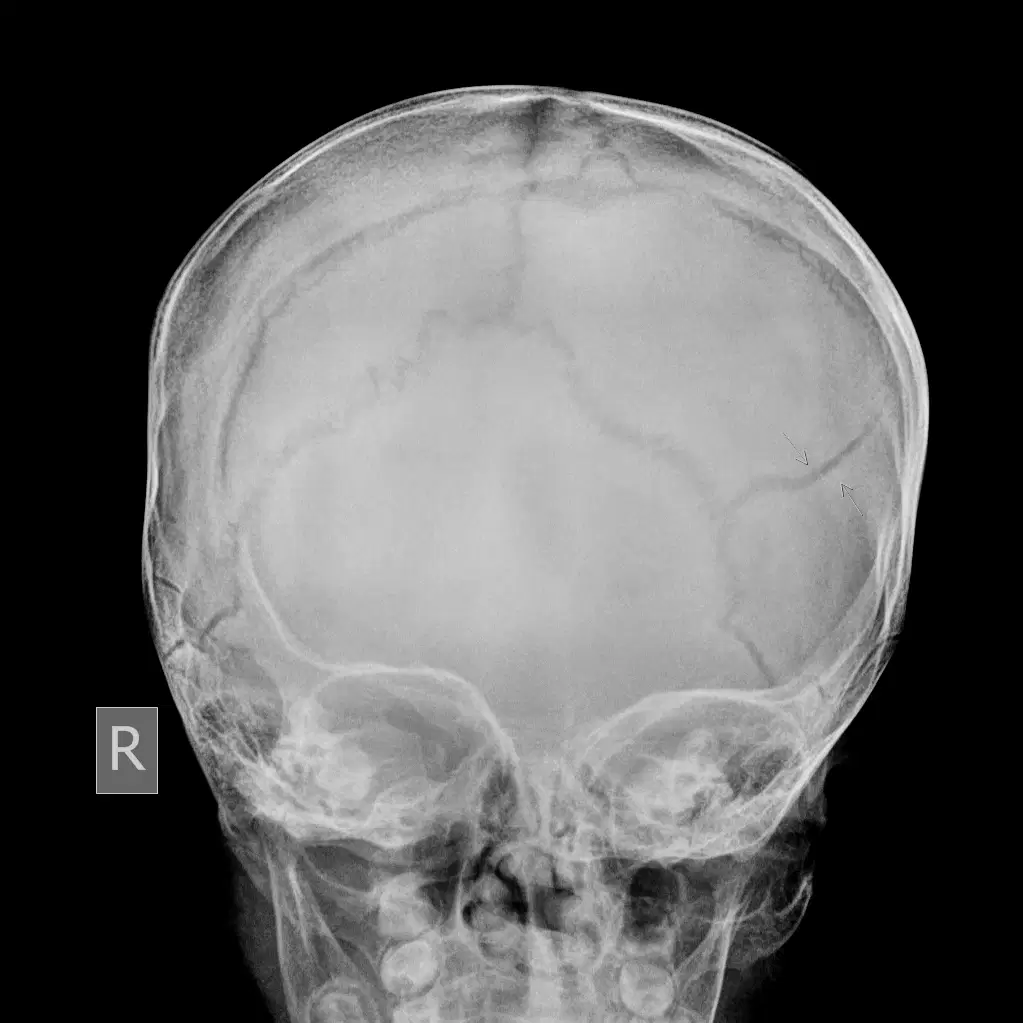
What is the pathology?
Nasal bone fracture
Left zygoma fracture
Left parietal bone fracture
Right skull fracture

What is the pathology?
Skull fracture
Right skull fracture
Parietal bone fracture
Left zygomatic arch fracture

Left zygoma fracture
Right skull fracture
Parietal bone fracture
Nasal bone fracture

