
 Worksheets
Q2 Benchmark
Total questions: 102
Worksheet time: 3600secs
A student tests how different amounts of salt affect how quickly ice melts. What is the independent variable?
Temperature of the room
Amount of salt added
Time it takes to melt
Type of container
Two groups test how effective a new plant fertilizer is. Group A uses 3 plants; Group B uses 30. Which group has more reliable results?
Group A
Group B
Both equally
Cannot tell
A balloon is placed in a freezer and shrinks. What explains this change?
Gas particles gain energy
Gas particles slow and exert less pressure
Gas particles increase in number
Balloon material becomes heavier
A metal spoon rests in hot soup. After 2 minutes the handle is hot. What happened?
Convection
Conduction
Radiation
Absorption
A student mixes baking soda with vinegar and the cup becomes warm. What type of change is this?
Physical
Chemical
Nuclear
Periodic
A student notices that a puddle disappears on a hot day. What is the BEST explanation?
Water freezes
Water boils suddenly
Water evaporates due to heat
The air absorbs water particles
A red shirt looks black under blue light. Why?
Red light is reflected
Blue light is reflected
The shirt absorbs blue light
The shirt reflects all colors
A science class tests how temperature affects dissolving rate. Which is the dependent variable?
Amount of water
Temperature of water
Type of solute
Rate at which it dissolves
A student places a cold metal block on warm wood. After a few minutes, both are the same temperature. Why?
Energy stops moving
Heat moves from cold to hot
Heat moves until equilibrium
Wood cools the metal only
A sample of sugar is heated until it turns brown and creates smoke. What does this indicate?
A physical change
A chemical change
A phase change
A mixture forming
A student shines a laser from air into water. The beam bends toward the normal line. Why?
Light speeds up
Light slows down
Light splits into colors
Water absorbs light
A student measures mass before and after boiling water. The mass is the same. Which law is demonstrated?
Law of magnetism
Law of reflection
Law of conservation of energy
Law of conservation of mass
Students mix sand, iron filings, and salt. How can they separate the iron?
Heating
Filtering
Using a magnet
Adding water
A roller coaster car stops at the highest point. Which energy is greatest?
Chemical
Kinetic
Potential
Light
A tree study uses only 5 trees and results vary widely. How can the reliability improve?
Use more trees
Use fewer trees
Use different fertilizer
Change the hypothesis
Students compare how sound travels through air, water, and metal. Where will it travel the fastest?
Air
Space
Water
Metal
A student heats a white solid with liquid B. The mixture fizzes and gives off heat. What type of change is this?
Physical
Chemical
Mixture
Freezing
A scientist dissolves sugar in water. What happened on the particle level?
Sugar breaks into new substances
Sugar reacts with water
Sugar particles spread out
Water changes chemically
A block of ice melts on a table. Which microscopic change explains this?
Particles freeze
Particles lose energy
Particles stop moving
Particles gain energy and move apart
Which is the smallest unit of matter that still has the properties of an element?
Molecule
Atom
Compound
Mixture
Which is a pure substance?
Saltwater
Air
Iron (Fe)
Lemonade
Water (H₂O) is classified as—
An element
A compound
A mixture
A solution
Which example is a mixture?
Oxygen gas
Gold
Table salt (NaCl)
Sand and iron
A sample contains only one type of atom. What is it?
Mixture
Element
Compound
Solution
Which is a homogeneous mixture?
Chocolate chip cookie
Trail mix
Saltwater
Pizza
Which describes a compound?
Has only one type of atom
Can be separated by physical means
Formed when atoms chemically bond
Always a solid
Which is the BEST example of a heterogeneous mixture?
Sugar water
Air
Oil and water
Stainless steel
What do all pure substances have in common?
Made of many different particles
Composition stays the same
Always mixtures
Can be separated physically
The chemical formula CO₂ tells you that the substance—
Is a mixture
Has 1 carbon and 2 oxygen atoms
Is an element
Has no atoms
Which is NOT a pure substance?
Copper
Water
Air
Salt (NaCl)
Which statement describes a molecule?
One atom
Two or more atoms chemically joined
A mixture of elements
Always made of metals
Which mixture can be separated using a magnet?
Sand and water
Sugar and water
Iron and sand
Saltwater
Which is BOTH a pure substance AND a compound?
Carbon
Helium
Water
Air
Which is a solution?
Salad
Soil
Saltwater
Oil and vinegar
Which correctly describes an element?
Cannot be broken down chemically
Made from two substances
Made of different atoms
Always a gas
Which sample is a mixture of compounds?
Water
Carbon dioxide
Air
Iron
A student stirs sugar into tea until it disappears. On the particle level—
Sugar breaks into new substances
Sugar particles spread evenly
Sugar atoms combine with tea
Tea changes chemically
Which is a chemical formula of a compound?
O₂
Ne
H₂O
Fe
A substance is made from two elements bonded together. Which term describes it?
Mixture
Solution
Compound
Element

A student wants to test the hypothesis of "If salt is added to water then the boiling point of water will decrease (go down)." What is the independent variable?
Whether salt is added or not
Boiling Point
Amount of water
Which is an example of a container filled with a pure substance?
a glass of iced tea
a bucket of salt water
a tire filled with air
a balloon filled with helium

What type of substance is pictured?
element
compound
mixture
solution

What type of substance is pictured?
element
compound
mixture
solution

What type of substance is pictured?
element
compound
mixture
A substance that can NOT be broken down by physical or chemical means
element
compound
mixture
Matter is anything that has...
weight and volume
mass and density
mass and weight
mass and volume
Matter that is composed of one type of atom is ...
an element
a compound
a molecule
a mixture
A combination of substances that are not bonded together is...
an element
a compound
a mixture
jello
Which is a mixture of compounds?


Which is a pure substance?


A substance that can be broken down by physical means is ...
an element
a compound
a mixture
a mixture that appears the same throughout is...
homogeneous
heterogeneous
two or more atoms bonded together is...
an element
a big atom
a molecule
a mixture
What determines the identity of an element?
Number of protons
Atomic mass
Number of electrons
Number of neutrons
What is the charge of a neutron?
Variable
Negative
Positive
No charge
What is the pH of a neutral solution?
1
0
7
14
Which of the following is a homogeneous mixture?
Sand and iron
Vinegar
Snack mix
Salad
What is the approximate mass of an electron?
3 amu
2 amu
0 amu
1 amu
What is the formula for density?
Density = Mass / Volume
Density = Volume / Mass
Density = Volume x Mass
Density = Mass x Volume
Which of the following is a pure substance?
Gold (Au)
Salad
Vinegar
Air
What is the result of a neutralization reaction?
Base
Salt and water
Hydrogen gas
Acid
Which of the following is a reversible change?
Melting ice
Rusting iron
Burning wood
Baking a cake

What do you call the red particles in this mixture?
Solvent
Solute
Solution



Which elements are colored red?
nonmetals
metals
metalloids

The arrow labeled #3 is pointing to:
Element Symbol
Atomic Mass
Atomic Number
Element Name

Which of the following is a base?
baking soda in water
orange juice
vinegar
lemonade

The pH scale...what numbers on the scale represent an acid?
0-6
7
8-14

Based on the pH scale representation, a pH of 3 demonstrates GREATER acidity than a pH of 5?
True
False
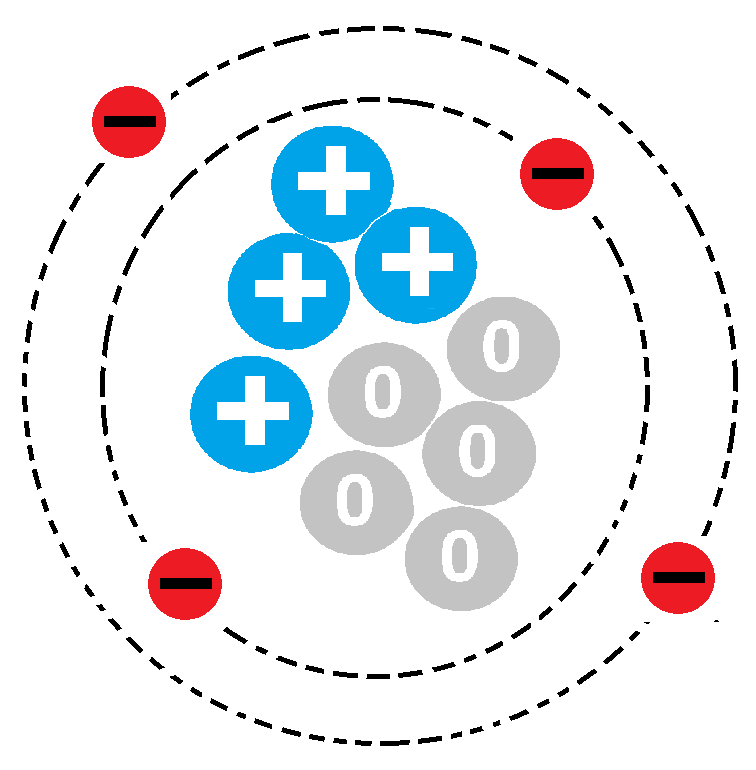


What is the atomic number of this atom?
(a)

Acid + Base → Salt + --------------------, the PH is about ---------------
water, 7
acid, 5
base, 9
Refraction is,
When light bounces off an object
When light is bent inside an object
When light is blocked by an object
When light is created from an object
A translucent object is
An object that transmits light, but not a clear image
An object that transmits light and detail
An object that stops light
An object that creates light
A transparent object is,
An object that transmits light
An object that transmits light and detailed image
An object that stops light
An object that creates light
A transparent object is,
An object that transmits light
An object that transmits light and detailed image
An object that stops light
An object that creates light
Light always travels in.
Curved lines
Scattered lines
Straight lines, until it encounters a medium
It does not travel

Which of the following is a sign that a chemical reaction (or change) has occurred?
change in shape
melting
formation of a gas
dissolving

Is melting butter for popcorn a chemical or physical change?
chemical
physical
Which of the following is NOT an example of a physical change?
crumpled paper
dissolving sugar in water
freezing water
burning a marshmallow

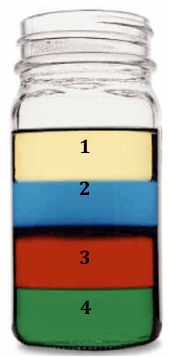

What is happening to the molecules of water in the chemical change: electrolysis?
Molecules get closer together and more packed
Molecules break apart and form new molecules (H and O gas)
The atoms in the molecules get bigger
Nothing happens to the molecules

