
 Worksheets
Dec Norblade Assessment 2025
Total questions: 50
Worksheet time: 27mins
Viral STIs are treatable only.
True
Depends on the STI
False
Condom use provides COMPLETE protection from
Pregnancy but not STIs
Both STIs and pregnancy
Neither STIs nor pregnancy
STIs but not pregnancy
To keep yourself 100% safe from STIs
Use protection every time
Use birth control
Remain abstinent
Get yourself tested before every partner
What are core memories?
The most impactful memories that strongly influence your emotions and behaviors
Any memory of something you do every day, like brushing your teeth or tying your shoes.
Memories that are impactful for only a part of your life then forgotten.
Memories when you were under 12 that you still remember
What are the 3 categories of drugs we covered in class?
Stimulants
Depressants
Prescription Medication
Hallucinogens
What is the legal BAC for an adult?
.2
.02
.8
.08
Which example shows a stimulant and then a depressant.
Alcohol, Nicotine
Caffeine, Nicotine
Weed, Caffeine
Caffeine, Alcohol
Select all the examples of "Binge"
A man consuming five or more drinks in a row
Watching an entire season of Grey's Anatomy in one night.
Having 2 alcoholic drinks at dinner.
Eating a bowl of cereal with milk, 2 scoops of ice cream, ½ bag of chips and a sleeve of cookies in a two hour period, after a full size dinner
13. Love Languages: Non Verbal, use of body language and contact to express love
Physical Touch
Words of Affirmation
Acts of Service
Receiving Gifts
14. Love Languages: Encourage, compliment, appreciate others.
Words of Affirmation
Physical Touch
Receiving Gifts
Acts of Service
15. Love Languages: Thoughtfulness, making another feel as a priority, getting thoughtful items
Receiving Gifts
Words of Affirmation
Physical Touch
Acts of Service
16. Love Languages: Creating a special moment together, going for walks, do something together, uninterrupted
Quality Time
Words of Affirmation
Receiving Gifts
Acts of Service
17. Love Languages: Do chores together, make them breakfast in bed, help them with their responsibilities.
Acts of Service
Words of Affirmation
Physical Touch
Receiving Gifts
What is the following type of Anxiety Disorders: Phobias
Having repeated episodes of sudden, unexpected, intense fear that come with symptoms like heart pounding, having trouble breathing, or feeling dizzy, shaky, or sweaty
Having extreme fear about a specific thing or situation.
Being persistently worried about the future and about bad things happening
Having frequent unwanted thoughts, and repetitive behaviors or habits that one feels like must be done because of those thoughts
Long-term symptoms that are caused by or related to witnessing or experiencing a traumatic event or a series of stressful events, that are upsetting and interfere with relationships or daily functioning
In terms of a healthy relationship, this is giving permission for something to happen.
Consent
Trust
Respect
Communication
Why is sadness a necessary part of life?
Helps Process Loss, Change and Encourages Reflection
Signals the Need for Support and Helps Balances Other Emotions
Builds Resilience and Strengthens Empathy
It doesn't, sadness is a waste of energy.
What is the name of our Resource Officer?
Fay
Carman
Innes
Spilker
What is the name of our school social Worker?
Carman
Fay
Innes
Spilker
What is the name of our school psychologist?
Spilker
Fay
Innes
Carman
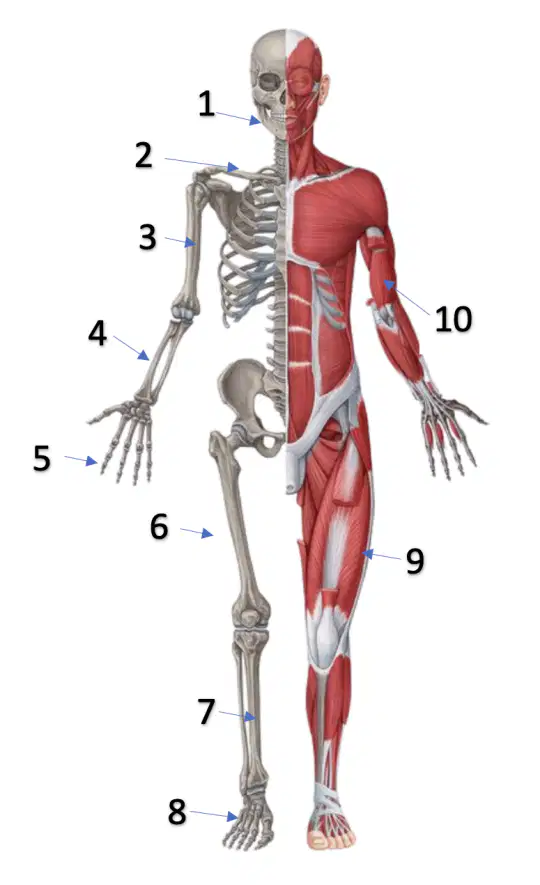
What is the name of the part labeled #1?
Metatarsals
Mandible
Bicep
Carpals
Hamstrings
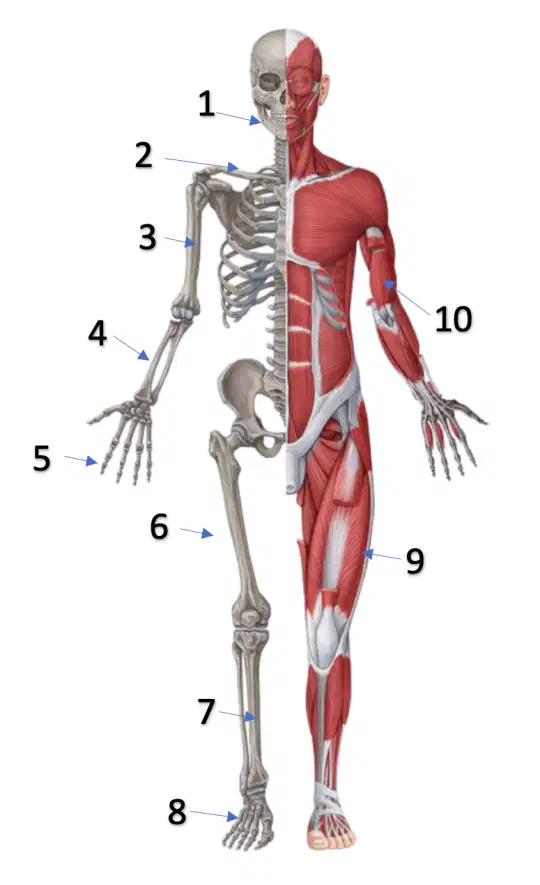
What is the correct name for the part labeled #5?
Tarsals
Carpals
Phalanges
Metatarsals
Metacarpals
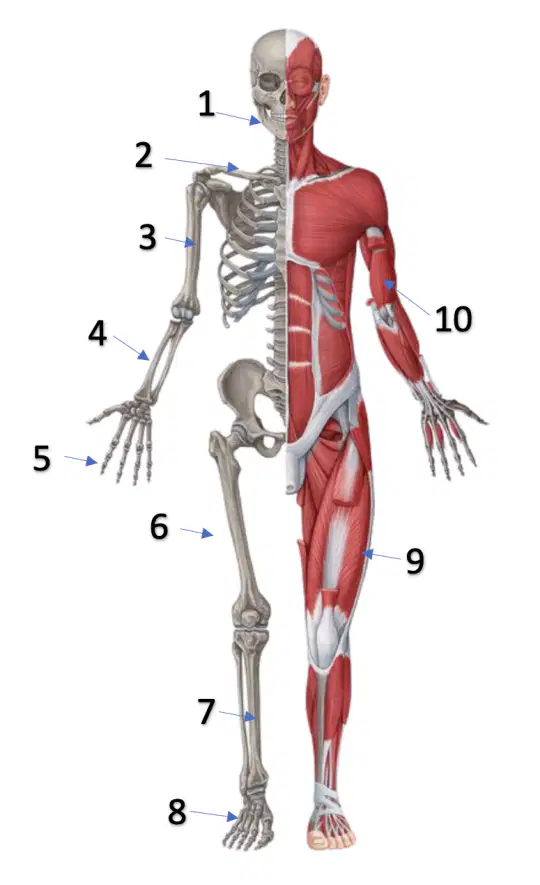
What is the correct name for the part labeled #2
Metatarsals
Clavicle
Bicep
Hamstrings
Femur

Which part is labeled as #3?
Tibia
Bicep
Radius
Humerus
Tricep
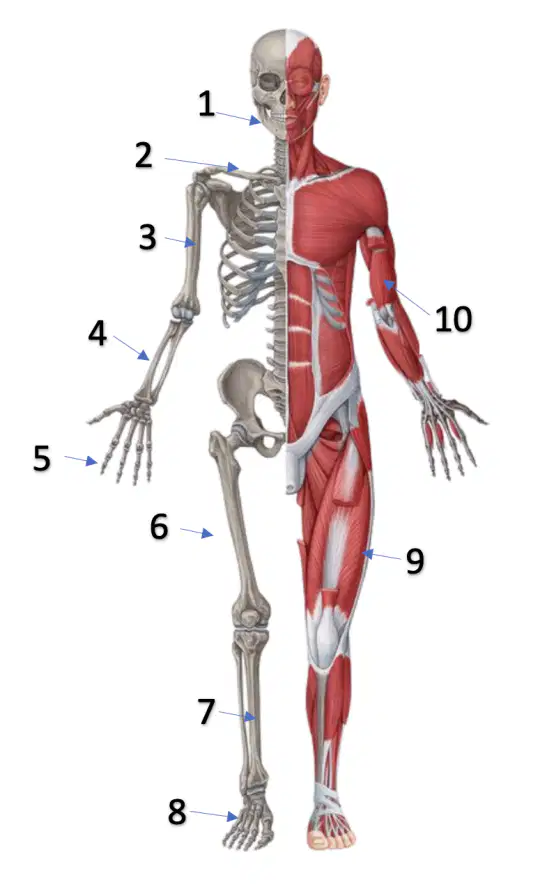
Which bone is indicated by label #4?
Femur
Radius
Humerus
Carpals
Ulna
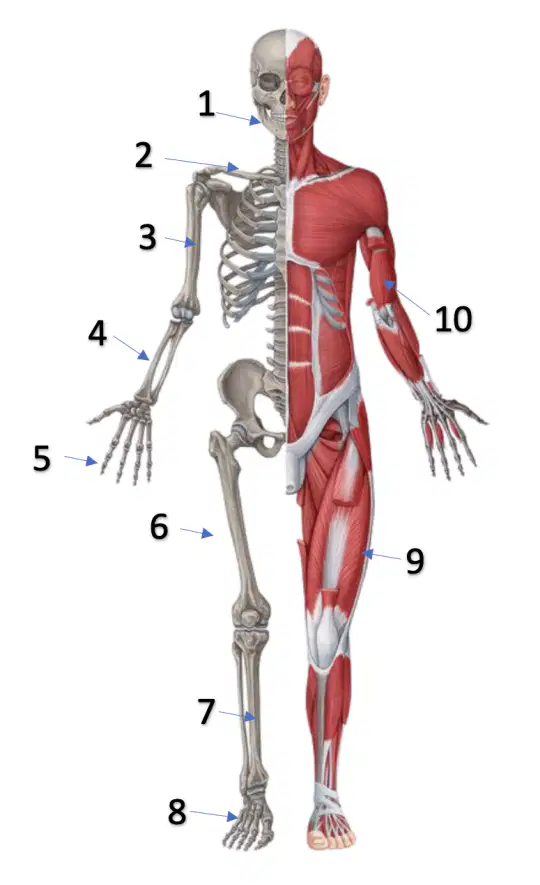
What is the name of the part labeled #6?
Humerus
Hamstrings
Fibula
Quadriceps
Femur
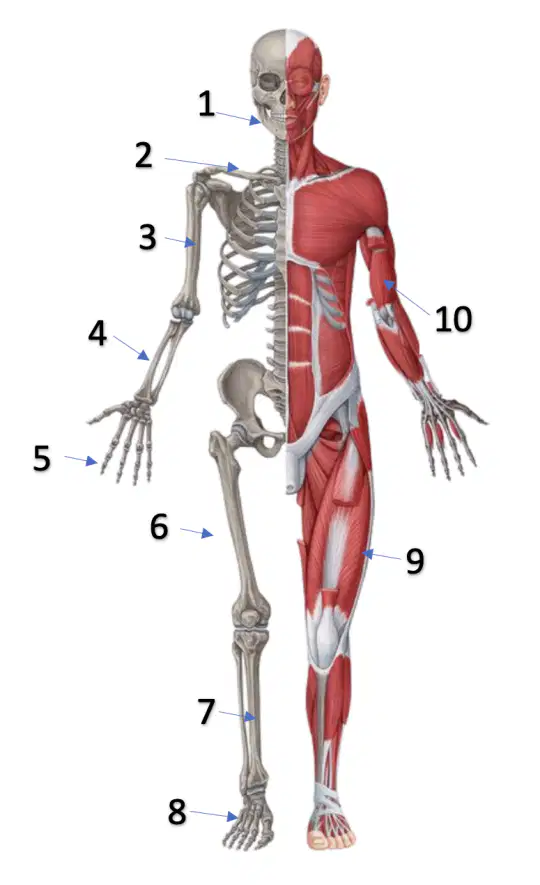
Which bone is labeled as #7?
Fibula
Ulna
Humerus
Femur
Tibia
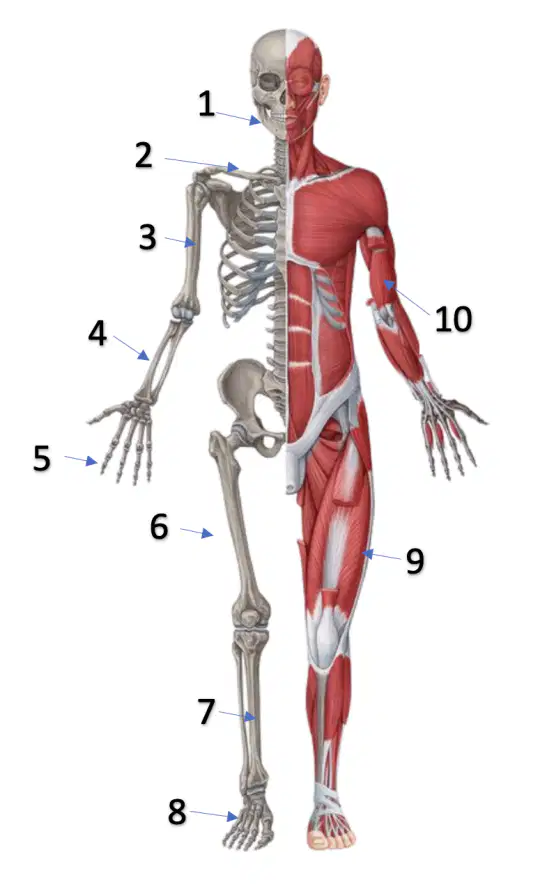
What is the correct anatomical name for the part labeled #8?
Metatarsals
Carpals
Tarsals
Metacarpals
Phalanges

Which part is indicated by label #9?
Femur
Hamstrings
Biceps
Quadriceps
Gluteus Maximus
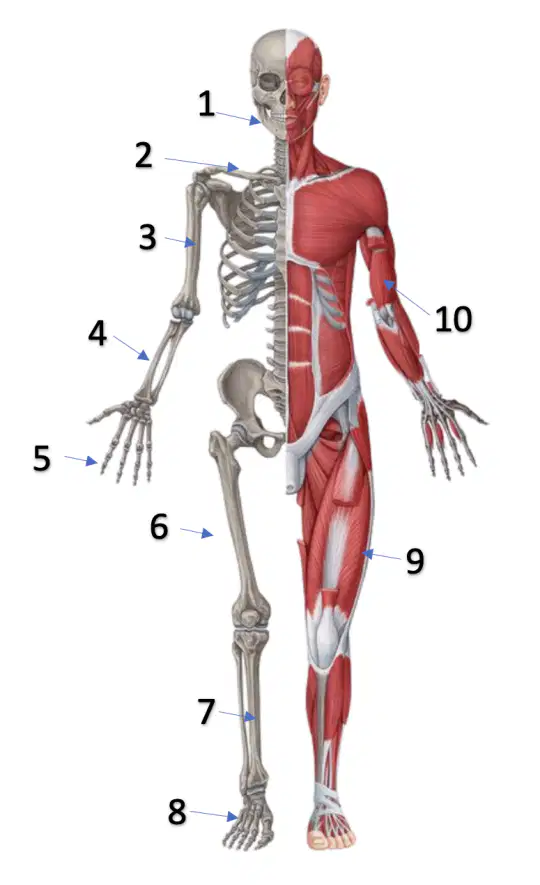
Which of the following is labeled as #10?
Triceps
Quadriceps
Pectorals
Biceps
Humerus
What dimension did we focus on with the Myers-Briggs Personality Test (16 personalities test)?
Intellectual Wellness
Emotional Wellness
Social Wellness
Occupational Wellness
Select the TRUE statements about creating a Resume.
Having your Resume be 4 pages is good, means you've done a lot
Skills relevant to the role applying and Education are main points that are looked at.
They look at it for an average of 6-7 seconds.
Format or the way it looks doesn't matter as long as you think you are right for the job.
How many bones are in the body?
206
216
306
316
After making the scene is safe for you and help is on the way, what is the logical next step in responding to an emergency?
Check for breathing
Perform chest compressions
Leave them
Give a rescue breath.
What is final step of CPR?
Call 9-1-1 and for an AED
Monitor the victim and hope for the best.
Continue performing chest compressions and rescue breaths until emergency personnel arrives
Perform 30 chest compressions
Steps for properly operating an AED
Power on the AED, attach electrode pads, shock the person, and analyze the rhythm
Power on the AED, shock the person, attach electrode pads, and analyze the rhythm
Power on the AED, attach electrode pads, allow AED to analyze the heart rhythm, deliver shock.
Power on the AED, analyze the rhythm, attach electrode pads, and shock the person
When our speaker, Luis, was here, what ways did he say to keep yourself protected from an STI/STD?
Make a wish on a star.
Get checked
Ask everyone you are intimate with and trust them.
Use protection.
When our speaker Luke was here, how did he say we help stop a venous bleed?
Slap a bandaid on it
By Applying pressure
Rub some dirt on it
Begin CPR
REM stands for
(a)
Which of the following is NOT one of the 3 Rs when it comes to environmental wellness?
Reduce
Revive
Recycle
Reuse
What is the Function of the Endocrine System?
Supplies Oxygen and Nutrients to the body
Produces and Distributes Hormones
Processes Food and Removes Waste
Breathes in Oxygen and Breathes out Carbon Dioxide
What does the letter "M" stand for in SMART goals
(a)
True or False?: Deodorant keeps you from sweating
True
False
What is the recommended limit of caffeine in milligrams (mg) for teenagers in a singular day?
100mg
200mg
300mg
400mg
How many hours of sleep should teenagers get a night?
8-10
7-9
10-12
12+
______ starts with a goal of becoming more aware of a situation so you can understand what’s happening and prepare yourself for it. This was very beneficial to us during COVID.
doomscrolling
webquest
search engines
facebook reels
Which of the following is NOT a Macronutrient
Carbohydrates
Proteins
Fats
Vitamins
CPR procedures include ___ compressions and ___ breaths.
30:2
2:30
1:30
30:1
The process of making choices which will contribute to sustaining the quality of life in the universe, including air, water, and land quality
Environmental Wellness
Physical Wellness
Spiritual Wellness
Tech Wellness
The process of creating and maintaining healthy relationships through the choices we make.
Emotional Wellness
Social Wellness
Intellectual Wellness
Spiritual Wellness
The process of accepting our worth, creating, recognizing, and expressing our feelings, and talking to ourselves in healthy ways.
Emotional Wellness
Social Wellness
Intellectual Wellness
Spiritual Wellness

