
 Worksheets
Atmospheric Pressure and Gas Composition at Altitude Quiz
Total questions: 85
Worksheet time: 43mins
Which of the following happens to atmospheric pressure as altitude increases?
It increases
It remains the same
It decreases
It fluctuates randomly
At higher altitudes, what happens to the partial pressure of oxygen (O₂), carbon dioxide (CO₂), and nitrogen (N₂)?
It increases
It remains the same
It decreases
Only oxygen decreases
Which term describes a condition of low partial pressure of oxygen (PO₂) typically found at high altitudes?
Hyperoxia
Normoxia
Hypoxia
Hypercapnia
If a person is at sea level and experiencing normal partial pressure of oxygen, which term best describes their condition?
Hypoxia
Hyperoxia
Normoxia
Anoxia
Explain why the partial pressure of oxygen decreases at higher altitudes even though the percentage of oxygen in the air remains the same.
Because the total atmospheric pressure decreases, lowering the partial pressure of all gases
Because the percentage of oxygen decreases
Because oxygen is replaced by nitrogen at altitude
Because carbon dioxide increases at altitude
Which of the following best describes the effect of decreased PO₂ (partial pressure of oxygen) on short-term anaerobic performance?
It should have no effect on performance.
It significantly decreases performance.
It greatly increases performance.
It causes muscle fatigue immediately.
Why does long-term aerobic performance decrease at higher altitudes?
Because decreased PO₂ results in poorer aerobic performance due to limited O₂ delivery to muscles.
Because air resistance is higher at altitude.
Because athletes are less motivated at altitude.
Because temperatures are always lower at altitude.
Which Olympic Games were held at a high altitude, providing a comparison for performance studies?
1968 Olympics in Mexico City
1964 Olympics in Tokyo
1972 Olympics in Munich
1980 Olympics in Moscow
Based on the data, how did the performance in short races (e.g., 100m) change from the 1964 Tokyo Olympics to the 1968 Mexico City Olympics for men?
Times slightly improved (decreased) at higher altitude.
Times significantly worsened at higher altitude.
There was no change in times.
Times doubled at higher altitude.
Analyze the data for long races and explain why marathon times were slower in the 1968 Mexico City Olympics compared to the 1964 Tokyo Olympics.
Lower oxygen availability at higher altitude reduced aerobic performance.
Higher temperatures in Mexico City slowed runners.
The marathon course was longer in Mexico City.
There were more competitors in 1968.
What is one reason why air resistance may increase performance in short-term anaerobic events at high altitude?
Air resistance is lower at higher altitudes, allowing for faster speeds.
Air resistance is higher at higher altitudes, slowing athletes down.
Air resistance does not change with altitude.
Air resistance only affects long races.
At approximately what altitude does VO₂max decrease by 20% compared to sea level?
3100 m
2400 m
4000 m
1000 m
What is the primary reason for the decrease in VO₂max at higher altitudes?
Lower O₂ extraction
Higher temperature
Increased humidity
Greater air pressure
At moderate altitudes (around 4,000 m), what is the main cause of reduced VO₂max?
Lower arterial PO₂
Higher Qmax
Increased maximal HR
Greater oxygen extraction
At higher elevations, why does VO₂max decrease in addition to lower oxygen extraction?
Due to a decrease in Qmax and maximal HR
Due to increased oxygen extraction
Due to higher arterial PO₂
Due to increased maximal HR
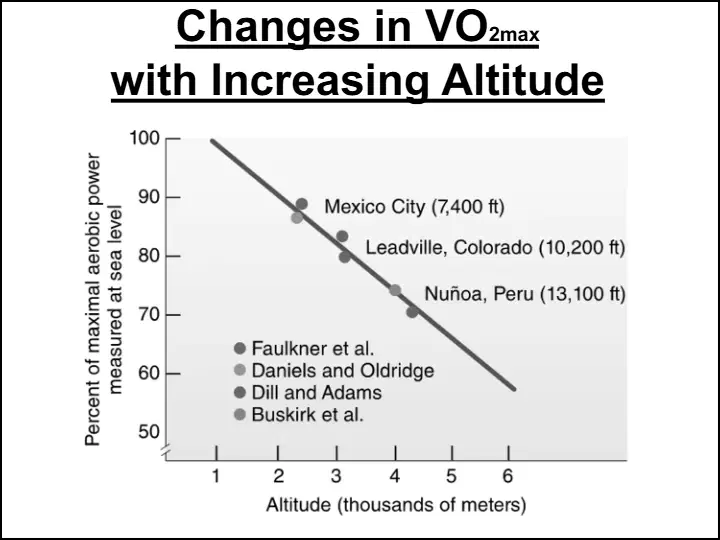
Based on the graph, which city is located at the highest altitude among those listed?
Nuñoa, Peru
Mexico City
Leadville, Colorado
Faulkner et al.

Using the information provided, explain why athletes might experience a decrease in maximal aerobic power when training at high altitudes. Support your answer with evidence from both the text and the graph.
Because lower oxygen extraction and reduced arterial PO₂ at higher altitudes decrease VO₂max, as shown by the declining percent of maximal aerobic power in the graph.
Because higher humidity at altitude increases VO₂max, as shown by the graph.
Because increased air pressure at altitude improves oxygen extraction, as shown by the graph.
Because maximal HR increases at altitude, leading to higher VO₂max, as shown by the graph.
What is the primary reason for an increased heart rate (HR) response at altitude during submaximal exercise?
Due to decreased oxygen content of arterial blood
Due to increased oxygen content of arterial blood
Due to decreased carbon dioxide content of arterial blood
Due to increased blood pressure at altitude
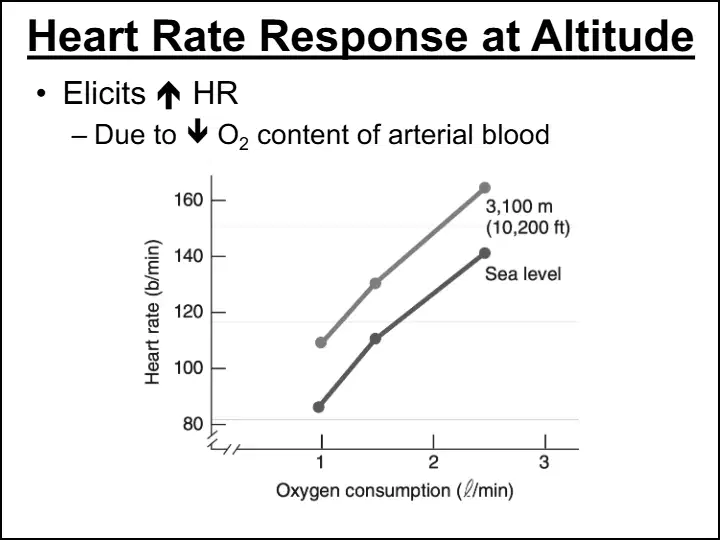
According to the graph, how does heart rate at 3,100 m (10,200 ft) compare to sea level for the same oxygen consumption during exercise?
Heart rate is higher at 3,100 m than at sea level for the same oxygen consumption
Heart rate is lower at 3,100 m than at sea level for the same oxygen consumption
Heart rate is the same at both altitudes for the same oxygen consumption
Heart rate decreases as altitude increases for the same oxygen consumption
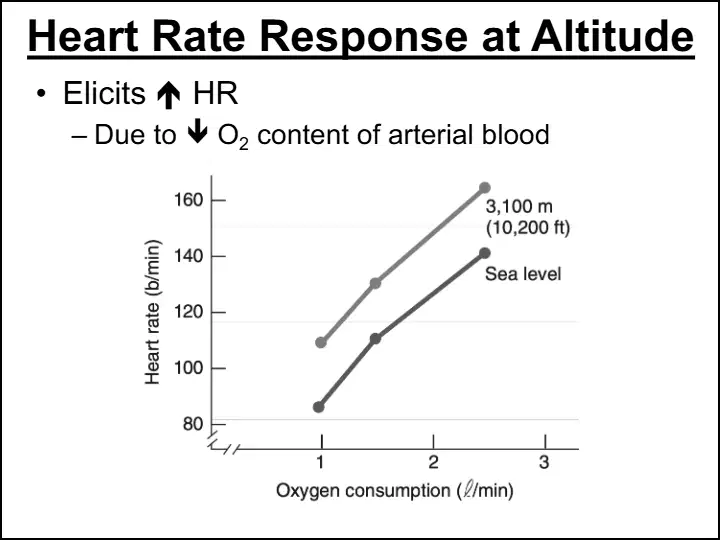
Explain why submaximal exercise at high altitude elicits a higher heart rate compared to sea level, using evidence from the provided graph and information.
Because the oxygen content of arterial blood is lower at altitude, the body compensates by increasing heart rate to deliver sufficient oxygen to tissues during exercise.
Because the oxygen content of arterial blood is higher at altitude, the body decreases heart rate to conserve energy.
Because the carbon dioxide content of arterial blood is higher at altitude, the body increases heart rate to expel more CO2.
Because the temperature is lower at altitude, the body increases heart rate to maintain body heat.
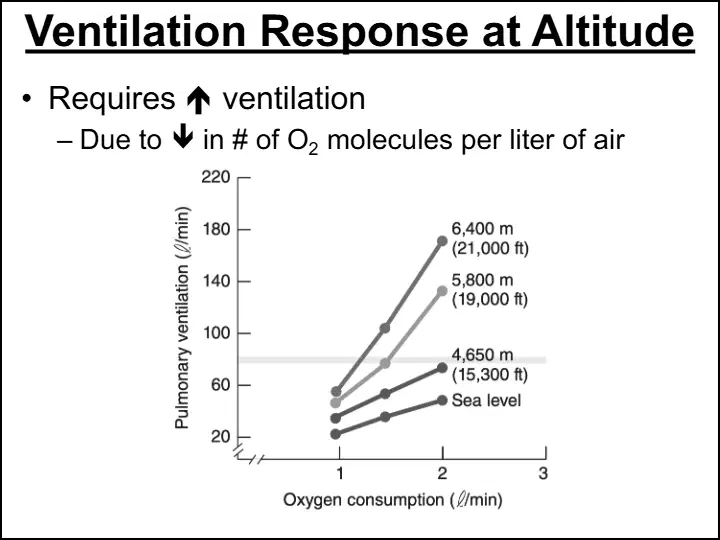
Which of the following is a primary reason for increased ventilation at high altitude?
Increased number of O₂ molecules per liter of air
Decreased number of O₂ molecules per liter of air
Increased carbon dioxide concentration in the air
Decreased pulmonary blood flow
Which factor is responsible for increased hemoglobin concentration during acclimatization to high altitude?
Increased nitric oxide production
Increased HIF-1 and EPO activity
Decreased RBC production
Increased oxygen saturation
What is a primary adaptation among Andean residents to counter desaturation at high altitude?
Increased oxygen saturation via nitric oxide
Increased hemoglobin concentration
Decreased blood flow to the lungs
Increased carbon dioxide retention
Which of the following is a primary adaptation among Himalayan Sherpas for high altitude acclimatization?
Increased hemoglobin concentration
Increased oxygen saturation due to increased blood flow to the lungs
Decreased nitric oxide production
Reduced RBC production
Lifetime altitude residents have which of the following characteristics compared to those arriving at altitude later?
Less complete adaptations in arterial O₂ content and VO₂max
Complete adaptations in arterial O₂ content and VO₂max
No adaptation in oxygen saturation
Reduced hemoglobin concentration
Explain how increased nitric oxide contributes to acclimatization at high altitude.
It decreases blood flow to the lungs, reducing oxygen saturation.
It increases blood flow to the lungs, enhancing oxygen saturation.
It reduces hemoglobin concentration, lowering oxygen transport.
It increases carbon dioxide retention, improving ventilation.
Which physiological change helps successful high-altitude climbers bind more oxygen to hemoglobin?
Increased PCO₂ and H⁺ in blood
Decreased PCO₂ and H⁺ in blood
Increased appetite
Increased muscle fiber diameter
What is one challenge climbers face at high altitudes related to nutrition and muscle?
Increased appetite and muscle fiber diameter
Loss of appetite and decreased muscle fiber diameter
Increased weight and muscle mass
Enhanced muscle growth and energy
In what year was Mount Everest first successfully climbed without supplemental oxygen?
1953
1978
1965
1985
Why was the VO₂max at the summit of Everest previously thought to be just above rest?
Due to accurate calculation of barometric pressure
Due to miscalculation of barometric pressure at summit
Because climbers used supplemental oxygen
Because climbers had increased muscle mass
Compare the MET value at the summit of Everest to common activities. Which activity is closest in MET value to the summit?
Running at 10 km/h
Calisthenics
Walking at 5.5 km/h
Both B and C
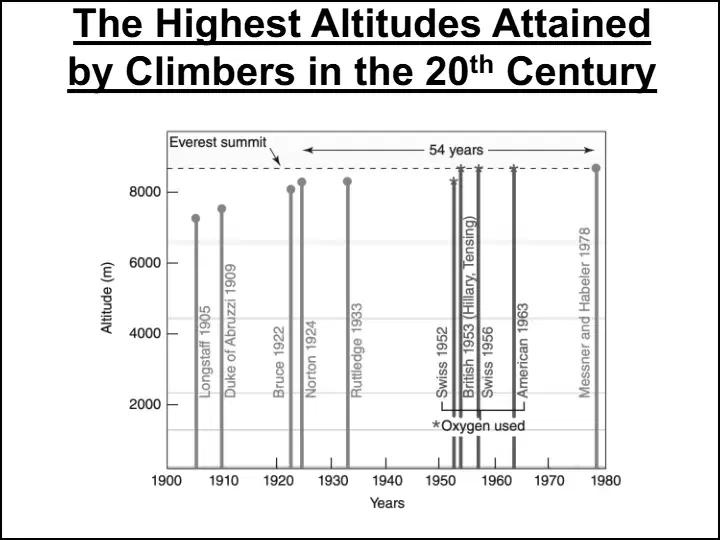
Which mountain's summit is referenced as the highest altitude attained by climbers in the 20th century?
Mount Kilimanjaro
Mount Elbrus
Mount Everest
Mount Denali
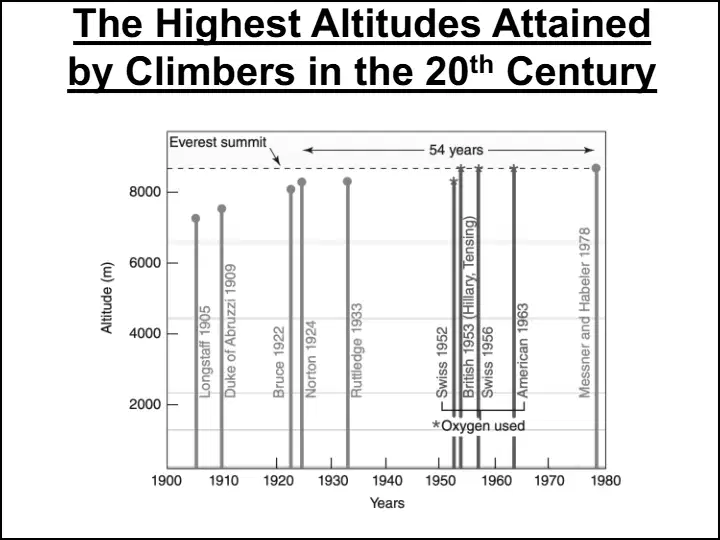
According to the graph, how many years did it take climbers to reach the summit of Everest after the first high-altitude climbs in the 20th century?
10 years
54 years
100 years
25 years
What does VO₂max represent in the context of altitude physiology?
The maximum heart rate at altitude
The maximal oxygen uptake at altitude
The minimum oxygen requirement for survival
The average breathing rate at sea level
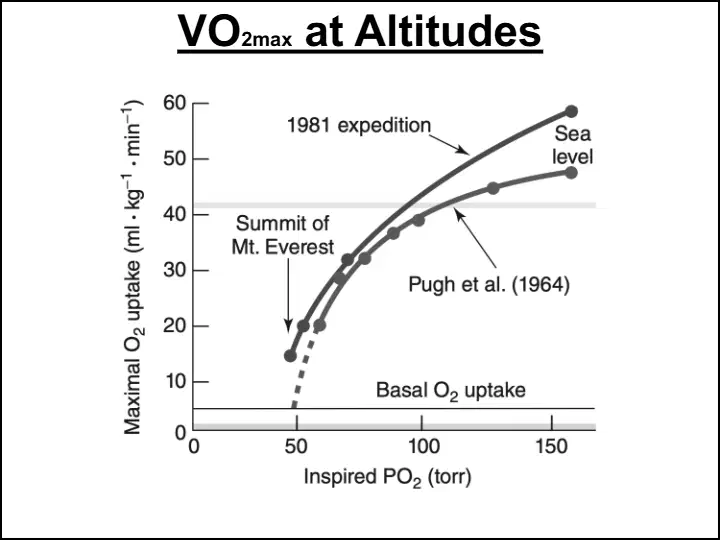
Based on the VO₂max at Altitudes graph, what happens to maximal oxygen uptake as inspired PO₂ decreases?
It increases
It remains constant
It decreases
It fluctuates randomly
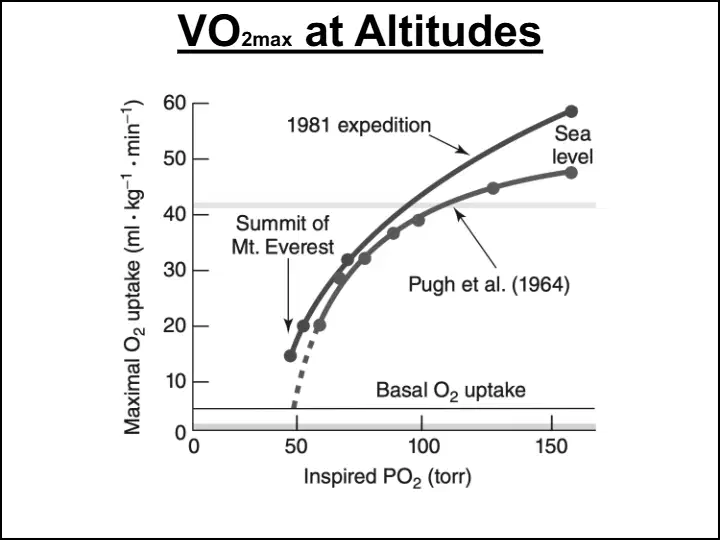
Using the information from the VO₂max at Altitudes graph, explain why climbers might find it more difficult to perform physical activities at the summit of Mt. Everest compared to sea level.
Because the temperature is lower at the summit
Because maximal O₂ uptake is much lower at the summit due to reduced inspired PO₂
Because there is more wind at the summit
Because the summit is closer to the sun
What is the primary goal of training for competition at altitude?
To improve performance
To increase muscle mass
To reduce body fat
To enhance flexibility
Which of the following is a key adaptation resulting from altitude training that helps increase the oxygen-carrying capacity of blood?
Increase in red blood cells (RBC) through stimulation of EPO
Decrease in heart rate
Increase in bone density
Decrease in lung volume
Which of the following is considered a central adaptation to altitude training?
Ventilatory adaptation
Buffering adaptation
Improved running economy
Increased muscle mass
Altitude training can lead to peripheral adaptations. Which of the following is an example of a peripheral adaptation?
Buffering
Neural adaptation
Hemodynamic adaptation
Increased EPO production
Suppose an athlete wants to maximize their performance for a competition at high altitude. Based on the information provided, what combination of adaptations should they focus on?
Both central (ventilatory, hemodynamic, neural) and peripheral (buffering, economy) adaptations
Only increasing muscle size
Only improving flexibility
Only reducing body fat
Which of the following is a traditional method of altitude training where both living and training occur at moderate altitude?
Live High, Train High (LHTH)
Live Low, Train High (LLTH)
Intermittent Hypoxic Exposure (IHE)
Intermittent Hypoxic Training (IHT)
What is the typical altitude range for the "Live High, Train High" (LHTH) method?
1800-2500 meters
500-1000 meters
2500-3500 meters
100-500 meters
Which of the following is NOT a progressive phase in the LHTH method?
Acclimatization
Primary Training
Oxygen Filtration
Recovery & Preparation
Which of the following sites is commonly used for Live High, Train High (LHTH) altitude training?
Colorado Springs, CO
Miami, FL
New York City, NY
Los Angeles, CA
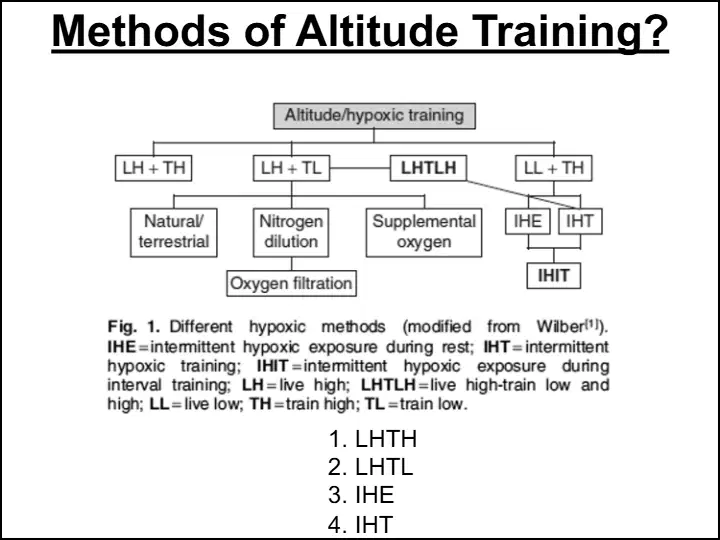
According to the diagram, which method involves living high and training low?
LHTHL
LHTH
LLTH
IHT
Why is the "Return to Sea Level" phase in LHTH considered controversial?
It is not well agreed upon and requires more investigation.
It is the most important phase.
It is always skipped in training.
It involves the highest intensity workouts.
Which of the following is a key purpose of the acclimatization phase in LHTH?
To get used to lower PO₂ and lower intensity
To increase training intensity immediately
To avoid any changes in oxygen levels
To maximize sea level performance instantly
What is the recommended altitude range for blood changes in the "Live High, Train Low" (LHTL) method?
1,000-1,500 m
2,000-2,500 m
3,500-4,000 m
500-1,000 m
Which hormone is responsible for increasing RBC mass during LHTL training?
Insulin
EPO (Erythropoietin)
Cortisol
Adrenaline
How many hours per day is considered ideal for simulating altitude in LHTL training?
5 hours
10 hours
≥20 hours
2 hours
For non-blood related changes, what is the required altitude in LHTL training?
1,500 m
2,000 m
3,100 m
4,000 m
Why do athletes only train at low altitude in the LHTL method?
To increase RBC mass
To maintain training quality
To reduce oxygen consumption
To avoid dehydration
What is the typical performance improvement range reported for LHTL?
5-10%
2-3%
1-1.5%
0.1-0.5%
Which of the following is a key requirement for intermittent hypoxic exposure?
Outdoor training
Hypobaric chamber
High carbohydrate diet
Low intensity exercise
How often is intermittent hypoxic exposure typically performed at very high altitude?
Daily for 10 minutes
3 times per week for 90 minutes
Once a month for 2 hours
Every other day for 30 minutes
What is a characteristic of reports on performance after intermittent hypoxic exposure?
Consistently positive
Equivocal
Always negative
Not studied
Which statement best describes the exposure pattern in intermittent hypoxic exposure?
Continuous exposure for several weeks
Periodic exposure separated by normoxia
Only exposure at sea level
No exposure to hypoxia
Which of the following best describes Intermittent Hypoxic Training (IHT)?
Training at sea level with increased oxygen
Actually training at altitude
Living high, training low
Training with reduced intensity at sea level
What is a possible effect of training at approximately 3850 meters altitude?
Decreased muscular adaptations
Induction of muscular adaptations
No change in muscular adaptations
Increased risk of dehydration
Which factor is mentioned as being involved in the molecular cell signaling during hypoxic training?
HIF-1α (hypoxia-inducible factor 1-alpha)
ATP synthase
Myoglobin
Hemoglobin
According to the material, what is unclear about Intermittent Hypoxic Training?
Its effect on red blood cell count
Whether it results in performance improvements
Its impact on oxygen carrying capacity
Its influence on hydration status
Which hypoxic training method is considered the best for increasing the oxygen carrying capacity of blood?
IHT (Intermittent Hypoxic Training)
LHTL (Live High, Train Low)
Nitrogen dilution
Oxygen filtration
What does IHT potentially increase in athletes?
Utilization of O₂
Utilization of CO₂
Utilization of glucose
Utilization of fat
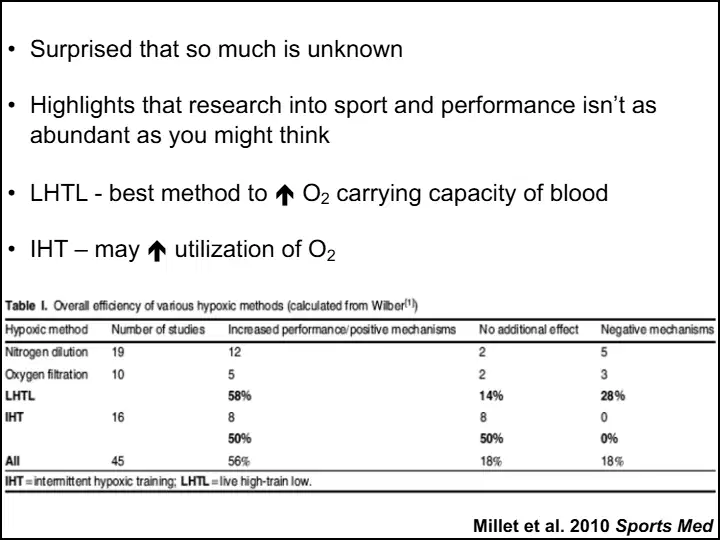
Based on the table from Millet et al. 2010, what is a key finding about research into sport and performance?
Everything is well understood
There is a surprising amount of unknowns
All methods result in negative effects
Only altitude training is effective
Which physiological responses increase during exercise when exposed to altitude?
Heart rate, VE, and lactate
Blood pressure, oxygen saturation, and plasma Epi
Glycogenolysis, airway resistance, and perception of effort
Plasma Epi, O2 transport capacity, and airway resistance
What is the lactate paradox observed after acclimatization to altitude?
Increased lactate response despite hypoxia
Decreased lactate response despite hypoxia
Increased plasma Epi and glycogenolysis
Decreased heart rate and VE during exercise
Which of the following is a possible cause of the lactate paradox?
Increased plasma Epi
Less glycogenolysis
Increased O2 transport capacity
Increased airway resistance
Why is there a debate about the existence of the lactate paradox?
All studies consistently observe the phenomenon
Some studies do not observe the phenomenon
It is only observed at sea level
It is caused by increased plasma Epi
Which gas is highlighted as a key component in air pollution affecting health and performance?
Oxygen
Nitrogen
Carbon Monoxide
Sulfur Dioxide
How does air pollution typically affect health and performance?
Increases O2 transport capacity and decreases airway resistance
Decreases O2 transport capacity and increases airway resistance
Increases plasma Epi and decreases perception of effort
Decreases lactate response and increases heart rate
Which factor does NOT influence the response to air pollution?
Concentration in air
Duration of exposure
Volume of air inhaled
Type of exercise performed
Explain how the perception of effort can be altered by air pollution during exercise. Use evidence or reasoning to support your answer.
Air pollution increases O2 transport capacity, making exercise easier
Air pollution decreases airway resistance, reducing effort
Air pollution can make exercise feel harder, especially on muggy days compared to cool days
Air pollution has no effect on perception of effort
Which Air Quality Index (AQI) level is considered to pose little or no risk to health?
Good
Moderate
Unhealthy
Hazardous
What is a recommended strategy to minimize health risks in areas with poor air quality?
Reduce exposure time
Increase exposure time
Ignore air quality index
Exercise during most polluted times
At which AQI numerical value range does air quality become "Very Unhealthy"?
201 to 300
151 to 200
101 to 150
0 to 50
Why should individuals avoid "bolus" amounts of air pollution?
To reduce health risks associated with high exposure
To increase their tolerance to pollution
To improve air quality for others
To avoid legal penalties
Which of the following times is most likely to have higher air pollution levels?
7-10 am and 4-7 pm
12-2 pm
10-11 pm
2-4 am
What does the Air Quality Index (AQI) help individuals monitor?
Levels of air pollution and associated health risks
Levels of water pollution
Levels of noise pollution
Levels of soil contamination
If the AQI is in the "Hazardous" range, what does this indicate?
Health warnings of emergency conditions; entire population is more likely to be affected
Air quality is satisfactory; no risk
Only sensitive groups may be affected
No health effects expected
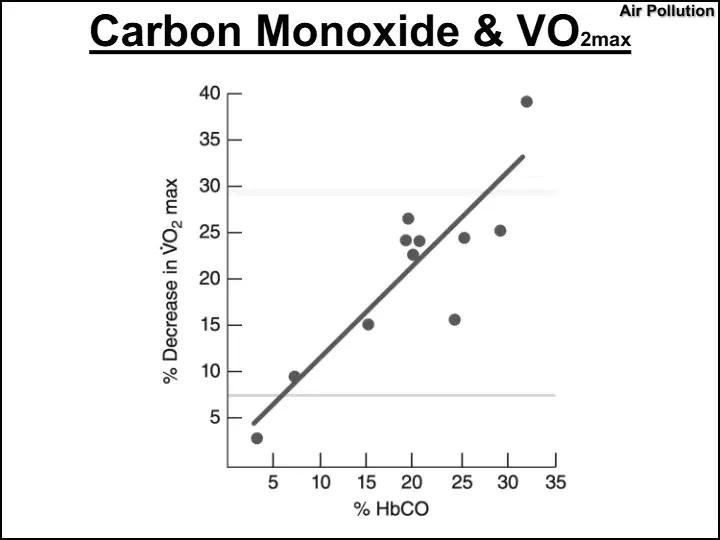
Based on the graph titled "Carbon Monoxide & VO₂max," what is the relationship between % HbCO and % decrease in VO₂max?
As % HbCO increases, % decrease in VO₂max increases
As % HbCO increases, % decrease in VO₂max decreases
There is no relationship between % HbCO and % decrease in VO₂max
As % HbCO decreases, % decrease in VO₂max increases
Why is it important to monitor the air quality index (AQI) in urban areas?
To avoid exposure to high levels of air pollution and reduce health risks
To increase exposure to air pollution for immunity
To measure water quality
To determine noise levels
Which of the following is a key point to consider when dealing with altitude in training?
Live high, train low
Train high, live low
Only train at sea level
Avoid all altitude exposure
Which of the following is NOT listed as a take home point in the material?
Effects on performance
Effects on submaximal exercise
How to deal with altitude
Nutritional requirements for athletes
If an athlete wants to optimize their adaptation to altitude, which strategy is suggested by the phrase “Live high, train low”?
Reside at high altitude and train at low altitude
Reside at low altitude and train at high altitude
Both live and train at high altitude
Both live and train at low altitude

