
 Worksheets
Science P6 SA1
Total questions: 57
Worksheet time: 1hrs 13mins


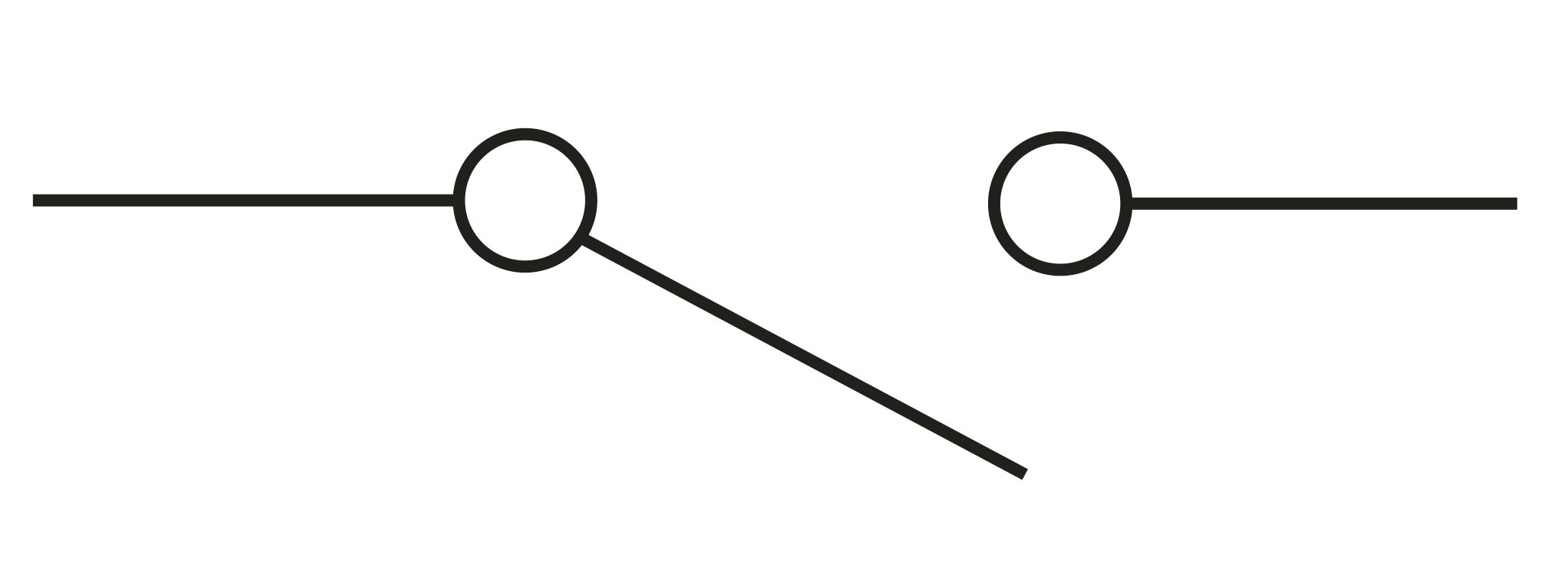


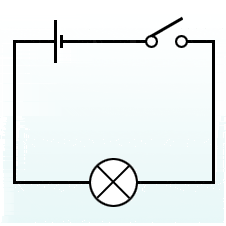
What needs to be done to this circuit so that the lamp lights up?
Close the switch
Add a source and close the switch
Add another lamp
Add another lamp and a switch

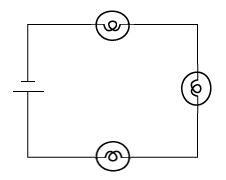
1. Which switch or switches must be closed to make the lamps light?
Only switch 1
Only switch 1
Switches 1 and 2
Switches 1 , 2 and 3
Which of the following materials is an electrical conductor?
Silver spoon
Silver-colored plastic spoon
cooper spoon
wooden spoon


Which of the following objects contain a magnet?


Which of the following transportation vehicles uses magnets?


Which of the following elements is magnetic?
aluminum
iron
tin
What happens when like poles of a magnet are placed together?
they repel
they attract
the strength of the magnet is doubled
What happens when the opposite poles of 2 magnets come close together?
They push away.
They pull together
They get bigger.

Surrounding every magnet is a __________ __________.
magnetic field
electrical current
another magnet

What will happen when these magnets are brought close together?
They will attract each other.
Both magnets will turn to the left
They will repel each other.
How is a permanent magnet DIFFERENT from a temporary magnet?
A permanent magnet keeps its magnetism for a long time.
A permanent magnet has poles.
A permanent magnet has a magnetic field.
The sun, moon, and earth all rotate on an __________.
Axle
Axis
Pivot
Point
How long does it take for the moon to revolve around the earth?
28 days
31 days
14 days
28 months
The ________ are caused by the moon.
weather
gravity
tides
night/day
Who launched the first spacecraft to visit the moon? When?
Soviet Union; 1979
Japan; 1959
Soviet Union; 1959
America; 1960
What do dwarf planets lack to move other bodies out of their orbit?
Weight
Gravity
Mass
Motivation
A chunk of rock or dust in space, generally smaller than an asteroid.
Meteor
Meteoroid
Meteorite
Asteroid
Which planet takes longer to rotate than revolve?
Earth
Venus
Mercury
Mars
Comets orbit __________.
the Asteroid Belt
the Sun
Earth
the moon Ganymede
Our Moon orbits________.
the Sun
Earth
in the Asteroid Belt
Venus

Which of the following part will produce egg cell (ovum)?
1
2
3
4
fertilization happens when. . . .
egg (ovum) attaches to the womb
the sperms start to develop and grow
the sperm fuses together with egg (ovum)
The sperms are produced in . . .
penis
testis
ovaries

The family tree shows members who have attached or detached earlobes. Which of the following statements is true?
Joe's grandfather has detached earlobes
Joe's parents have detached earlobes
Joe's sister has attached earlobes
Joe's aunt has attached earlobes

Which part in diagram 2 has a similar function as part X in diagram 1?
A
B
C
D
How does the developing baby obtain the nutrients from mother's placenta?
by using the fallopian tubes
by using the uterus
by using the umbilical cord
Which of the followings are the similarity between plant and human reproduction?
both of male produce sperms
They won't pass down their characteristics
during the fertilization, a sperm and an egg fuse together
both of female produce an egg (ovum)
male and female always in separated body

Based on the process after this fertilization, the baby will develop into . . .
fraternal twins
identical twins
dizygotic twins
Which of the following shows the correct order of phases that an egg cell goes through after fertilisation?
A : Baby
B : Foetus
C : Balls of Cells
A --> B --> C
A --> C --> B
C --> B --> A
B --> C --> A
Which of the following are part of the male reproductive system?
A : Penis
B : Testis
C : Ovary
D : Womb
A and B
A and C
A, B and C
C and D

The diagram above shows the female reproductive system.
Which one of the following statements is correct?
A fertilised egg is released from Y
The eggs travels from X to Z
During fertilisation, the sperm fuses with the egg in Z
The fertilised egg will divide to form more cells and attach to the wall in Y
The place where food is stored in the seed called ________.
seed coat
endosperm
cotyledon
embryo
Seeds with two cotyledons are called ______.
dicot
monocot
vegetative
generative
The outer cover that protect the embryo of the seed is called ______.
seed coat
endosperm
cotyledon
embryo
Seeds with one cotyledons are called ______.
dicot
monocot
vegetative
generative
If the ______ conditions are not met, the seed will not grow.
pollination
fertilization
germination
propagation
Plants can reproduce asexually with parts such as _____ , _____ , and ______.
leaves
roots
stem
seed
In dicot seeds, the cotyledons are _______ of the soil.
pulled out
remain
waste
bury down
One of the vegetative propagation/reproduction techniques is cutting. Which of the plants below can be propagated through leaf cutting?


There are two types of plant reproduction. These are the vegetative and generative propagation. Which of the following statements states the difference between the two reproductions?
Vegetative propagation does not require pollination and fertilization.
Vegetative propagation is possible due to human intervention.
Generative propagation requires pollination and fertilization.
All of the above.
Which of the following is true about rhizomes?
Rhizomes are fleshy roots that have nodes from which the young plant emerges.
Rhizomes are horizontal roots that grow a new plant with the same species.
Rhizomes are fleshy stems that contains nodes from which the young plant emerges and grow.
Rhizomes are the main root of the plant that produce shoots.
Which of the following does not belong to the group?
ginger, galangal, strawberry
potato, beet, cassava
banana, asparagus, bamboo
strawberry, spider plant, jasmine

The process of fertilizing flowers by transferring pollen from the male to female parts
pollination
asexual reproduction
budding
flowerization

What part of a sprouting seed is "the small developing plant"?
Radicle
Cotyledon
Seed Coat
Embryo
When the patient needs eye surgery because he has the same eye problem as his mom and dad, it is a(n) ______ .
learned behavior
acquired physical trait
inherited physical trait
instinct

