
 Worksheets
Super Review Chem Semester 1
Total questions: 129
Worksheet time: 43mins
What is the nucleus of an atom made of?
Protons & electrons
Protons & neutrons
The nucleus of an atom makes up _____ of its mass.
50%
99.9%
What is the relationship between the size of the nucleus and the size of the atom?
The nucleus is about 100,000 times smaller than the atom.
The nucleus is twice as big as the atom.
Neutrons have __________ charge.
positive
no
Protons have __________ charge.
no
positive
Electrons have __________ charge.
negative
no
Which particle has almost no mass?
Electrons
Protons
What does amu stand for?
Atomic mass unit
Atom matter unit
Which best describes the movement of electrons?
They move slowly.
They are constantly moving.
Most of the atom is empty space.
True.
False.

Thompson was the first to discover a subatomic particle - the electron. What are the others?
protons & neutrons
protons & positrons

Rutherford concluded that the amount of positive charge varies
with different elements.
with the amount of neutrons in the nucleus.

A positively charged particle found in the nucleus is called a
neutron.
proton.

The word "proton" comes from an ancient Greek word meaning
to change or become flexible.
proteus.

The word "electron" comes from the ancient Greek word meaning
electricity.
amber.

Electrons can best be described as having a
large size, negative charge.
very small size, negative charge.

Electrons are subatomic particles that exist
in simultaneous dimensions.
outside the nucleus.

Neutrons (discovered by James Chadwick in 1932) are neutral subatomic particles that are located
in the nucleus.
in alternate universes.

Neutrons have almost exactly the same mass as
protons.
quarks.

Only protons & neutrons can be distinguished by mass, charge and position in an atom.
True
False

James Dalton proved that the true nature of the atom could best be described as resembling "plum pudding."
True
False

Rutherford proved the existence of protons located in a very small nucleus by using a crude particle accelerator in 1911.
True
False

The atomic number (#) of an element is equal to the
# of protons in a single atom of that element.
weight of an electron.

Atoms of different elements have
the same # of protons.
a different # of protons.

Because atoms are neutral, each positive charge is
the same as no charge.
balanced by a negative charge.

Which statement best describes the mass number (#) of an atom?
the difference in mass between protons & neutrons
the sum of protons & neutrons in the nucleus

If you know the atomic number (or # of protons) and mass number of an atom, you can find the
number of electrons by adding to the mass number.
number of neutrons by subtracting from the mass number.

If the atomic mass of an element is 32 and the atomic # is 16, then
the number of neutrons is also 16.
the element most likely has isotopes.
the number of electrons is also 16.
the number of protons is also 32.

Every neutral atom has the same number of protons and electrons, however
they may also have the same atomic mass.
they may not have the same # of neutrons.

Which statement best describes an isotope of an element?
they share an equal amount of neutrons
they have the same atomic #'s but with different mass #'s
What is the subatomic particle that has a negative charge?
Neutrons
Electrons

What is the image a picture of?
Pierre Model
Bohr Model
What subatomic particles are located in the nucelus?
Electrons
Protons
_________ has a positive charge.
Neutrons
Protons
What subatomic particle has a 0 charge?
Neutrons
Electrons
What is the basic unit of matter?
Subatomic Particles
Atom
The center of an atom is called the (a) .
True or False: Protons and Neutrons are always the same number
True
False
True or False: Protons and Electrons are equal to the atomic number.
True
False
The scientist(s) that is repsonsible for the Solid Sphere Model is
JJ Thompson
John Dalton
The scientist(s) that is repsonsible for the Plum Pudding Model is
JJ Thompson
Schordinger & Heisenberg
The scientist(s) that is repsonsible for the Electron Cloud Model is
Schordinger & Heisenberg
JJ Thompson
The scientist(s) that is repsonsible for the Planetary Model is
Niels Bohr
Ernest Rutherford
The results of the Gold Foil Experiment led Rutherford to discover
that the nucleus is positively charged
that the atom is a solid sphere
that the atom is mostly empty space
that electrons exist
During the gold foil experiment, postively charged particles (alpha particles) were shot at an atoms thick piece of gold. What was observed?
Most of the alpha particles went straight through but a few bounced back
All of the alpha particles bounced back
The results of the Cathode Ray Tube experiment led Thompson to believe
The atom is an electron cloud
The atom is a positively charged particle with negative electrons distributed through out
During the Cathode Ray Tube experiment the beam bent towards the magnet's positive side. This meant that the beam was
Positively charged
Negatively charged
Neutrally charged
No Charge was observed.
The Electron Cloud Model of an atom
is a mathematical representation of the possible location of electrons around the nucleus.
tells us the exact location of an electron and its speed at the same time.
The solid sphere model was developed
because no one could come up with a better idea.
by Dalton experimenting with different substances and gasses and noticing patterns

The image shows the
Solid Sphere Model
Plum Pudding Model
Planetary Model
Bohr Model
Electron Cloud Model

The image shows the
Solid Sphere Model
Plum Pudding Model
Planetary Model
Bohr Model
Electron Cloud Model

The image shows the
Solid Sphere Model
Plum Pudding Model
Planetary Model
Bohr Model
Electron Cloud Model

The image shows the
Solid Sphere Model
Plum Pudding Model
Planetary Model
Bohr Model
Electron Cloud Model

The image shows the
Solid Sphere Model
Plum Pudding Model
Planetary Model
Bohr Model
Electron Cloud Model
Electrons that have not been excited are said to be at:
high level
base line
set state
ground state

This shape is that of a...
s orbital
d orbital
p orbital
f orbital

This is a ____ orbital
s
d
p
d
The principle quantum number, n, represents the:
spin value
suborbital value
energy level
magnetic value
Orbital sublevels, or L, represents:
orbital color
orbital shape
electron spin
energy level
With each higher energy level, the electrons are
lower in energy
more stable
weaker
farther from the nucleus
How many electrons total are found in the f orbital?
2
6
10
14
What does the 1 in "1s" stand for?
energy level
s orbitals
p orbitals
the number of electrons
How many electrons are in 1s2 2s2 2p4?
5
6
8
13


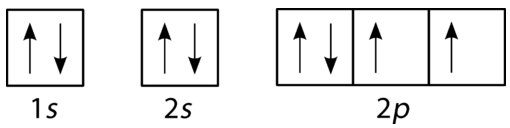


Identify the rule that is being violated
Aufbau's Principle
Hund's Rule
Pauli's Exclusion Principle
Heisenberg uncertainty principle
1s22s22p63s23p64s23d10
Which is the electron configuration of Ar (Argon)
1s2 2s2 2p6 3s2 3p6
1s2 2s2 2p6 3s2 3p0
1s2 2s2 3s2 4s2 4p6
3s2 4f14 4s2
1s22s22p63s23p64s23d6
cobalt
iron
copper
zinc
manganese
In 1s2, the 1 means
there is 1 electron
the electrons are in the 1st energy level
the shape is circular
there is a -1 charge
In 1s2, the s means
the shape of the orbital is circular
the shape of the orbital is figure 8
there are six electrons
it is neutral
In 1s2, the 2 means
there are 2 electrons in this level
it is the 2nd energy level
there is a +2 charge
there is a -2 charge
Cr (Z=24) shows anomalous electronic configuration.
The actual electronic configuration is
1s2 2s2 2p6 3s2 3p6 4s1 3d5.
This is because ...
the half-filled d-orbital (3d5) is more stable
the completely filled d-orbital (3d10) is more stable
the partially filled d-orbital (3d4) is more stable


What are valence electrons?
The innermost electrons
The outermost electrons
What is the octet rule?
Elements can only have 8 electrons in its outermost shell
The elements must form an octopus like structure
How many valence electrons does Carbon have
1
4
How many valence electrons does Argon have
8
11
Electron dot notation is . . . .
A representation of an element in which only valence electrons of an atom are shown
A representation of how compounds are formed.

Which of the elements in the picture has correct electron dot notation?
1
2
3
4
Which statement correctly and completely identifies a trend?
Ionic radius increases across a period and increases down a group.
Atomic radius decreases across a period and increases down a group.
As you move down a group, atomic radius increases because -
you add more and more neutrons
you add more and more shells (energy levels)
Francium (Fr) has the lowest ionization energy in Group 1 because -
it has the smallest number of valence electrons
its 1 valence electron is very far from the nucleus, so little energy is needed to remove it
Of the halogens, which has the smallest radius?
F
Br
He
At
Which of the following will have a higher electronegativity than arsenic (As)?
Carbon (C)
Neon (Ne)
Antimony (Sb)
Germanium (Ge)
Which of the following will have a lower ionization energy than Scandium (Sc)?
Helium (He)
Titanium (Ti)
Calcium (Ca)
Magnesium (Mg)

Which of the following halogens has the greatest electronegativity?
Chlorine (Cl)
Bromine (Br)
Iodine (I)
Astatine (At)

Which group of elements has the lowest ionization energies?
Alkali Metals (Group 1)
Alkaline Earth Metals (Group 2)
Halogens (Group 17)
Noble Gases (Group 18)

The vertical (up and down) columns in the Periodic Table are called
groups
towers
periods
atomic numbers

What element is in period 3 group 18, 8A?
Aluminum
Potassium
Argon
Neon

How many valence electrons does this element have?
20
2
4
1

The horizontal (left to right) rows on the periodic table are known as
periods.
atoms.
groups or families.
valence electrons.

Using the element picture, what is the atomic number?
1
H
Hydrogen
1.00794


Which of the following elements has the best physical properties to be a good conductor of energy?
Carbon (C)
Chlorine (Cl)
Iron (Fe)
Neon (Ne)

Sodium (Na) is found in period
3
2
4
1
The Alkali Metals are group _____ on the periodic table.
2
6
3
1
What is 20,300,000 in scientific notation?
2.03×10⁷
20.3×10⁷
2.03×10⁶
20.3×10⁶
What is 0.00051 in scientific notation?
5.1×10⁻⁴
5.1×10⁴
5.1×10⁻³
5.1×10³
What is 99,010,000,000 in scientific notation?
9.901×10¹⁰
9.901×10⁻¹⁰
9901×107
9.901×10⁹
What does kilo mean?
103
10−3
10−6
10−2
How many grams is 400 kilograms?
4×10⁵
4×10³
4×10⁻³
4×10⁻⁵

