
 Worksheets
Bio Review
Total questions: 120
Worksheet time: 6hrs 0mins
During cell respiration, animals take in oxygen and food from the environment and fuel a series of chemical reactions that ultimately produce water and carbon dioxide. Which of the core concepts of biology is exemplified by cell respiration?
Structure and function
Evolution
Pathways and transformations of energy and matter
Systems
Information flow, exchange, and storage
The wing of a flamingo is used for flying, and the flipper of a blue whale is used for swimming. Evidence from the fossil record indicates that both structures were modified from a front limb that was used for walking in a pre-existing ancestor. This is an example of which core concept(s) in biology?
Living systems depend on information transactions
Structure determines function
Evolution explains the unity and diversity of life
Life is subject to chemical and physical laws (systems)
Which level of organization is present in all life forms?
organ
tissue
organelle
cell
The name of the element with 2 electrons, 6 protons, and 7 neutrons is:
carbon
magnesium
nitrogen
fluorine
helium
Which type of bond is shared between an atom of C and and atom of H?
metallic
hydrogen
ionic
nonpolar
polar
What type of interaction is likely to occur between two water molecules or two strands of DNA?
both hydrogen and covalent
covalent
hydrogen
ionic
both hydrogen and ionic
Which of the following statements abput hydrogen bonding is correct?
they have little importance in biology
they involve hydrogen interacting with N, F, or O
they have very strong true bonds that involve two or more metals
they are the bonds that keep O and H together within a single molecule of water
Which of the following sets are LEAST likely to be attracted to each other?
water and an ionic compound (e.g. table salt)
a positive ion and a negative ion
two polar molecules
two nonpolar molecules
What is NOT a characteristic of water that makes it a good candidate for the basis of life on earth?
a molecule of water is completely uncharged and nonreactive
many different compounds will dissolve in water
at typical atmospheric pressure, water can exist as a solid, with a liquid, or a gas
water has high specific heat (i.e. it takes a lot of energy to heat up water)
Two molecules with identical molecular formulas but different structures are called:
monomers
polymers
isomers
dimers
Amphipathic molecules:
do not tend to interact with other molecules
have hydrophilic but not hydrophobic properties
have both hydrophilic and hydrophobic properties
have neither hydrophilic nor hydrophobic properties
have hydrophobic but not hydrophilic properties
What feature of carbon is important for its ability to produce a wide variety of organic molecules?
carbon bonds are not breakable in the range of temperatures associated with life
carbon can form both polar and nonpolar covalent bonds with various elements
carbon can form up to two total bonds
carbon bonds are the strongest bonds on earth
carbon can form hydrogen bonds with water
A monomer contains the following components: a phosphate group, a 5-carbon sugar, and a nitrogen-containing base. Joining together multiple of these monomers into a poly results in which of the following?
a uracil
a lipid
a protein
a carbohydrate
a nucleic acid
A disaccharide, such as maltose, consists of two molecules of glucose linked by what type of bond?
phosphodiester
peptide
glycosidic
hydrogen
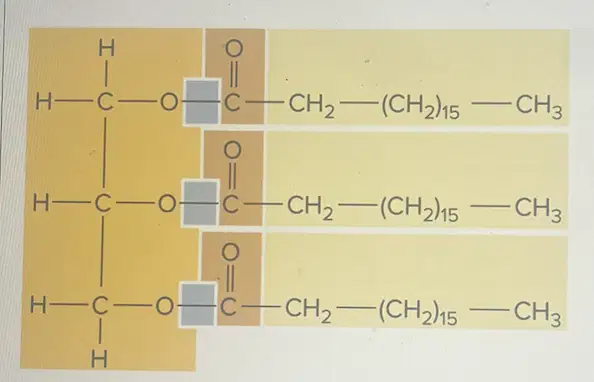
The polymer pictured below is made up of multiple fatty acids. It falls into which of the following categories?
carbohydrate
nucleic acid
lipid
protein
Which of the following types of cells lack(s) a nucleus?
fungi
plant
bacteria
animal
Which is the most likely pathway taken by a newly synthesized protein that will be secreted by a cell?
nucleus -> ER -> golgi
ER -> golgi -> vesicles that fuse with plasma membrane
ER -> lysosomes -> vesicles that fuse with plasma membrane
free ribosome -> nucleus -> golgi
Which of the following correctly lists the order of the proposed phases of the origins of life on earth?
cellular functions arise in RNA world, origin of organic molecules, enclose polymers, origin of polymers
origin of organic molecules, origin of polymers, enclose polymers, cellular functions arise in the RNA world
cellular functions arise in the RNA world, origin of organic molecules, origin of polymers, enclose polymers
enclose polymers, origin of polymers, origin of organic molecules, cellular functions arise in the DNA world
origin of organic molecules, enclose polymers, origin of polymers, cellular functions arise in the RNA world
Three ways that plant cells are different than animal cells are the presence of __________, __________, and __________.
chloroplasts, vacuoles, cell walls
plasma membrane, chloroplasts, nucleus
mitochondria, cell walls, plasma membrane
rough ER, cell wall, nucleus
Which of the follwoing are found in bacterial cells? Check all that apply.
plasma membrane
mitochondria
chloroplasts
ribosomes
DNA
Which of the following components could NOT be found in an animal cell?
lysosome
cytopskeleton
cell wall
mitochondria
Which of the following factors would increase membrane fluidity?
a smaller portion of phosphorylated nucleotides
a smaller portion of peripheral proteins
a greater portion of unsaturated phospholipids
a greater portion of transmembrane proteins
What property allows O2 and CO2 to cross a lipid bilayer without the help of membrane proteins?
they are both small, nonpolar molecules
they are both uncharged molecules
they are both large, complex molecules
they are both polar molecules
Water held behind a dam would best reflect:
kinetic energy
mechanical energy
heat energy
potential energy
chemical energy
In the reaction A- + B -> A + B-,
molecule A is reduced and molecule B is oxidized
molecule A and B are both reduced
molecule A is oxidized and molecule B is uncharged
molecules A and B are both oxidized
molecule A is oxidized and molecule B is reduced
In photosynthesis, carbon dioxide gas is reduced and combined to form glucose. This is an example of:
cannabolism
embolism
anabolism
catabolism
You measure the amount of enzyme activity in the presence of compound X and notice that enzyme activity decreases. You note that as you add more substrate the amount of enzyme activity increases. This indicates that the compound X is a(n)
enzyme
activator
competitive inhibitor
non-competitive inhibitor
Why is ATP an important molecule in metabolism?
its terminal phosphate has higher energy than the other two
all reactants in cells are catalyzed by ATP
it provides energy coupling between exergonic and endergonic reactions
its hydrolysis creates oxidative phosphorylation
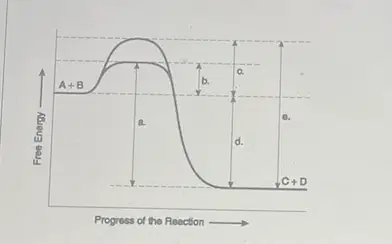
The following question is based on the reaction shown above A + B --> C + D with and without an enzyme.
Which of the following represents the activation energy required for the reactants to reach the transition state and convert the reactants to products in the presence of the enzyme?
e
b
d
a
c
What are the net products of glycolysis?
2 ATP, 1 glucose, 2 pyruvate
4 ATP, 6 phosphate groups, 6 carbons
4 ATP, 2 NADH, 2 pyruvate
2 ATP, 2 NADH, 2 pyruvate
Which of the following statements is TRUE of both aerobic and anaerobic respiration?
both use glycolysis to oxidize glucose to pyruvate and both produce NADH as high-energy intermediates.
both produce ethanol
both require oxygen to oxidize glucose to pyruvate
both require a functional mitochondrion
Respiration is measured in a human. How do the concentration of O2 AND CO2 in inhaled air compare with exhaled air?
inhaled air has less O2 AND CO2 than exhaled air
inhaled air has more O2 and CO2 than exhaled air
inhaled air has less O2 and CO2 than exhaled air
inhaled air has more O2 and less CO2 than exhaled air
In chemiosmosis in the chloroplast, protons flow from the thylakoid space into the stroma to provide the enrgy to make ATP via the ATP synthase. In what direction do protons flow during chemiosmosis in the mitochondria to make ATP?
from the matrix to the stroma
from the intermembrane space to the cytosol
from the intermembrane space to the matrix
from the matrix to the cytosol
In the equation, C6H12O6 + 6O2 --> 6CO2 + 6H2O, on which side of the reaction would you find ATP and heat?
ATP AND heat would be products because this is an exergonic reaction
ATP and heat could appear on either side because this reaction is in equilibrium
ATP and heat would be reactants because this is an exergonic reaction
ATP and heat would be reactants because this is an endergonic reaction
ATP and heat would be products because this is an endergonic reaction
The equation C6H12O6 + 6O2 --> 6CO2 + 6H2O is a summary equation for which of the following process?
photosynthesis
cellulose biosynthesis
cellular respiration
lipid biosynthesis
A comparison of mitochondria and chloroplasts shows that:
they have very different electron transport protein complexes
both use oxygen as a final electron transporter
both generate ATP via an H+ gradient
only mitochondria contain ATP synthase
In the reaction, 6CO2 + 6H2O --> C6H12O6 + 6O2, which side should energy be placed on?
the left side; this is an exergonic reaction
the left side; this is an endergonic reaction
the right side; this is an exergonic reaction
the right side; this is an endergonic reaction
How is the water necessary for photosynthesis used?
to combine with ADP forming ATP
as an electron donor
as a substrate for ATP synthase
as an electron acceptor
Which of the following molecules are products of the light reactants of photosynthesis and are used in the catabolic reactions of the Calvin Cycle?
H+ and electrons
CO2 and H2O
O2 and H2O
ATP, NADPH
Placing celery sticks in fresh water will make them more turgid and harder. This is because
the celery cells are isotonic to fresh water
the celery sticks are hypotonic to fresh water
water moves from the celery cells into fresh water
the celery cells are hypertonic to fresh water
What is meant by the description "antiparallel" regarding the strands that make up DNA?
one strand contains only purines and the other contains only pyrimidines
the 5' to 3' direction of one strand runs counter/opposite to the 5' to 3' direction of the other strand
the twisting nature of DNA creates nonparallel strands
base pairings create unequal spacing between the two DNA strands
Which of the following experimental approaches proved DNA is the genetic material?
purify different types of macromolecules (DNA, RNA protein) from lethal bacteria (a strain that kills mice) and test which macromolecules is capable of transforming non-lethal bacteria into lethal bacteria
determine the structure of different macromolecules using x-ray diffraction
heat kill lethal bacteria (a strain that kills mice) and incubate the dead bacteria with live bacteria of a non-lethal strain
use radiolabeled nucleotides to show that they are semi-conservatively incorporated into DNA
Rosalind Franklin's important contribution to solving the structure of DNA was:
discovering that the number of adenines matches the number of thymines in all genomes
obtaining x-ray diffraction data that revealed the double helix structure
piecing together "ball and stick" models of nucleotides to form a double helix
transformation of R-type bacteria with DNA S-type bacteria
What happens to RNA primers during DNA replication?
a RNA transisomerase converts the RNA into DNA
RNA can't base pair with DNA, so the RNA primer doesn't stay associated with the template DNA
a DNA polymerase removes the RNA primer and replaces it with DNA
the nucleotide excision repair pathway removes the RNA primer
Which of the following statements about Origins of Replication is FALSE?
in eukaryotes, multiple origins of replication form along a chromosme
origins of replication are bidirectional
in eukaryotes, a single origin of replication forms at one telomere and spreads toward the opposite telomere so that only one origin of replication is required to replicate a chromosome
each replication fork contains a leading strand and a lagging strand
Which of the following best describes the function of telomerase at the telomere?
it makes special primers that do not need to be removed from the lagging strand
it adds repeats of a specific DNA sequence to the 3' end of the template strand of DNA
it allows DNA polymerase to add a polyA tail (many A nucleotides) to the end of chromosomes without any template sequence
it adds a random sequence of nucleotides to the 3' end the newly synthesized "daughter" strands of DNA
The protein that separates DNA strand at the replication fork is
DNA ligase
DNA helicase
DNA primase
DNA polymerase
A gene whose promoter is located within "tightly condensed chromatin" (also known as heterochromatin) is likely to:
not be copied during RNA replication
not be transcribed
be found within the telomere region at the end of chromosomes
be transcribed
An octamer of histone proteins with 147 base pairs of DNA wrapped around it forms:
an enhancer domain
a telomere
a nucleosome
looped regions of chromosomes
Which of the following is necessary to compact the "beads-on-a-string" form of DNA into the "30-nm fiber" form"?
chromatin remodeling enzymes
chromosome looping
telomerase
histone H1 binding "linker" regions of DNA
How many nucleotides are in a codon?
three
two
one
four
What mRNA sequence will be transcribed from this DNA template sequence: 3' - TTCGGACTA - 5'
5' - UAGUCCGAA - 3'
3' - UUCGGACUA - 5'
5' - AAGCCUGAU - 3'
3' - AUCAGGCUU - 5'
Transcription begins at a site in the DNA called the
transcription unit
core promoter
response element
enhancer
What process enables a single gene to encode two or more polypeptides that are different in their amino acid sequence?
spliceosome jumping
capping
alternative splicing
reverse transcription
mRNA processing in eukaryotes (including 5' cap addition and splicing), occurs;
only after Dicer converts the RNA from double stranded to single stranded
in the cytoplasm
in the nucleus
only after ribosomes bind the mRNA
The genetic code is considered "degenerate" or "redundant" because:
every amino acid is encoded by only one codon
amino acids are encoded by more than one codon
codons contain uracil (U) instead of thymine (T)
there is more than one amino acid - there are 20
In which of the ribosomal sites, the A site, P site, and/or E site, could a tRNA with an attached polypeptide (protein with multiple amino acids) be found at the beginning of the Elongation stage?
E site
A site
P site
A and E sites
What occupies the ribosome "A" site when the codon in the "A" site is UAA?
tRNAs that are not charged with an amino acid
any tRNA charged with Met
nothing - the A site is not filled when that codon is present
release factor protein
At the beginning of each round of Translation Elongation, what best describes tRNA in the A site?
the tRNA recognizes a stop codon
the tRNA does not have an amino acid attached
the tRNA has the growing polypeptide attached
the tRNA has a single amino acid attached
Which of the following is NOT a property of the genetic code?
it specifies the amino acids within a polypeptide
it is composed of codons, which are specific sequences of three bases
it has a start codon, which specifies the starting point of the polypeptide synthesis
it determines the rate of transcription
Which sequence of events CORRECTLY describes the initiation and elongation steps of translation in bacteria?
(1) initiator tRNA binds start codon on mRNA
(2) small ribosomal subunit binds to mRNA
(3) large ribosomal subunit binds
(4) tRNA entry and peptidyl transfer reaction
(5) translocation of ribosome and release of tRNA
2, 3, 1, 5, 4
1, 2, 3, 5, 4
1, 3, 2, 4, 5
2, 1, 3, 4, 5
The Exit Site of "E" in a ribosome is where:
the tRNA that adds the next amino acid enters the ribosome
the 5' end of the mRNA has already been translated exits the ribosome
the finished polypeptide exits the ribosome
the tRNA that was previously in the P site and no longer has any amino acid attached exits the ribosome
Cell type-specific regulation of gene transcription typically requires:
mutations that cause different DNA sequences in each cell type
loss of a DNA repair pathway in one of the cell types
cell-type specific exons within the gene
combinations of DNA sequence elements (enhancers and silencers) in the promoter/regulatory region
The collagen gene is transcribed in fibroblast cells but is never transcribed in neurons. This differential transcription could be regulated by:
a transcription factor (activator) that is only expressed in fibroblasts and binds to an enhancer DNA sequence (regulatory element) in the collagen promoter
the absence of a core promoter in the collagen gene of neurons
an enhancer DNA sequence (regulatory element) that is only present in the collagen promoter of fibroblasts
a silencer DNA sequence (regulatory element) that is only present in the collagen promoter of neurons
At the lac operon, when lactose and glucose are present at low level:
cAMP levels are high and CAP is able to activate very high rates of transcription
the rate of transcription is low but the lactose permease gene is not included in the polycistronic mRNA
the rate of transcription is very low because the lac repressor binds to its target sequence (the operator)
RNA polymerase is able to bind to the operator so the rate of transcription is very high
Which statement best describes why multicellular eukaryotes typically use more complex combinations of regulatory elements to control gene transcription compared to bacteria?
the complexity ensures that all mRNAs are translated - in bacteria only a portion of mRNAs are translated
the complexity allows precise control over the timing of transcription and the type of cell where transcription occurs
the complexity allows each cell type to have different DNA sequences
the complexity is caused by DNA mutations that don't occur in bacteria
Which of the following statements about chromatin is TRUE?
nucleosome are not considered part of chromatin
chromatin modifications only occur during DNA replication
chromatin is only found in the protein coding portions of genes
histones are a major component of chromatin
If lacl were mutated so that the Lac Repressor ALWAYS binds to the operator DNA sequence (regardless of small effector molecule levels), this would cause:
the Lac operon would we transcribed at very high rates when lactose levels are low and glucose levels are high
the lac operon would be transcribed at very low rates when lactose levels are low, but would be transcribed at very high rates when lactose levels are high
the Lac operon would be transcribed at very high rates when lactose and glucose levels are low
the Lac operon would always be transcribed at very low rates, the levels of lactose and glucose would not matter
Fibroblast cells (a eukaryotic cell type) contain 1,000 different proteins. You predict that "Gene X" is important for fibroblast development and delete the gene (the entire gene is removed from the genome). You discover that fibroblasts lacking Gene X now contain only 997 proteins. The three missing proteins contain an identical domain but other amino acid sequences are unique to each protein. This result could be explained by:
a missense mutation in Gene X
alternative splicing of Gene X pre-mRNA
Gene X being located in a nucleosome free region
Three different ribosome binding sites in the Gene X mRNA
To produce multiple proteins from a polycistronic mRNA, each translated region must have:
a ribosome binding site, a start codon, a stop codon
a start codon, a stop codon
a splice site before the next protein coding region
a start codon, a stop codon, a termination sequence
Differential gene expression between two cell types could occur because:
all of these are correct
a transcription activator in one cell type but not the other
a histone modifying enzyme is present in one cell type but not the other
alternative splicing skips an exon in one cell type but not the other
Which of the follwoing is an example of a somatic mutation? select all that apply.
a mutation in an adult neuron
a mutation in an egg cell
a mutation in a sperm cell
a mutation in an embryonic muscle cell

A deletion occurs during DNA replication, causing the underlined guanine (also shown in red) to be removed from the coding strand of a gene. What effect is this most likely to have on the final protein?
5' ATG CGG GTA GTT AGC CGA TAG 3'
the deletion will cause a single amino acid chnage
the deletion will cause a silent mutation - the protein won't change in any way
the deletion will cause a frameshift and introduce a premature stop codon - the resulting protein will be shorter than normal
the deletion will cause a frameshift that removes a stop codon - the resulting protein will be longer than normal
In which of the following locations is a mutation least likely to affect gene function?
core promoter
an intergenic region between genes
protein coding region
regulatory site such as an enhancer
A mutation in a gene in the fruit fly Drosophila was found to affect eye color. The relevant protein is normal in its molecular weight and amino acid sequence (in other words, nothing changes about the protein), but much less of the protein is made in mutant flies. A reasonable explanation for the change in levels of protein is that the mutation:
introduces a premature stop codon
is in a splice site and causes alternative splicing of the pre-mRNA
causes a frameshift
is in the core promoter of the gene
Which of the following is an example of a spontaneous DNA mutation ( a mutation that is caused by normal metabolic byproducts produced in a cell)?
reverse transcriptase enzymes convert thymine (T) to uracil (U)
nitrous oxide converts cytosine (C) to uracil (U)
ultraviolet (UV) light from the sun causes thymine dimers
True of False: DNA mutations only occur during replication, when the DNA polymerase adds an incorrect nucleotide
true
false
Which of the following statements correctly describes the error rate of DNA replication?
errors are common - the rate is around 1 out of every 1 thousand nucleotides
the error is very low but not zero - the rate is around 1 out of every 1 billion nucleotides
the error rate is zero, it is impossible for DNA polymerase to add an incorrect nucleotide
What would happen if actively dividing cells were treated with a chemical that inhibits telomerase activity during each round of cell division?
okazaki fragments could not be properly joined together
the ends of chromosomes would become shorter (DNA sequence would be lost) after each round of DNA replication
origins of replication could not form in the middle of the chromosome
large portions of the middle of chromosomes would be single-stranded
What was the surprising finding from Griffith's work with mice and pneumonia-causing bacteria in 1928?
heat killed pathogenic cells (S cells) caused pneumonia and killed mice
a heritable substance from heat killed pathogenic bacteria (S cells) transformed nonpathogenic bacteria (R cells) making them lethal (the transformed bacteria killed mice)
nonpathogenic cells (R cells) plus pathogenic S-cell mRNA caused pneumonia and killed mice
nonpathogenic cells (R cells) plus pathogenic S-cell proteins caused pneumonia and killed mice
Which of the following statements about sister chromatids is TRUE?
all answers are correct
sister chromatids are produced during metaphase
sister chromatids are held together bby complementary base pairing of DNA
sister chromatids are exact copies of each other and are formed before the M phase begins
sister chromatids contain the same genes, but they may have different alleles because they come frim different biological parents
The presence of cell walls in plants is associated with _______ in telophase.
cell plate formation
cleavage furrows
differentiation
spindle fiber formation
Place the following events of mitosis in the correct order.
I. The cleavage furrow forms
II. Sister chromatids align on the metaphase plate
III. The mitotic spindle forms and spindle microtubules attach to sister chromatids
IV. Sister chromatids seperate
V. Chromosomes begin to condense
I, V, II, III, IV
V, III, II, IV, I
V, II, III, IV, I
V, IV, III, II, I
III, V, IV, II, I
Compared to the mother cell, daughter cells at the end of mitosis have ________ number of chromosomes.
the same
twice the
half of the
two more than the original
What is a likely advantage of sexual reproduction over asexual reproduction?
there is a lower chance of using up the resources in a given environment
sexual reproduction is more cost-effective
sexual reproduction results in variation in the offspring
sexual reproduction involves fewer stages
Bivalents, also known as tetrads align in the middle of the cell during
anaphase of Meiosis II
anaphase of Mitosis
metaphase of Meiosis II
metaphase of Meiosis I
anaphase of Meiosis I
Which of the following processes do not lead to variation in offspring with the same parents?
random or independent assortment of chromosomes
random joining of sperm and egg
chromosomal duplication
crossing over
A human zygote has a(n) _______ number of chromosomes.
tetraploid
polypoid
haploid
diploid
Which of the following events does not occur during some stage of interphase?
cell growth and elongation
DNA duplication
separation of sister chromatids
passing through the G1 checkpoint
Which of the following is NOT a checkpoint that controls the progression of the cell cycle?
the metaphase checkpoint determines if all chromosomes are attached to the spindle apparatus
the G2 checkpoint checks for DNA damage and determines if all of the DNA is replicated
the G1 checkpoint checks for proper cell size and nutrients for the S phase
cytokinesis involves the formation of cleavage furrow to separate the cells
Which of the following statements about the cell cycle is correct?
In actively dividing cells, the S and G2 phases are collectively known as interphase.
The phases of the cell cycle are G1, S, and M phases.
During G2 phase, the cell grows and copies its chromosomes in preparation for cell division.
When S phase is finished, chromosome duplication is complete.
What does the term monohybrid cross mean?
a monohybrid cross involves organisms that are heterozygous for one character
a monohybrid cross produces a single offspring
a monohybrid is performed for one generation
a monohybrid cross involves a single parent
Th expression of genes is called the _______.
phenotype
genotype
karyotype
pedigree
How many alleles do diploid organisms package into their gametes for each of their genes?
1
4
2
3
Which is the best definition of different alleles?
different DNA sequences found at the same locus on sister chromatids
different DNA sequences found at the same locus on homologous chromosomes
different phenotypes for a particular character
different particles found in gametes
When a homozygous dominant individual is crossed with a homozygous recessive individual in the parental (P) generation, what is the phenotypic ratio of the F2 offspring (ratio is written as dominant phenotype:recessive phenotype)?
1:2
3:1
1:3
1:2:1
2:1
Should a genetic abnormality arise, ______ prevent a cell from progressing uncontrollably through the cell cycle.
spindle proteins
checkpoint proteins
allelease enzymes
DNA synthases
The accumulation of mutations and epigenetic changes in a lineage of cells that leads to uncontrolled cell growth is called ________.
cancer
dosage compensation
a Barr body
a tumor suppressor
CRISPR/Cas-based genome editing involves what normal process in a cell?
the pathways that add telomere sequences at the end of chromosomes
the 3'-5' exonuclease activity of DNA polymerase
the pathways that repair double-stranded DNA breaks
the reverse transcriptase pathway that converts RNA into DNA
"Next Generation" DNA sequencing technology is different from previous/ "older" DNA sequencing techniques in what way?
it is only able to "read" eukaryotic DNA sequences
it requires cloning DNA sequences into a bacterial vector
it doesn't use any nucleotides to generate a complementary DNA sequence
it can "read" more than 100 million DNA sequences all at the same time
Why are fluorescently-labeled ddNTPs used for sequencing?
the fluorescent signal is used to identify the last nucleotide added to the different sized DNA-fragments
the fluorescent signal is used to identify vectors that contain the cloned DNA
the fluorescent signal is used to distinguish template RNA from newly made DNA
the fluorescent signal is used to confirm that DNA synthesis is occuring
The dideoxy chain termination sequencing method uses what enzyme?
DNA polymerase
Topoisomerase
Reverse Transcriptase
RNA polymerase
An XY individual is colorblind. Which of the following must be true? Recall that the allele for colorblindness is represented as XC
this person's father, an XY individual, was colorblind
this person's mother, an XX individual, had at least one XC allele
100% of this person's offspring will be colorblind
this person's mother, an XX individual, was colorblind
In mammals, dosage compensation happens via
X chromsome inactivation
Y chromosome inactivation
X/Y chromosome triploidy
X chromosome apoptosis
Y chromosome duplication
If AaBb is crossed with aabb, what proportion of the offspring would be expected to be aabb?
4 in 16
8 in 16
2 in 16
1 in 16
Genetically identical plants are grown in the same soil with the same amount of light, but put into rooms that are set 75, 80, 85, or 90 degrees. The plants grown at 85 degrees are always significantly taller than those grown at any of the other temperatures. This is an example of
some plants having stronger height genes than others
the different plants having different genes for height
plant height not being an inherited trait
the environment affecting the expression of the gene(s) that control the height of the plants
errors in height measurement
The discovery that there are homologous Hox genes in nearly all animals suggests that
Hox genes are not important if they are in all animals
animal development is a simple process that can use any duplicated gene to pattern an embryo
DNA replication is defective in animals and makes many mistakes
the last common ancestor of all animals used Hox genes to pattern its body
Which of the following is NOT a beneficial characteristic of developmental model of organisms?
sequenced genome
produce many offspring
transparent embryos
long life span
A true-breeding pea plant with smooth pods is crossed to a true-breeding pea plant with constricted pods. The offspring of this cross all have smooth pods. This indicated that (select all that apply)
constricted and smooth are not alleles
constricted and smooth are variants of the same gene
smooth is dominant and constricted is recessive
constricted is dominant and smooth is recessive
Two black female mice (Z and W) are crossed with the same brown male. In a number of litters female Z produced 9 black mice and 7 brown mice and female W produced 14 black mice. What are the possible genotypes of the parents?
Female Z = Bb; Female W = bb; Male = bb
Female Z = Bb; Female W = BB; Male = bb
Female Z = BB; Female W =Bb; Male = BB
Female Z = Bb; Female W = BB; Male = Bb
Which of the following describe a body axis displayed by Arabidopsis thaliana, a popular plant model system?
dorsal-ventral
left-reight
anterior-posterior
root-shoot
Pattern formation in animal and plant embryos is controlled by
the activation of a series of homologous enzymes
a hierarchy of cell-type specific transcription factors
gametogenesis which produces the oocyte and the sperm
stem cells which are induced by signaling factors
X chromosome inactivation occurs
very early in development, but after multiple rounds of cell division
in adult offspring of heterozygotes only
only in XY individuals
immediately after fertilization at the one cell stage
Mutations in which of the following genes lead to transformations in the identity of entire body parts?
egg-polarity genes
homeotic genes
general transcription factor genes
segmentation genes
A stem cell that can give rise to any type of cell of an embryo and produce extraembryonic tissue such as the amnion is called
multipotent
unipotent
totipotent
pluripotent
If W = purple flower and w = white, and D = tall plants and d = short plants, a wwDd plant would be
purple and short
white and short
white and tall
purple and tall
Every gamete from a diploid parent with a homozygous dominant genotype for a certain gene has
one dominant allele for this gene
both alleles for this gene
either one dominant or one recessive allele for this gene
one recessive allele for this gene
A plant with white flowers is crossed to a plant with dark purple flowers, and the F1 generation is 100% plants with light purple flowers. What is the expected phenotypic ratio for the F2 generation (two F1 plants crossed to each other)?
50% dark purple: 50% white
75% dark purple: 25% white
100% dark purple
25% white: 50% light purple: 25% dark purple
An XX individual who has blood type A has a XX offspring who is blood type O and a XY offspring who is type B. Which of the following is a possible blood type phenotype for the other parent?
A blood type
B blood type
O blood type
AB blood type
What would happen if only dideoxyribonucleotides were used in sequencing (instead of a mixture of deoxyribonucleotides (regular dNTPs) and dideoxyribonucleotides (ddNTPs)?
no nucleotides would be added to the primer
the DNA wouldn't have a negative charge and couldn't be separated by electrophoresis
DNA synthesis would never stop and the DNA produce would be too long for sequencing
DNA synthesis would always stop after adding the first nucleotide to the primer

