wayground logo

Free Printable Worksheets

NEW

Font size

S
M
L
XL
Worksheets

Force, Energy, Seasons and Tides

Total questions: 60

Worksheet time: 53mins

Name
Class
Date
1.
What is a force?
a)
a push or pull
b)
speed or acceleration 
c)
potential or kinetic energy
d)
balanced or unbalanced force
2.
When objects remain in the same place, it is called...
a)
gravity
b)
friction
c)
balanced force
d)
unbalanced force
3.
When an object has potential energy, it is not moving.
a)
true
b)
false
4.
What is the force that causes everything to be pulled down to the Earth?
a)
friction
b)
gravity
c)
balanced
d)
unbalanced
5.
Kinetic energy is when....
a)
energy is stored up in an object
b)
energy is released and the object moves
6.
Force is measured in....
a)
Galileos 
b)
Newtons
c)
Di Vincis
d)
Einsteins 
7.
An unbalanced force is when objects move in one direction because the force is greater from that direction.
a)
true
b)
false
8.
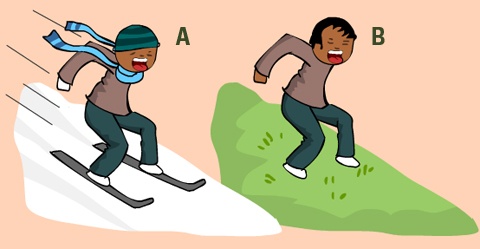
Why is it harder for the boy in Image B to get down the hill?
a)
Motion
b)
Friction
c)
Work
d)
Displacement
9.
Edward kicks a soccer ball across the backfield. What force works to slow the ball down?
a)
pushes and pulls
b)
friction
c)
magnetism
d)
gravitation
10.
How does friction help us move from place to place?
a)
Friction does not help us.
b)
Friction keeps us from slipping and sliding.
c)
Friction only helps cats.
d)
Friction makes us slip and fall.
11.

A cup sitting on the edge of a table

a)

Kinetic Energy

b)

Potential Energy

12.

A roller coaster gliding down the tracks

a)

Kinetic Energy

b)

Potential Energy

13.

Energy that is stored

a)

Kinetic Energy

b)

Potential Energy

14.

A rubber band that is stretched out

a)

Kinetic Energy

b)

Potential Energy

15.

Energy of an object that is in motion

a)

Kinetic Energy

b)

Potential Energy

16.

_________________________ is energy that does not need matter to travel; light.

a)

Potential Energy

b)

Thermal Energy

c)

Nuclear Energy

d)

Radiant Energy

17.

__________________ is energy stored due to position in a gravitational field; commonly due to Earth's gravity (Example: a marble sitting at the top of a hill)

a)

Thermal Energy

b)

Chemical Energy

c)

Gravitational Potential Energy

d)

Kinetic Energy

18.

___________________ is energy in the form of heat

a)

Radiant Energy

b)

Mechanical Energy

c)

Thermal Energy

d)

Potential Energy

19.

This is the energy of vibrating molecules that move through matter.

a)

sound

b)

thermal

c)

mechanical

d)

electrical

20.

_________ is the ability to do work

a)

Power

b)

Strength

c)

Energy

d)

Force

21.

What form of energy is this?

a)

Electrical

b)

Mechanical

c)

Chemical

d)

Thermal

22.

What form of energy is stored in a battery?

a)

Chemical energy

b)

Light energy

c)

Mechanical energy

d)

Heat energy

23.

Which of these is an example of light energy being transformed into chemical energy?

a)

A glow stick lights up when broken.

b)

Water heated by the sun evaporates.

c)

A plant makes sugar in the sunlight.

d)

A battery causes a buzzer to vibrate.

24.
Which type of energy transformation occurs when a flashlight shines?
a)
chemical → thermal → electrical
b)
chemical → electrical → light
c)
thermal → chemical → light
d)
chemical → electrical → chemical
25.

The Law of the Conservation of Energy states -

a)

Energy can be created, just not destroyed. It changes its form from one type to another.

b)

Energy can never be created nor destroyed. It can only change its form from one type to another.

c)

The total energy in our Universe changes, as different forms of energies can be transformed from each other under certain circumstances.

d)

Energy transformations do not passively occur in our lives, rather we actively make use of energies and transform energies.

26.

What is a medium?

a)

the matter through which a mechanical wave travels

b)

two lines that will never touch

c)

the particles of a medium that travel parallel to a wave

d)

two lines that meet at a right angle

27.

What is a transverse wave?

a)

the particles of a medium that travel perpendicular to a wave

b)

the particles of a medium that are fast

c)

the particles of a medium that travel parallel to a wave

d)

the particles of a medium that you can touch

28.

What is a medium?

a)

the matter through which a mechanical wave travels

b)

two lines that will never touch

c)

the particles of a medium that travel parallel to a wave

d)

two lines that meet at a right angle

29.

What type of wave is this?

a)

Transverse

b)

Longitudinal

c)

Surface

d)

Hair wave

30.

What type of wave is this?

a)

Transverse

b)

Longitudinal

c)

Surface

d)

Hair wave

31.
What kind of wave is pictured?
a)
Transverse
b)
Longitudinal
c)
surface
d)
none of the above
32.

Is made up of compressions and rarefactions.

a)

Transverse Wave

b)

Longitudinal Wave

33.

Is made up of crests and troughs

a)

Transverse Wave

b)

Longitudinal Wave

34.
a)

Transverse Wave

b)

Longitudinal Wave

35.

a)

Transverse Wave

b)

Longitudinal Wave

36.
In winter, the axis of the earth is pointed away or toward the sun?
a)
towards
b)
up
c)
down
d)
away
37.
In summer, the axis of the earth is pointed away or toward the sun?
a)
towards
b)
up
c)
down
d)
away
38.
Which season is taking place in the Northern Hemisphere in Position 1?
a)
Winter
b)
Spring
c)
Summer
d)
Fall
39.
What are the reasons for the season?
a)
Earth's tilt & rotation
b)
Earth's tilt & revolution
c)
Earth's rotation & size
d)
Earth's tilt & resolution
40.
The term equinox means....
a)
equal amount of day light and equal amount of night
b)
Equal amount of winter and summer
c)
Equal amounts of hot dogs for everyone
d)
The longest day of the year
41.
One rotation of Earth is equal to
a)
a day.
b)
a year.
42.
If its ____ in the Northern hemisphere, then its fall in the Southern hemisphere. 
a)
spring
b)
summer
c)
fall
d)
winter
43.
If its ____ in the Northern hemisphere, then its summer in the Southern hemisphere. 
a)
spring
b)
summer
c)
fall
d)
winter
44.
The Earth's _______ is an imaginary line that goes from the North Pole to the South Pole.
a)
vernal equinox
b)
axis
c)
solar eclipse
d)
solar flare
45.
caused by the pull of the moon's gravity on the Earth
a)
seasons
b)
tides
c)
day/night cycle
d)
moon
46.
Tides are caused mainly by what?
a)
Moon’s gravitational pull
b)
Sun’s gravitational pull
c)
Earth’s gravitational pull
47.
Most places on Earth experience about how many high and low tides in 24 hours?
a)
2 high and 2 low tides
b)
4 high and 4 low tides
c)
1 high and 1 low tides
48.
What type of tide occurs during a new and full moon?
a)
Neap tides
b)
Spring tides
c)
Normal tides
49.
What type of tide occurs during the first or third quarter moon?
a)
Neap tides
b)
Spring tides
c)
Normal tides
50.
If the Sun, Earth, and Moon are in perfect alignment, the Earth would have a _______ tide.
a)
Spring
b)
Neap
c)
Normal
51.
What type of Tide is this?
a)
Spring Tide
b)
Neap Tide
52.

What is the correct alignment needed for a SPRING tide to occur?

a)

Sun, Earth, Moon

b)

Earth, Sun, Moon

c)

Sun, Moon, Earth

d)

None of these

53.

A neap tide occurs during which two lunar phases?

a)

Full Mooon and New Moon

b)

Waxing Crescent and Waning Crescent

c)

Waxing Gibbous and Waning Gibbous

d)

1st Quarter and 3rd Quarter

54.

A spring tide occurs during which two lunar phases?

a)

New Moon and Full Moon

b)

Waxing Crescent and Waning Crescent

c)

Waxing Gibbous and Waning Gibbous

d)

1st Quarter and 3rd Quarter

55.

A[n] ___________ tide occurs when the sun, Earth, and the moon are inline.

a)

spring

b)

high

c)

low

d)

neap

56.
What type of tides would this arrangement of earth-moon-sun create?
a)
neap tide
b)
spring tide
c)
new moon tide
d)
full moon tide
57.
What type of tide would this arrangement of earth-moon-sun create?
a)
full moon tide
b)
new moon tide
c)
neap tide
d)
spring tide
58.

_______are daily changes in ocean water.

a)

Waters

b)

Tides

c)

Colors

d)

Earths

59.
How many high tides does a place have each day?
a)
3
b)
4
c)
5
d)
2
60.
The bulge of water on the side of the Earth closest to the moon produces ___________.
a)
high tide
b)
low tide
c)
neap tide
d)
spring tide