
 Worksheets
Semester Test
Total questions: 98
Worksheet time: 1hrs 3mins
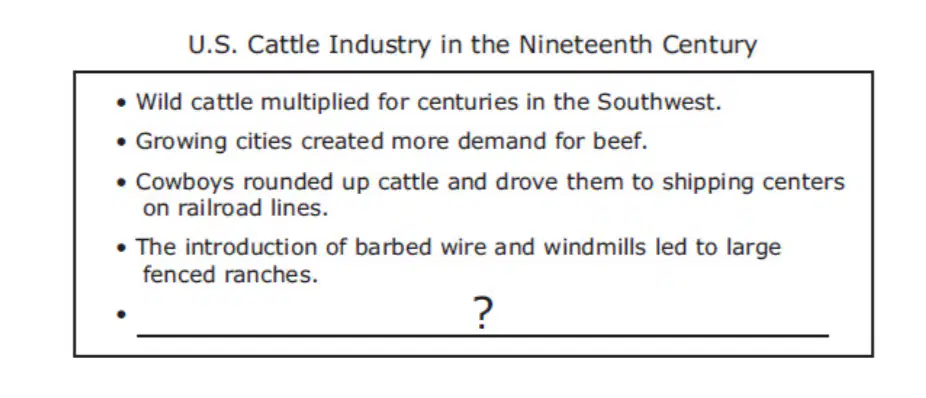
Which statement best completes this list?
Congress passed legislation imposing tariffs on imported beef.
Most of the cowboys on cattle drives were European immigrants.
The cattle industry was nationalized under the Department of Agriculture.
The need to process large amounts of cattle made meatpacking a major industry.
The primary objective of the Dawes Act was to —
promote cultural assimilation of American Indians
turn American Indian reservations into corporate farmland
end warfare between American Indians and the U.S. military
promote American Indian investment in private industry
How did the expansion of railroad transportation most benefit farmers in the United States?
By raising the consumer price of agricultural products
By increasing the variety of locally grown crops
By providing farmers with affordable access to distant markets
By encouraging farmers to form the first agricultural cooperatives
Which two developments of the Civil War helped open up the American West the most? Select all that apply.
The implementation of the Homestead Act
The invention of the cotton gin
The building of the Erie Canal
The completion of the Transcontinental Railroad
Which of the following contributed most to increased settlement of the Great Plains?
The availability of buffalo
The discovery of precious metals
A series of federal land grants
A decrease in agricultural production
Determine which stipulation applied MOST to Dawes Act, Homestead Act, or to both acts: Distributed 160 acres of land to the head of each family.
Dawes Act
Homestead Act
Both
Determine which stipulation applied MOST to Dawes Act, Homestead Act, or to both acts: Meant for settlers who would improve the conditions of the land.
Dawes Act
Homestead Act
Both
Determine which stipulation applied MOST to Dawes Act, Homestead Act, or to both acts: Meant to assimilate Native Americans into a more "civilized" lifestyle.
Dawes Act
Homestead Act
Both
Which of the following occurred between 1865 and 1900 as a result of the rapid industrialization of the United States?
Social and economic class divisions began to disappear.
Concerns about air pollution led to stricter environmental regulations.
Union membership increased as workers sought better pay and conditions.
Factory owners introduced wage-equity policies for women in the workplace.
Why did the Populist Party want free coinage of silver?
To increase the amount of money in circulation
To reduce economic inflation
To raise campaign contribution limits
To decrease the bargaining power of labor unions
Which of the following best characterizes the Gilded Age?
The discovery of goldfields in the West led to an increase in the amount of money issued for circulation.
Industrialists used their connections with corrupt government officials for material gain and political power.
In the Deep South a sharp increase in immigration brought a boom in construction and industry.
Small, family-owned farms were bought and consolidated to form large agricultural corporations.
Which of the following occurred as a result of the Sherman Antitrust Act?
Workers secured a greater share of company profits.
The influence of labor unions on factory owners was reduced.
The federal government could dissolve business monopolies.
Businesses were required to pay fees to open overseas locations.
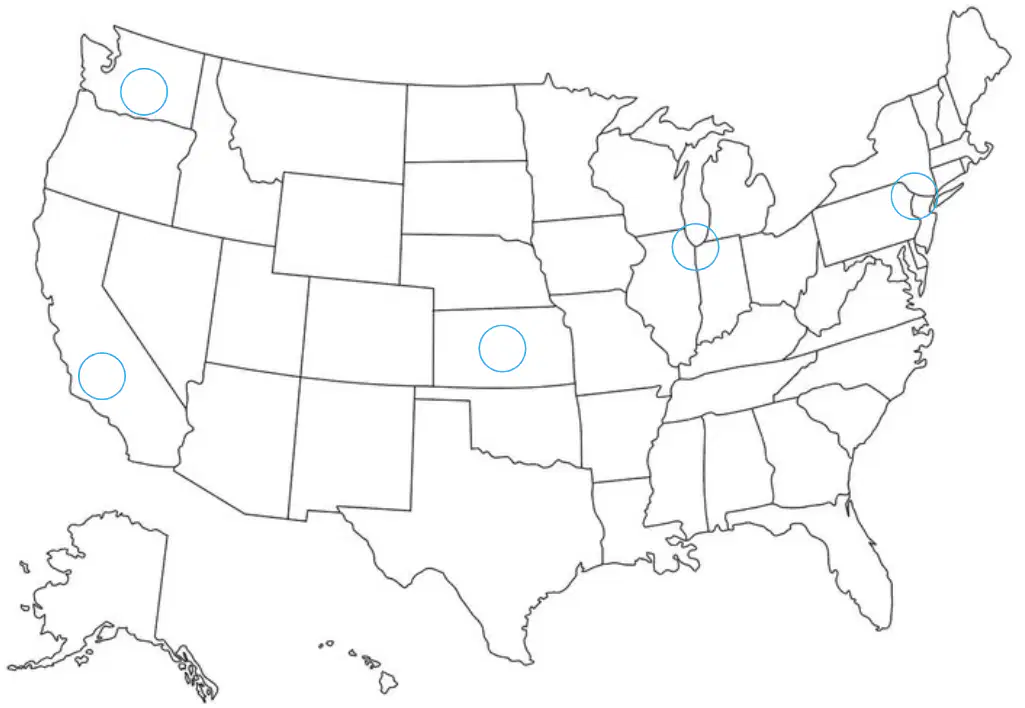
Thousands of African Americans moved to the Great Plains during the late nineteenth century. Many of them moved to Kansas in what was called the Great Exodus, and the participants were called Exodusters. Select where the Exodusters moved as they left the South and moved to the Great Plains.
Pacific Northwest
Coastal California
Kansas on the central Great Plains
Great Lakes region
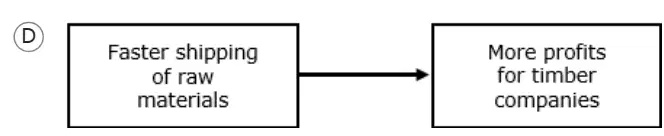
Which diagram shows how the completion of the transcontinental railroad contributed to the closing of the western frontier?
Improved communications → Increased protection of sites sacred to American Indians
Greater ease of travel → Higher demand for unclaimed territory
Advances in factory technology → Improved agricultural processes
Expanded foreign trade → Decreased migration to urban centers
The Chinese Exclusion Act of 1882 was primarily a response to —
increased U.S. presence in China
competition for jobs on the West Coast
rapid population growth in the Northeast
China’s actions during the Boxer Rebellion
These demands most reflected the concerns of —
small farmers in need of affordable credit
robber barons pursuing higher profits
prominent bankers who controlled the money supply
immigrant workers seeking economic justice
Choose the correct answer from the options to complete the sentence. _____ successfully adopted the Bessemer process, revolutionizing the American iron industry by enabling the cheap and efficient mass production of _____. Select the person for the first blank.
Andrew Carnegie
John D. Rockefeller
J. P. Morgan
Cornelius Vanderbilt
Choose the correct answer from the options to complete the sentence. _____ successfully adopted the Bessemer process, revolutionizing the American iron industry by enabling the cheap and efficient mass production of _____. Select the product for the second blank.
steel
oil
textiles
electric power
How did Andrew Carnegie contribute to civic and social life in the United States?
By promoting spiritual and moral values in public schools
By supporting conservative ideals in federal legislation and foreign policy
By establishing philanthropic organizations dedicated to education and the arts
By creating a charitable foundation to end hunger
Which of these was a major goal of Jane Addams’s Settlement House movement in Chicago?
The founding of women’s colleges
The introduction of prison reform
The assimilation of immigrants
The establishment of public libraries
The creation of initiative, referendum, and recall procedures during the Progressive Era resulted in —
a system of separate schools for new immigrants
the expansion of citizens’ direct participation in the democratic process
Choose the correct answer from each drop-down menu to complete the sentences. Industrialist and business leaders used horizontal and vertical integration to reduce competition and expand their companies. Which term controls every phase of a business?
vertical integration
horizontal integration
laissez-faire
monopoly
Choose the correct answer from each drop-down menu to complete the sentences. Industrialist and business leaders used horizontal and vertical integration to reduce competition and expand their companies. Which term buys out competing companies?
vertical integration
horizontal integration
laissez-faire
trust-busting
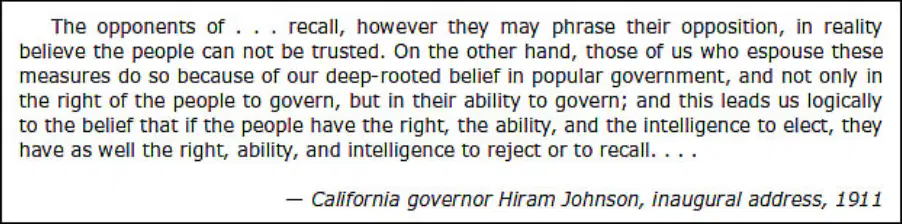
The reform discussed by Governor Johnson in this excerpt —
required elected officials to communicate regularly with the public
provided citizens with more resources to run for office
made elected officials more directly accountable to their constituents
created new eligibility requirements for candidates for public office
During the Progressive Era, one goal of state-level political reformers was to —
prevent party leaders from amending campaign platforms
increase the influence of business owners on regulatory legislation
promote the principle of direct democracy
limit the use of judicial review by circuit courts
Many Progressives opposed social Darwinism because it promoted the idea that —
people in lower classes were not capable of economic success
immigration weakened national unity
the government should take responsibility for the well-being of people
poverty could be eradicated through increased economic regulation
General John J. Pershing made a major contribution to the Allied victory in World War I by —
transforming inexperienced troops into an effective military force
developing advanced technologies for battlefield use
requesting humanitarian aid from Congress for war-torn countries
negotiating the terms of the Treaty of Versailles
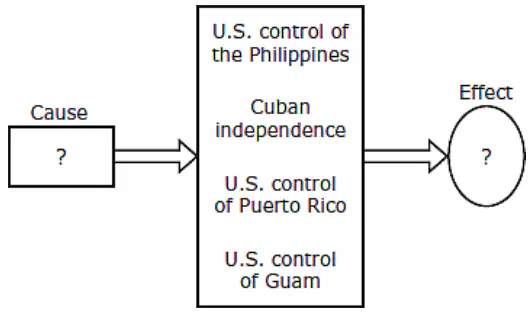
Refer to the diagram showing a cause-and-effect relationship. The central effects listed are: U.S. control of the Philippines; Cuban independence; U.S. control of Puerto Rico; U.S. control of Guam. The cause and the overall effect are both labeled with question marks. Which sentence provides information needed to complete both the cause and effect portions of this diagram?
The 1898 Spanish-American War led to world power status for the United States.
The 1914 opening of the Panama Canal encouraged international trade.
The 1919 Treaty of Versailles contributed to the start of World War II in Europe.
The 1929 stock-market crash set off the Great Depression in the United States.
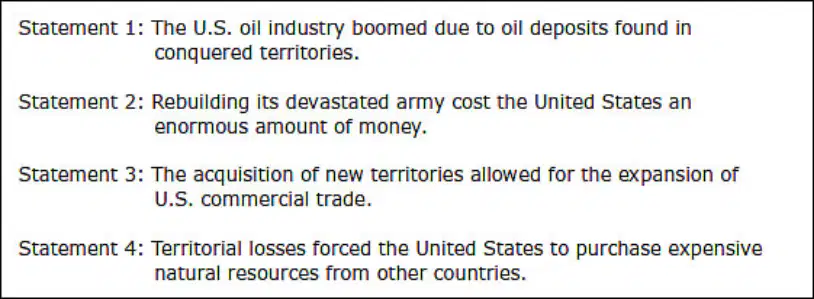
Which statement would most likely be found in a history of the economic impact of the Spanish-American War on the United States?
Statement 1
Statement 2
Statement 3
Statement 4
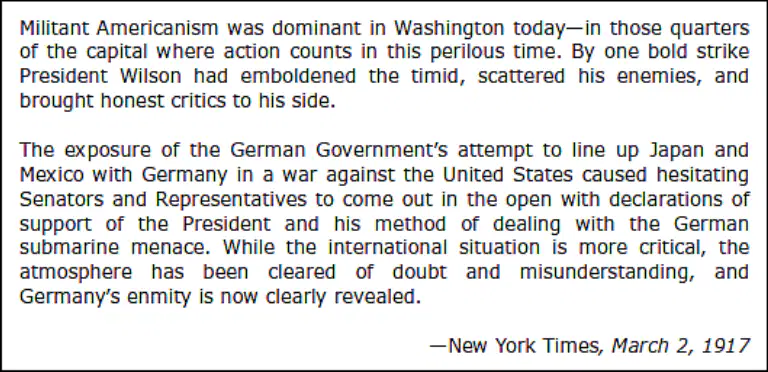
What was one result of the events reported in the excerpt above?
Germany financed the Mexican army’s attempted invasion of the United States.
The U.S. government abandoned its official policy of neutrality.
Germany’s navy blockaded several Mexican seaports.
The U.S. government boycotted goods imported from Europe.
The Spanish-American War, resulted in the beginning of US imperialism after acquiring the following territories: (select 3)
Guam
Spain
Philippines
Puerto Rico
• USS Maine sinks. • Spanish-American War begins. • United States acquires Puerto Rico and Guam. The events in the box above took place in what year?
1865
1898
1914
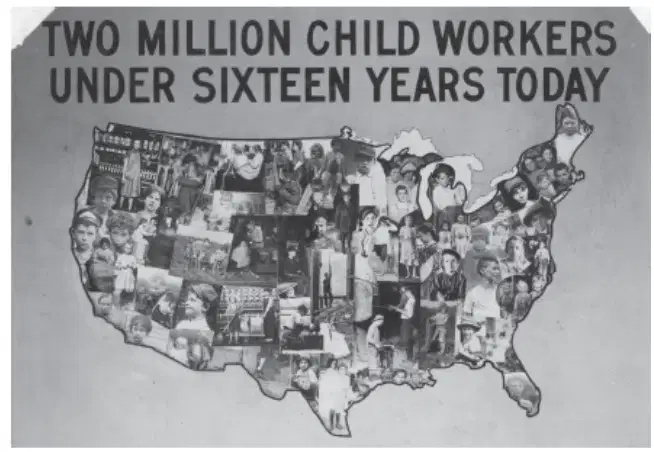
The issue addressed by this poster is primarily associated with the —
Progressive Era
Great Depression
Roaring Twenties
Cold War
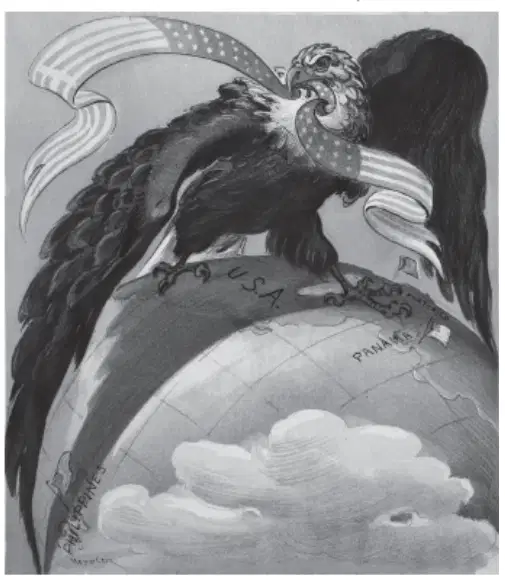
What message about imperialism did this political cartoon convey?
The closer an acquired territory was, the more self-government it should be allowed to exercise.
Imperialism was not likely to improve access to overseas markets.
It was not worth angering European powers to annex new territories.
The farther imperialist expansion extended, the harder it would be for the United States to maintain control.
The Fourteen Points reflected President Woodrow Wilson’s belief that —
intervention in the affairs of other nations was never justifiable
travel among nations should be regulated by an international organization
no country should be allowed to spend more on defense than any other country
cooperation among international leaders was essential to maintaining world peace
“The great rule of conduct for us in regard to foreign nations is in extending our commercial relations, to have with them as little political connection as possible. So far as we have already formed engagements, let them be fulfilled with perfect good faith. Here let us stop. Europe has a set of primary interests which to us have none; or a very remote relation. Hence she must be engaged in frequent controversies, the causes of which are essentially foreign to our concerns.” —George Washington, Farewell Address, 1796.
Which group followed the advice given in this address?
Expansionists during the Spanish-American War
Isolationists regarding the Treaty of Versailles after World War I
Hawks in Congress during the Vietnam War
Civil libertarians in Congress after the start of the War on Terror
In each box provided, check in the appropriate box to identify the correct Progressive Era reform: Which Progressive Era reform prohibited the manufacture, distribution, and consumption of alcohol?
Federal Reserve Act of 1913
17th Amendment
18th Amendment
19th Amendment
Select the reform that corresponds to the description: Provided full suffrage, regardless of gender.
Federal Reserve Act of 1913
17th Amendment
18th Amendment
19th Amendment
Select the reform that corresponds to the description: Provided for the direct election of senators.
Federal Reserve Act of 1913
17th Amendment
18th Amendment
19th Amendment
What was the name of the peace settlement that made Germany accept sole responsibility for World War I?
Treaty of Portsmouth
Geneva Accords
Marshall Plan
Treaty of Versailles
How did the outcomes of both the Spanish‑American War and the First World War similarly influence the U.S. economy?
Both restricted job growth
Both raised levels of inflation
Both lowered wages in the agricultural sectors
Both stimulated industrial and agricultural output
Supreme Court case of Plessy v. Ferguson ruled that separation of races in public accommodations was legal and did not violate the 14th Amendment. This established the doctrine of —
separate but equal
judicial review
clear and present danger
due process
The United States adopted the Open Door policy primarily to —
spread democracy in Asia
secure trade opportunities in China
promote immigration to U.S. territories
negotiate free trade concessions from Britain
Alfred Thayer Mahan supported moving the United States into a position of power by —
bolstering U.S. industrial output
strengthening U.S. naval capacity
improving relations with U.S. allies
increasing funding for the U.S. Air Force
• The rise of militarism upset the balance of power in Europe.
• Political interference in the unstable Balkan Peninsula increased tensions throughout Europe.
• Germany, Austria-Hungary, and the Ottoman Empire aligned against France, Russia, and Great Britain.
Which of the following is the best title for this list?
Issues Contributing to the Outbreak of World War I
Principal Reasons for U.S. Entry into World War II
Consequences of Twentieth-Century European Isolationism
Economic Rivalries Between Cold War Superpowers
Choose the result that best completes the sentence: Yellow Journalism, the publication of the DeLome Letter, and the sinking of the U.S.S. Maine led to this result —
The United States declared war on Spain, beginning the Spanish–American War
The United States reaffirmed the Monroe Doctrine and avoided foreign conflict
The United States reduced its overseas ambitions and ended imperial expansion
The United States adopted a policy of neutrality in European wars

A sequence shows: The USS Maine sinks in Havana Harbor → The U.S. Congress declares war → The Treaty of Paris is signed. How did these events affect the United States?
They increased public support for cuts in U.S. defense spending.
They prompted the end of Dollar Diplomacy in Latin America.
They set a precedent of including territorial acquisitions in settlements.
They helped establish the United States as an imperial power similar to European nations.
In the late 1800s, Sanford B. Dole contributed to the expansion of the United States by advocating the annexation of —
Puerto Rico
the Panama Canal Zone
Hawaii
the Philippines
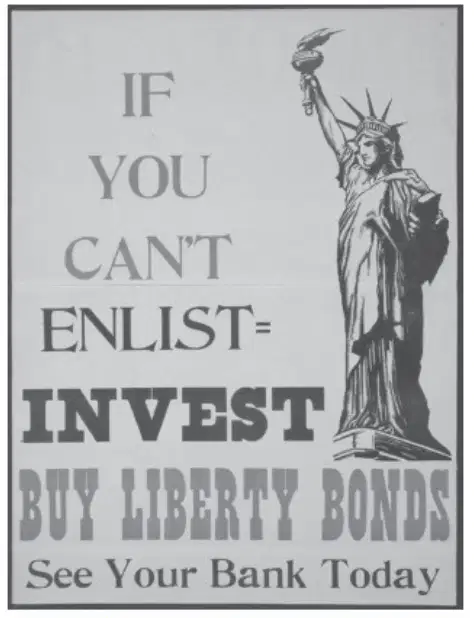
This poster was intended to persuade —
farmers to consume fewer scarce goods during the war
women to work producing war materials
people to save money during the war
people to help finance the war
The Open Door policy was implemented as a result of attempts by foreign nations to restrict trade with —
Japan
India
Korea
China
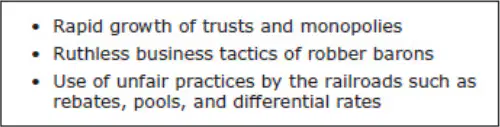
One way the U.S. government responded to the problems caused by the conditions in this list was by —
passing the Interstate Commerce Act
implementing the silver standard for currency
creating a federal jobs program for the unemployed
establishing a new tax on capital gains
In response to public concern over issues raised by Upton Sinclair’s The Jungle, the federal government expanded its role in —
working with labor unions to increase worker salaries
taking responsibility for the safety of consumers
setting limits on the growth of private industry
implementing social welfare programs
During the Gilded Age there was a notable increase in federal support for —
the growth of big business
involvement in foreign wars
the acquisition of foreign territories
increased temperance regulations
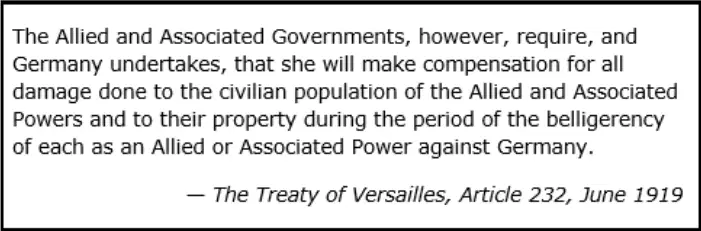
One reason this provision was included in the Treaty of Versailles was to —
create a democratic government in Germany
divide Germany into smaller states to be governed by Allied countries
grant independence to all German colonies
weaken the power of Germany in the international community
Under the Treaty of Versailles, which country had to accept full responsibility for the war and pay huge amounts for the damages caused during the war?
Germany
Austria-Hungary
France
Russia
Which of the following had the greatest impact on the role of women in U.S. politics?
The growth of the labor movement
The passage of the Prohibition amendment
The creation of New Deal agencies
The accomplishments of the suffrage movement
Which statement best explains how the application of electricity in the early 1900s affected the development of the U.S. economy?
Long-distance travel became more expensive.
College education became more accessible.
Manufacturing processes became more efficient.
Household appliances became more costly.
In the late 1800s, the Supreme Court’s decision in Plessy v. Ferguson —
established a legal remedy for victims of discrimination
created a legal justification for segregation laws
affirmed the legality of federal regulation of state elections
recognized public protests as a legal form of civil disobedience
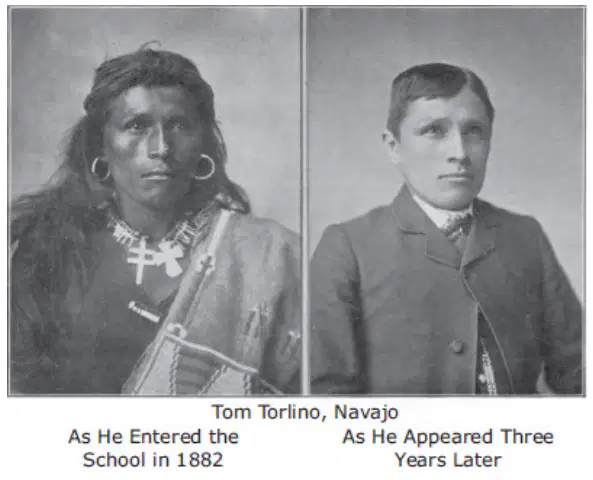
These photographs are of the same student at Carlisle Indian School during the late nineteenth century. Which word best explains the changes shown in these photographs?
Immigration
Assimilation
Nullification
Nativism
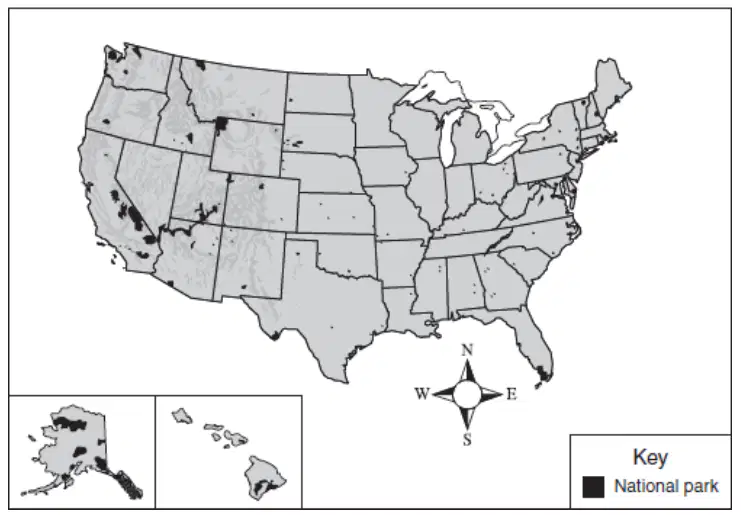
Selected U.S. National Parks — The federal lands shown above were set aside as a response to concerns about —
border conflicts
community development
environmental conservation
property values
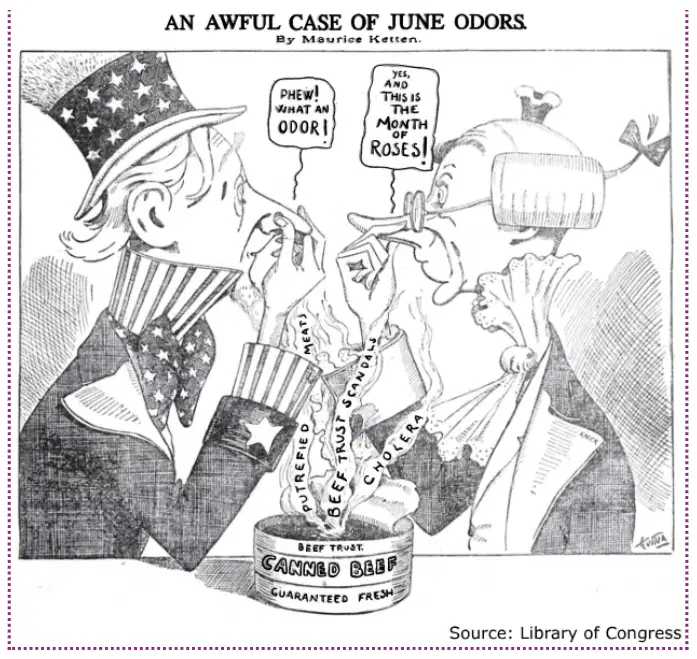
What was the most likely result of the publication of images such as this 1906 political cartoon?
The government passed the Sherman Antitrust Act.
Private companies refused to import foreign foods.
The government passed the Pure Food and Drug Act.
Labor unions protested unsafe working conditions.
In victory gardens, people
grew their own produce to conserve resources for the military
sold war bonds to raise government revenue
rationed gasoline to reduce imports from abroad
recycled scrap metals to construct naval ships
Whose idea was the League or Nations?
Woodrow Wilson
Theodore Roosevelt
Franklin D. Roosevelt
William Howard Taft
Due to the combination of European immigrants seeking industrial jobs in the United States and the outbreak of World War I, there was a resurgence of _____ that was aimed at those who were considered "not originally from the United States". One way the U.S. government responded to this combination of events was to _____.
nativism; enact immigration restrictions
isolationism; enter into international alliances
progressivism; expand social welfare programs for immigrants
imperialism; annex new territories for labor
The Roaring Twenties were characterized by —
internment camps, the rationing of goods, and the first use of an atomic bomb
bank failures, the New Deal, and bread lines
installment plans, Prohibition, and flappers
brinkmanship, McCarthyism, and a policy of containment
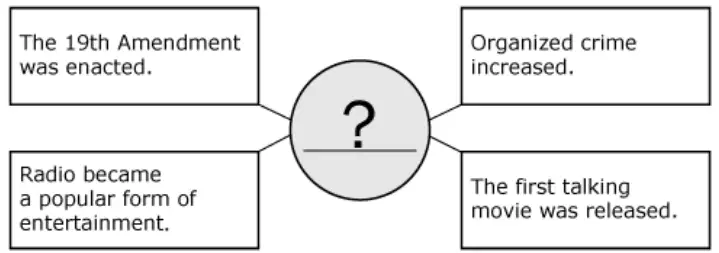
What is the best title for this diagram?
Events of the Cold War
Events of the Great Depression
Events of the Roaring Twenties
Events of the Civil Rights Era
The establishment of speakeasies in the 1920s was an unintended consequence of which federal government action?
The taxation of imported luxury goods
The deportation of suspected communist sympathizers
The prohibition of the sale of alcoholic beverages
The implementation of immigration restrictions
During the 1920s, Clarence Darrow and William Jennings Bryan were most closely identified with the —
increased use of credit by U.S. consumers
development of new forms of popular entertainment
decline of public support for Progressive reforms
conflict between modernism and traditionalism
What led to the need for large amounts of cattle and made meatpacking a major industry?
The invention of refrigeration
The need to process large amounts of cattle
The increase in population
The rise of fast food chains
What role did John J. Pershing play in the Allied victory in World War I?
Transforming inexperienced troops into an effective military force
He negotiated the Treaty of Versailles, ending the war.
He was a key figure in the development of the League of Nations.
He served as a diplomat to maintain peace talks with Germany.
Who strengthened the US naval capacity?
Alfred T. Mahan (The Navy Man)
Franklin D. Roosevelt
George Washington
Abraham Lincoln

How did the concerns depicted in this cartoon affect the food industry?
The food industry increased the cost of products in order to pay for chemical additives.
The federal government regulated the food industry in order to protect the health of the public.
The food industry imported more goods from Europe in order to offer customers more choices.
The federal government passed antitrust legislation in order to increase competition in the food industry.

Which U.S. government action is MOST CLOSELY based on this idea?
The federal government passes laws to protect individual liberties.
The Supreme Court votes to approve the appointment of presidential cabinet members.
The Electoral College votes to approve the winner of congressional elections.
The federal government passes laws to regulate businesses.

Which reason contributed to the trend shown in this table?
The number of factories using assembly lines decreased.
A progressive movement worked to stop the use of child labor.
A political movement worked to lower taxes for businesses.
The number of people joining labor unions decreased.

Which caption best replaces the question mark in this photograph?
Abolish the Poll Tax and the Literacy Test
Demand the Direct Election of Senators
Come in and Learn Why Women Ought to Vote
Lower the Voting Age for Women to Eighteen

What was the purpose of the Pure Food and Drugs Act of 1906?
To protect consumers by regulating the food and drug industry.
To lower the cost of essential foods and drugs for consumers.
To prevent shortages by regulating the supply of food and drugs.
To reduce production costs for food and drug manufacturers.

What is one way the Progressive Era reform outlined in this diagram has affected U.S. politics?
More women have been elected to Congress.
Citizens have a more direct influence on lawmaking.
Corrupt officials can be removed from office.
Primary elections are prohibited in several states.

This model was evident in the United States through the works of —
Frances Willard and her support of the temperance movement.
A. Philip Randolph and his protests during World War II.
Jane Addams and her programs for new immigrants.
Eugene V. Debs and his establishment of the American Railway Union.

Which numbered territory did the United States gain by winning the Spanish-American War?
1
2
3
4

What was one economic effect of the Spanish–American War?
Shipbuilding industries in the United States declined.
New free and fair trade treaties were established between the United States and developing countries.
The United States gained direct access to additional natural resources and overseas markets.
Demand for coal and petroleum as energy sources declined.

Why did the U.S. Senate refuse to ratify the Treaty of Versailles after World War I?
The Senate would not support America’s participation in the League of Nations.
The Senate believed the treaty did not punish Germany enough.
The Senate thought the treaty did not have the power to prevent secret alliances.
The Senate could not agree on military disarmament levels.

How did the Roosevelt Corollary to the Monroe Doctrine affect the role of the United States in the world?
By establishing military alliances with Asian nations.
By proclaiming a policy of isolationism.
By creating a plan to stop the spread of communism.
By announcing a willingness to intervene in the affairs of Western Hemisphere nations.

Which question is associated with the passage of the Espionage and Sedition Acts during World War I?
Should industries be allowed to prohibit workers from joining unions?
Can the government require citizens to purchase war bonds?
At what age should citizens be required to enlist in a branch of the military?
Can the government limit the constitutional rights of citizens during wartime?

During WWI, which country started unrestricted submarine warfare?
Germany
Russia
Britain
The United States

What does this political cartoon best represent?
Public opposition to the League of Nations
German Imperial Fleet discussing a blockade of Mexico
The Zimmerman Telegram
Talks of Germany's unrestricted submarine warfare
Which of the following took place from 1914 to 1918?
The Great Depression
World War I
The Populist movement
The Spanish-American War

These demands most reflected the concerns of?
Small farmers in need of affordable credit
Robber barons pursuing higher profits
Prominent bankers who controlled the money supply
Immigrant workers seeking economic justice

Why did the Populist Party want free coinage of silver?
To increase the amount of money in circulation.
To reduce economic inflation.
To raise campaign contribution limits.
To decrease the bargaining power of labor unions.

What was the main reason given for the creation of these restrictions?
Preventing the depletion of natural resources.
Discouraging anti-American activism.
Reducing competition for U.S. jobs.
Addressing a lack of urban housing.

Which factor facilitated statehood for the darker–shaded areas?
The introduction of barbed wire throughout the Great Plains.
The expansion of railway lines throughout the West.
The acceptance of Mormons by other religious sects in the East.
The peaceful integration of settlers with American Indian populations.
How did the Roosevelt Corollary to the Monroe Doctrine affect the role of the United States in the world?
By establishing military alliances with Asian nations.
By proclaiming a policy of isolationism.
By creating a plan to stop the spread of communism.
By announcing a willingness to intervene in the affairs of Western Hemisphere nations.

Which amendment abolished slavery and involuntary servitude, except as punishment for a crime?
13th Amendment
14th Amendment
15th Amendment
16th Amendment
What amendment makes all those who live in the U.S. naturalized citizens and provides equal protection under the law?
What amendment allows for voting rights to not be denied due to race or color?

Which of these contributed to the ratification of the 18th Amendment?
Veteran Soldiers protesting to obtain benefits
The growing political influence of women
Politicians campaigning for education reform
The growing number of workers organizing into labor unions
The Seventeenth Amendment provides that ____.
people, not state legislatures, will elect senators
the legislatures of each state will choose senators
senators will be appointed by the president
senators can serve only tow terms in office

