
 Worksheets
Final prep
Total questions: 79
Worksheet time: 40mins
Three of the following statements are true regarding the interplay between heredity and environment in child development. Which statement is false?
Children’s inherited tendencies may make them more or less susceptible to particular environmental conditions.
Certain environmental experiences may have a greater impact at some ages than at others.
Heredity is more influential when children live in extremely impoverished circumstances than when they have good nutrition and other environmental supports.
Inherited predispositions have a large influence in some aspects of development, whereas environment is more influential in other aspects.
Which one of the following statements best describes a developmental systems perspective of child development such as Bronfenbrenner’s Bioecological Theory?
Traumatizing events in the early years can have a lifelong impact on children’s emotional well-being.
Children are influenced by many levels in their environment, but so, too, do they influence the environment in which they grow up.
Children’s growing knowledge structures are at first relatively separate and isolated, but they increasingly become integrated and interactive.
Developmental progressions in the cognitive, emotional, and social domains are interrelated throughout childhood and adolescence, such that advancements in one domain invariably influence development in other domains as well.
Azure is a teacher. The students in Azure’s class have frequent mood swings, and they worry constantly about what others might think about them. They are also just beginning to think idealistically about how the world might be better than it actually is. Azure’s students are most likely in the developmental period of ____________.
Early childhood
Middle childhood
Early adolescents
Late adolescents
Three of the following statements reflect developmentally appropriate practice. Which one does not?
Look for and build on children’s existing talents.
Keep in mind that the “weaknesses” of children and adolescence may serve a developmental purpose.
Work hard to help children acquire more advanced ways of thinking as quickly as possible.
Use the universals of development to form general expectations about children and adolescents, but expect diversity at every turn.
Many psychologists are concerned about whether certain aspects of development are marked by universality or diversity. Which one of the following statements illustrates diversity?
Children almost always first sit, then walk, then run.
Children think in increasingly logical ways as they get older.
By interacting with their physical environment all children learn that things always fall down, never up, when released.
On average, teenagers who live in middle-income neighborhoods have better study skills than those who live in low-income neighborhoods.
Imagine that you want to find out which extracurricular activities in a community’s after-school programs are of most interest to teenagers. Which data collection technique would be most useful for this purpose?
A self-report questionnaire
An Apgar scale
An observation
A measure of habituation
Three of the following statements describe ethical practices in developmental research. Which one does not?
Children participate in studies voluntarily, and only with their parents’ consent.
Researchers put the welfare of participants ahead of any desire to learn new information about child development.
Researchers can publish data about specific participants in local newspapers if the descriptions are flattering ones.
Researchers inform participants’ families about the results and conclusions of their research.
LJ is a developmental researcher and he needs to be sure that any data collection method he use is actually assessing what it is supposed to assess. In other words, JL needs to be concerned about the _______ of his data-collection techniques.
Reliability
Practicality
Validity
Psychological basis
Ari wants to know if children’s knowledge about nutrition increases over the course of the elementary years. To find out, she gives a test about nutrition to students in the first, third, and fifth grades. She then compares the test scores for the three grade levels. Which one of the following research designs does the nurse’s study best reflect?
Cross-sectional design
Experimental design
Longitudinal design
Correlational design
Culture has a pervasive influence on child development. Which one of the following best describes the general nature of a culture?
The art and artifacts associated with a social group
The behaviors and beliefs that characterize a social group
A group of people who share the same religious background
Sixteen-year-old Danicka wants to go on a three-day trip with her friends, some of whom are males. She tells her parents about the trip and asks if she can go. If Danicka’s parents typically use an authoritarian parenting style, which one of the following responses is most likely?
Do whatever you want. You’re getting old enough to decide for yourself in situations like this.
Let’s sit down and discuss this. We’re not sure it’s a good idea, but we’d like to hear about the details.
We don’t think it is a good idea, but if you really want to go, then do it.
Absolutely not! Case closed.
Research suggests that, in the United States, children from ethnic minority groups often have lower academic achievement when compared with children from the majority culture. Of the following, which one is not a likely reason for this disparity?
Children from minority groups selectively adopt customs of the majority culture rather than fully assimilate.
Children from minority groups experience environmental stresses associated with economic hardship.
Many teachers have low expectations for children from minority groups.
Children from minority groups have limited access to good schools and educational opportunities.
When considering children’s and adolescents’ cultural and ethnic backgrounds, it is important to keep in mind that:
Youngsters’ ethnic identities are almost always stronger than their need to “belong” to mainstream North American culture.
Youngsters’ need to “belong” to mainstream North American culture is almost always stronger than their ethnic identities.
Some youngsters may simultaneously be active participants in two or more cultural groups.
In the elementary grades, children typically have little conscious awareness that their backgrounds might be different from those of their classmates.
Which one of the following conclusions is most warranted from research on brain development?
It is essential that children begin studying basic mathematics and science in the preschool years.
Educational experiences can affect students’ cognitive development throughout the elementary and secondary school years.
Educators and counselors should interpret lack of impulse control in children over six years old as a sign of a significant delay in brain development.
The ability to think abstractly depends on the development of many synaptic connections during the first two years of life.
Quincy is in third grade. She raises her hand when she wants to answer a question. She takes turns when using classroom materials. She keeps track of her homework assignments and submits her assignments on time. All of these actions she is able to do on her own. Which ability does Melissa demonstrate through these actions?
Executive functions
Self-concept
Self-regulation
Maturity
Which one of the following best describes how neurons transmit messages to one another?
By stimulating the flow of blood in nearby arteries
By sending chemical substances to one another
By fusing together into a single neuron
By generating myelin in the synapses
Coley is carefully weighing the many advantages and disadvantages of attending a large state university rather than a small local college. Which part of the brain can Coley largely thank for the ability to make her decision?
Hindbrain
Forebrain
Cerebellum
Midbrain
Which one of the following best reflects Piaget’s notion of equilibration?
A child assimilates without accommodating.
A child doesn’t encounter any new or challenging ideas.
A child accommodates without assimilating.
A child revises existing schemes to incorporate new information.
In describing the cognitive abilities of infants, Piaget appears to have:
Overestimated what they know and can do
Assessed their abilities quite accurately
Overestimated the importance of language in their early thinking
Underestimated what they know and can do
Which one of the following statements best describes Piaget’s view of how children acquire knowledge about the world?
Children are naturally disposed to think about their environment in particular ways; in a sense, some basic knowledge about the world is “pre-wired.”
Children actively construct their own view of the world from their experiences with the environment.
Children repeatedly parrot their parents’ and teachers’ beliefs, eventually internalizing these beliefs as their own “knowledge.”
Initially, children unconsciously develop a rather complex and confused view of the world, but this view becomes simpler and more straightforward as time goes on.
In her first trip to a zoo, 7-year-old Latisha notices that leopards have paws very similar in shape to her cat Snowball’s paws. She also notices that leopards walk in much the same way that Snowball does. Latisha starts to wonder if perhaps leopards are cats. Latisha’s thinking illustrates Piaget’s idea that thought is characterized by:
Egocentrism
Conservation
Use of schemes
Compartmentalization
Which one of the following statements most accurately describes Vygotsky’s view of how cognitive development occurs?
Children’s cognitive growth is best judged on the basis of their actual developmental level, not on the basis of their level of potential development.
Cognitive development progresses through four distinct stages; each stage is characterized by increasingly more complex thought and language.
Children develop by working on challenging tasks with the assistance of more competent individuals.
Language and thought, although closely intertwined in the first few years of life, become increasingly distinct entities over time.
Which one of the following issues reflects a fundamental difference between Piaget’s and Vygotsky’s theories of cognitive development?
How much children depend on adult guidance to make cognitive gains
Whether challenging tasks promote cognitive development
Children are motivated to learn
Whether social interactions are important for cognitive development
Frankie loves to write poetry. Often he uses techniques that his favorite poets use, but typically he modifies these techniques to better suit his own style. This situation illustrates which one of the following concepts in Vygotsky’s theory?
Appropriation
Mediation
Challenge
Actual developmental level
In Vygotsky’s view, when Katie and Pablo engage in pretend play (e.g., playing “house” or “doctor”) it provides the opportunity to have which one of the following effects?
It allows children to practice adult behaviors.
It fosters traditional gender stereotypes.
It helps children shed their egocentric views of the world.
Children do not pretend play enough to make a difference on their cognition.
Sociocultural theory suggests that with development, children acquire many cognitive tools of their culture. Which teacher is most clearly applying this idea?
Jaren shows students how to graph their research results so that they can more easily see trends in the data.
Mallorie reminds her students that she will let them go to lunch only after they’ve put away their art supplies.
Yuri smiles to show her approval when students listen quietly and politely during a guest speaker’s visit.
Daysha wears leopard print pants to school.
It is difficult for children to think about too many things all at the same time—a fact that reflects:
The existence of a sensory register
The integrative nature of long-term memory
The limited capacity of working memory
The constructive nature of long-term memory
Laila is trying to remember all of the objects in her locker at school. “Let me think . . . pens, pencils, markers . . . um, math book, science book, notebooks . . . my coat, hat, and gloves . . . I can’t remember any more.” What learning strategy does Laila’s response illustrate?
Rehearsal
Elaboration
Organization
Comprehension monitoring
Which one of the following examples best illustrates involvement of a central executive in information processing?
Nick absentmindedly cracks his knuckles every minute or two.
Madelyn thinks about how she can best prepare for a history test.
Natalie has trouble keeping her mind on her classwork
Koby is frightened the first time he hears the loud noises at a fireworks display.
Samuel learns that Christopher Columbus’s first voyage across the Atlantic was financed by Queen Isabella of Spain. He thinks to himself, “She probably thought she would make a profit on her investment.” By considering the queen’s motives, Samuel is demonstrating which one of the following processes?
Rehearsal
Elaboration
Organization
Comprehension monitoring
To prepare for his test on Tuesday morning, Jesus studied on Monday night. He remembered the information long enough to do well on the test on Tuesday but could not remember it for a surprise quiz a week later. Based on this information, how far in Jesus’s information processing system did the information get?
It reached long-term memory.
It reached the sensory register.
It reached working memory.
It never got into the memory system at all.
Different theorists conceptualize intelligence differently, but most agree that intelligence:
Is an entity completely separate and distinct from learning ability.
Is 100% determined by genetics
Involves many different cognitive processes
Is largely the result of environmental factors
Which one of the following statements most accurately reflects the concept of distributed intelligence?
Children will behave more intelligently when they can use outside resources as well as their minds.
How “intelligent” children become is, to some extent, a function of the number of siblings they have; children from larger families tend to have slightly lower IQ scores.
How “intelligent” children are is, to some extent, a function of class size; children achieve at lower levels when they are in larger classes.
Children almost invariably perform at higher levels in some academic subject areas than they do in others.
People have different learning styles and because of that we should find out what each students learning style is and then teach to it specifically.
True
False
I have no idea
This is not important
Dr. Fleck always prints quizzes on half-sheets of paper. Midway through the quarter, when Dr. Fleck arrives to class with a stack of half-sheets of paper, you notice your heart rate goes up and you feel a sense of dread. (You learned to fear the half-sheets). What is the ½ sheet of paper in this example?
URS
UCR
CS
CR
One characteristic common to all behaviorist theories of development is an emphasis on:
The effect of the environment on development
The negative emotional repercussions of punishment
The importance of each and every event in a person’s life
How one learns by observing the actions of others
Is this example positive reinforcement, negative reinforcement, or punishment? Example: A professor giving extra credit to students with perfect attendance
positive reinforcement
negative reinforcement
punishment
The process by which a stimulus strengthens or increases the probability of the response that it follows is called _______________.
higher-order conditioning
latent learning
classical conditioning
reinforcement
As 2-year-old Evelyn and her father go into the family garden one day, Dad exclaims, “Look at all the wonderful daisies!” Evelyn infers that the only plants blooming in the garden must be called daisies. Her inference is an example of:
expansion
fast mapping
functionalism
semantic bootstrapping
Considering what we have learned from research regarding cognitive and linguistic development, we should expect elementary school children to have the greatest difficulty understanding the meaning of which one of the following words?
however
somersault
swim
vehicle
Two-year-old Isabelle always hears the word pretty just before a word that refers to a concrete object (e.g., “pretty flower,” “pretty lady,” “pretty picture”). Although she does not yet know what an adjective is, at an intuitive level she understands that pretty is a “describing” word. Isabelle’s understanding reflects:
Expansion
Functionalism
acquisition of a grammatical word
semantic bootstrapping
Sometimes the sociolinguistic behaviors that are expected at school are quite different from the behaviors that children have acquired at home. When this happens, children may initially:
Experience “culture shock” at school
Engage in figurative speech
Show considerable wait time
Will adopt the school’s behaviors right away
Children from multiethnic families tend to develop ethnic identities that are:
strong
foreclosed
conflicted
diffused
Which one of these examples best reflects the role that children’s and adolescents’ sense of self typically plays in their behavior?
Selena knows she is a good reader, so she takes an extra reading class as an elective.
Eva doesn’t want to take any more math classes because she knows she’s already good at math.
Sean thinks of himself as physically fit, so he doesn’t think he needs to participate in sports or other physical activities.
Dominic doesn’t think he is very popular, so he smiles at others and tries to talk to them so they will like him.
Cora puts off doing a project for the science fair until she has so little time to do it that she cannot possibly complete a good project. Such behavior is most consistent with the concept of:
Androgyny
Personal fable
Recursive thinking
Self-handicapping
Adults can most effectively enhance children’s sense of self when they:
Talk about the advantages of having high self-esteem
Encourage children to think more positively about themselves
Hold high yet achievable expectations for children’s performance
Hold expectations for performance that they know children can achieve with little or no effort
Lamont worries that he has unintentionally hurt another student’s feelings. From this information alone, we can reasonably conclude that Lamont:
Must be at least ten years old
Is able to think androgynously
Is capable of recursive thinking
Has developed a theory of mind
Which one of the following children is displaying extrinsic motivation?
Jessica wants to be an accountant because she likes working with numbers.
Jaren wants to be a veterinarian because he loves animals and wants to help them.
John wants to become a professional football player so others will admire him.
Donnetta wants to become an actress because she thinks acting is fun.
Sam is at the mall with his friends. The other boys are playing video games, but Sam is just watching. Although Sam knows that playing video games is fun, he wants to save up his money to buy a computer. It is clear, then, that Sam:
Can delay gratification
Has an incremental view of ability
Responds to vicarious reinforcement
Prefers primary reinforcers over secondary reinforcers
Which one of the following adolescents is displaying intrinsic motivation?
Annette loves to play the viola and so practices for at least an hour every day.
Bob works hard in his classes because his parents have promised to buy him a car if he gets at least a 3.5 grade-point-average this year.
Cassie does her math homework faithfully every night because she likes her teacher and wants to please him.
Dennis takes physics because he wants to become an engineer and make a lot of money.
Which one of the following examples shows the discovery learning approach to instruction?
Azure instructs her students to take notes during her lecture and then goes over the notes with them to make sure that they understand the material.
Madeline gives her students a free day to spend in the library reading about whatever subjects they like.
Hazel takes her science students to a tide pool and asks them to describe and categorize the different life forms they find there.
Lionel instructs his drama students to think about what their characters are like as they memorize their lines for a play.
Which cognitive process, according to Bloom, has learners use information in a new way?
Remembering
Understanding
Creating
applying
All of the following are suggestions for using expository instruction effectively. Which one is not a recommendation?
Limit ideas and discussion in the lesson to things that are immediately/specifically related to the information.
Review previously learned material first
Present new ideas in small, logically sequenced steps
Provide statements of the objectives of that lesson.
Match the theory of child development with the correct short description. 1. ____ effects of environmental stimuli on behavior
b. Behaviorism & Social Learning
a. Piaget's Cognitive Development
c. Attachment Theory
d. Psychodynamic Theory
Match the theory of child development with the correct short description. 2. ____ precise nature of cognitive operations
e. Cognitive process
a. Psychosocial development
b. Moral reasoning
c. Attachment theory
Match the theory of child development with the correct short description. 3. ____ genetic, physiological structures
a. Biological
b. Cognitive
c. Psychosocial
d. Behavioral
Match the theory of child development with the correct short description. 4. ____ acquisition of tools, abilities and skills learned with others
f. Sociocultural
a. Psychosexual
b. Cognitive
c. Behavioral
Match the theory of child development with the correct short description. 5. ____ focus on early experiences and internal conflicts
a. Behaviorist
b. Cognitive
c. Psychodynamic
d. Humanistic
Match the theory of child development with the correct short description. 6. ____ major transformations in thinking
d. Cognitive developmental
a. Psychosocial
b. Behavioral
c. Ecological
Match the theory of child development with the correct short description. 7. ____ multiple influences on development
g. Developmental systems
a. Behaviorism
b. Psychoanalytic theory
c. Cognitive development
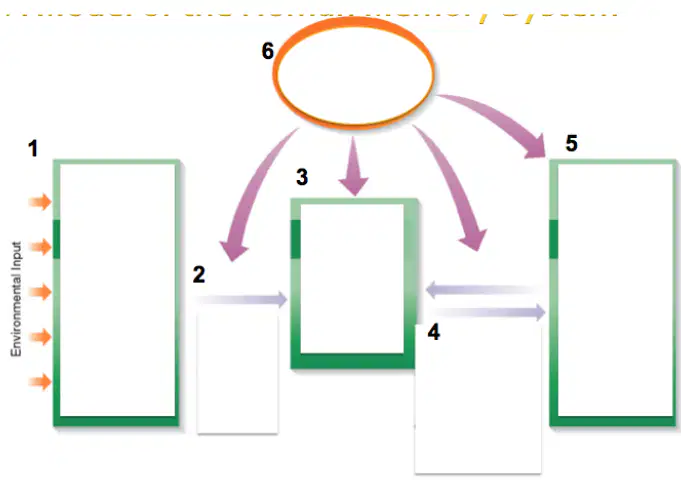
Using page 3 of the scantron, correctly label the parts of the human information processing system. Label part 1 in the diagram.
D. Sensory register
A. Short-term memory
B. Long-term memory
C. Response generator
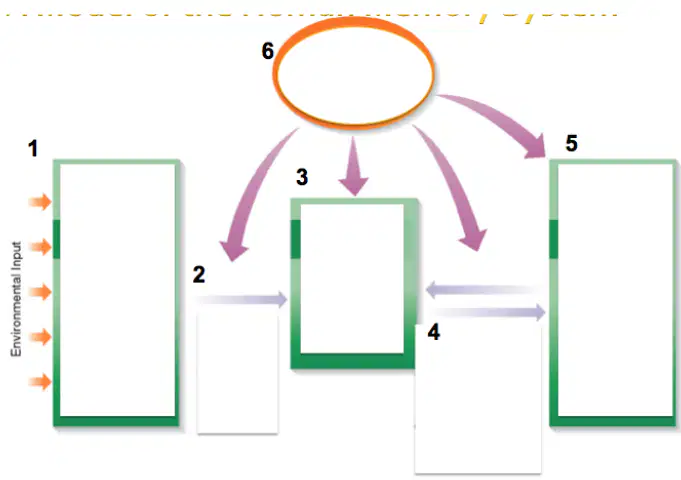
Using page 3 of the scantron, correctly label the parts of the human information processing system. Label part 2 in the diagram.
H. Attention
A. Sensory Memory
B. Long-term Memory
C. Response Generator
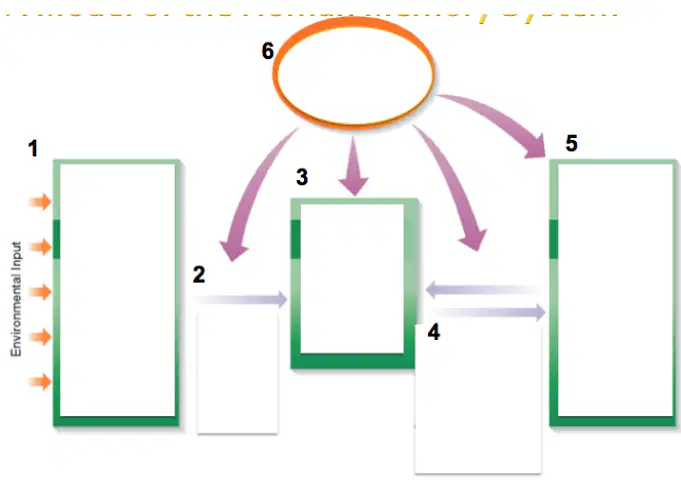
Using page 3 of the scantron, correctly label the parts of the human information processing system. Label part 3 in the diagram.
A. Working memory
B. Sensory memory
C. Long-term memory
D. Attention
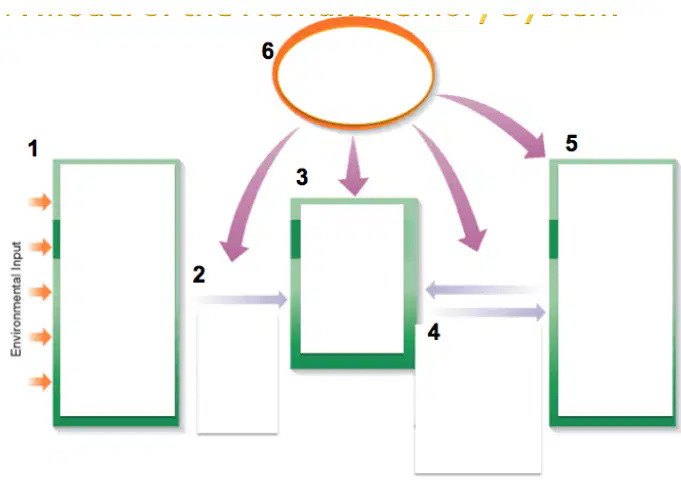
Using page 3 of the scantron, correctly label the parts of the human information processing system. Label part 4 in the diagram.
B. Central executive
A. Sensory register
C. Long-term memory
D. In-depth Processing
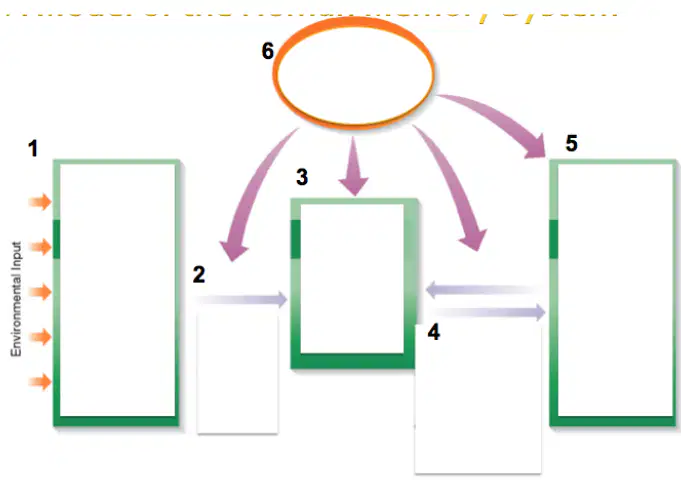
Using page 3 of the scantron, correctly label the parts of the human information processing system. Label part 5 in the diagram.
G. Long-term memory
A. Sensory memory
B. Short-term memory
C. Input device
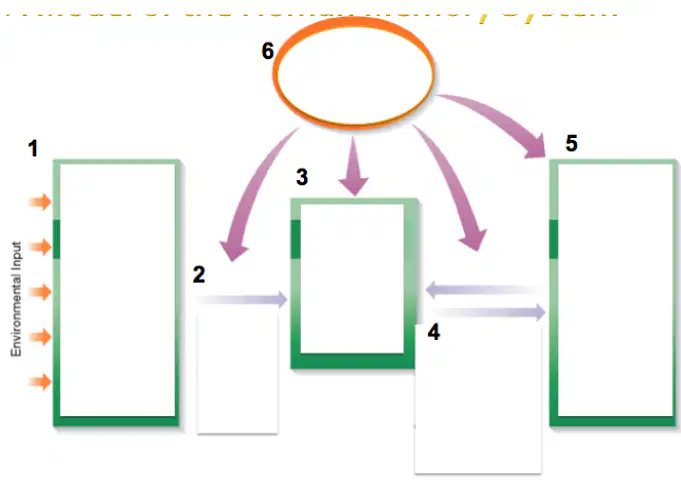
Using page 3 of the scantron, correctly label the parts of the human information processing system. Label part 6 in the diagram.
E. Central executive
A. Sensory memory
B. Short-term memory
C. Output response
While in its _____________________________ the electric charge of the cell is more negative.
Resting potential
Action potential
Depolarized state
Refractory period
The end result is a _____________________________ that travels along the cell ultimately releasing neurotransmitters into the synapse.
Action potential
Dendrite impulse
Synaptic vesicle
Neurotransmitter enzyme
8. _____________________________ occurs when positive ions flow into the cell.
Depolarization
Repolarization
Hyperpolarization
Polarization
The arm-like part of the cell is called a/an _____________________________ which sends information to other cells.
Axon
Dendrite
Nucleus
Mitochondria
A _____________________________ is the basic brain cell that transmits information to other cells.
Neuron
Axon
Dendrite
Synapse
Identify the word or phrase that best completes each statement or answers the question. _______________ helps to speed up and protect neural signals.
Myelination
Osmosis
Photosynthesis
Fermentation
Match the theory with the correct statement. “Which one of the following statements is consistent with ________view of language development?”
“To foster children’s language development, parents and other adults praise them first for making speech like sounds (da-da), later for saying recognizable words (more!), and still later for forming understandable sentences (Can I have some milk?).”
Behaviorism
Nativism
Cognitive process theories
Sociocultural
Functionalist
Match the theory with the correct statement. “Which one of the following statements is consistent with ________view of language development?”
“From a very early age, children are motivated to learn how to speak because speech enables them to interact with other people and, ultimately, to get what they want.”
Behaviorism
Nativism
Cognitive process theories
Sociocultural
Functionalist
Match the theory with the correct statement. “Which one of the following statements is consistent with ________view of language development?”
“Although children can learn the specific vocabulary and syntax of their native language only by hearing the people around them speak it, they seem to have some built-in knowledge of the form that any language should take.”
Behaviorism
Nativism
Cognitive process theories
Sociocultural
Functionalist
Match the theory with the correct statement. “Which one of the following statements is consistent with ________view of language development?”
“Children initially use language primarily in their interactions with other people, but increasingly they also use it to help them think more effectively.”
Behaviorism
Nativism
Cognitive process theories
Sociocultural
Functionalist
Match the theory with the correct statement. “Which one of the following statements is consistent with ________view of language development?”
“Children have many abilities that allow them to make inferences about patterns in their native language. They use these patterns in interactions with adults to adapt their speech and emerge their skills.”
Behaviorism
Nativism
Cognitive process theories
Sociocultural
Functionalist
“Compare and contrast the different instructional approaches (i.e. ways to implement a lesson).” This statement is an example of ________________
An instructional objective
A lesson plan
Teacher directed instruction
A task analysis
When students have considerable say in the issue they address and the ways they address them the teacher's overarching view is said to be _____________.
Cooperative learning
Learner directed
Direct instruction
Teacher directed

