
 Worksheets
Pre AP Final Exam
Total questions: 112
Worksheet time: 6hrs 36mins
Identify the point that represents atomic mass.


Using the model for the formation of Scandium Fluoride (an ionic compound), write the chemical formula.
Sc3F
Sc3F3
Sc+3F-1
ScF3


Which of the following produce Hydrogen ions (H+) in a water solution and have a formula such as HCl or H2(NO3)?
H2(SO4)


Why is NaNO3 Soluble? Select ALL that apply.
Nitrates are soluble
Ions with alkali metals are soluble
Sodium is an exception to insoluble
Nitrates are an exception to insoluble
Which of the following is a polar molecule?
O2
CO2
NH3
CH4

Which of following would correctly describe the following molecule CH3F?
A nonpolar Ionic Compound
A polar Ionic Compound
A nonpolar covalent Compound
A polar covalent compound


Compounds that are composed of the same number and type of atoms but have them arranged in different ways are ___________.
isomers
isotopes
polymers
alkanes
In a stereoisomer, ________ means "on the same side" and ______ means "across from."
cis; trans
cis; L
D; L
trans; cis

How many grams of Pb(NO3)2 must be added to 100g of water to form a saturated solution at 100C?
40g
46g
50g
60g
How many molecules would be in 8.4 moles of Octane (C8H18)?
5.7 x 10²³
5.1 x 1024
5.8 x 1026
5.0 x 10²³
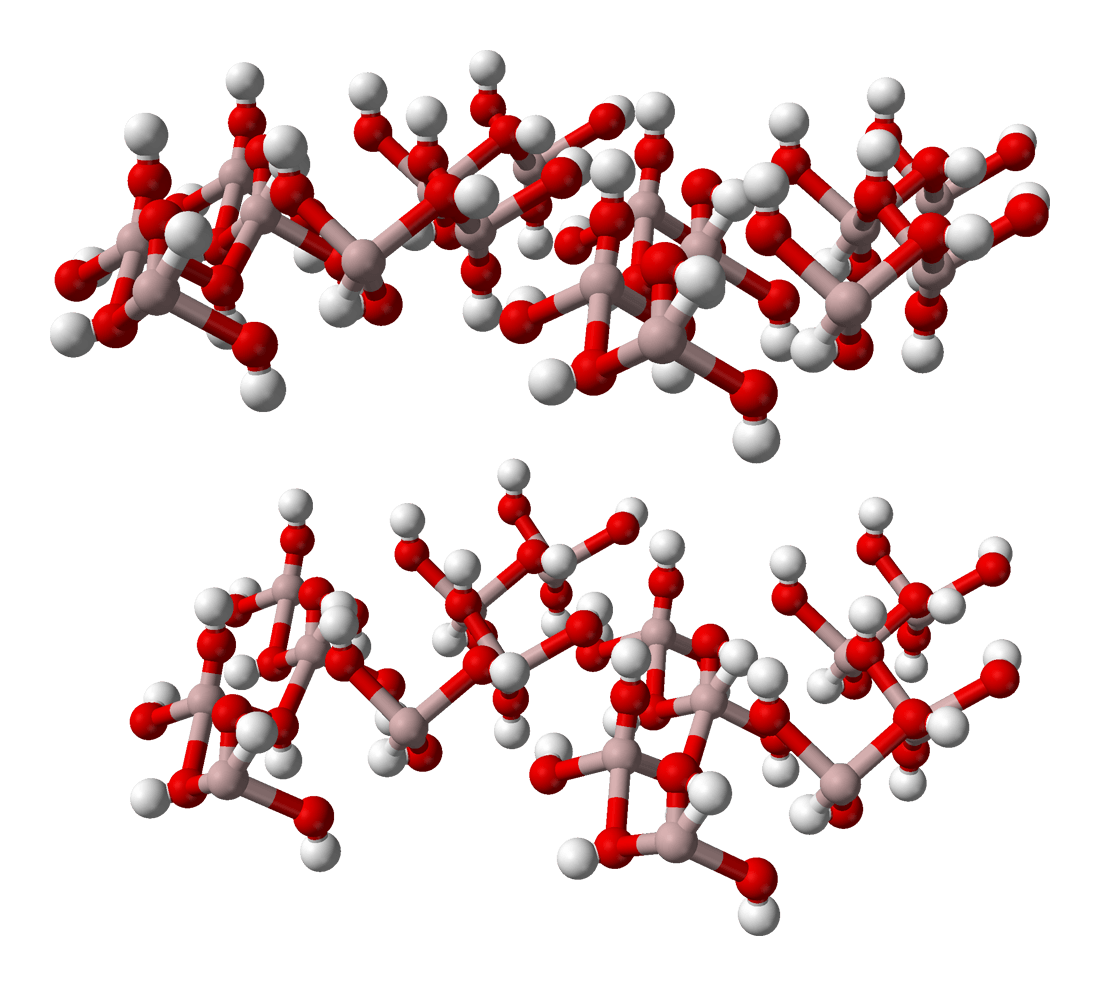

Isabella measures out 720. g of epsom salt (MgSO4) to put in her bath. How many molecules of MgSO4 went in the bath?
3.6 x 1024 g
720 g
0.050 g
340 g
What is the molarity of a solution which contains 2.6 moles of NaCl in 500.0 mL of solution?
2.6 M
2.6 mol
5.2 M
1.3 M
Use the Ideal Gas Formula to calculate the volume that a 0.323 mol sample of a gas will occupy at 265 K and a pressure of 0.900 atm.
8 L
What is the percent by mass of sulfur in (NH4)2S ?
12.05% of sulfur
19.30% of sulfur
47.11% of sulfur
56.18% of sulfur


Given the following: 42.07% Na, 18.89% P, and 39.04% O, determine the empirical formula.
NaPO2
Na2PO3
Na3PO4
NaPO4
What is the molecular formula for a compound with the empirical formula: K2SO4 and a molecular mass of 696 g.
K2SO4
K8SO16
K8S4O8
K8S4O16
C2H3O2
CH2O
C2H4O2
C3H8O3
True or False: A metallic bond may form between a metal and any other element
True
False
What is the sea of electrons model related to?
Covalent bonding
Hydrogen bonding
Ionic bonding
Metallic bonding
What is the main characteristic of a metallic bond?
It involves the sharing of electrons
It involves the transfer of electrons
It involves a sea of delocalized electrons
It involves the sharing of protons
2H2 + O2 --> 2H2O
2C3H7OH +9O2 -> 6CO2 + 8H2O
Fe + CuSO4 -> Cu + FeSO4
AgNO3 + NaCl → AgCl + NaNO3
Single Replacement
Double Replacement
Decomposition
Combustion
What is the missing product?
CxHy + O2 ➔ CO2 + __________
H2O
HO
CHO
What would the missing product be?
Au2S3 + 3 H2 ➔ 2 Au + ____________
2 H3S
2 AuH3
3 H2S
What would the missing product be?
Fe + O2 ➔ ___________
Fe2O2
2 FeO
2 FeOH


Look at the problem shown. Why was the conversion factor written like this?

Balance the following equation and then determine how many moles of Oxygen (O2) are produced from 4 moles of potassium chlorate (KCl03).
Convert the following to scientific notation. 457,000,000: __________________________
4.57 x 10⁷
4.57 x 10⁶
4.57 x 10⁸
0.457 x 10⁸
Convert the following to scientific notation. 0.000241: __________________________
2.41 x 10⁻⁴
2.41 x 10⁴
2.41 x 10⁻³
0.241 x 10⁻⁴
Convert the following to standard notation. 5.13 X 10⁻⁷
0.0000000513
0.000000513
0.00000513
0.0000513
Round 72.187 to 4 significant figures.
72.18
73.00
72.19
72.10
Convert the following: 715.0 cm= ________________ ft (Conversion Factors: 1 in = 2.54 cm & 1 ft = 12 in)
23.45 ft
3.82 ft
12.15 ft
27.07 ft
Convert the following: 530 L = ________________ mL (Conversion Factor: 1 L = 1000 mL)
530,000 mL
530 mL
5,300 mL
53 mL
Which of the following are examples of a physical property?
Color and melting point
Rusting and burning
Digestion and photosynthesis
Fermentation and combustion
What are the units for density?
g/mL or g/cm3
kg
L
m2
What is the volume of gold if its density is 19.32 g/mL and has a mass of 55 g?
2.8 mL
5.2 mL
0.56 mL
9.2 mL
How many joules of energy are absorbed by a pot of water (specific heat of 4.2 J/g°C) that has a mass of 25.8 grams in order to raise the temperature from 21°C to 54°C?
3600 J
1,570 J
2,350 J
780 J

What phase would water be at 100°C and 0.6 kPa?
Water vapor (gas)
Liquid water
Ice (solid)
Supercritical fluid
The relationship between the variables of Gay-Lussac’s Law is:
Directly proportional between pressure and temperature at constant volume.
Inversely proportional between pressure and temperature at constant volume.
Directly proportional between pressure and volume at constant temperature.
Inversely proportional between pressure and volume at constant temperature.
A gas has a volume of 250 mL at 25°C. If the volume changes to 150. mL, what is the new temperature in Celsius?
-259 °C
-94.2°C
178.8 °C
23°C
A container has a mixture of four gases. Gas 1 has a pressure of 5.78 atm. Gas 2 has a pressure of 3.21 atm. Gases 3 and 4 have pressures of 9.56 atm each. What is the total pressure in the container?
28.11 atm
32.59 atm
18.55 atm
15.73 atm


What particle view below is a mixture?


What is the best classification of this substance?
An element
A compound
A mixture of 2 elements
A mixture of 2 compounds


Match the image to C-D on the heating curve.


Which particles are more strongly attracted to one another and why?
Water particles, because it takes a lot of energy to separate the particles resulting in a high boiling point.
Carbon Dioxide particles, because it takes a lot of energy to separate the particles resulting in a high boiling point.
Water particles, because it takes a less energy to separate the particles resulting in a high boiling point.

A heated substance changes from a solid to a liquid to a gas. During this time, how does the strength of the forces of attraction change among particles?
the strength of attraction decreases
the strength of attraction increases
the strength of attraction remains the same
none of the above
In which of the following conditions would the distance between the molecules of hydrogen gas increase?
(i) Increasing pressure on the hydrogen contained in a closed container
(ii) Some hydrogen gas is leaking out of the container
(iii) Increasing the volume of the container of hydrogen gas
(iv) Adding more hydrogen gas to the container without increasing the volume of the container
(i) and (iii)
(i) and (iv)
(ii) and (iii)
(ii) and (iv)
A teacher gives a group of students a mixture of sugar and sand. The sugar grains are the same size as the grains of sand. What is the easiest way for the students to separate the sand from the sugar?
Use tweezers to remove every grain of sand
Put the mixture in water and filter the sand out of the water
Pour the mixture through a wire screen to remove the sand
Run a strong magnet through the mixture to attract the salt
In 1808, John Dalton established his atomic theory. Which of the
following is not part of Dalton’s atomic theory?
All matter is composed of atoms.
An atom consists of a nucleus and a cloud of electrons.
Atoms cannot be subdivided, created, or destroyed.
In chemical reactions, atoms are combined, separated, or rearranged.

What atom does this Bohr Model represent?
(a)
Select the TWO that explain the ionization energy trend within periods
electrons are closer to the nucleus
their is a weak pull between electrons from the nucleus, making them easily moveable
feel more of a pull from nucleus, making them harder to move
electrons are further from the nucleus

Which has the highest ionization energy?
Arsenic
Iron
ZInc
Cobalt

Which element does this Bohr model represent?
Aluminum
Silicon
Magnesium
Cobalt
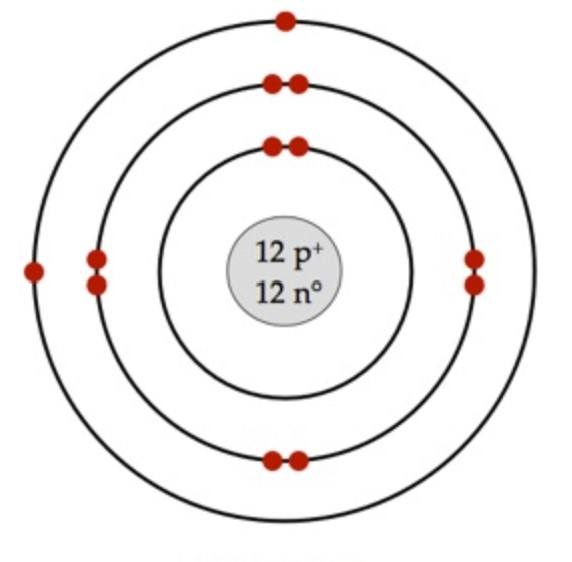
What element does this Bohr model represent?
Chromium
Magnesium
Carbon
Krypton
What is the Noble gas electron configuration for the Sulfur atom?

