
 Worksheets
Final Exam Review
Total questions: 90
Worksheet time: 45mins
Which system of government is an indirect form of democracy, placing political decision making at least one step away from the people?
theocracy
republic
monarchy
dictatorship
What does an authoritarian regime become at its most extreme?
republican
totalitarian
oligarchy
monarchy
Which system of government is largely an American invention?
federal
unitary
confederal
oligarchy
Which system of government is represented by the illustration in the center of the graphic?
unitary
federal
totalitarian
confederal
Which form of government has been the most common throughout world history?
democracy
monarchy
republic
theocracy
In an oligarchy, who runs the government?
dictator
elected officials
monarch
small group of people
The form of government in which one person controls most of the governing decisions is a(n)
autocracy
republic
oligarchy
direct democracy
Which of the following was a weakness of the Articles of Confederation?
Congress lacked the power to tax.
Congress was not allowed to coin money.
Congress was not allowed to conduct foreign policy.
The president had too much power.
Antifederalists believed that representative government
would only work with a strong national government.
could only exist in a small territory.
was less important than state sovereignty.
would only work with a weak Congress.
Thomas Jefferson argued in the Declaration of Independence that, if a government disregards the will of the people, the people are free to do which of the following?
stop paying taxes to the government
change their government
move to another country
execute the king
For which reason is James Madison hailed as the Father of the Constitution?
He proposed the Great Compromise.
He authored the Federalist Papers.
He greatly influenced the outcome of the convention.
He was the oldest delegate to the convention.
What ideal did the Antifederalists find the Constitution lacked?
representative government
social contract
individual rights
economic freedom
Delegates gathered in Philadelphia in May of 1787 to do what?
write an entirely new plan for government
revise the Articles of Confederation
encourage states to support the Confederal Congress
frame a new constitution
Why did Alexander Hamilton, John Jay, and James Madison write the Federalist Papers?
As Antifederalists, they wanted people to understand the weakness of the new Constitution.
They wrote the articles to help people to appreciate the Antifederalist arguments.
They wrote the articles in defense of the new Constitution.
They wanted people to know that the Federalists were more intellectual than the Antifederalists.
The first ten amendments to the constitution are traditionally called the
Petition of Right.
Bill of Rights.
Great Compromise.
Three-Fifths Compromise.
In order for a national convention to be called to propose an amendment to the Constitution, who must take action?
Congress alone
state legislatures and Congress
Congress and the president
state legislatures alone
Which of the following is one way an amendment to the Constitution can be ratified?
three-fourths vote in each house of Congress
simple majority
The main purpose of the Bill of Rights is to
create a system of laws.
maintain order.
organize the national government.
protect individual freedoms.
Who has the ultimate authority to decide whether or not a federal law or action is constitutional?
senators
Congress
Supreme Court
president
The 1803 landmark Supreme Court case Marbury v. Madison established the principle of
federalism.
popular sovereignty.
separation of powers.
judicial review.
Under the Constitution, who holds the actual power to elect the president?
electoral college
state legislatures
representatives
voters
What is the purpose of the Preamble of the Constitution?
reviews the achievements of the American Revolution
states the goals for the new government
summarizes the qualifications of the Framers
creates the Bill of Rights
In the Preamble, what does the phrase form a more perfect union mean?
Provide laws that are fair.
Maintain order within the country.
Protect the liberties won in the American Revolution.
Strengthen the relationship among the states.
Which of the following is a power the executive branch has to check the legislative branch?
override
veto
oversight
review
The phrase We the People relates to which of the following principles of the Constitution?
federalism
judicial review
popular sovereignty
checks and balances
When the president vetoes a law passed by Congress, the president is applying the principle of
checks and balances
federalism
popular sovereignty
customs and traditions
What power does the judicial branch of government hold?
carrying out laws
interpreting laws
making laws
vetoing laws
One of the types of injustices included in the original Constitution and addressed by amendments is
property rights.
presidential appointments.
gridlock.
voting rights.
Which of the following is a legislative power that is part of the system of checks and balances?
appointing federal judges
vetoing laws
ruling a law unconstitutional
declaring war
The duties of governing are divided among three branches under the principle of
popular sovereignty.
limited government.
federalism.
separation of powers.
Which of the following is an expressed power of the federal government that is not shared with the states?
declaring war
creating a national bank
regulating the possession of guns
collecting taxes
Which of the following is an implied power of the federal government?
regulating radio and TV stations
regulating interstate commerce
coining money
declaring war
Which of the following is a power reserved to the states?
printing money
collecting taxes
controlling public school systems
establishing court systems
Which of the following is an expressed power of the president?
refusing to testify in court
commanding the military
imposing taxes
ruling on constitutional issues
The power to borrow money is which type of power?
enumerated
inherent
implied
concurrent
The federal government is denied the power to do which of the following?
establish duties on imports
regulate the possession of drugs
deprive a person of liberty
take away freedom of speech
Creating local governments is which type of power?
enumerated
reserved
concurrent
inherent
Laws made by the will of the people come through which body of the U.S. government?
House of Representatives
Congress
Senate
Rules Committee
Who has the final authority to ratify any amendments Congress proposes?
president
states
Senate majority leader
Supreme Court
Which type of constitutional power allows Congress to declare war?
implied
denied
inherent
expressed
Who is the most powerful member of the House of Representatives?
majority leader
Speaker of the House
majority whip
floor leader
Who is second in line of succession to the presidency of the United States?
Senate majority leader
Speaker of the House
vice president
Chief Justice of the Supreme Court
What job does the Constitution assign the vice president of the United States?
Senate majority leader
Speaker of the House
Speaker of the House
president of the United States
According to the Constitution, both senators and members of the House may submit bills with the exception of what kind of bill?
education bills
health bills
transportation bills
tax bills
Which provision adds an unpopular provision to a popular bill that is likely to be passed?
hopper
rider
revision
compromise
Which resolution is not a bill but follows the same procedure as a bill and has the force of law, if it is signed by both houses of Congress and the president?
concurrent resolution
nonbinding resolution
joint resolution
binding resolution
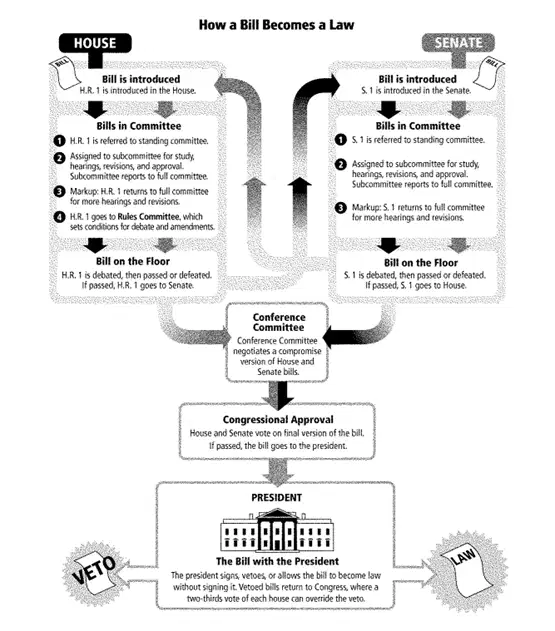
Where does a bill go if it is introduced and passed in the House of Representatives?
conference committee
Senate
president
Congress for approval
What does the conference committee issue when it reaches an agreement on a bill?
conference report
conference meeting
conference hearing
conference debate
When the president signs a bill, it
is vetoed.
goes back to the Senate.
becomes law.
goes back to the House.
What can Congress try to do if its members disagree with the president’s veto of a bill?
call for a pocket veto
override it
have a roll-call vote
sign a discharge petition
When a president seeks to improve relations with another country, he or she is acting in the role of
chief executive
commander in chief
foreign policy leader
chief agenda setter
In the role of symbolic figurehead representing the United States internationally, the president acts as the
commander in chief
chief administrator
chief citizen
chief of state
If a president dies in office, the vice president
assumes the duties but not the title of president.
becomes president and serves out the term.
becomes president and serves until a special election can be held.
serves until the speaker of the House can take over.
Under the Presidential Succession Act of 1947, the person next in line after the vice president is the head of the
Department of State.
Department of Homeland Security.
Senate.
House of Representatives.
What happens if a president becomes disabled?
The vice president takes over presidential duties temporarily.
The vice president becomes president and serves out the term.
The president’s spouse takes over presidential duties temporarily.
The Speaker of the House takes over presidential duties temporarily.
What can a president do to bypass the Senate approval that is required for a treaty?
ratify the treaty as commander in chief
make an executive agreement instead
submit the treaty to the people in a referendum
ask the Supreme Court to rule on the treaty
A bureaucracy is any organization, either in government or the private sector, which has a clear, formal structure, a division of labor, and
a cabinet-level department head.
operates under a set of rules and procedures.
accomplishes a set task.
provides goods and services for the public.
What typically happens to the federal bureaucracy when a new president takes office?
Top administrators are replaced but most employees keep their jobs.
Top administrators stay but about half of the employees are replaced.
Not much changes; employees at all levels keep their jobs.
The new president fires employees who don’t belong to his or her political party.
Federal monetary policy is controlled by
an independent regulatory commission.
the Department of the Treasury.
Congress and the president.
a committee of independent bankers.
Predict what would happen if the Federal Reserve lowered the interest rate it charges the nation’s banks.
The monetary supply would increase, stimulating the economy.
The monetary supply would decrease, slowing the economy.
Inflation would begin to taper off.
The government would have to borrow more money.
Which courts hear the vast majority of cases in the United States?
bankruptcy courts
federal courts
appellate courts
state courts
Which courts serve as the trial courts of the federal system?
district courts
courts of appeals
state supreme courts
bankruptcy courts
What is the main job of a federal district court judge?
deciding which cases to hear
presiding over trials
hearing appeals from lower courts
maintaining court records
What is the U.S. attorney’s job?
representing defendants who cannot afford a lawyer
handling cases before the Supreme Court
helping district judges decide cases
representing the United States in court
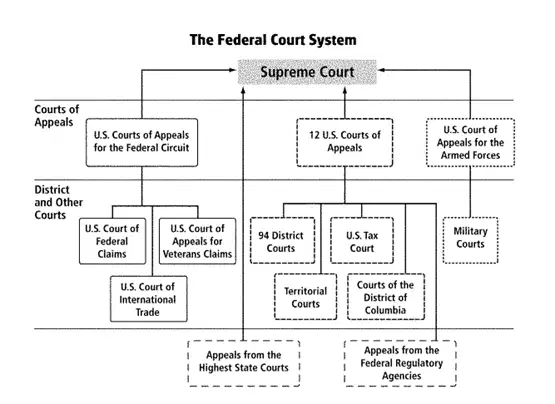
Appeals from the U.S. Court of Appeals for Veterans Claims reach the Supreme Court through the
U.S. Courts of Appeal.
district courts.
In which court do people bring claims against the United States?
U.S. Court of Federal Claims
U.S. Tax Court
U.S. district courts
U.S. Court of International Trade
In which case did the Supreme Court assert its power of judicial review?
McCulloch v. Maryland
Dred Scott v. Sandford
Marbury v. Madison
Gibbons v. Ogden
From which court is a case most likely to make its way to the Supreme Court?
state supreme court
federal bankruptcy court
federal court of appeals
federal district court
A majority opinion is one that is signed by at least how many members of the Supreme Court?
three
four
five
six
An interest group that wants to contribute to candidates for Congress would most likely
hire a lobbyist.
start a Web page.
create a trade association.
form a political action committee.
Which of the following descriptions is most likely to apply to an interest group whose Web site offers the article “Can the Amazon Rainforest Be Saved”?
cause-based group interested in the environment
trade association for tropical lumber producers
labor group for workers in the banana industry
cause-based group interested in building democracy
An interest group that endorses a candidate is
criticizing the candidate’s actions.
giving money for a campaign.
asking voters to elect the candidate.
asking for the candidate’s help.
What is a goal common to all interest groups?
electing a slate of candidates
promoting business-friendly laws
influencing public policy
expanding democratic freedoms
What is the origin of today’s two major U.S. political parties?
Constitution
Federalist Papers
a party split
Bill of Rights
A significant difference between political parties and interest groups is that
political parties tend to focus on a single overriding issue, such as taxes.
political parties pressure government from the outside.
the main goal of political parties is to elect their members to public office.
interest groups operate in all areas of the country.
What party system is the most common party system?
one-party
two-party
third-party
multiparty
In our two-party system, each major party tries to
form a coalition with the other.
focus on one overriding issue.
appeal to as broad a base as possible.
avoid catering to special constituencies.
Which of the following is the best argument in favor of making it easier for people to use absentee ballots?
Voter fraud would be reduced.
Voter registration would become easier.
More 18-year-olds would vote.
Voter participation would increase.
Freedom of speech can be limited whenever
a. a majority of Congress chooses to do so.
b. the president chooses to limit it.
c. it is likely to lead to immediate lawless action.
d. the states want to limit it.
Which of the following was one reason that the Second Amendment was included in the Bill of Rights?
to forbid the quartering of troops in people’s homes
to ensure government control of all firearms
to allow people to worship freely
to protect the right of states to form militias
What did the Supreme Court rule in United States v. Miller?
The First Amendment does not protect the right to free speech.
The Second Amendment was not meant to protect the right to have all types of weapons.
Private ownership of guns that might be used by people in a militia is banned.
The Second Amendment protects the right to own any kind of weapon.
What is true about the Third Amendment?
has never been the subject of a Supreme Court case
involves the quartering of U.S. forces overseas
is a frequent subject of court cases
has been incorporated into the Fourteenth Amendment
What is probable cause?
reasonable grounds to indict someone
legal standard used in defamation cases
cause for a declaration of war
reasonable grounds for a search
A search warrant gives the police
authority to arrest someone.
legal authority to search private property.
the right to keep someone jailed until bail is met.
authority to release someone from jail.
What is the exclusionary rule?
Witnesses must be excluded from the courtroom while another witness is testifying.
Evidence cannot be gathered without a warrant.
Evidence obtained illegally cannot be used against a person in court.
The police are not allowed to testify in criminal cases.
Under the Equal Access Act of 1984, a school cannot discriminate against a club on the basis of the club’s
religious or philosophical viewpoint.
advocacy of hate or violence.
tolerance of vulgar language.
support for illegal actions.
Which of the following guarantees the right to equal treatment by the federal government?
original Constitution
Fourth Amendment
Tenth Amendment
Fourteenth Amendment
The position of lieutenant governor is comparable to that of what federal official?
secretary of state
attorney general
chief justice
vice president
Which of the following is a power held by many governors but not by the president?
power of executive clemency
power to propose a budget
power to veto parts of a bill
power of military command
Which of the following best describes the pay and benefits of governors?
Governors generally receive a salary but do not get travel expenses.
Governors usually receive both a salary and an official residence.
Most governors receive higher salaries than the president.
Most governors receive the same pay as their lieutenant governor.

