
Font size
 Worksheets
Projectile Motion and Graph Interpretation Worksheet
Total questions: 101
Worksheet time: 1hrs 10mins
The vertical component of velocity for a projectile changes because:
gravity acts on the projectile
air resistance increases the velocity
the projectile is moving horizontally
the mass of the projectile changes
Vertical acceleration is -9.8 m/s^2.
True
False
Which accurately shows the horizontal and vertical velocity vectors?
A diagram with arrows showing horizontal velocity to the right and vertical velocity upward.
A diagram with both velocity vectors pointing downward.
A diagram with only a horizontal velocity vector and no vertical component.
A diagram with both velocity vectors pointing to the left.
At what point on its trajectory does a projectile reach a zero vertical velocity?
At the highest point of its trajectory
At the point of launch
Just before hitting the ground
At the midpoint of its ascent
We can assume that horizontal velocity:
remains constant in the absence of external forces.
increases due to gravity.
decreases over time without air resistance.
changes direction spontaneously.
Roll a bowling ball off the edge of a table. As it falls, its horizontal component of velocity _______.
Stays the same
Increases
Decreases
Becomes zero
Typically, the horizontal acceleration of a projectile is: 0 m/s/s.
True
False
A person makes a round-trip journey, finishing where they started. What describes their motion?
Distance non-zero, Displacement zero
Distance zero, Displacement non-zero
Distance non-zero, Displacement non-zero
Distance zero, Displacement zero
Slope is calculated by ________.
rise/run
run/rise
rise+run
run-rise
Symbol for velocity: ________
v
a
t
s
Units for Acceleration: ________
m/s2
m/s
kg/m^2
m^2/s
A projectile has how many components?
One
Two
Three
Four
Acceleration Due to Gravity is commonly denoted by the symbol g; it is the same for all objects on Earth, regardless of their mass.
True
False
Magnitude is the size of a vector quantity, ignoring its direction.
True
False
Does horizontal velocity of a projectile change once it is launched?
Yes, it increases over time.
No, it remains constant.
Yes, it decreases over time.
Yes, it fluctuates randomly.
A bullet is fired horizontally at the exact same time and height as a matching bullet is dropped. Which bullet lands first?
The fired bullet lands first.
The dropped bullet lands first.
Both bullets land at the same time.
Neither bullet lands.
Centripetal acceleration always points to the center.
True
False
Uniform circular motion is moving in a circle with constant speed.
True
False
Velocity for an object traveling in a circle points _________
In the direction of motion (straight line) / tangential
Toward the center of the circle
Away from the center of the circle
Perpendicular to the plane of the circle
How do you calculate centripetal force?
mv2/R
mR2/v
mRv2
m/v2R
The rate at which velocity changes.
Acceleration
Speed
Distance
Force
The distance an object travels per unit of time.
Speed
Mass
Force
Acceleration
Which one represents velocity?
15 mi/h eastward
15 mi/h
15 miles
15 eastward
What does the unit m/s mean?
Meters per second.
Miles per second.
Minutes per second.
Millimeters per second.
What does this graph represent?
Accelerating
Constant speed
Decelerating
At rest
What information is needed to calculate speed?
distance and time
mass and volume
temperature and pressure
height and width
force and acceleration
Speed and direction of a moving object is called
velocity
acceleration
momentum
distance
A box sliding down an inclined plane attains a velocity of 27 m/s in 3 seconds from rest. Find the acceleration.
9 m/s2
3 m/s2
6 m/s2
12 m/s2
Changing direction is an example of a kind of
acceleration
velocity
distance
force
What is the unit for FORCE?
N (Newtons)
kg (kilograms)
m (meters)
s (seconds)
A glance at your speedometer will tell you
instantaneous speed.
average speed.
velocity.
acceleration.
Units of acceleration
m/s2
kg
m
s
How far an object has moved. Can be measured in m, in, ft, mi, etc.
distance
velocity
mass
temperature
A basketball player applies a rightward force on the basketball. What is the reaction to this force?
The ball applies a leftward force on the player
The player moves to the right
The ball accelerates to the right
The ball stops moving
When forces are ______, an object will change its motion.
unbalanced
balanced
equal
opposite
Adriana walks 3 meters west. Then she walks 4 meters North. What is her displacement?
5 meters northwest
7 meters north
1 meter west
4 meters east
Acceleration is the change in....
speed and direction
mass and volume
temperature and pressure
distance and time
An apple falls from a tree. The apple falls toward the Earth, but the Earth doesn't visibly fall toward the apple. Why?
The apple and Earth apply equal and opposite forces to each other, but the Earth has much greater mass
The Earth is not affected by gravity
The apple is lighter, so it falls faster than the Earth
The Earth repels the apple instead of attracting it
Acceleration is a change in
velocity
mass
temperature
distance
A box is pulled by a rope at a constant speed to the left. Displacement is...
a vector measuring the distance and direction between the start and end
the total path length traveled by the box
always equal to zero for any movement
a scalar quantity representing only the magnitude
Speed formula
distance / time
time / distance
distance × time
distance + time
Gravitational force is 12N and then BOTH of the masses doubles. What's the new force (Fg)?
48 N
24 N
96 N
12 N
At what point on its track does a projectile reach a zero vertical velocity?
at maximum height
at launch point
just before hitting the ground
at the midpoint of its trajectory
Velocity formula
v=d/t, direction
v=d*t, direction
v=t/d, direction
v=d/t, speed
Two people on ice skates push off from each other. One person has a larger mass than the other person. Which is true?
The larger person moves away faster
The smaller person moves away faster
They both move away at the same speed
The larger person does not move at all
Which of these best states Newton's Second Law? (Think about which is the true statement)
The force acting on an object is equal to the mass of that object times its acceleration.
An object at rest will stay at rest unless acted upon by a force.
For every action, there is an equal and opposite reaction.
The acceleration of an object is directly proportional to the net force acting on it and inversely proportional to its mass.
Which of the following is an example of Newton's First Law of Motion?
A car suddenly stops and the passengers lurch forward.
A ball rolls down a hill.
A rocket launches into space.
A person jumps off a diving board.
If Earth's mass was cut in 1/2, what would happen to your mass?
nothing...mass is the same no matter where you are
Your mass would be cut in half as well
Your mass would double
Your mass would become zero
If there are two forces going in the SAME direction, you would...?
(+) add the forces
(-) subtract the forces
(x) multiply the forces
(/) divide the forces
Which term explains why a crash-test dummy lunges forward during a car crash?
inertia
friction
gravity
acceleration
The acceleration of a projectile along the vertical motion is
9.81 m/s2
0 m/s2
5 m/s2
15 m/s2
What is this graph showing?
constant speed
increasing speed
decreasing speed
variable speed
What does Newton's First Law of Motion state?
An object at rest stays at rest and an object in uniform motion will remain in its state of motion unless acted upon by an unbalanced force.
An object will accelerate in the direction of the applied force regardless of its initial state.
The force between two objects is directly proportional to the product of their masses and inversely proportional to the square of the distance between them.
Energy cannot be created or destroyed, only transformed from one form to another.
How much time will it take for a bus to increase its speed from 10 mi/hr to 30 mi/hr if it accelerates at a rate of 4 mi/hr/sec?
5 sec
10 sec
2 sec
20 sec
A stone is thrown horizontally at a speed of 10m/s from a height of 90m. What is the time taken to reach the ground?
4.28s
2.5s
6.0s
9.0s
An object is moving along a circular path. Which one of the following describes the direction of the acceleration vector?
It is directed towards the center of the circle.
It is directed away from the center of the circle.
It is tangent to the path.
It is perpendicular to the velocity.
When forces are balanced there is ____ acceleration.
no
high
low
constant
A golf ball accelerates off a tee at 15 m/s^2, changing its velocity from 0 m/s to 50 m/s down the fairway. How long did it take the golf ball to accelerate?
3.33 seconds
7.5 seconds
0.3 seconds
15 seconds
Which of the following statements are true of the horizontal motion of a projectile?
The horizontal velocity at the peak is the same as just after it was launched
The horizontal velocity at the peak is zero
The horizontal velocity increases as it falls
The horizontal velocity decreases as it rises
Mass is measured in...
kg
m
s
A
A rope is used to lower a bucket at constant speed. What is the acceleration of the bucket?
0 m/s^2
9.8 m/s^2
-9.8 m/s2
1 m/s^2
SI unit of velocity
m/s
kg
m
s
The acceleration of a projectile along the horizontal motion is 0 m/s^2.
True
False
What is Newton's first law often associated with?
Law of Inertia
Law of Acceleration
Law of Action-Reaction
Law of Gravity
Why would one ball accelerate more than the other when pushed with the same amount of force?
Different masses
Different shapes
Different colors
Different sizes
A roller coaster accelerates from an initial velocity of 6.0 m/s to a final velocity of 70 m/s over 4 seconds. What's the acceleration?
16 m/s^2
10 m/s^2
8 m/s^2
12 m/s^2
If I went to the moon, my mass would
stay the same
increase
decrease
What is true about the Earth and the Moon?
Earth and Moon apply equal forces on each other
Earth applies more force on the Moon
Moon applies more force on the Earth
When a cannon is fired, the cannon ball ends up moving much faster and further than the cannon because...
The ball has less mass, so it experiences higher acceleration from the same amount of force
The cannon is heavier
The ball is round
The cannon is fixed
Newton's Second Law is F=ma. If you apply an unbalanced force on an object to the right the object will accelerate to the ______.
Right
Left
Up
Down
If force stays the same, but mass increases, the acceleration will _____
decrease
increase
stay the same
become zero
The phrase "For every action there is an equal and opposite reaction" describes Newton's ______ Law of Motion.
Third
First
Second
Fourth
Work: A push or a pull (force) on an object that causes it to move in the same direction as the force.
A push or a pull (force) on an object that causes it to move in the same direction as the force.
A push or a pull (force) on an object that causes it to move in the opposite direction as the force.
A push or a pull (force) on an object that does not cause it to move.
A push or a pull (force) on an object that causes it to stop moving.
A horse pushes the ground backward when it starts walking. What is the reaction to this force?
The ground pushes the horse forward
The horse moves upward
The ground pulls the horse backward
The horse stops moving
2 objects attract each other with a Fg of 16. If the mass of both objects is doubled and the distance is doubled, what is the new Fg?
16
8
32
4
The ______ distance between two objects, the more the gravitational pull.
less
greater
equal
average

Which time interval shows a constant velocity and no acceleration?
18 s to 24 s
4 s to 18 s
0 s to 24 s
0 s to 3 s


At what point is vy= 0 m/s?
A
B
C
D
None of these points

What is the speed of the object between 25 to 60 seconds?
4 m/s
2m/s
0 m/s
5 m/s

What is the speed pf the object in section A?
0 m/s
30 m/s
0.5m/s
2 m/s

In which section object is travelling fastest?
A
B
C

In which segment the object stopped?
A
B
C

Line A indicates that the object is
Speeding up in positive direction
Speeding up in negative direction
moving at constant speed in negative direction
moving at constant speed in positive direction

Around What time object is turning and moving in the opposite direction
2 sec
10 sec
4 sec
6 sec

Between which two points is the car parked?
AB
DE
FG
BC

What is occuring between points B and C?
The car is moving at a constant velocity of 2 km/min.
The car is parked.
The car is accelerating at a rate of 2 km/min/min.
The car is moving at a constant speed of 3.5 km/min.

What does this line represent on the graph?
Constant acceleration
Stationary
Negative acceleration
Constant velocity

What does the line on this graph represent?
Stationary
Constant negative acceleration
Acceleration
Constant speed (velocity)

Between which points did the object move at a constant speed?
BC
DE
CD
OA

What is happening to the object between points A and B?
Stationary
Moving at a constant speed of 10 m/h
Negative acceleration of 3 m/s/s
Acceleration of 5 m/s/s

How long was the object in motion?
20 seconds
10 seconds
25 seconds
15 seconds

What was the speed of the object between points E and F?
10 m/s
0 m/s
5 m/s
25 m/s
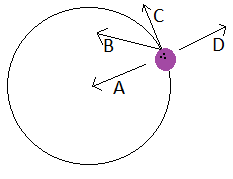
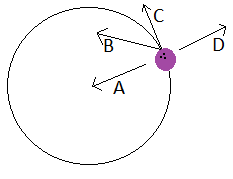

A 10kg car travels at a constant speed of 20.0 m/s around a horizontal circular track. Which diagram correctly represent the direction of the car's velocity (v) and the direction of the centripetal force (Fc) acting on the car at a particular moment?



