Wayground logo

Free Printable Worksheets

Font size

S
M
L
XL
Worksheets

Biology 2025 Midterm Review

Total questions: 70

Worksheet time: 1hrs 21mins

Name
Class
Date
1.

A student makes a Venn diagram to compare the functions of carbohydrates and lipids.

Which function of carbohydrates and lipids should be placed in the shared section of the Venn diagram?

a)

Hormone production

b)

Structural support of cell walls

c)

Energy storage

d)

Catalyst for chemical reactions

2.

(question 16) What biomolecule do enzymes belong to?

a)

Carbohydrate

b)

Lipid

c)

Nucleic Acid

d)

Protein

3.

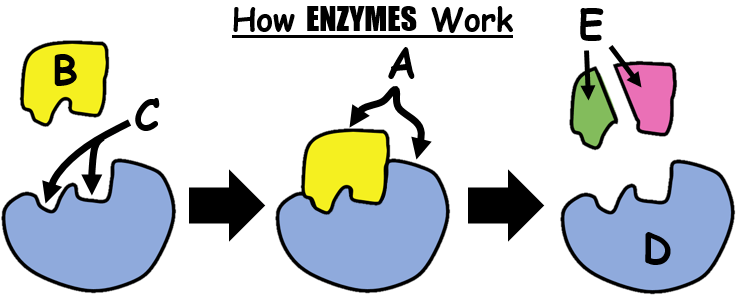
(question 19) What is the name of Letter D

a)

active site

b)

enzyme

c)

substrate

d)

products

4.

What is a catalyst?

a)

A substance that slows down a reaction

b)

A substance that speeds up a reaction

c)

A substance the stops a reaction

d)

A substance that explodes

5.

Which biomolecules are organic molecules.

a)

Carbohydrates and Lipids

b)

Carbohydrates, lipids, Protein, and Nucleic Acids

c)

Only Helium

d)

Carbon, Hydrogen, Oxygen and Nitrogen

6.
Which 2 molecules contains the elements C-H-O and function pertains to energy?
a)
Lipids and Protein
b)
Carbohydrates and Nucleic Acids
c)
Protein and Carbohydrates
d)
Carbohydrates and Lipids
7.

Monomer: nucleotide

a)

Carbohydrate

b)

Lipid

c)

Protein

d)

Nucleic Acid

8.
Which biomolecule is your main source of energy?
a)
Nucleic Acid
b)
Protein
c)
Lipid
d)
Carbohydrate
9.
Which biomolecule is made of amino acids?
a)
Nucleic Acid
b)
Carbohydrate
c)
Protein
d)
Lipid
10.
Which biomolecule has sugars and starches?
a)
Lipids
b)
Proteins
c)
Carbohydrates
d)
Nucleic Acid
11.
Which biomolecule is responsible for insulation and energy storage?
a)
Protein
b)
Nucleic Acid
c)
Lipid
d)
Carbohydrate
12.

Which statement is true?

a)

A virus has a nucleus, but no other organelles.

b)

A virus has a nucleus and ribosomes.

c)

A virus has no organelles, because it has no cells, and it is non-living.

13.

What do viruses need to reproduce?

a)

they need genetic material

b)

They need a host cell

c)

They need bacteria

d)

They need insulin

14.
When a virus invades a living cell, its _______
takes over the cell's functions.
a)
outer coat
b)
genetic material
c)
core
d)
cytoplasm
15.
Antibiotics kill viruses
a)
True
b)
False
16.

What part of a virus is the protein capsule that houses the genetic material (DNA/RNA)?

a)

tail

b)

nucleus

c)

capsid

d)

glycoprotein

17.

Should a doctor give a patient antibiotics to treat a disease caused by a virus?

a)

Yes, because antibiotics will stop the cellular processes of the virus, helping the patient get better faster.

b)

Yes, because antibiotics will kill bacteria in the body, giving the immune system an easier time fighting the virus.

c)

No, because diseases caused by viruses are always deadly, meaning that the patient cannot be saved.

d)

No, because viruses are not cells, and antibiotics target cellular processes.

18.
Anything living or nonliving that can cause a disease is known as a?
a)
Antibiotic
b)
Foe
c)
Pathogen
19.
What is the longest stage of the cell cycle called?
a)
Cytokinesis
b)
M phase
c)
Interphase
d)
G1 Phase
20.
What is a series of events a cell goes through as they grow and divide?
a)
Cell Division
b)
Cell Cycle
c)
Cytokinesis
d)
Mitosis
21.
During what stage does the G1, S and G2 phases happen?
a)
Interphase
b)
M phase
c)
Mitosis
d)
Cytokinesis
22.
During which stage of the cell cycle does mitosis and cytokinesis occur?
a)
Interphase
b)
S phase
c)
M phase
d)
G1 phase
23.
During what phase of the cell cycle does cell division occur?
a)
Interphase
b)
M phase
c)
S phase
d)
G2 phase
24.
During what phase of the cell cycle is DNA replicated?
a)
G1 phase
b)
S phase
c)
G2 phase
d)
M phase
25.
Put the following stages of mitosis in order: anaphase, prophase, metaphase, and telophase. 
a)
prophase, metaphase, telophase, anaphase
b)
prophase, anaphase, metaphase, telophase
c)
prophase, metaphase, anaphase, telophase
d)
prophase, telophase, metaphase, anaphase
26.
What part of the cell cycle results in the splitting of the new cells?
a)
Interphase
b)
Mitosis
c)
Metaphase
d)
Cytokinesis
27.

Cancer is defined as the

a)

uncontrolled division of mutated cells

b)

normal division of cells

c)

normal DNA replication

d)

abnormal ATP synthesis

28.

A ________________is a critical point where stop and go signals can regulate the cycle

a)

tumor

b)

checkpoint

c)

growth factor

d)

oncogene

29.

Cell programmed self destruction is called

a)

Atopic

b)

Apoptosis

c)

Antiparallel

d)

Anticellular

30.

Embryonic stem cells are

a)

cells that grow uncontrollably

b)

cells present early in development that can form into any type of cell

c)

not able to go through cell division

d)

found within the tissues of a fully developed human
31.
Why is DNA important?
a)
it is very small and very complicated
b)
it's in everything
c)
it serves as the blueprint for traits of all living things
d)
because we eat it every day for energy
32.
What are the 4 nitrogen bases?
a)
adenine, thymine, cytoplasm, and guanine
b)
adenine, thymine cytosine, and guanine
c)
adenine, thymine, cytosine, and gylcerol
d)
adenine, thymine, cytosine, and glucose
33.
Which shows the correct complementary base pairing for DNA?
a)
C-A, T-G
b)
A-G, C-T
c)
C-G, U-A
d)
T-A, G-C
34.
The sugar in DNA is ?
a)
sucrose
b)
glucose
c)
deoxyribose
d)
fructose
35.
Which 2 molecules form the sides (backbone) of the DNA ladder?
a)
deoxyribose sugar and adenine
b)
deoxyribose sugar and a hydrogen bond
c)
deoxyribose sugar and the nucleus
d)
deoxyribose sugar and phosphate
36.
The two strands of nitrogenous bases in DNA are joined by which type of bond?
a)
polar bonds
b)
ionic bonds
c)
covalent bonds
d)
hydrogen bonds
37.
X outlines a(n) ___________.
a)
amino acid
b)
nitrogen base 
c)
nucleotide
d)
nitrogen base pair
38.
Which sequence of DNA bases would pair with this partial strand
ATG TGA CAG
a)
ATG TGA CAG
b)
TAC ACT GTC
c)
GTA AGT GAC
d)
CAT TCA CTG
39.

What is the order of the steps in protein synthesis?

a)

Translation, then Transcription

b)

Transcription, then Replication

c)

Transcription, then Translation

d)

Translation, then Replication

40.

Determine the correct order of the amino acid sequence to be produced from the DNA template:

3' CCG TCT AAG GTG ACC CTT 5'

a)

Valine - Threonine - Lysine - Serine - Proline - Glutamic Acid

b)

Glycine - Valine - Lysine - Serine - Proline - Alanine

c)

Proline - Serine - Lysine - Threonine - Valine - Stop

d)

Glycine - Arginine - Phenylalanine - Histidine - Tryptophan - Glutamic Acid

41.

Determine the correct amino acid sequence from the mRNA strand:

5' AUG CAG UCU GCA CUG AGC 3'

a)

Met-His-Ser-Ala-Leu-Ser

b)

Met-Arg-Ser-Ala-Leu-Ser

c)

Met-His-Ser-Leu-Ala-Ser

d)

Met-Gln-Ser-Ala-Leu-Ser

42.

Which amino acid is coded for by the following mRNA codon CCU?

43.

What type of mutation is shown in the picture?

a)

substitution

b)

insertion

c)

deletion

d)

translocation

44.

What type of mutation is shown in this picture?

a)

No mutation

b)
Substitution
c)
Deletion
d)
Insertion
45.

What type of mutation is shown in this picture?

a)
Insertion
b)
Deletion
c)
Substitution
d)

No mutation

46.

A cat has a total of 40 chromosomes in its body cells. How many in its sex cells?

a)

38

b)

20

c)

76

d)

10

47.
The process of crossing over occurs in what meiotic phase?
a)
anaphase 1
b)
prophase 1
c)
prophase 2
d)
telophase 1
48.

Meiosis would occur in which of these cells?

a)

skin cells

b)

liver cells

c)

brain cells

d)

sperm cells

49.
The chromosomes that pair up during meiosis, are called __________ chromosomes.  
a)
homozygous 
b)
asexual
c)
homologous
d)
genes
50.
Crossing over helps promote ?
a)
male genotype
b)
genetic variation
c)
DNA replication
d)
mitosis
51.
With mitosis you get ___, _________ cells, but with meiosis, you get ___, ____________.
a)
4 different, 2 identical
b)
4 identical, 2 different
c)
2 different, 4 identical
d)
2 identical, 4 different
52.

In the image above, what is the percentage of the offspring has the possibility of inheriting blood type O?

a)

0%

b)

25%

c)

50%

d)

100%

53.
Hemophilia is a recessive x-linked disorder.
Which genotype represents a female who is a carrier for hemophilia?
a)
XHXh
b)
XhXh
c)
XHXH
d)
XhY
54.
Which of the following genotypes belongs in the red box in the Punnett square?
a)
XBXb
b)
XbXb
c)
XbY
d)
XBY
55.
AA and Aa always show up as
a)
dominant
b)
recessive
56.
aa always shows up as
a)
dominant
b)
recessive
57.
What goes in box 1
a)
AABb
b)
AABB
c)
aabb
d)
AaBb
58.

Which of the following describes incomplete dominance?

a)

Two traits create a third blended trait

b)

Two traits appear simultaneously

c)

One trait overpowers the other

d)

Traits are linked on the X-chromosome

59.

Which of the following describes Co-dominance?

a)

Two traits create a third blended trait

b)

Two traits appear simultaneously

c)

One trait overpowers the other

d)

Traits are linked on the X-chromosome

60.
G = green, g = yellow
The genotype for a yellow plant is...
a)
GG
b)
Gg
c)
gg
d)
all of the choices result in yellow
61.
Which of the following is homozygous dominant?
a)
Yy
b)
Y
c)
yy
d)
YY
62.
The exact genetic makeup of an organism, such as RR, Tt, PP is its?
a)
phenotype
b)
dominance
c)
genotype
d)
trait
63.
Tt is-
a)
homozygous dominant
b)
homozygous recessive
c)
heterozygous
d)
none of these
64.

Genotype or Phenotype: Black hair

a)

Phenotype

b)

Genotype

65.
If "T" is the allele for tall and "t" is the allele for short, then Tt would produce?
a)
tall
b)
short
c)
medium
d)
not enough info
66.
T - tall and t = short
In the punnett square below, what belongs in the missing square
a)
tt
b)
Tt
c)
Bb
d)
TT
67.
What is the yellow seed genotype?
a)
aa
b)
Aa
c)
AA
d)
AA or Aa
68.

What is the probability that the offspring will express the dominant trait?

a)

25%

b)

50%

c)

75%

d)

100%

69.
Question Image

​ Match the image with the correct vocabulary word.

a)
1.

DNA

an organic chemical that carries all information of a living thing

b)
2.

Chromosome-

threadlike structures that carry information about the organism in units called genes

c)
3.

Cell-

the smallest unit with the basic properties of lifeand made of molecules

70.

How many PAIRS of chromosomes do humans typically have?

a)

23

b)

46

c)

12

d)

92