
NEW
Font size
 Worksheets
Geology Review
Total questions: 67
Worksheet time: 2hrs 11mins
Which of the following is a process in which rocks are BROKEN down into sediment?
Weathering
Erosion
Deposition
Compaction
Which processes results in the formation of sediment?
Compaction and Cementation
Heat and Pressure
Cooling and Crystallization
Melting
Weathering, Erosion, and Deposition
Which process occurs when sediment is pressed together?
Weathering
Deposition
Compaction
Cementation
Erosion
Which processes result in a metamorphic rock forming?
Weathering, Erosion, and Deposition
Cooling and Crystallization
Compaction and Cementation
Heat and Pressure
Melting
Which of the following occurs when minerals glue the sediment together?
Deposition
Weathering
Compaction
Cementation
Erosion
A rock is a naturally occurring solid mixture of one or more minerals that may also include organic matter.
True
False
What process creates magma/lava?
Cooling and Crystallization
Melting
Heat and Pressure
Weathering, Erosion, and Deposition
Sedimentary rocks must turn into metamorphic rocks before it can be turned into an igneous rock.
True
False
_ is molten rock that is below Earth's surface.
Lava
Magma
Sediment
Rock
What Are The Three Main Types Of Rocks?
Igneous, Depository, Metamorphic
Depository, Igneous, Sedimentary
Metamorphic, Igneous, Depository
Igneous, Metamorphic, Sedimentary
Minerals and rocks are the same?
True
False
Rocks have four main characteristics that are used to classify them?
True
False
What are the four characteristics used to classify rocks?
Formation, mineral composition, erosion
Formation, mineral composition, texture, color
Streak, mineral composition, color, texture
Formation, mineral composition, texture, erosion
What are rocks made of?
Salt
Minerals
Other rocks
Sand
The rocks cycle follows a specific order?
True
False
What can cause rocks to change?
The Earth's orbit around the sun
Environmental conditions
The minerals falling apart
Internal conditions

When molten (melted) rock cools and becomes a solid, a _____ rock forms.
Igneous
Sedimentary
Metamorphic
Mineral
Fossils are more likely to form in which type of rock?
Sedimentary rocks form in layers which help keep fossils from being destroyed.
Metamorphic rocks form by being exposed to a lot of heat and pressure and this keeps the fossils from being destroyed.
Igneous rocks form when lava or magma cools and this keeps the fossils from being destroyed
Fossils only form in igneous rocks.

What is letter A?
Cooling
Melting
Heat and pressure
Weathering and erosion
What is letter B?
Cooling
Melting
Heat and pressure
Weathering and erosion
What is letter E?
Heat and pressure
Melting
Deposition, Compaction, Cementation
Weathering and erosion
What is letter G?
Heat and pressure
Cooling
Deposition, Compaction, Cementation
Weathering and erosion


What type of landform MOST likely results when an oceanic plate subducts under a continental plate?
volcanic mountains
reverse faults
transform boundaries
tsunamis
A divergent boundary occurs when plates ....
Pull apart
Come together
Slide past each other
subducting
Which feature forms at convergent boundaries?
trench
rift valley
mountain range
mid-ocean ridge

What kind of boundary is shown here?
convergent
divergent
transform


Where would you find the oldest rocks on the ocean floor?
near the mid-ocean ridge
near the trench

Which type of boundary forms a mid-ocean ridge?
transform
divergent
convergent
Which type of boundary forms a mid-ocean ridge?
transform
divergent
convergent

What is true of tectonics plates?
They are constantly moving
Earthquakes cause them to move
They don't move for centuries at a time
There are fewer & fewer of them

What makes the plates move?
Conduction in the mantle
Convection in the mantle
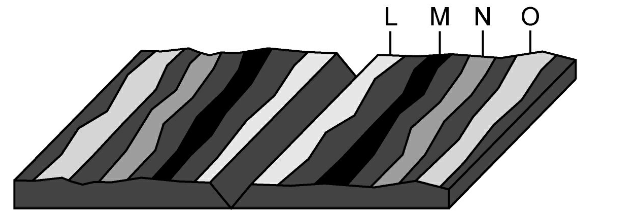
Where would the oldest rock be found?
L
M
N
O
Which of the following lists Earth's layers in order from outer to inner?
inner core, outer core, mantle, crust
mantle, outer core, inner core, crust
crust, mantle, outer core, inner core
Which layer is thought to be responsible for continental drift?
crust
mantle
core
What happens to the temperature as you go deeper down inside Earth?
it increases
it decreases
it stays the same

What is the thickest layer of the Earth?
Crust
Mantle
Outer Core
Inner Core

What is the thinnest layer of the Earth?
Crust
Mantle
Outer Core
Inner Core

Which layer of the Earth is a dense solid ball of Iron and Nickle?
Crust
Mantle
Outer Core
Inner Core

What layer of the Earth is represented by the letter D?
Crust
Mantle
Outer Core
Inner Core

What layer of the Earth is represented by the letter B?
Crust
Mantle
Outer Core
Inner Core
What are convection currents?
the cycle of heated rock or metal rising, and cooling rock or metal falling.
the cycle of cooling rock or metal rising, and heated rock or metal falling.
an electric current found in the mantle.
and electric current found in the outer core.

Density ______________________ as you go deeper into the Earth.
increases
decreases
goes up or down depending on the layer
stays the same
The correct order of the Earth's layers starting from the OUTSIDE going IN is
crust, inner core, mantle, outer core
mantle, outer core, inner core, crust
crust, mantle, outer core, inner core
inner core, outer core, mantle, crust
Fossils of the fern-like, tropical plant, Glossopteris have been found on the continents of Africa, South America, and Antarctica. How have scientists explained this observation?
The wind blew the plant's seed across the ocean from continent to continent.
The fern developed on each continent.
The continents were once joined together and later moved apart.
The fern had adaptations to survive in different climates.

Which crust is thicker
oceanic
continental
bread
pizza

