
 Worksheets
KS3 Biology revision 1
Total questions: 64
Worksheet time: 35mins


Is it a living or a non-living thing?
Living thing
Non-living thing
An animal that hunts other animals for food
omnivore
consumer
predator
prey
Break down and absorb nutrients from decaying organisms
prey
ecosystems
consumers
decomposers
An animal that is hunted and eaten by another animal
producer
consumer
predator
prey
Organisms that cannot make their own food. They eat other organisms to get energy.
consumer
predator
prey
omnivore
Animals that feed on herbivores, the primary consumers in a food web.
tertiary consumers
primary consumers
decomposers
secondary consumers
All of the living and nonliving things in an area that interact with one another.
food web
food chain
ecosystem
consumers
An animal that feeds on secondary consumers in a food chain.
secondary consumer
primary consumer
tertiary consumer
producer
Shows how food and energy passes from one organism to another in an ecosystem.
connect the dots
food web
food chain
CEC classes
What is a Herbivores?
A animal that eats plant
A animal that eats meat
A plant that makes its own food
a plant that eats meat
What is a Carnivore?
A animal that eats plants
A animal that eats meat
A animal that makes it own food
A animal that doesn't eat animals or plants
which one is a Producer?


*Remember Humans are on the top of all food chains because we do not get hunted.


Cell
Made up of many organs all working towards the same purpose.
Component of a cell. Each one has a particular function within the cell.
A group of tissues working together to carry out a particular function.
Smallest living unit of an organism. Made of organelles.
Organism
Made up of many organs all working towards the same purpose.
A group of tissues working together to carry out a particular function.
This is a living thing. It can either be made up of one cell (e.g. bacteria) or many cells (e.g. human)
Made up of many organs all working towards the same purpose.
Contains chlorophyll (green pigment) and uses the sun to make food
cell membrane
cell wall
chloroplast
cytoplasm
rigid outer layer that supports and allows it to grow tall
cell membrane
cell wall
chloroplast
cytoplasm
controls movement of materials in and out of the cell, maintains homeostasis
cell membrane
cell wall
chloroplast
cytoplasm
jelly like material that protects cell organelles
cell membrane
cell wall
chloroplast
cytoplasm
"power house" of the cell - converts sugar into energy
cytoplasm
mitochondrion
nucleus
vacuoles
fluid-filled sacs that store food
cytoplasm
mitochondrion
nucleus
vacuoles
the brain of the cell
cytoplasm
mitochondrion
nucleus
vacuoles
Which of these is not found in the animal cell and is found in the plant cell? Pick more than one
cell membrane
cell wall
chloroplast
cytoplasm
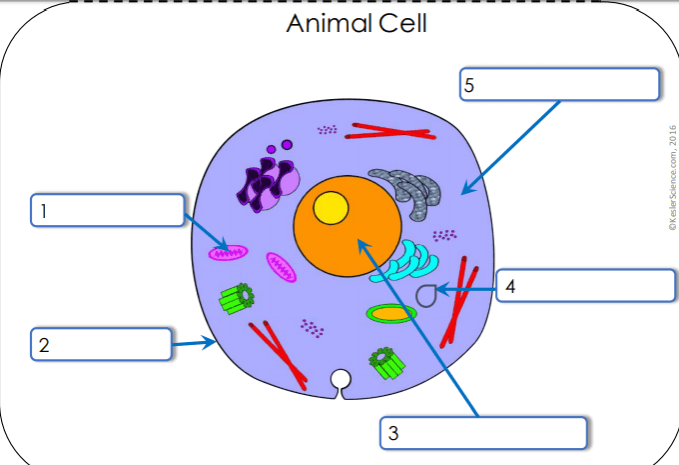
What is #1 in the diagram?
nucleus
cell wall
cytoplasm
mitochondrion
What is #2 in the diagram?
vacuoles
cell membrane
chloroplast
nucleus
What is #3 in the diagram?
vacuoles
cell membrane
chloroplast
nucleus
What is #4 in the diagram?
vacuoles
cell membrane
chloroplast
nucleus
What is #5 in the diagram?
nucleus
cell wall
cytoplasm
mitochondrion
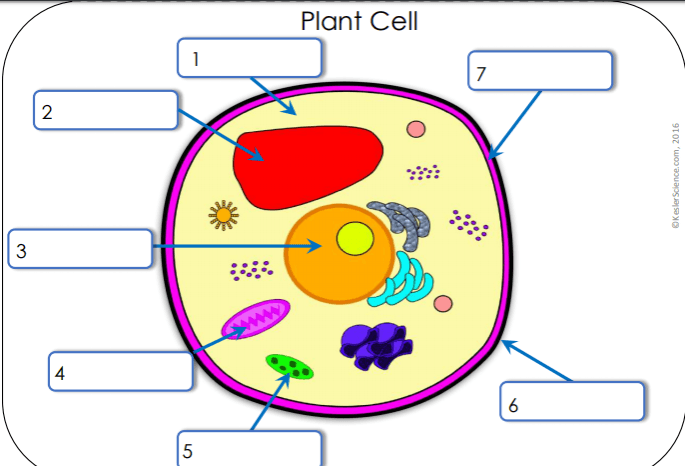
What is #1 in the diagram?
nucleus
cell wall
cytoplasm
mitochondrion
What is #2 in the diagram?
vacuoles
cell membrane
chloroplast
nucleus
What is #3 in the diagram?
vacuoles
cell membrane
chloroplast
nucleus
What is #4 in the diagram?
nucleus
cell wall
cytoplasm
mitochondrion
What is #5 in the diagram?
vacuoles
cell membrane
chloroplast
nucleus
What is #6 in the diagram?
nucleus
cell wall
cytoplasm
mitochondrion
What is #7 in the diagram?
vacuoles
cell membrane
chloroplast
nucleus

