
 Worksheets
Lesson 6.1 (Slide 1 of 2)
Total questions: 98
Worksheet time: 49mins
Describe the extracellular and intracellular fluid compartments.
The extracellular fluid compartment consists of fluid outside cells, while the intracellular fluid compartment consists of fluid inside cells.
The extracellular fluid compartment consists of fluid inside cells, while the intracellular fluid compartment consists of fluid outside cells.
Both compartments contain only extracellular fluid.
Both compartments contain only intracellular fluid.
Describe the composition of the extracellular and intracellular body fluid compartments.
The extracellular compartment contains mainly sodium and chloride, while the intracellular compartment contains mainly potassium and phosphate.
Both compartments contain mainly potassium and phosphate.
The extracellular compartment contains mainly potassium and phosphate, while the intracellular compartment contains mainly sodium and chloride.
Both compartments contain mainly sodium and chloride.
Fluid transport and fluid balance are maintained primarily by which of the following mechanisms?
Osmosis and filtration
Active transport and diffusion
Endocytosis and exocytosis
Pinocytosis and phagocytosis
Identify the causes, signs and symptoms, and treatment of fluid imbalances.
Causes include dehydration and kidney issues; signs are edema and confusion; treatment involves fluid replacement and monitoring.
Causes include only infections; signs are always fever; treatment is antibiotics only.
Causes are limited to dietary choices; signs are only weight gain; treatment is exercise.
Causes include only genetic factors; signs are always skin rashes; treatment is surgery.
The major functions of the major electrolytes—sodium, potassium, calcium, magnesium, and chloride—include:
Regulating fluid balance, nerve transmission, muscle contraction, and acid-base balance
Providing energy for cellular metabolism
Acting as structural components of cell membranes
Serving as enzymes for metabolic reactions
Identify the causes, signs and symptoms, and treatment of electrolyte imbalances.
Electrolyte imbalances are caused by fluid loss, kidney dysfunction, or medications; signs include muscle weakness and confusion; treatment involves correcting the underlying cause and restoring electrolyte balance.
Electrolyte imbalances are only caused by excessive exercise; signs include fever and rash; treatment is always surgery.
Electrolyte imbalances are caused by eating too much sugar; signs include headache and sore throat; treatment is antibiotics.
Electrolyte imbalances are caused by lack of sleep; signs include insomnia and anxiety; treatment is sleep therapy.
LIST DATA TO BE COLLECTED FOR THE FOCUSED ASSESSMENT OF FLUID AND ELECTROLYTE STATUS.
Vital signs, intake and output, laboratory values, physical assessment findings
Patient's favorite foods, sleep patterns, hobbies, travel history
Family medical history, vaccination records, employment status
Height, weight, eye color, hair color
Medical treatment and nursing management of persons with fluid and electrolyte imbalances include:
Monitoring vital signs and administering IV fluids as prescribed.
Ignoring changes in fluid balance.
Restricting all fluid intake regardless of symptoms.
Avoiding electrolyte replacement therapies.
Older persons are at increased risk for fluid and electrolyte imbalances because:
they have decreased kidney function and reduced thirst sensation.
they have increased muscle mass and higher metabolic rate.
they have enhanced absorption of fluids and electrolytes.
they have a stronger immune system.
LIST THE FOUR TYPES OF ACID-BASE IMBALANCES.
Respiratory acidosis, respiratory alkalosis, metabolic acidosis, metabolic alkalosis
Respiratory acidosis, metabolic acidosis, metabolic dehydration, metabolic alkalosis
Respiratory alkalosis, metabolic alkalosis, metabolic dehydration, metabolic acidosis
Respiratory acidosis, respiratory alkalosis, metabolic dehydration, metabolic alkalosis
IDENTIFY THE MAJOR CAUSES OF EACH ACID-BASE IMBALANCE.
Respiratory and metabolic disturbances such as hypoventilation, hyperventilation, renal failure, and prolonged vomiting.
Genetic mutations only.
Physical trauma to limbs.
Vitamin deficiency.
Medical treatment and nursing management of acid-base imbalances include:
Administering appropriate medications, monitoring blood gases, and providing supportive care.
Ignoring symptoms and waiting for spontaneous recovery.
Only using surgical intervention for all cases.
Focusing solely on dietary changes without monitoring laboratory values.
What is homeostasis?
The process of cell division
Maintaining relatively constant conditions as in fluid compartments
The breakdown of nutrients
The movement of muscles
To maintain internal balance, the body must be able to regulate _______.
fluids
temperature
oxygen
nutrients
Which of the following is involved in homeostasis?
Only the heart
Only the brain
All organs and structures of the body
Only the kidneys
Which type of fluid is found inside cells?
Extracellular fluid
Intracellular fluid
Plasma
Interstitial fluid
Which type of fluid is found outside cells?
Intracellular fluid
Extracellular fluid
Cytoplasm
Nucleus
What is the largest portion of body weight according to the composition of body fluids?
Water
Solutes
Electrolytes
Nonelectrolytes
The percentage of water in body fluids is affected by which of the following factors?
A) Age
B) Sex
C) Body fat
D) All of the above
Fill in the blank: The solutes in body fluids include ______ and nonelectrolytes.
electrolytes
carbohydrates
lipids
enzymes
Which of the following is NOT an electrolyte found in body fluids?
Sodium (Na)
Potassium (K)
Chloride (Cl)
Glucose
Fill in the blank: The chemical symbol for Calcium is ______.
Ca
Cl
Cu
Cs
Fill in the blank: The chemical symbol for Magnesium is ______.
Mg²⁺
Mg
Mn
Ma
What type of membrane allows certain substances to pass while blocking others?
Semipermeable membrane
Impermeable membrane
Permeable membrane
Nonselective membrane
Which of the following is NOT a transport process involved in the transport of water and electrolytes?
Diffusion
Active transport
Filtration
Photosynthesis
Osmosis
Fill in the blank: ________ is the movement of particles from an area of higher concentration to an area of lower concentration.
Diffusion
Osmosis
Evaporation
Condensation
Fill in the blank: ________ is the process that requires energy to move substances across a membrane against their concentration gradient.
Active transport
Passive transport
Diffusion
Osmosis
Fill in the blank: ________ is the process by which water moves across a semipermeable membrane from an area of lower solute concentration to an area of higher solute concentration.
Osmosis
Diffusion
Active transport
Filtration
What is the term for the process that separates particles from a solution by passing it through a membrane?
Filtration
Evaporation
Distillation
Crystallization
Osmolality is defined as the concentration of a solution determined by the number of dissolved particles per kilogram of water.
True
False
What is the normal range of osmolality in mOsm/kg for water?
280-294 mOsm/kg
200-220 mOsm/kg
320-340 mOsm/kg
150-170 mOsm/kg
What are the main regulators of fluid balance in the body?
Kidneys
Liver
Lungs
Heart
How do kidneys control extracellular fluid?
By adjusting the concentration of specific electrolytes, osmolality of body fluids, the volume of extracellular fluid, blood volume, and pH.
By producing hormones that directly regulate heart rate.
By increasing the absorption of nutrients in the intestines.
By controlling the release of digestive enzymes in the stomach.
What is the primary activity of kidneys?
Filtration
Digestion
Respiration
Movement
What does the glomerulus filtrate when blood plasma enters the kidneys?
Blood plasma
Red blood cells
Platelets
White blood cells
Which process in the kidneys involves the reabsorption of substances from the tubular fluid back into the blood?
Tubular reabsorption
Glomerular filtration
Tubular secretion
Excretion
Which process in the kidneys involves the secretion of substances from the blood into the tubular fluid?
Tubular secretion
Glomerular filtration
Reabsorption
Excretion
Which hormone system is triggered by low blood pressure and/or low blood volume?
Renin-Angiotensin-Aldosterone System (RAAS)
Thyroid Hormone System
Insulin-Glucagon System
Growth Hormone System
Activation of which hormone results in reabsorption of water?
Antidiuretic Hormone (ADH)
Insulin
Thyroxine
Adrenaline
Which hormone's activation results in increased excretion of sodium and water by the kidneys by decreasing renin synthesis, thus reducing blood volume and blood pressure?
Atrial Natriuretic Factor (ANF)
Aldosterone
Antidiuretic Hormone (ADH)
Cortisol
What does the thirst mechanism regulate?
Blood pressure
Fluid intake
Heart rate
Body temperature
Increased plasma osmolality stimulates osmoreceptors in the brain, leading to what sensation?
Hunger
Thirst
Sleepiness
Pain
Fill in the blank: More Na+ and less H2O in the body leads to _______.
thirst
dehydration
fatigue
sweating
Fill in the blank: Kidneys conserve water until plasma osmolality returns to _______.
normal
high
low
zero
Fluid gain is primarily achieved by _________
drinking and eating
sleeping
breathing
exercising
Which of the following is NOT a way fluid is lost from the body?
A) Kidneys
B) Skin
C) Drinking
D) Lungs
E) GI tract
The typical urine volume is ________ per day or ________ per hour.
1-2L/day or 1mL/kg per hour
2-3L/day or 0.5mL/kg per hour
0.5-1L/day or 2mL/kg per hour
3-4L/day or 3mL/kg per hour
Fluid can be lost through perspiration via the ________.
skin
lungs
kidneys
intestines
Evaporation via ________ is a method of fluid loss.
respirations
digestion
absorption
filtration
Which of the following is a clinical sign to monitor for age-related changes?
Disorientation or confusion
Fever
Rash
Cough
Which of the following is a clinical sign to monitor for age-related changes?
Constipation
Headache
Nausea
Sore throat
Which of the following is a clinical sign to monitor for age-related changes?
Falls from postural hypotension
High blood pressure
Skin dryness
Joint pain
Which of the following is a clinical sign to monitor for age-related changes?
A) Changes in mental status
B) Muscle cramps
C) Blurred vision
D) Chest pain
Which of the following is a clinical sign to monitor for age-related changes?
Recent weight changes
Persistent cough
Swelling in legs
Dizziness
Which of the following is a chronic condition that is a risk factor in older adults?
Heart failure
Renal insufficiency
Both A and B
None of the above
Which medications are considered risk factors in older adults?
Antihypertensives
Diuretics
Antacids
All of the above
Reduced mobility or cognitive impairment in older adults can lead to decreased _______ intake.
fluid
protein
calorie
vitamin
Which of the following are acute contributors to risk factors in older adults?
Trauma
Infection
Fever
All of the above
Fill in the blank: Aging kidney is slower to adjust to changes in ________, fluid, and electrolyte balances.
acid-base
glucose
pressure
temperature
Fill in the blank: Older adult often has a reduced sense of ________ and therefore may be in a state of chronic dehydration.
thirst
hunger
pain
hearing
Fill in the blank: Total body water declines with age; greatest loss from the ________ fluid compartment.
intracellular
extracellular
interstitial
vascular
Fill in the blank: Older person has limited reserves to maintain fluid balance when ________ losses occur.
abnormal
normal
minor
temporary
Fill in the blank: Antihypertensives, diuretics, and ________ can also contribute to imbalances.
antacids
antibiotics
analgesics
antivirals
Which of the following conditions may disrupt fluid/electrolyte balance?
Vomiting
Diarrhea
Burns
Kidney disease
DM (Diabetes Mellitus)
Which medication listed may affect fluid/electrolyte balance?
Diuretics
Antibiotics
Analgesics
Antidepressants
Which medical treatment/procedure may disrupt fluid/electrolyte balance?
Gastric suctioning
Blood transfusion
Physical therapy
Vaccination
Fill in the blank: _______ is a condition that may disrupt fluid/electrolyte balance.
Any of the listed conditions (Vomiting, Diarrhea, Kidney disease, DM, Burns, CHF, Ulcerative colitis)
Seasonal allergies
Mild headache
Normal aging process
Diuretics are medications that may disrupt fluid/electrolyte balance.
True
False
Gastric suctioning is a medical procedure that may disrupt fluid/electrolyte balance.
True
False
Which of the following is NOT listed as a condition that may disrupt fluid/electrolyte balance?
Vomiting
Diarrhea
Kidney disease
Hypertension
Fill in the blank: _______ is a medical treatment/procedure that may disrupt fluid/electrolyte balance.
Gastric suctioning
Physical therapy
Eye examination
Dental cleaning
Fill in the blank: _______ is a medication that may disrupt fluid/electrolyte balance.
Diuretics
Antibiotics
Analgesics
Antidepressants
Which of the following is a condition that may disrupt fluid/electrolyte balance?
Ulcerative colitis
Asthma
Migraine
Arthritis
Fill in the blank: One component of physical assessment is _________.
Vital signs
Photosynthesis
Gravity
Erosion
Fill in the blank: One component of physical assessment is _________
Intake and output
Blood transfusion
Medication administration
Surgical procedure
Fill in the blank: One component of physical assessment is _________.
Body weight
Color of shoes
Favorite food
Type of music
Fill in the blank: One component of physical assessment is _________.
Skin
Engine
Algorithm
Keyboard
Fill in the blank: One component of physical assessment is _________
Mucous membranes
Engine oil
Wallpaper
Bluetooth
Fill in the blank: One component of physical assessment is _________
Veins
Temperature
Pulse
Respiration
What is fluid volume deficit? Fill in the blank: Fluid volume deficit is when ________ is less than normal in the body.
water
oxygen
protein
sugar
What are the two types of fluid volume deficit?
Hypovolemia (isotonic extracellular fluid deficit) and dehydration (hypertonic extracellular fluid deficit)
Hypervolemia and dehydration
Hypovolemia and hypervolemia
Dehydration and overhydration
Hypovolemia is also known as:
Isotonic extracellular fluid deficit
Hypertonic extracellular fluid deficit
Hypotonic fluid excess
Isotonic fluid excess
Dehydration is also known as:
Isotonic extracellular fluid deficit
Hypertonic extracellular fluid deficit
Hypotonic fluid excess
Isotonic fluid excess
What is fluid volume excess? Fill in the blank: Fluid volume excess is when there is ________ water in the body.
increased
decreased
no
normal
What are the two types of fluid volume excess?
Extracellular fluid excess (isotonic fluid excess) and intracellular water excess (hypotonic fluid excess)
Interstitial fluid excess and plasma volume excess
Hypertonic fluid excess and hypotonic fluid excess
Vascular fluid excess and tissue fluid excess
What is the definition of Isotonic Extracellular Fluid Deficit (Hypovolemia)?
Deficiency of water without electrolyte deficiency
Deficiency of both water and relative electrolytes
Excessive fluid intake
Increased water loss related to high blood glucose
What is the definition of Hypertonic Extracellular Fluid Deficit (Dehydration)?
Deficiency of both water and relative electrolytes
Deficiency of water without electrolyte deficiency
Excessive fluid loss related to vomiting
Shifting of fluid into interstitial space
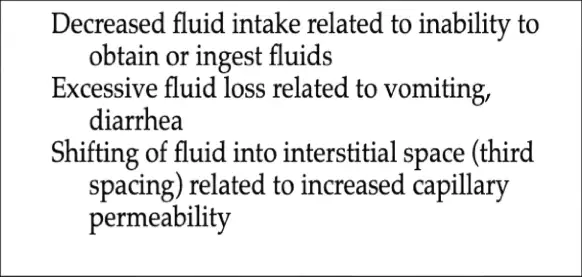
Name one etiology of Isotonic Extracellular Fluid Deficit (Hypovolemia) as described in the table.
Decreased fluid intake related to inability to obtain or ingest fluids
Excessive sodium intake
Increased capillary permeability
Overhydration due to renal failure
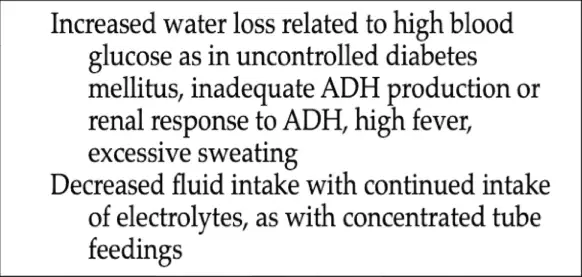
Name one etiology of Hypertonic Extracellular Fluid Deficit (Dehydration) as described in the table.
Increased water loss related to high blood glucose as in uncontrolled diabetes mellitus, inadequate ADH production or renal response to ADH, high fever, excessive sweating
Excessive sodium intake from diet
Chronic liver disease
Overhydration due to excessive IV fluids
What is the blood pressure finding in the Focused Assessment Findings table?
Hypotension
Hypertension
Normal
Prehypertension
What is the pulse finding in the Focused Assessment Findings table?
Weak, rapid
Strong, slow
Irregular, thready
Bounding, regular
What is the respiration finding in the Focused Assessment Findings table?
Rapid
Shallow
Labored
Irregular
What is the temperature finding in the Focused Assessment Findings table?
Decreased
Increased
Normal
Fluctuating
What is the weight finding in the Focused Assessment Findings table?
Loss
Gain
Stable
Fluctuating
What is the tissue turgor finding in the Focused Assessment Findings table?
Normal or edema
Dry and flaky
Firm and non-pitting
Decreased elasticity
What is the mucous membranes finding in the Focused Assessment Findings table?
Moist
Dry
Pale
Bluish
What is the blood cells finding in the Focused Assessment Findings table?
Hgb, Hct, RBCs increased
Hgb, Hct, RBCs decreased
WBCs increased
Platelets decreased
What is the urine output finding in the Focused Assessment Findings table?
Decreased
Increased
Normal
Absent

