
Font size
 Worksheets
[HIPP] Biology Fall Semester Exam Review
Total questions: 51
Worksheet time: 51mins
Which relationship would demonstrate the symbiotic relationship: commensalism (one benefits / one neutral)?
Bees and flowers
Lion and zebra
Shark and remora
Human and tapeworm
Which relationship would demonstrate the symbiotic relationship: mutualism (both benefit)?
Barnacles and whales
Lions and zebras
Bees and flowers
Cats and dogs
Which symbiotic relationship would ticks on a deer represent?
Parasitism
Mutualism
Commensalism
Predation
Which relationship would demonstrate the symbiotic relationship: competition (two organisms fighting for the same resource)?
Coyotes and wolves fight over deer
Bees pollinate flowers
Remora fish attach to sharks
Tapeworms live in the intestines of mammals
Which relationship would demonstrate the symbiotic relationship: predation (one hunts the other)?
A wolf hunts and eats an elk
A bee pollinates a flower
A clownfish lives in a sea anemone
A bird builds a nest in a tree
If the biodiversity within an ecosystem increases then stability will ________.
increase
decrease
remain the same
fluctuate unpredictably
If the biodiversity within an ecosystem decreases then the stability will ________.
decrease
increase
remain the same
fluctuate unpredictably
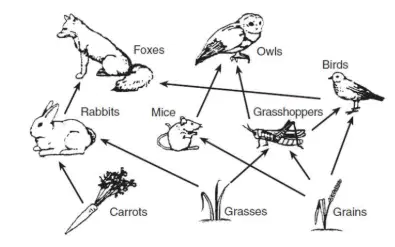
Look at the food web below.
The removal of which species would cause the most instability?
The producer
The top predator
A secondary consumer
A decomposer
If there is too much nitrogen in the nitrogen cycle (like from run off or algae) what could happen to the ecosystem?
It can cause algae blooms that deplete oxygen and harm aquatic life.
It can increase the population of large mammals.
It can reduce the amount of sunlight reaching the earth.
It can cause a decrease in soil fertility.
What do invasive species NOT cause to happen in ecosystems?
Competition over resources
Decrease in biodiversity (outcompete native species)
Take over the ecosystem (loss of habitat)
Decrease in natural populations
Increase in population / better stability
What could overfishing cause to happen in ecosystems?
Reduction in biodiversity of the marine ecosystem
Cause some species to become endangered
Possible collapse of an entire marine ecosystem
All of the above
How do natural disasters affect ecosystems?
Decreases biodiversity / Decrease ecosystem stability
Increase biodiversity / Increase ecosystem stability
What positive effect can reforestation have on an ecosystem?
Reforestation can increase both biodiversity and ecosystem stability.
Reforestation can decrease soil fertility and water retention.
Reforestation can reduce the number of native species in the area.
Reforestation can increase the risk of erosion and habitat loss.
Some people can keep closed terrariums at home for YEARS and the organisms within the closed ecosystem stay thriving. How is this possible? (Think about cycling of matter, photosynthesis, cellular respiration).
THERE ARE TWO CORRECT ANSWERS!
Plants take in sunlight and carbon dioxide and produce oxygen for animals
Animals cycle nutrients and breathe out carbon dioxide for the plants
Animals take in sunlight and carbon dioxide and produce oxygen for animals
Plants cycle nutrients and breathe out carbon dioxide for the plants
What is the difference between how plants and consumers interact with oxygen and carbon dioxide?
Plants produce oxygen gas and take in carbon dioxide gas and get energy from the sun, while consumers take in oxygen gas and produce carbon dioxide gas.
Plants take in oxygen gas and produce carbon dioxide gas, while consumers produce oxygen gas and take in carbon dioxide gas.
Both plants and consumers produce oxygen gas and take in carbon dioxide gas.
Plants and consumers both take in carbon dioxide gas and produce oxygen gas.
Why do plants produce flowers?
To make more plants (reproduction)
To absorb sunlight
To anchor themselves in the soil
To protect themselves from animals
Explain pollination.
Pollination is the process where pollen from the stamen is transferred by a pollinator to the stigma of another flower, leading to fertilization and seed production.
Pollination is the process where seeds are dispersed by wind to new locations for plant growth.
Pollination is the process where leaves convert sunlight into energy through photosynthesis.
What is the function of the circulatory body system?
Transport oxygen, nutrients, and other materials around the body
Break down food to absorb nutrients
Control body activities using hormones
Protect the body from disease and infection
What is the function of the excretory body system?
Transport oxygen, nutrients, and other materials around the body
Break down food to absorb nutrients
Control body activities using hormones
Protect the body from disease and infection
Eliminate waste
What is the function of the digestive body system?
Transport oxygen, nutrients, and other materials around the body
Break down food to absorb nutrients
Control body activities using hormones
Protect the body from disease and infection
Eliminate waste
What body systems are involved in the circulatory body system?
Lungs, alveoli, bronchioles
Heart, arteries, veins
Stomach, intestines, liver
Kidneys, bladder, ureters
What body systems are involved in the respiratory body system?
Lungs, alveoli, bronchioles
Heart, arteries, veins
Stomach, intestines, liver
Kidneys, bladder, ureters
What is the function of the integumentary body system?
Protection and regulate body temperature
Transport oxygen and nutrients
Break down food for energy
Produce hormones
What body systems are involved in the immune body system?
Lymph nodes, white blood cells, tonsils, spleen
Heart, arteries, veins, capillaries
Kidneys, ureters, bladder, urethra
Brain, spinal cord, nerves
Which two body systems interact to break down nutrients and transport the nutrients?
Circulatory and Digestive
Integumentary and Immune
Digestive and Respiratory
Nervous and Reproductive
Which two body systems interact to deliver oxygen to the body?
Circulatory and Respiratory
Digestive and Nervous
Muscular and Skeletal
Endocrine and Excretory
Which two body systems help control response and regulation for the body?
Nervous and Endocrine
Digestive and Respiratory
Skeletal and Muscular
Circulatory and Excretory
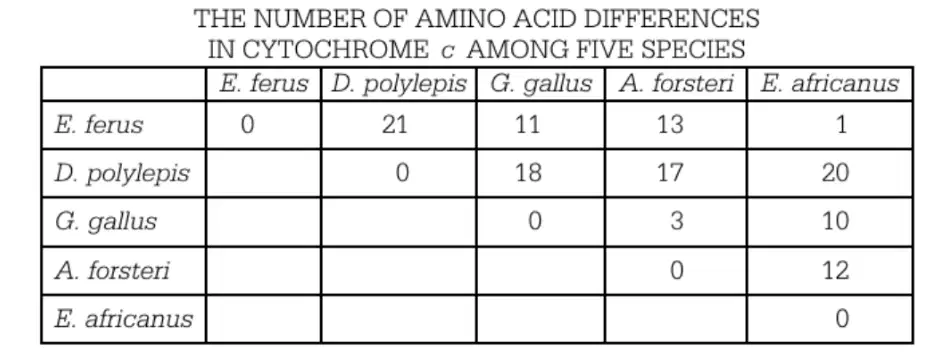
Put the species in order from most to least closely related to the E. ferus species.
D. polyepis, A. forsteri, G. gallus, E. affricanus
E. affricanus, G. gallus, A. forsteri, D. polyepis
E. affricanus, G. gallus, D. polyepis, A. forsteri
G. gallus, A. forsteri, E. africanus, D. polyepis
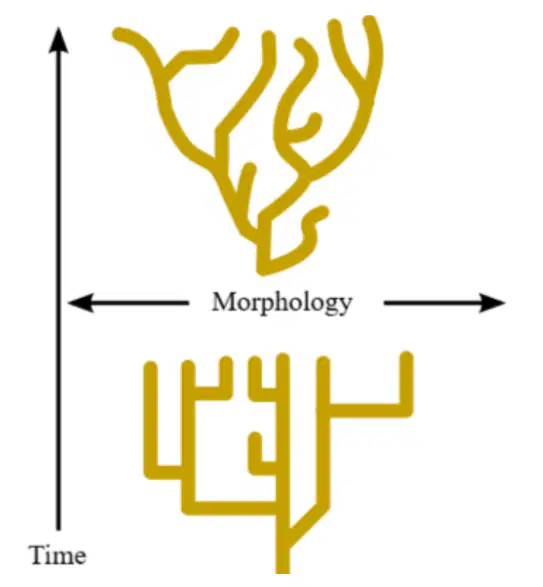
Which cladogram represents a pattern of abrupt appearance followed by a period of stasis:
Top
Bottom
Rock pocket mice live in a desert with dark lava rocks and light sand. Some mice have dark fur and others have light fur. What could explain how the dark fur color came about?
Natural selection caused dark mice to survive on the lava due to camouflage
Natural selection caused light mice to survive on the lava due to camouflage
Natural selection caused dark mice to survive on the sand due to camouflage
Rock pocket mice live in a desert with dark lava rocks and light sand. Some mice have dark fur and others have light fur. What could explain how the light fur color came about?
Natural selection caused dark mice to survive on the sand due to camouflage
Natural selection caused light mice to survive on the sand due to camouflage
Natural selection caused light mice to survive on the lava due to camouflage
What is natural selection?
Natural selection is when nature selects for or against traits to survive in a population. Individuals who have the favorable traits will survive and reproduce while the individuals who do not have these traits will NOT survive or reproduce. The population will then change over time.
Natural selection is when individuals choose their own traits to survive in a population, regardless of environmental factors.
Natural selection is when all individuals in a population survive and reproduce equally, regardless of their traits.
Natural selection is when traits are randomly assigned to individuals without any impact on survival or reproduction.
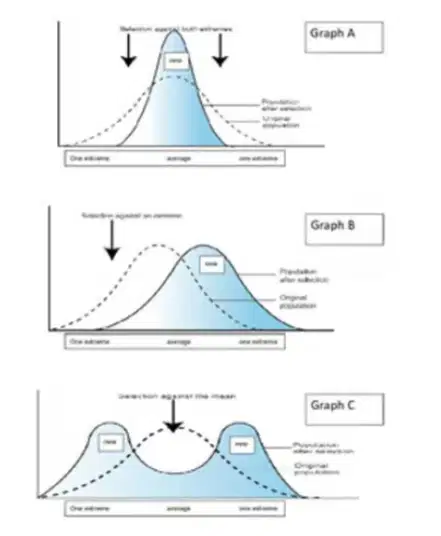
Which graph is demonstrating a Directional selection graph?
Graph A
Graph B
Graph C
Which graph is demonstrating a Disruptive selection graph?
Graph A
Graph B
Graph C
Which graph is demonstrating a Stabilizing selection graph?
Graph A
Graph B
Graph C
Which type of evolutionary mechanism is this:
A tornado has come through a forest of beetles that were once green, black, and brown. By chance, only the brown beetles have survived.
Genetic Drift
Natural Selection
Gene Flow
Mutation
Which type of evolutionary mechanism is this:
Brown beetles are able to blend into the environment while green beetles are easily seen by predators. The population changes to contain more brown beetles over time.
Natural Selection
Genetic Drift
Mutation
Gene Flow
Which type of evolutionary mechanism is this:
Some birds migrate from one island to another and mate with the population of birds on the new island, introducing new traits to the island.
Gene Flow
Genetic Drift
Natural Selection
Mutation
Which type of evolutionary mechanism is this:
An error made during DNA replication causes a gene to change fur color in mice.
Mutation
Natural Selection
Genetic Drift
Gene Flow
Which type of evolutionary mechanism is this:
The shuffling of traits due to sexuarl reproduction.
Genetic Recombination
Natural Selection
Genetic Drift
Mutation
There are two types of cells. Prokaryotic cells lack a ______ and membrane bound organelles. They are simple and small in size and the only example left of them on earth is ______. Eukaryotic cells do have a true nucleus and contain membrane bound organelles like chloroplasts, mitochondria, and endoplasmic reticulum.
nucleus; bacteria
cell wall; fungi
mitochondria; plants
chloroplast; animals
Which biomolecule has the function: Short term/quick energy; structural component of cell walls (cellulose = plant cell walls, chitin = fungal cell walls)?
Carbohydrates
Proteins
Lipids
Nucleic acids
Which biomolecule has the function: Long term energy; cell membrane bilayer; protection; insulation; steroid hormones?
Lipids
Carbohydrates
Proteins
Nucleic acids
Which biomolecule has the function: Stores genetic information; helps make and assemble proteins?
Nucleic Acids
Carbohydrates
Lipids
Proteins
Which biomolecule has the function: Structural- muscle, skin, hair, nails; Hormones (insulin), enzymes, antibodies (immune system), muscle movement; transport (embedded in the membrane)?
Proteins
Carbohydrates
Lipids
Nucleic acids
Which two biomolecules have the function of energy in common?
carbohydrates and lipids
proteins and nucleic acids
vitamins and minerals
enzymes and hormones
Which two biomolecules have hormones in common?
lipids and proteins
carbohydrates and nucleic acids
proteins and nucleic acids
lipids and carbohydrates
How does the carbohydrate lactose interact with the protein lactase?
Lactose is a sugar found in milk which is broken down by the enzyme lactase. Lactase attaches to the lactose substrate and speeds up the chemical reaction to help break down lactose. If lactase is not present in the body, people have a hard time digesting lactose because it sits too long in the body.
Lactose is a protein that binds to lactase and prevents it from functioning.
Lactase is a sugar that is broken down by lactose in the digestive system.
Lactose and lactase do not interact; they are found in different parts of the body.
How do nucleic acids and proteins depend on each other?
Nucleic acids are the instructions for making proteins. DNA holds the instructions while RNA helps assemble the proteins. Without the DNA and RNA proteins could not be made. Enzymes (which are proteins) help these processes.
Proteins are the instructions for making nucleic acids. DNA and RNA are assembled by proteins only.
Nucleic acids and proteins do not interact in any biological process.
Proteins are the genetic material, while nucleic acids help in digestion.
Viruses are considered nonliving because they are not made of cells. They are made of a protein coat called a ______ and genetic material (DNA or RNA but not both). They must hijack a ______ in order to reproduce and use the cell’s biomolecules in order to spread and cause disease.
capsid; host cell
cell wall; nucleus
envelope; mitochondria
membrane; ribosome
Enzymes are ______ that ______ chemical reactions. They work by ______ the amount of energy needed to ______ the reaction, which is called ______. Another term for enzyme is biological ______.
proteins; speed up; lowering; start; activation energy; catalyst
lipids; slow down; increasing; stop; kinetic energy; inhibitor
carbohydrates; block; raising; finish; potential energy; reactant
nucleic acids; delay; maintaining; prevent; thermal energy; substrate

