
 Worksheets
Chapter 4 test 25-26
Total questions: 142
Worksheet time: 4hrs 6mins
What is the process called when one tectonic plate is forced under another?
Subduction
Convergence
Divergence
Transform
What is the hottest layer of the Earth?
Outer Core (up to 4000°C)
Crust (up to 1000°C)
Inner Core (up to 6000°C)
Mantle (up to 3000°C)
What type of plate boundary is characterized by plates moving apart?
Convergent Boundary
Transform Boundary
Divergent Boundary
Subduction Boundary
What is the term for the boundary where two tectonic plates slide past each other?
Divergent Boundary
Convergent Boundary
Transform Boundary
Subduction Zone
What is the term for the rigid outer layer of the Earth that includes the crust and upper mantle?
Lithosphere
Asthenosphere
Mesosphere
Hydrosphere
What geological feature is formed at a divergent boundary?
Mid-ocean ridges
Mountain ranges
Volcanic islands
Deep-sea trenches
What type of plate boundary occurs when two plates collide?
Convergent Boundary
Divergent Boundary
Transform Boundary
Subduction Boundary
What is the name of the tectonic plate that includes Greenland and North America?
North American Plate
Eurasian Plate
African Plate
Indo-Australian Plate
What is the primary cause of tectonic plate movement?
Convection currents in the mantle
Gravitational pull from the moon
Earth's rotation
Magnetic field fluctuations
Which layer of the Earth is composed of solid rock and is the outermost layer?
Mantle
Core
Crust
Lithosphere
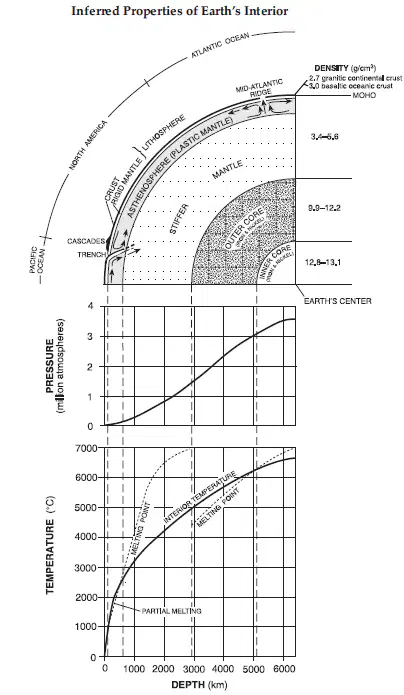
As depth increases, the density of Earth's layers
increases
decreases
remains constant
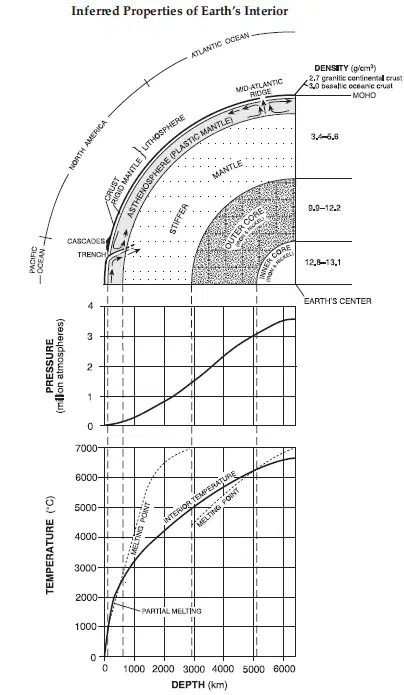
As depth increases, the temperature of Earth's layers
increases
decreases
remains constant
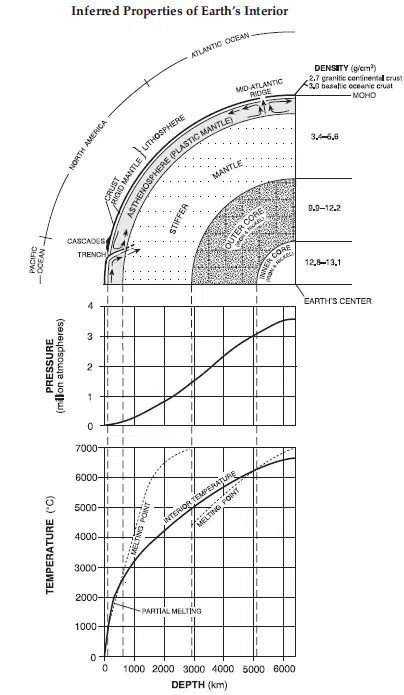
As depth increases, the pressure within the Earth
increases
decreases
remains constant
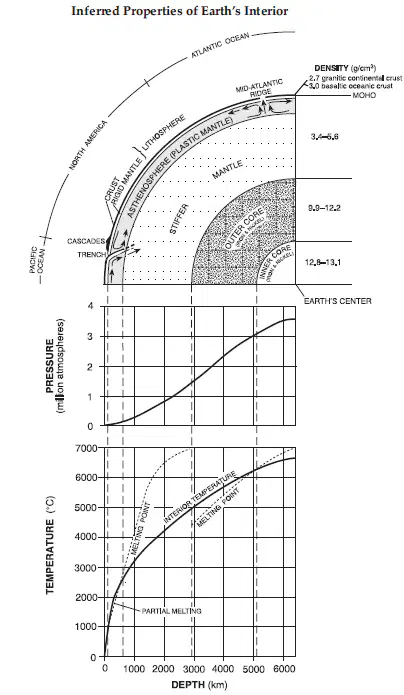
Match the following depths with their corresponding Earth layers.
lithosphere
0-100 km
stiffer mantle
100-700 km
outer core
2900-5100 km
inner core
5100-6371 km
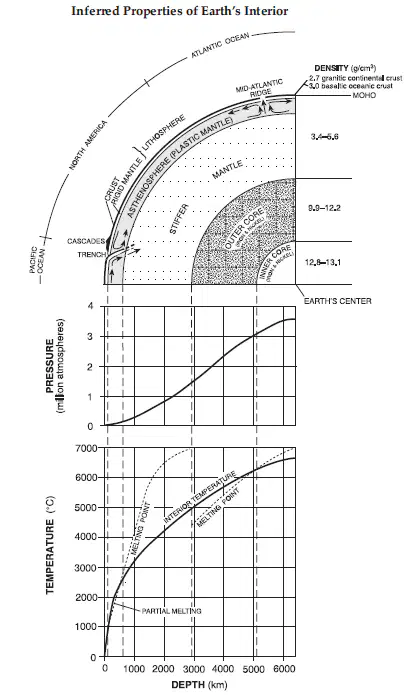
"Partial melting" occurs in the:
asthenosphere
stiffer mantle
inner core
lithosphere

Which of the following is the thinnest layer of the Earth?
Mantle
Crust
Lithosphere
Inner Core

What rock is mostly found in the Earth's continental crust?
basalt
granite
pumice
obsidian

Choose the statement that is TRUE
Oceanic crust is thinner and denser than continental crust.
Oceanic crust is thicker and denser than continental crust.
Continental crust is thinner and denser than oceanic crust.
Continental crust is thicker and denser than oceanic crust.
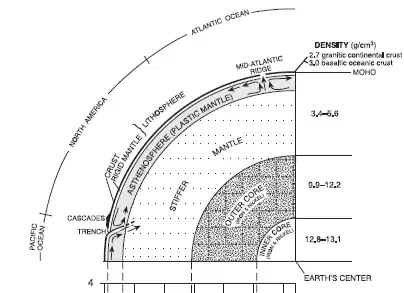
What is the density of oceanic crust?
3.0 g/cm3
2.7 g/cm3
3.7 - 4.4 g/cm3
12.0 g/cm3
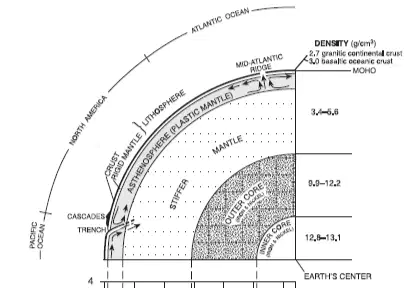
Which layers are made of iron and nickel?
Lithosphere/crust
Mantle
Core

Which statement best describes Earth's crust and mantle?
The crust is thicker and less dense than the mantle
The crust is thicker and more dense than the mantle
The crust is thinner and less dense than the mantle
The crust is thinner and more dense than the mantle

Identify this plate boundary.
Convergent
Divergent
Transform
Conform

Identify this plate boundary.
Convergent
Divergent
Transform
Conform

Identify this plate boundary.
Convergent
Divergent
Transform
Conform
What type of convergent boundary creates mountains?
2 oceanic plates colliding
2 continental plates colliding
1 oceanic plate and 1 continental plate colliding
the movement of 1 oceanic plate
What type of boundary is present at the mid-Atlantic Ridge?
Convergent
Divergent
Transform
Conform
What type of boundary is present at the San Andreas Fault?
Convergent
Divergent
Transform
Conform
What type of boundary forms rift valleys?
Convergent
Divergent
Transform
Conform
Transform boundaries can occur in the ocean or on land.
True
False
How does tectonic plate movement affect evolution?
It decreases diversity on the planet.
It has no major affect on evolution.
It helps to keep same type of animals together.
It increases diversity on the planet.
At a convergent boundary, the oceanic plate goes above the continental plate.
True
False

Where do convection cycles happen?
core
mantle
crust
Convection cycles move in the mantle. How does this affect the crust?
crust has no motion
crust moves in random direction
crust moves in same direction convection cycle moves
What is magma made of?
solid rock
melted rock
small pieces of sediment
If magma decreases in temperature (cooler) what will happen to the magma?
It will move down (sink)
It will rise up (float)

Why does hot mantle rise (go/move up)?
hot = less dense
hot = no change
hot = more dense
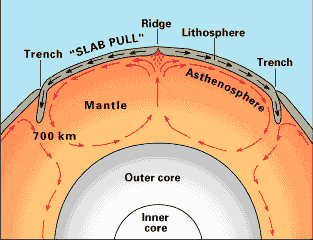
What is the source of energy that drives plate movement?
the subducton of the sea floor
the different densities of the oceanic and crustal plates
convection currents in the asthenosphere
the friction force between the plates that move past each other

What did the coastlines of some continents appear to fit together like?
A jigsaw puzzle
A mosaic
A painting
A map

Scientists have found fossils of the same species on different continents (separated by oceans). What does this imply about the landmasses?
The landmasses were once connected.
The species could fly across oceans.
The fossils were moved by humans.
The species evolved independently on each continent.

What do the fossils of tropical plants found on islands in the Arctic Ocean indicate about the climate?
The Arctic Ocean has always been cold.
The climate was once warm enough to support tropical plants.
The Arctic Ocean was once a desert.
The climate has never changed in the Arctic region.
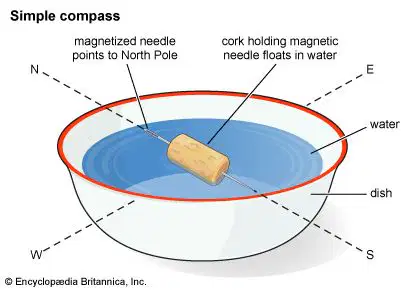
True or False: There are many locations where the magnetic North and South of rocks do not match that of the Earth.
True
False

Which of the following is a true statement about continental drift.
The theory of continental drift was initially excepted.
Alfred Wegener collected all new data to develop his theory about continental drift.
Seafloor spreading explained how continental drift occurred.
Alfred Wegener could not provide enough evidence to support his theory continental drift.
Which of the following is evidence supporting continental drift?
different fossils found on different continents
fossils only found on certain continents with hot climates
fossils are not considered to be evidence that supports continental drift
same fossils found on different continents
Select the evidence that supports continental drift. (select all that apply)
same fossils found on different continents
Pangaea had only one climate across the entire supercontinent
shapes of continent coastline fit together like puzzle pieces
Tropical plant fossils found in the arctic
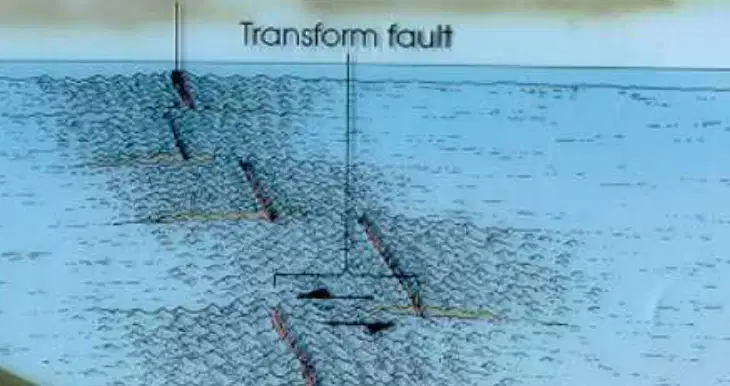
What is created at the location of the mid-oceanic ridge?
Oceanic trench
New oceanic crust
Continental crust
Folded mountains
What is the term used to describe the process by which new oceanic crust is formed at mid-ocean ridges and spreads outwards?
Paleomagnetism
Magnetic reversal
Isochron
Seafloor spreading
What technological advancements in the 1940s and 1950s changed the perception of the ocean floor and crust?
Television
Sonar technology
Satellite imagery
Computers
What geological feature is formed at the boundary where two sections of oceanic crust are moving apart?
Trench
Mid-ocean ridge
Continental crust
Rift valley
Where is the newly formed oceanic crust located in relation to the mid-ocean ridge?
Farther from the mid-ocean ridge
Closest to the mid-ocean ridge
Beneath the continental crust
Along the trench
What pattern did the polarity of the rocks show on the ocean floor?
Circular pattern
Random pattern
Striped pattern
No pattern
Which type of rocks provide a record of Earth's magnetic field?
Granite rocks.
Sedimentary rocks.
Rocks containing iron-bearing minerals.
Marble rocks.
What does seafloor spreading state about the formation and destruction of oceanic crust?
It is formed at deep-sea trenches and destroyed at ocean ridges.
It is formed and destroyed at ocean ridges.
It is formed at ocean ridges and destroyed at deep-sea trenches.
It is continuously formed at ocean basins without being destroyed.
What major theory did seafloor spreading lead to being developed?
Theory of Plate Tectonics
Theory of Evolution
Theory of Relativity
Big Bang Theory
What did he theorize was happening at the Great Global Rift (mid-ocean ridges) and at deep ocean trenches?
Formation of new oceanic crust at mid-ocean ridges and subduction of oceanic crust at trenches
Erosion of oceanic crust at mid-ocean ridges and accumulation at trenches
Stability of oceanic crust at both mid-ocean ridges and trenches
Expansion of oceanic crust at trenches and contraction at mid-ocean ridges
What is Paleomagnetism?
The study of the magnetic properties of rocks
A type of ancient art form
A method of carbon dating
A branch of paleontology

Paleomagnetism was used to confirm seafloor spreading because it showed
Patterns of polarity reversals in the seafloor that was identical on either side of the mid ocean ridge
The magnetic north pole was at one time in the Atlantic Ocean
Cosmic radiation being deflected by the Earth’s magnetic field lead to fracturing the continents
The oldest rock on the ocean floor is closest to the mid ocean ridge

Which mineral property is being shown here?
Luster
Hardness
Cleavage
Streak
______ is the way a mineral reflects light from its surface.
Luster
Streak
Hardness
Color
A naturally formed, inorganic solid with a crystalline structure
Density
Streak
Mineral
Non silicate mineral

When a mineral breaks apart in an irregular way with rough or jagged edges, it is called
Cleavage
Fracture
Hardness
Streak
A shiny material is described as having a __________________ luster
Metallic
Nonmetallic
A dull material is described as having a __________________ luster.
Metallic
Nonmetallic
Moh’s scale of hardness ranks minerals from 1 which is the _______________ to 10 which is the ________________.
Softest, hardest
Hardest, softest
Minerals formed from magma that cools very slowly will have __________ crystals
Large
Small
Pink
Cubic
Minerals formed from magma that cools quickly will have __________ crystals
Large
Small
Red
Hexagonal
______________ is the least reliable clue of a minerals identity because trace elements could throw off its identity.
Streak
Color
Cleavage
Hardness
At what temperature do minerals in a melt first start to crystallize?
(a)
At what temperature do the last minerals in a melt crystallize?
(a)
At what temperature do the first minerals in a solid rock begin to melt?
(a)
At what temperature do the last minerals in a solid rock melt?
(a)
Locate the Sequence of Mineral Crystallization from Magma column on the Model of Bowen’s Reaction Series. How many series of mineral crystallization are there?
(a)
In the space below, write the order in which minerals crystallize from a melt for each series:
The images below show a Time Series of a rock forming from a magma melt composed of Biotite Mica (⬢), Quartz (◯), and Pyroxene (△). Only minerals that are crystallized appear as shapes. Draw what would happen to the rock as the rock heats back up to 1,800°C.
Which type of Plagioclase Feldspar would be the first to crystallize out of a melt?
(a)
What is the difference between each of the four listed types of feldspar?
Why is Plagioclase Feldspar considered a continuous series? Use evidence from the text to support your claim.
What is the difference between each group?
According to the Bowen’s Reaction Series, what type of minerals would be found in an intermediate igneous rock?
(a)
Based on the minerals found within the Palisades sill, was the magma that intruded mafic or felsic?
(a)

What is the first mineral to crystallize in a magma chamber as it cools?
quartz
olivine
mica

If a magma chamber slowly cools to solid rock underground, where would you expect to find the ultramafic rocks located?
at the top
in the middle
at the bottom
Granitic (felsic) rocks are generally
light colored
dark colored
rainbow glitter colored
As a magma chamber is cooling, where would you expect the first minerals to crystallize?
at the top
in the middle
at the bottom
Which of the rocks below contains the most quartz?
basalt
gabbro
granite
Minerals that crystallize at higher temperatures tend to be low in
Iron
Calcium
Silicon
Magnesium
Minerals that crystallize at lower temperatures tend to be low in
Iron
Potassium
Silicon
Oxygen
The mineral that melts first as rock heats up would be
Calcium Plagioclase
Potassium Feldspar
Sodium Plagioclase
Biotite
Which of the following would crystallize first as magma cools.
Pyroxene
Quartz
Amphibole
Sodium Plagioclase
Mafic rocks are composed of mostly
silicon and calcium
sodium and magnesium
potassium and aluminum
iron and magnesium
The lighter in color the igneous rock, the higher the amount of
iron
silica
calcium
sodium
If a magma has the same composition but cools at a slower rate the result will be
a rock with different mineral composition
a rock with smaller grain size
a rock with larger grain size
a rock with lighter colors

What elements would this rock most likely be rich in?
iron and magnesium
silicon and oxygen
sodium and potassium
aluminum and sodium
When molten rock undergoes crystallization above ground, what type of rock results?
Extrusive igneous rock
Intrusive igneous rock
Sedimentary rock
Metamorphic rock
What combination of processes can transform a metamorphic rock to sediments?
Melting, crystallization, and compaction
Heating, pressure, and lithification
Erosion, crystallization, and melting.
Exposure, weathering, and erosion.
What sequence of events could lead to magma becoming soil?
Crystallization followed by increased heat and pressure.
Crystallization followed by exposure and weathering.
Compression and lithification followed by erosion and deposition.
Erosion and deposition followed by exposure to heat and pressure.
Which of the following rock types form from placing other rocks under heat and pressure?
Sedimentary rock
Intrusive igneous rock
Metamorphic rock
Extrusive igneous rock
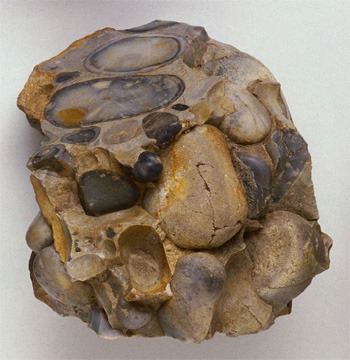
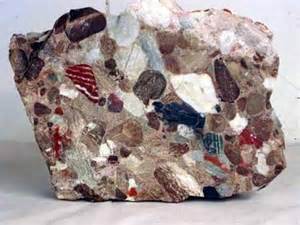
What is the product of Melting?
Igneous Rock
Sediments
Sedimentary rock
Magma
Metamorphic rock
What is the product of Deposition and Lithification?
Igneous Rock
Sediments
Sedimentary rock
Magma
Metamorphic rock
breaks the rock down into smaller pieces
melting
deposition
lithification
uplift
weathering and erosion
transforms sediments into sedimentary rock with increasing temperature, pressure and burial
melting
lithification
transportation
uplift
weathering and erosion
Example of igneous rock is
pumice
marble
magma
limestone

what type of rock is this?
cement rock
metamorphic rock
igneous rock
sedimentary rocks
during which process does layer upon layer of sediment build up, exerting pressure on the layer below?
erosion
compaction
conglomerate
weathering
(a) rocks makeup 90% of Earth's crust.
(a) Created from the cooling and solidification of magma or lava.
(b) Created from the deposition of sediments in layers over long periods of time, it often contains fossils.
(c) Existing rock is subjected to very high heat and pressure, usually underground.
(a) is the creation of small pieces of rock through physical or chemical means.
(b) is the moving of sediments from their original position.
(c) is the settling out of sediments.
(d) is the process by which sediment is squeezed and glued together into a new rock.
Shale, limestone, and conglomerate rocks are examples of what type of rock?
Metamorphic
Sedimentary
Igneous
Magma
(a) refers to molten rock underground. When magma erupts from the ground on Earth's surface, we call it (b) .

Using the picture above to answer the following question.
When magma cools, what type of rock is formed?
Metamorphic Rock
Sedimentary Rock
Compacting and Cementing
Igneous Rock

When heat and pressure is added to a sedimentary rock what type of rock is formed?
Sedimentary Rock
Metamorphic Rock
Igneous Rock
Melting Rock
Click on the part of the rock cycle that represents a MAGMA.
Click on the part of the rock cycle that represents a SEDIMENT.
Click on the part of the rock cycle that represents an IGNEOUS ROCK.
Click on the part of the rock cycle that represents a SEDIMENTARY ROCK.
Click on the part of the rock cycle that represents a METAMORPHIC ROCK.

What is this rock?
Intrusive Igneous
Chemical Sedimentary
Non-Foliated metamorphic
Foliated Metamorphic

What is this rock?
Extrusive Igneous
Chemical Sedimentary
Biological Sedimentary
Foliated Metamorphic

Granite is an example of...
Igneous
Metamorphic
Sedimentary

Pumice is an example of
Igneous
Metamorphic
Sedimentary

Obsidian is an example of...
Igneous
Sedimentary
Metamorphic

Which type of rock is made from magma cooling inside Earth?
cool rock
intrusive igneous
non-foliated metamorphic
sedimentary
This rock forms deep inside the Earth from felsic magma that cools slowly.
Rhyolite
Granite
Diorite
Pumice

This igneous rock cools quickly and comes from mafic magma.
Gabbro
Diorite
Basalt
Sandstone
Which of the following rocks is most likely to contain fossils?
Granite
Limestone
Basalt
Marble
The more dense an igneous rock is the more:
Felsic it is
Mafic it is
Neither felsic or mafic
Felsic or Mafic

Is this rock mafic or felsic?
Mafic
Felsic

Describe the mineral composition of the following igneous rock.
felsic
mafic
How is a Mafic Igneous Rock different from a Felsic Igneous Rock?
It is more dense
It is darker in color
It is rich in Fe and Mg
All the above
What does Igneous rock grain size depend on?
Cooling rate
Color
Composition
Compaction

Describe the mineral composition of the following igneous rock.
felsic
mafic

