
 Worksheets
Biology Grade 7 - Gas Exchange and Stomata Worksheet
Total questions: 49
Worksheet time: 25mins
State the concept of gas exchange in living organisms. What is the mechanism of gas exchange in living organisms?
Concept: Gas exchange is the process by which living organisms take in oxygen and release carbon dioxide. Mechanism: Gas exchange occurs mainly through diffusion across respiratory surfaces.
Concept: Gas exchange is the process by which living organisms take in nitrogen and release oxygen. Mechanism: Gas exchange occurs mainly through active transport.
Concept: Gas exchange is the process by which living organisms take in carbon dioxide and release oxygen. Mechanism: Gas exchange occurs mainly through osmosis.
Concept: Gas exchange is the process by which living organisms take in water vapor and release carbon dioxide. Mechanism: Gas exchange occurs mainly through filtration.
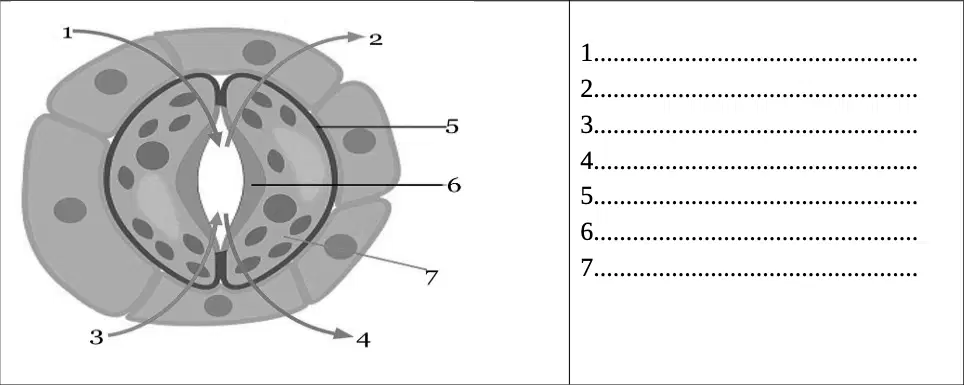
Observe the diagram below, label the parts and answer the following questions.
1. Guard cell 2. Stoma (pore) 3. Epidermal cell 4. Chloroplast 5. Cell wall 6. Cytoplasm 7. Nucleus
1. Xylem 2. Phloem 3. Root hair 4. Cuticle 5. Spongy mesophyll 6. Vascular bundle 7. Palisade cell
1. Mitochondria 2. Ribosome 3. Golgi apparatus 4. Lysosome 5. Peroxisome 6. Vacuole 7. Endoplasmic reticulum
1. Leaf vein 2. Petiole 3. Stem 4. Flower 5. Fruit 6. Seed 7. Branch
Describe the structure of stomata:
Stomata consist of two guard cells surrounding a pore. The guard cells control the opening and closing of the pore, allowing gas exchange.
Stomata are made up of a single cell that absorbs water from the environment.
Stomata are clusters of vascular tissue found in the stem of plants.
Stomata are pores filled with chlorophyll that perform photosynthesis.
State the mechanism of opening and closing of stomata:
The opening and closing of stomata are regulated by the turgor pressure in the guard cells. When guard cells absorb water, they swell and open the pore; when they lose water, the pore closes.
The opening and closing of stomata are controlled by the movement of chloroplasts in the guard cells.
Stomata open and close due to the presence of waxy cuticle on the leaf surface.
The opening and closing of stomata are regulated by the temperature changes in the environment.
Through which physiological processes does gas exchange via stomata in leaves occur?
Gas exchange via stomata occurs during photosynthesis and respiration.
Gas exchange via stomata occurs only during transpiration.
Gas exchange via stomata occurs only during digestion.
Gas exchange via stomata occurs only during fermentation.
What is the role of water loss in leaves?
Water loss in leaves (transpiration) helps in cooling the plant, maintaining nutrient flow, and facilitating gas exchange.
Water loss in leaves causes the plant to wilt and die immediately.
Water loss in leaves prevents photosynthesis from occurring.
Water loss in leaves increases the plant's sugar production.
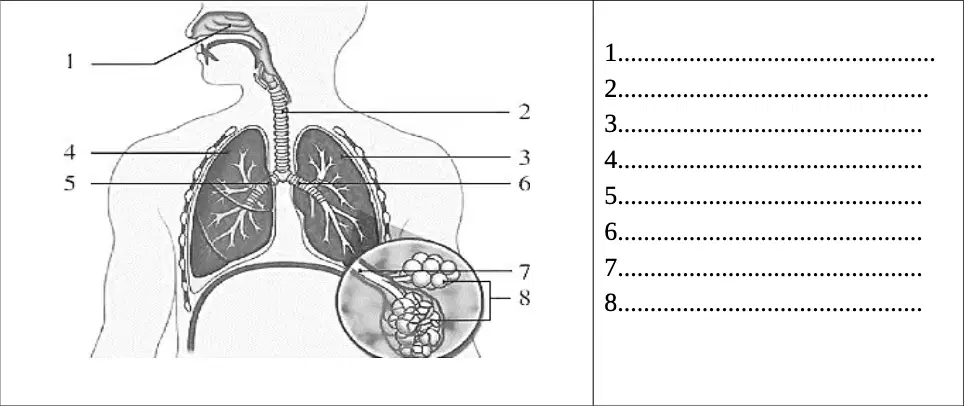
Observe the diagram below, then fill in the labels for the human respiratory system. (Sơ đồ cơ quan hô hấp ở người)
1. Nasal cavity 2. Pharynx 3. Larynx 4. Trachea 5. Bronchus 6. Bronchioles 7. Alveoli 8. Diaphragm
1. Nasal cavity 2. Esophagus 3. Larynx 4. Trachea 5. Bronchus 6. Bronchioles 7. Alveoli 8. Diaphragm
1. Nasal cavity 2. Pharynx 3. Larynx 4. Trachea 5. Bronchus 6. Bronchioles 7. Alveoli 8. Stomach
1. Nasal cavity 2. Pharynx 3. Larynx 4. Trachea 5. Bronchus 6. Bronchioles 7. Alveoli 8. Heart
Animals have different types of respiratory organs. Which of the following correctly matches a type of respiratory organ with an example?
Gills - Fish
Lungs - Earthworm
Tracheae - Frog
Skin - Bird
c. State the role of the respiratory system for the animal body.
It supplies oxygen to the body and removes carbon dioxide.
It helps in digestion of food.
It controls movement and coordination.
It produces hormones for growth.
State the structural characteristics and properties of water. What role does water play for living organisms?
Water is a polar molecule with high cohesion and is essential for metabolic processes in living organisms.
Water is a non-polar molecule and does not participate in biological reactions.
Water has low cohesion and is not important for living organisms.
Water is a gas at room temperature and is rarely found in living systems.
* Physical properties of water:
Colorless and odorless liquid at room temperature
Solid at room temperature
Highly viscous at room temperature
Yellowish liquid at room temperature
* Chemical properties of water:
It is a universal solvent and participates in chemical reactions like hydrolysis.
It is a good conductor of electricity in pure form.
It is highly acidic in nature.
It does not react with any substances.
What is the role of water in plants?
Water plays a crucial role in plant life, including nutrient transport, photosynthesis, and maintaining cell structure.
Water is only used for cooling the plant during hot weather.
Water is mainly for giving color to the leaves.
Water is used to make the plant grow taller without any other function.
What is the pathway of water absorption in roots?
Water is absorbed by root hairs from the soil and transported through the root cortex to the xylem.
Water is absorbed directly by leaves and transported to the roots.
Water is absorbed by the stem and moves to the leaves.
Water is absorbed by flowers and transported to the roots.
How is water transported in the stem?
Water is transported in the stem through the xylem vessels from roots to leaves.
Water is transported in the stem through the phloem vessels from leaves to roots.
Water is transported in the stem by diffusion through all cells.
Water is transported in the stem by active transport only.
How does water evaporate from leaves?
Water evaporates from leaves through stomata in a process called transpiration.
Water evaporates from leaves through the roots in a process called condensation.
Water evaporates from leaves through the veins in a process called precipitation.
Water evaporates from leaves through the stem in a process called respiration.
What is the role of water evaporation from leaves?
Evaporation of water from leaves helps in cooling the plant and maintaining nutrient flow.
It increases the rate of photosynthesis directly.
It causes the leaves to wilt immediately.
It prevents the absorption of nutrients from the soil.
What is the mechanism of opening and closing of stomata?
The opening and closing of stomata are regulated by guard cells in response to environmental conditions.
Stomata open and close due to the movement of chloroplasts in leaf cells.
Stomata open and close only during the night due to temperature changes.
Stomata open and close because of the presence of wax on the leaf surface.
What are the influencing factors on water and nutrient exchange in plants?
Factors include light, temperature, humidity, wind, and soil conditions.
Only soil type affects water and nutrient exchange.
Water and nutrient exchange is influenced only by plant age.
Only the amount of sunlight affects water and nutrient exchange.
How is the knowledge of water and nutrient exchange applied in irrigation and fertilization?
Understanding water and nutrient exchange helps optimize irrigation and fertilization for better plant growth.
It is used to increase the amount of pesticides applied to crops.
It helps in reducing the need for sunlight in plant growth.
It is used to make irrigation and fertilization less important for plants.
Câu 6. Chọn sơ đồ đúng về con đường vận chuyển nước và khoáng từ đất lên lá và con đường vận chuyển các chất hữu cơ tổng hợp ở lá đến các cơ quan khác.
Nước và khoáng vận chuyển từ rễ lên lá qua mạch gỗ, các chất hữu cơ vận chuyển từ lá đến các cơ quan khác qua mạch rây.
Nước và khoáng vận chuyển từ lá xuống rễ qua mạch rây, các chất hữu cơ vận chuyển từ rễ lên lá qua mạch gỗ.
Nước và khoáng vận chuyển từ rễ lên lá qua mạch rây, các chất hữu cơ vận chuyển từ lá đến các cơ quan khác qua mạch gỗ.
Nước và khoáng vận chuyển từ rễ lên lá qua mạch gỗ, các chất hữu cơ vận chuyển từ lá đến các cơ quan khác qua mạch gỗ.
Câu 1. Sau những trận mưa lớn kéo dài, hầu hết cây trong vườn bị ngập úng lâu và bị chết. Nguyên nhân nào khiến cây bị chết khi bị ngập nước lâu, mặc dù nước rất quan trọng đối với sự sống của cây?
Do rễ cây không hấp thụ được oxy khi bị ngập nước lâu.
Do cây hấp thụ quá nhiều chất dinh dưỡng từ nước.
Do nước làm cây bị lạnh và chết.
Do nước làm cây mất hết lá.
Câu 2. Vì sao nhiệt độ ở bề mặt lá cây phát tài lại thấp hơn nhiệt độ môi trường khoảng 0,5 - 1 °C?
Do lá cây hấp thụ nhiệt từ môi trường xung quanh.
Do quá trình thoát hơi nước ở lá cây làm mát bề mặt lá.
Do lá cây phản xạ toàn bộ ánh sáng mặt trời.
Do lá cây không tiếp xúc trực tiếp với không khí.
Câu 3a. Khi ở trong phòng kín đông người một thời gian, nhịp hô hấp của cơ thể thường tăng do đâu?
Do lượng oxy trong phòng giảm, cơ thể cần hô hấp nhiều hơn để cung cấp đủ oxy.
Do nhiệt độ phòng tăng làm cơ thể phải hô hấp nhanh hơn.
Do cơ thể bị kích thích bởi tiếng ồn trong phòng.
Do ánh sáng trong phòng làm tăng nhịp hô hấp.
Câu 3b. Khi tập thể dục hoặc vận động mạnh, sự trao đổi khí diễn ra nhanh hơn do đâu?
Do cơ thể cần nhiều oxy và thải nhiều CO2 hơn.
Do nhiệt độ cơ thể giảm xuống.
Do lượng máu trong cơ thể giảm.
Do hệ thần kinh hoạt động chậm lại.
Khi bị nôn, sốt cao hoặc tiêu chảy, cơ thể bị mất nước nhiều. Em cần làm gì?
Uống nhiều nước để bù lại lượng nước đã mất.
Không cần làm gì, chờ cơ thể tự hồi phục.
Ăn thật nhiều đồ ngọt để lấy lại sức.
Chỉ nghỉ ngơi mà không uống nước.
Việc tiết mồ hôi có thể làm giảm nhiệt độ cơ thể vì:
Mồ hôi bay hơi giúp lấy đi nhiệt từ cơ thể.
Mồ hôi làm tăng nhiệt độ cơ thể.
Mồ hôi giúp cơ thể hấp thụ nhiệt từ môi trường.
Mồ hôi làm giảm lượng nước trong cơ thể.
Nêu khái niệm trao đổi khí ở sinh vật. Quá trình trao đổi khí ở sinh vật tuân theo cơ chế nào?
Khái niệm trao đổi khí: là sự trao đổi khí O2 và CO2 giữa cơ thể sinh vật và môi trường. Cơ chế trao đổi khí: khuếch tán.
Khái niệm trao đổi khí: là sự trao đổi chất dinh dưỡng giữa cơ thể sinh vật và môi trường. Cơ chế trao đổi khí: vận chuyển chủ động.
Khái niệm trao đổi khí: là sự trao đổi nhiệt giữa cơ thể sinh vật và môi trường. Cơ chế trao đổi khí: thẩm thấu.
Khái niệm trao đổi khí: là sự trao đổi nước giữa cơ thể sinh vật và môi trường. Cơ chế trao đổi khí: lọc thụ động.
Mô tả cấu tạo của khí khổng
Gồm 2 TB hình hạt đậu áp sát nhau, thành trong dày, thành ngoài mỏng.
Gồm 2 TB hình cầu, thành trong mỏng, thành ngoài dày.
Gồm 1 TB hình hạt đậu, thành trong dày, thành ngoài mỏng.
Gồm nhiều TB hình vuông, thành trong và ngoài đều dày.
Nêu cơ chế hoạt động đóng mở khí khổng:
- Khi thiếu nước → TB khí khổng xẹp → lỗ khí khổng đóng - Khi đủ nước → TB khí khổng căng lên → cong về phía ngoài → khí khổng mở
- Khi thiếu nước → TB khí khổng căng lên → lỗ khí khổng mở - Khi đủ nước → TB khí khổng xẹp → lỗ khí khổng đóng
- Khi thiếu nước → TB khí khổng xẹp → lỗ khí khổng mở - Khi đủ nước → TB khí khổng căng lên → lỗ khí khổng đóng
- Khi thiếu nước → TB khí khổng căng lên → cong về phía ngoài → khí khổng mở - Khi đủ nước → TB khí khổng xẹp → lỗ khí khổng mở
Sự trao đổi khí qua khí khổng của lá được thực hiện trong những quá trình sinh lí nào?
- Quá trình quang hợp: lấy CO2, thải O2 - Quá trình hô hấp: lấy O2, thải CO2
- Quá trình vận chuyển nước: lấy H2O, thải O2 - Quá trình tổng hợp protein: lấy N2, thải CO2
- Quá trình phát triển mô: lấy O2, thải H2O - Quá trình hấp thụ khoáng: lấy CO2, thải N2
- Quá trình phân giải chất hữu cơ: lấy CO2, thải H2O - Quá trình trao đổi ion: lấy O2, thải N2
Sự thoát nước ở lá có vai trò gì?
- Mở khí khổng → trao đổi khí - Điều hoà nhiệt độ, làm mát - Tạo động lực đầu trên cho quá trình hút nước và muối khoáng ở rễ và vận chuyển trong thân
- Tăng cường quá trình quang hợp ở lá
- Giúp lá chuyển hóa chất dinh dưỡng thành năng lượng
- Làm cho lá có màu xanh đậm hơn
Câu 3. Đâu là chú thích đúng cho vị trí số 1 trong sơ đồ cơ quan hô hấp ở người?
Mũi
Phế quản
Phổi
Thanh quản
Refer to the diagram. What is the name of part 1?
Khí quản
Khoang mũi
Phổi trái
Phổi phải
What is the name of part 3?
Phổi trái
Phổi phải
Phế quản trái
Phế quản phải
Animals use different types of organs for gas exchange. Which of the following lists correctly matches an organ with an example animal?
Lungs - Mammals, Gills - Fish, Skin - Earthworms, Tracheae - Insects
Lungs - Fish, Gills - Mammals, Skin - Birds, Tracheae - Reptiles
Lungs - Insects, Gills - Birds, Skin - Fish, Tracheae - Mammals
Lungs - Earthworms, Gills - Insects, Skin - Mammals, Tracheae - Fish
Describe the pathway of gases through the different types of respiratory organs listed in the table.
Gases move from the environment into respiratory organs, then into the bloodstream.
Gases move from the bloodstream directly into the environment without passing through respiratory organs.
Gases circulate only within the respiratory organs and do not enter the bloodstream.
Gases move from the environment directly into the bloodstream without passing through respiratory organs.
What is the role of the respiratory system for animals?
To perform gas exchange, helping the body obtain O2 and supply it for life activities.
To digest food and absorb nutrients.
To circulate blood throughout the body.
To control movement and coordination.
State the structural characteristics and properties of water. What roles does water play for living organisms?
Water is a polar molecule with hydrogen bonding, high specific heat, and acts as a solvent, temperature regulator, and transport medium for living organisms.
Water is a non-polar molecule with low specific heat and does not participate in biological processes.
Water is a gas at room temperature and is not essential for living organisms.
Water is a solid at room temperature and only serves as a structural component in cells.
What is the boiling point of water?
100°C
50°C
150°C
0°C
What is the freezing point of water?
0°C
10°C
-10°C
100°C
Is water a polar molecule?
True
False
Câu 6. Sơ đồ nào sau đây đúng về đường đi của nước và muối khoáng từ đất lên lá, và đường đi của các chất hữu cơ tổng hợp từ lá đến các cơ quan khác trong cây?
Nước và muối khoáng đi qua mạch gỗ từ đất lên lá, các chất hữu cơ đi qua mạch rây từ lá đến các cơ quan khác.
Nước và muối khoáng đi qua mạch rây từ đất lên lá, các chất hữu cơ đi qua mạch gỗ từ lá đến các cơ quan khác.
Nước và muối khoáng đi qua mạch gỗ từ lá xuống đất, các chất hữu cơ đi qua mạch rây từ các cơ quan khác về lá.
Nước và muối khoáng đi qua mạch rây từ lá xuống đất, các chất hữu cơ đi qua mạch gỗ từ các cơ quan khác về lá.
Câu 1. Sau những trận mưa lớn kéo dài, hầu hết cây trong vườn bị ngập úng lâu và bị chết. Nguyên nhân nào khiến cây bị chết khi bị ngập nước lâu, mặc dù nước rất quan trọng đối với sự sống của cây?
Do rễ cây không hấp thụ được oxy khi bị ngập nước lâu.
Do cây hấp thụ quá nhiều chất dinh dưỡng từ nước.
Do nước làm cây bị lạnh và chết.
Do nước làm cây mất khả năng quang hợp.
Câu 2. Nhiệt độ ở bề mặt lá cây phát tài thường thấp hơn nhiệt độ môi trường khoảng 0,5 - 1 °C. Nguyên nhân của hiện tượng này là gì?
Do lá cây hấp thụ nhiệt từ môi trường xung quanh.
Do quá trình thoát hơi nước ở lá cây làm mát bề mặt lá.
Do lá cây phản xạ toàn bộ ánh sáng mặt trời.
Do lá cây không tham gia vào quá trình trao đổi nhiệt với môi trường.
Câu 3a. Khi ở trong phòng kín đông người một thời gian, nhịp hô hấp của cơ thể thường tăng do nguyên nhân nào?
Do lượng oxy trong phòng giảm, cơ thể phải thở nhanh hơn để cung cấp đủ oxy.
Do nhiệt độ trong phòng tăng làm cơ thể phải thở nhanh hơn.
Do cơ thể vận động nhiều hơn trong phòng kín.
Do ánh sáng trong phòng ảnh hưởng đến nhịp thở.
Câu 3b. Khi tập thể dục hoặc vận động mạnh, sự trao đổi khí diễn ra nhanh hơn vì:
Cơ thể cần nhiều oxy hơn để đáp ứng nhu cầu năng lượng tăng lên.
Cơ thể giảm nhu cầu oxy khi vận động mạnh.
Sự trao đổi khí không thay đổi khi vận động.
Cơ thể không cần oxy khi tập thể dục.
Khi bị nôn, sốt cao hoặc tiêu chảy, cơ thể bị mất nước nhiều. Em cần làm gì?
Uống nhiều nước để bù lại lượng nước đã mất.
Không uống nước để tránh nôn thêm.
Chỉ nghỉ ngơi mà không cần uống nước.
Ăn thật nhiều đồ ngọt để lấy lại sức.
Việc tiết mồ hôi giúp giảm nhiệt độ cơ thể vì:
Mồ hôi bay hơi lấy đi nhiệt từ da, làm mát cơ thể.
Mồ hôi làm tăng nhiệt độ cơ thể.
Mồ hôi giúp cơ thể hấp thụ thêm nhiệt từ môi trường.
Mồ hôi làm cho máu lưu thông chậm lại.

