
 Worksheets
APES Unit 2/3 Review
Total questions: 88
Worksheet time: 1hrs 9mins
What is the term for species with broad ecological niches; they can live in many different habitats, eat a variety of foods, and tolerate a wide range of environmental conditions?
Generalist Species
Specialist Species
Endemic Species
Invasive Species
What is the term for species with narrow ecological niches; they thrive only in specific habitats, eat specific foods, or tolerate limited conditions (e.g., pandas, koalas)?
Specialist Species
Generalist Species
Invasive Species
Endemic Species
What is the term for non-native species that spread rapidly in a new environment, often outcompeting native species and disrupting ecosystems?
Invasive Species
Endemic Species
Keystone Species
Indicator Species
What is the term for species that produce fewer offspring but invest a lot of energy in parental care; populations tend to be stable and close to carrying capacity (e.g., elephants, humans)?
K-selected Species
r-selected Species
Opportunistic Species
Pioneer Species
What is the term for species that reproduce quickly, have many offspring, and provide little or no parental care; populations fluctuate widely (e.g., insects, bacteria)?
r-selected Species
K-selected Species
Endangered Species
Invasive Species
What is the term for the maximum reproductive capacity of a species under ideal environmental conditions?
Biotic Potential
Carrying Capacity
Ecological Niche
Population Density
What is the term for a graph showing the number or proportion of individuals surviving at each age for a given species or group?
Survivorship Curve
Population Pyramid
Life Table
Growth Curve
What is the term for high survival in early and middle life, followed by a rapid decline in survival in older age (typical of K-selected species, like humans)?
Type I Curve
Type II Curve
Type III Curve
Exponential Curve
A constant death rate over the organism’s life span (e.g., birds, some reptiles) is known as the ________.
Type II Curve
Type I Curve
Type III Curve
Exponential Growth
High death rate for young individuals, with few surviving to adulthood (typical of r-selected species, like fish or plants) is known as the ________.
Type III Curve
Type I Curve
Type II Curve
Logistic Growth
The maximum population size that an environment can sustain indefinitely without degrading the habitat is called ________.
Carrying Capacity (K)
Population Density
Biotic Potential
Limiting Factor
When a population temporarily exceeds the carrying capacity of its environment, it is called ________.
Overshoot
Undershoot
Equilibrium
Extinction
A sharp decline in a population after it overshoots the carrying capacity, due to resource depletion or other limiting factors, is called ________.
Dieback
Succession
Migration
Speciation
A sharp decline in a population after it overshoots the carrying capacity, due to resource depletion or other limiting factors, is called ________.
Dieback
Succession
Migration
Speciation
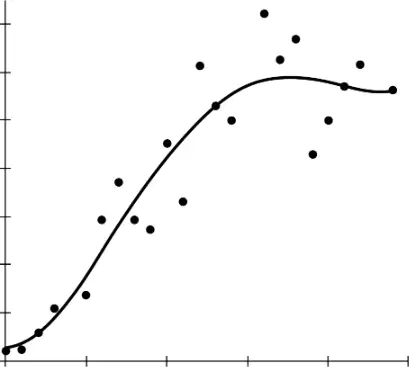
Based on the data in the graph, which of the following best identifies the reproductive strategy of harbor seals?
Type II
Type III
K-selected
r-selected
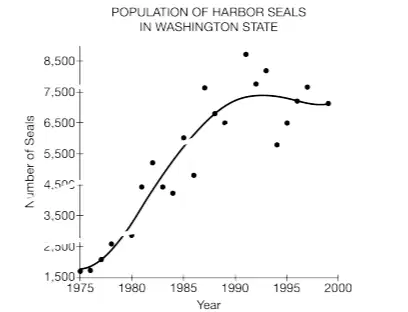
Based on the graph, what is the approximate carrying capacity of the seal population?
1,500
4,500
7,500
8,500
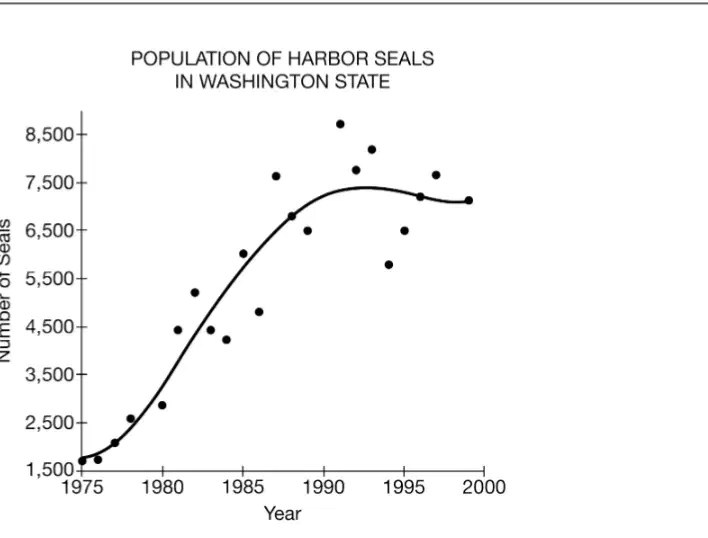
Based on the data in the graph, which environmental factor would have most likely lead to the change in the harbor seal population size from 1980–1990?
Increased availability of food
Decreased resistance to parasites
Increased competition with carnivores
Decreased number of primary producers
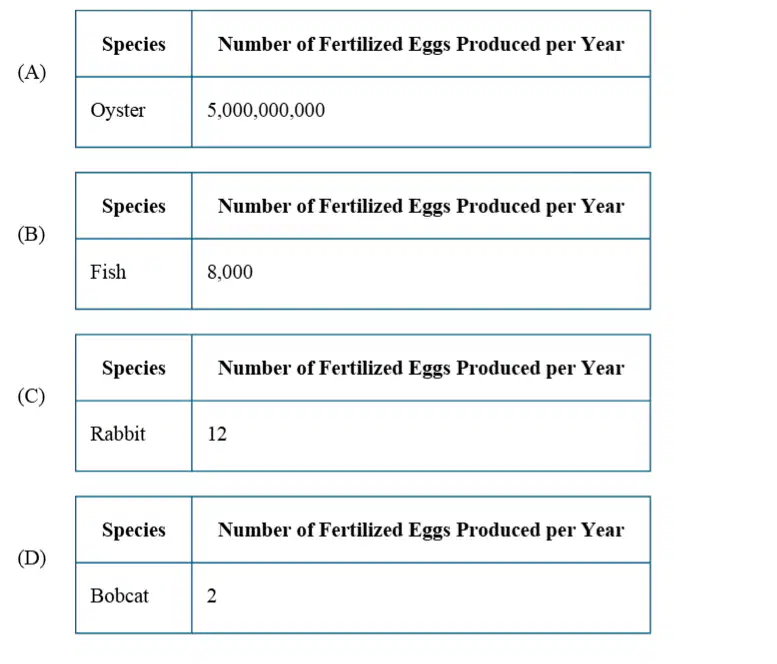
Which of the following species is most likely to provide extensive parental care to its offspring?
Species: Oyster, Number of Fertilized Eggs Produced per Year: 5,000,000,000
Species: Fish, Number of Fertilized Eggs Produced per Year: 8,000
Species: Rabbit, Number of Fertilized Eggs Produced per Year: 12
Species: Bobcat, Number of Fertilized Eggs Produced per Year: 2
Members of an r-selected species characteristically
grow slowly
produce few offspring
reach sexual maturity quickly
have long life spans
are very protective of their offspring
Which of the following is generally true of K-strategist species as compared to r-strategist species?
They reach sexual maturity earlier.
They have more young.
They are more likely to be invasive species.
They have longer life spans.
Their population cycles are more rapid.
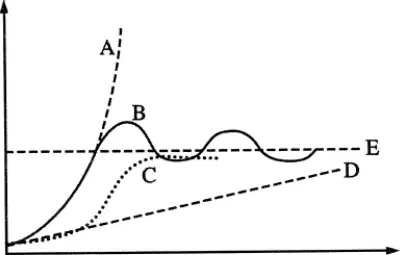
Represents the maximum number of individuals that can be supported by a particular ecosystem on a long-term basis
A
B
C
D
E
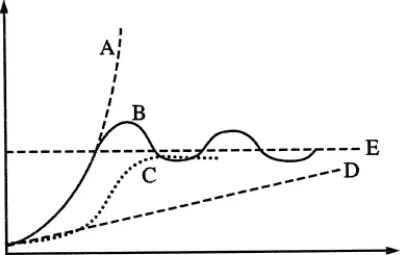
Represents the biotic potential of the species
A
B
C
D
E
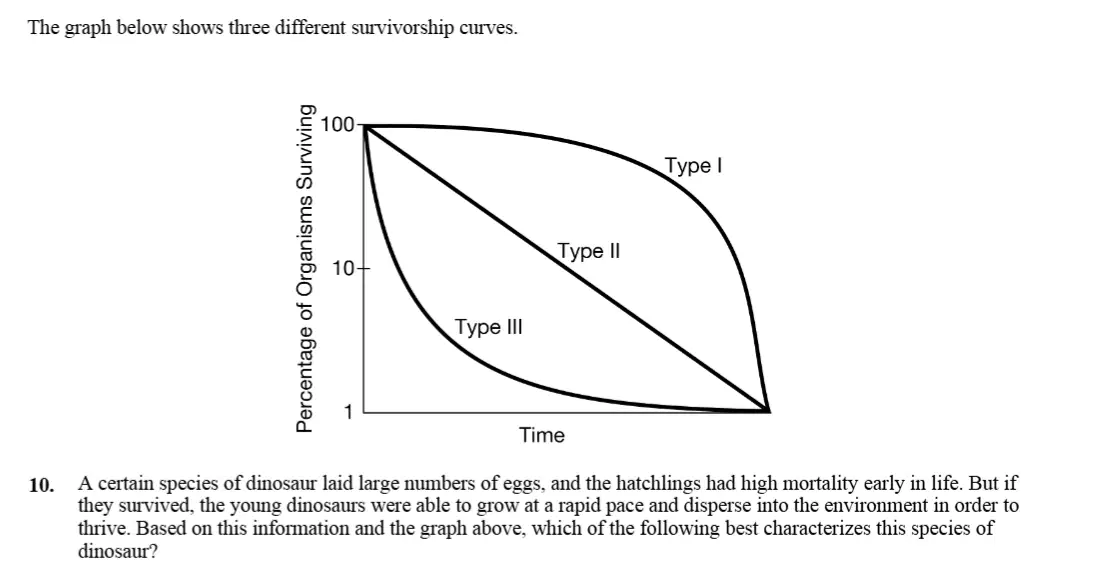
Based on this information and the graph above, which of the following best characterizes this species of dinosaur?
The dinosaurs were r-strategists and exhibited a Type I survivorship curve.
The dinosaurs were r-strategists and exhibited a Type III survivorship curve
The dinosaurs were K-strategists and exhibited a Type II survivorship curve.
The dinosaurs were K-strategists and exhibited a Type I survivorship curve.
Raccoons eat a variety of foods and can live in a variety of habitats, including locations near humans. Tiger salamanders eat an abundance of worms and insects and require wetland habitats so they do not dry out. Which of the following best identifies the two different species?
Raccoons are decomposers, and tiger salamanders are scavengers.
Raccoons are carnivores, and tiger salamanders are herbivores.
Raccoons are generalists, and salamanders are specialists.
Raccoons have a Type II survivorship curve, and tiger salamanders have a Type I survivorship curve.
The tropical rain forests are known to have a large variety of animals. One example is the orchid mantis that is highly camouflaged when standing on a certain species of orchid found in tropical environments. Another species, the tropical cockroach, can live anywhere in the rain forest where it can find water and a food source. Which of the following statements best describes why it is predicted that the orchid mantis will be more affected by global climate change than the tropical cockroach will be?
As the climate changes, the number of orchids is likely to increase, leading to more competition for space by the mantis population.
Orchid mantises tend to be advantaged in habitats that remain constant; the rain forest habitat is likely to shift because of global climate change.
Orchid mantises are generalists, so global climate change will give them more diverse habitats to colonize.
Climate change will lead directly to the clear-cutting of the forests, resulting in a smaller habitat for both the mantis and the tropical cockroach.
Which of the following changes would most likely lead to a mammal population exceeding its carrying capacity?
an increase in mortality of adults during the mating season
a decrease in the food supply immediately after offspring are born
an increase in the number of predators immediately after offspring are born
a decrease in the number of adult females during mating season
The Venus flytrap is a carnivorous plant that grows best in nutrient-poor, acidic soil. They typically grow in certain longleaf pine savanna ecosystems in the Carolinas. Which of the following terms best describes this species?
A keystone species, because it is carnivorous.
A generalist species, because it is advantaged in changing habitats.
An invasive species, because it competes with other plants for water and sunlight.
A specialist species, because it thrives only in soils with low pH and nutrient levels.
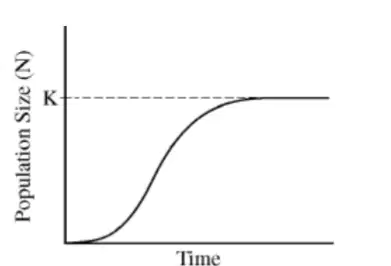
In the graph below charting the growth of a population of organisms, the line labeled K represents the...
biotic potential of the organism
doubling time of the population in the environment
carrying capacity of the population
reproductive lag time of the organism
intrinsic rate of increase of the population in the environment
Which factors are involved with population regulation?
predation
food availabililty
disease
all of these
h
If a species of wildebeast is growing at its biotic potential, it is growing
logistically
linearly
exponentially
up to its carrying capacity
An r-selected species has a ______________ survivorship curve, a population with many offspring, that decreases rapidly early in life, but that then shows that some reach old age.
Type I
Type II
Type III
The biological capacity to reproduce; the number of offspring an organism is capable of producing over its lifetime is called ________.
Fecundity
Senescence
Metamorphosis
Homeostasis
What are factors that affect population size based on density, such as competition, predation, and disease, called?
Density-dependent Factors
Abiotic Factors
Limiting Nutrients
Carrying Capacity
What are factors that affect population size regardless of density, such as natural disasters, climate, and pollution, called?
Density-independent Factors
Density-dependent Factors
Carrying Capacity
Limiting Resources
A species with a broad niche and can survive in many environments is a ___________.
generalist
specialist
predator
parasite
The maximum population size an ecosystem can support is called ___________.
carrying capacity
population density
biotic potential
limiting factor
A population that exceeds carrying capacity experiences ___________.
dieback (or population crash)
exponential growth
increased immigration
genetic drift
Organisms that produce many offspring with little parental care are __________ species.
r-selected
K-selected
endangered
invasive
A graph showing survival patterns of populations is a ___________.
survivorship curve
population pyramid
food web
age structure diagram

Tracks organisms that tend to live long lives (low death rate and high survivorship rate); toward the end of their life expectancies, however, there is a dramatic increase in the death rate.
Type I
Type II
Type III
Type IV
Which of the following is a measure of the biodiversity of an ecosystem?
The total number of individuals of a single animal species
The density of individuals in a hectare
The total number of different plant species
The soil depth at which burrowing insects are located
The Cretaceous-Tertiary extinction event was caused when an asteroid impacted Earth approximately 66 million years ago, near what is now the Gulf of Mexico. The indirect effects of the impact affected the entire globe. The event resulted in the extinction of nearly 75 percent of all plant and animal species on Earth, including the majority of dinosaur species.
Which of the following likely best describes why most of these species went extinct?
Direct effects from the impact
Loss of competitors
Increase in genetic diversity in most species
Rapid climate and habitat change
Which of the following statements about levels of biodiversity is correct?
Genetic biodiversity is a measure of the total number of genes in a community.
A narrow distribution of habitats leads to an increase in species diversity.
Global hotspots are areas where species diversity is thriving due to habitat restoration.
A population with high genetic biodiversity is better able to respond to environmental stressors.
Which of the following is most likely to be the direct result of lack of genetic diversity in a food crop such as corn?
Decreased kernel size
Decreased dependence on chemical fertilizers
Increased susceptibility on plant disease
Increased resistance to pests
Which of the following can be used to assess the biological diversity of an area?
Population size of each species and area occupied by each population
Minimum population area and minimum viable population size
Ratio of r-strategists to K-strategists and life expectancy of K-strategists
Genetic variation within each species and number of species present
Which of the following would be categorized as a cultural ecosystem service of forests?
Recreation and scenic areas for tourism
Timber and landscape materials
Mushroom and plant harvests
Soil stabilization and air purification
Which of the following correctly describes the disruption of an ecosystem service by an anthropogenic activity?
Provisioning services are disrupted by increased combustion of fossil fuels, which leads to an increase in air pollution.
Regulating services are disrupted by flash flooding from a hurricane, which decreases available food resources.
Supporting services are disrupted by an earthquake that causes habitat destruction, which displaces plants and animals.
Cultural services are disrupted by a tornado that causes the loss of acres of forest, which reduces the amount of harvestable timber.
The consumption of mosquitoes by bats and the control of flooding provided by tropical forests in mountainous areas of Central America are examples of
adaptive radiation
ecosystem services
ecological equilibrium
positive feedback loops
The many finch species of the Galápagos Islands evolved from a single species that immigrated to the islands from the coast of South America. These species differ primarily in beak shape, which is closely related to the type of food each species specializes in eating.
Which of the following best explains why each of the finch species on the Galápagos Islands evolved to be specialists?
Islands have limited food resources, forcing species to feed on a small range of food items.
Climate on islands tends to be less variable than on the mainland, minimizing seasonal absences of food.
Reduced competition from other bird species allows finch species to focus on specific food resources.
Food resources on islands are more plentiful and nutrient rich than on the mainland, leading to specialist behaviors in feeding.
Based on the theory of island biogeography, which of the following is the most likely reason that an island in the ocean that is 5 kilometers from a continent would have a higher number of species than one that is 15 kilometers from a continent?
There are more species that have the ability to travel 5 kilometers than can travel 15 kilometers.
Islands that are closer to continents always have a wider range of habitats than more distant islands do.
There are smaller populations of each species on islands that are at greater distances from continents.
Islands that are closer to continents always have more ecological niches than more distant islands do.
For which of the following reasons do small isolated islands have a greater rate of species extinction than larger, less isolated islands?
Small isolated islands are more likely to receive more migrating species.
Small isolated islands provide opportunities for a greater diversity of species.
Because of their size, small isolated islands accumulate more species by chance.
Small isolated islands have a lower availability of resources.

Scientists are interested in determining the average number of species that have migrated from the mainland to a group of islands, as shown below. Partway through their study, they decided to include an additional island in their study group.
Based on the theory of island biogeography, which of the following best explains how the scientists’ calculation of average number of species would change with the inclusion of this new island in their study?
The average would increase because more species would have migrated directly to the farther island.
The average would decrease because fewer species would have migrated directly to the farther island.
The average would not change because it is likely that the additional island has about the same number of species that migrated as the original island group.
The average would not change because the island is approximately the same size as those in the original group and therefore just as likely to recruit species from the mainland.
Small populations of animals, such as those typically found on islands, are prone to extinction because
they contain a high degree of genetic variability
they tend to have more predators
they are usually generalist species
they are more vulnerable to unpredictable events
A 163 square-kilometer (km2) small island is found 2,000km from the mainland. A second, larger, 230,000km2 island is found 1,000km from the mainland. Based on the theory of island biogeography, which of the following statements is most likely true about the small island when compared with the large island?
The rate of immigration is lower for the small island than for the large island.
The small island has niches that are more like the mainland than the large island.
The small island has more available resources than the large island.
The rate of species extinction is lower on the small island than on the large island.
Highly specialized species tend to evolve on islands because of the environmental conditions and resource availability.
Based on the theory of island biogeography, which of the following would most likely experience the greatest decline of specialist species if an invasive species emigrated from the mainland?
A small island a far distance from the mainland
A small island in close proximity to the mainland
A large island a far distance from the mainland
A large island in close proximity to the mainland
A one-hectare pond is sampled in early September. The sample yields 1 small catfish as well as 17 benthic invertebrates that represent 10 species.
If the pond is resampled a year later, which of the following would best indicate that the pond had been adversely affected by adjacent development?
An increase in low-tolerance species has occurred.
A decrease in high-tolerance species has occurred.
A specialist species population has increased.
The biodiversity of the pond has decreased.
A student reads that nanosilver particles are used in cosmetics to allow nutrients to penetrate deeper into the skin. When the cosmetics are washed off, the nanosilver particles can enter freshwater ecosystems. These particles may decrease survival in many aquatic organisms. The student determines that Daphnia magna, a tiny freshwater crustacean widely found in North America, might make a good test subject for an experiment.
Which statement below is the most likely testable hypothesis based on the information provided?
When the concentration of nanosilver particles in water and the temperature of water are both increased, the population of Daphnia magna will decrease.
When the concentration of nanosilver particles in water is increased, the population of Daphnia magna will decrease.
When the concentration of nanosilver particles in water is increased, the population of Daphnia magna will adapt to new conditions and become a new species.
When the concentration of nanosilver particles in water is decreased, the population of aquatic organisms that feed on Daphnia magna will increase.

The diagrams above show the range of tolerance for soil moisture content for two different species of terrestrial invertebrate: Species 1 and Species 2. The ranges represented are for each species where it occurs alone. Soil moisture content is a limiting factor for both species. If populations of both species are placed together in a new location, which of the following diagrams represents the most likely actual (realized) ranges of the species’ distribution of individuals with respect to soil moisture content after five generations?


The Devils Hole pupfish is one of the world’s rarest fishes, spending most of its life in the top few meters of very warm waters of a cavern located in the middle of the Mojave Desert. Devils Hole, a geologic pool, is the only naturally occurring habitat for the endangered Devils Hole pupfish. This fish's habitat is one of the smallest natural ranges known for any vertebrate. Devils Hole is an extreme environment, with water temperatures and dissolved oxygen concentrations near the lethal limits for most fish species.
Which of the following statements best explains why the Devils Hole pupfish are able to live in this environment?
Climate change led to the death of other organisms at Devils Hole, reducing competition for the pupfish.
Thermal inversions have limited the species diversity at Devils Hole, and only a few fish species can survive the high temperatures.
A trophic cascade in the Devils Hole food chain decreased the number of pupfish predators.
The pupfish are well adapted to the habitat of Devils Hole and can thrive in conditions that are outside of the range of tolerance for most other species.

The graph shows data about three tree species after a glacial retreat. Based on the data shown in the graph, which of the following events occurred after the glacial retreat?
Primary succession
Flooding
Sea level rise
Global climate change

Which of the following explanations is best supported by the data shown in the map above?
Earth’s climate has changed over geological time, and plates on Earth’s crust have shifted.
Sea level rise has led to an increased concentration of wildlife inland as the coastal areas flood.
Organisms adapt to human population growth by changing at the genetic level.
Animals migrate seasonally to mate and to find food in different habitats.

The graph shows the change in sea level from the Cambrian period to today compared to today’s sea level. Which of the following statements correctly describes the trends seen in the data?
The highest sea level occurred in the Triassic period.
The lowest sea level occurred during the Paleogene period.
The first rise in sea level occurred during the Cretaceous period.
Sea level decreased from the beginning of the Triassic period to the end of the Cretaceous period.

The graphs above show the population size and distribution of beak sizes in a finch population on the island of Daphne Major in the Galapagos in 1976 and 1978. Smaller-beaked finches are better suited for eating grasses and small seeds. Larger-beaked finches are better suited for cracking larger seeds and nuts. In 1977 a drought took place and the vegetation of the island was affected by the lack of rain.
Which of the following was the average beak size of finches on the island of Daphne Major in 1976?
8.8 mm
9.5 mm
10.2 mm
13.8 mm

The table below shows measurements of the beak size of a sample of ten ground finches on each of two islands in the Galápagos archipelago. The two islands are about ten kilometers apart, and all the birds are the same species. Given that beak size is genetically determined, which of the following hypotheses is the most likely explanation for the differences in data between the islands?
Beak size exerts selective pressure on prey size.
Birds on Daphne Island live longer than birds on Santa Cruz Island.
Large-beaked birds move to Santa Cruz Island and small-beaked birds move to Daphne Island.
The types of food found on the two islands exert selective pressure on beak size.
Which of the following best shows the process of evolution?
A lizard's color becomes brown as it sits on a log.
A population of foxes increases as more prey becomes available.
A population of mosquitoes develops resistance to a pesticide.
A plant loses its leaves in a drought.
In North America, native pollinators often increase the quantity and quality of crops of native plants that are insect pollinated more effectively than European honeybees do. The most likely reason for the phenomenon is that native pollinators
are unaffected by commercial pesticides
have coevolved with native plant species
have no known native predators
are uniformly smaller than European honeybees
In England approximately 250 years ago, the peppered moth had light-colored wing patterns that camouflaged them against the light-colored trees. Over time in urban areas, the number of peppered moths with dark-colored wings increased as pollution from the Industrial Revolution darkened the trees the moths rested on.
Which of the following statements best describes how the moths adapted to the new environment over time?
The moths adapted to the new environment through isolation.
The moths adapted to the new environment through primary succession.
The moths adapted to the new environment by changes in the genetics of the population.
The moths adapted to the new environment by becoming a generalist species.
Scientists are interested in determining the impact of the construction of a hydroelectric dam on a population of salmon that live downstream of a populated area. They measure the health of the salmon population in its current state, several years after the dam was constructed. Which of the following would be the best to use as a control in this study?
The health of the salmon population prior to any dam construction
The health of the salmon population in the river before humans lived in the area
The health of the salmon population at the apex of the dam’s construction
The health of the salmon population just after the dam’s construction was completed

Based on the data shown in the graph, which of the following best describes how ecologists could determine when this ecosystem is approaching a climax community?
Determine if the keystone species in the ecosystem is present two years after the volcanic eruption
Measure the biomass of the pioneer species present before and after the volcanic eruption
Record the number and type of producers present every year after the eruption
Calculate the net primary productivity of a specific indicator species every year after the eruption

Based on the data shown in the graph, when would the species richness of the ecosystem have been the lowest?
Before the volcanic eruption occurred
One to four years after the volcanic eruption
Four to ten years after the volcanic eruption
Ten to fourteen years after the volcanic eruption

Which of the following claims is best supported by the data in the graph?
The temperature of Earth rises and biodiversity increases immediately after a volcanic eruption.
The carrying capacity of plants in the area is approximately 250 species.
After the volcanic eruption, pioneer species colonized the area and the ecosystem began to undergo succession.
Plant species that are well adapted will survive and reproduce, leading to a change in the ecosystem biodiversity through the process of natural selection.
A research team monitoring a local freshwater ecosystem noticed that over the past few years the otter population had declined significantly, while the populations of other species remained fairly constant. After running tests, the research team determined that mercury levels in invertebrates and small fish in the ecosystem were very high. In this ecosystem, what role did the otters occupy?
Pioneer species
Indicator species
Primary consumer
r-selected species
A North Carolina timber company proposes to clear-cut 45 hectares of oak-hickory deciduous forest in the Appalachian Mountains. The company has said that the forest will regrow naturally, and 50 years after the clear-cutting the company plans to harvest again, cutting all the oaks and hickories that have at least a 40-centimeter diameter. A local citizens’ group claims that this is not a realistic plan. Which of the following, if true, best supports the claim of the citizens’ group?
Harvesting oak and hickory will disrupt the soil in the first year after clear-cutting; oaks and hickories cannot germinate that first year.
Oak and hickory are late-successional species; pioneer species will dominate for many decades before the oaks and hickories are reestablished.
Coniferous forests can regrow after having been clear-cut; the biome will change to a boreal forest after clear-cutting.
Erosion rates on the slopes of the Appalachian Mountains will decrease after clear-cutting; many new species will move into the forest.

Which of the following best identifies and describes the process that is illustrated in the diagram above?
Primary succession, because the result is a mature forest with a variety of shade-intolerant shrubs and grasses
Primary succession, because the process in the diagram begins with bare rock.
Secondary succession, because intermediate plant species like grasses and weeds are present
Secondary succession, because the result is a mature forest with a variety of shade-tolerant trees

Which of the following best describes the role of moss in the transition to stage III of the process?
It serves as a soil seed bank in the leaf litter.
It breaks down rock and adds organic nutrients to the soil.
It provides shade and reduces surface temperatures.
It provides habitat for birds and mammals.

Based on the diagram above, in which stage are most species present considered pioneer species?
I
II
III
IV
Which of the following best describes why secondary succession generally occurs more quickly than primary succession?
Secondary succession is not hindered by the presence of any existing vegetation, but primary succession is.
Secondary succession takes place in areas that already have soil and nutrients in place, whereas primary succession occurs in areas that lack soil.
Secondary succession includes the return of plants and animal species, whereas primary succession includes only the return of plants.
Secondary succession requires pioneer species, including lichen and mosses, in the earliest stages, but primary succession does not.

Which tree species grows best with full sunlight?
White oak
Hickory
Dogwood
Sweet gum

On the coast of Oregon, mussels cover most of the rocky shoreline. Two mussel predators include Pisaster (ochre stars) and Nucella (whelks). A sixty-day removal study was conducted, and the results are presented in the graph. Which of the following conclusions is best supported by the data in the graph?
Pisaster is an indicator species, because when it was removed the proportion of live mussels was less than when Pisaster were present.
Pisaster is a keystone species, because when Nucella was removed the proportion of live mussels was similar to the control.
Nucella is an indicator species, because when it was removed the proportion of live mussels was greater than when Nucella was present.
Nucella is a keystone species, because when Pisaster was removed the proportion of live mussels was similar to the control.
This species is instrumental to the function of its local ecosystem.
(a)
This species is used by biologists to detect changes in environmental conditions.
(a)
This species, typically a low-growing plant like lichen and mosses, colonizes areas of disurbance first.
(a)
This species, including large ecosystem-defining plants like trees, requires a foundation of soil nutrients other living species to thrive.
(a)
This type of biodiversity reflects the differences in adaptations and potential adaptations between organisms of the same species.
(a)
This type of biodiversity reflects the differences between plants, animals, and other organisms in a ecological community.
(a)
This type of biodiversity reflects the differences between adjacent biomes through which plants and animals spread and migrate.
(a)
This is defined as the various stressors and forces that cause certain adaptations to be favored by an environment over others.
(a)
This is defined as a strategy through which conservation areas can be spatially connected or expanded.
(a)

