
 Worksheets
Semester 1 Cumulative REVIEW
Total questions: 86
Worksheet time: 47mins
Which statement best describes the four inner planets?
They are large and made mostly of gas.
They have no moons.
They are small and rocky.
They orbit in the opposite direction of outer planets.
What separates the inner planets from the outer planets?
Oort Cloud
Kuiper Belt
Asteroid Belt
Solar winds
What separates the inner planets from the outer planets?
Oort Cloud
Kuiper Belt
Asteroid Belt
Solar winds
Copernicus’s heliocentric model places the —
Earth at the center
Moon at the center
Sun at the center
Galaxy at the center
Which statement best describes the four inner planets?
They are large and made mostly of gas.
They have no moons.
They are small and rocky.
They orbit in the opposite direction of outer planets.
What separates the inner planets from the outer planets?
Oort Cloud
Kuiper Belt
Asteroid Belt
Solar winds
Who first used a telescope to observe celestial objects in detail?
Ptolemy
Galileo
Aristotle
Newton
Copernicus’s heliocentric model places the —
Earth at the center
Moon at the center
Sun at the center
Galaxy at the center
What technological development greatly improved knowledge of the solar system?
Microscope
Telescope
Compass
Spectrometer
Ptolemy’s model with Earth at the center is called—
Solar
Geocentric
Heliocentric
Cosmic
Why does Earth experience a stable orbit?
Balanced gravity and inertia
Only gravity acts on it
Only inertia acts on it
Earth has no rotational motion
What causes the varied lengths of planetary orbits?
Differences in size
Distance from the sun
Atmospheric composition
Amount of moons
Gravity between two objects depends on—
Distance and mass
Color and temperature
Orbit and speed
Angle and direction
The main energy source for the solar system is—
Earth
The sun
Jupiter
The Milky Way
A planet’s “orbital period” is the time it takes to—
Rotate once
Orbit the sun once
Form rings
Cool from formation
A planet’s size is most related to—
Distance from Earth
Composition and mass
Number of moons
Orbit shape
The first four planets in order are—
Mercury, Venus, Earth, Mars
Venus, Earth, Mars, Jupiter
Earth, Mars, Jupiter, Saturn
Mercury, Earth, Mars, Venus
Which objects orbit the sun?
Planets
Comets
Moons
Asteroids
Which describe gas giants?
Large planets
Many moons
Mostly hydrogen and helium
Rocky surfaces
Which are characteristics of dwarf planets like Pluto?
Orbit the sun
Nearly round shape
Cannot clear their orbital path
Are always icy
Match the following terms with their definition:
Small, rocky planets closest to the sun
Inner planets
Large gas giants with many moons
Outer planets
Force pulling objects toward one another
Gravity
Tendency of an object to keep moving in a straight line
Inertia
Tool that increased understanding of the solar system
Telescope
Match the following terms with their definition:
A natural satellite that orbits a planet
moon
A rock burning in Earth's atmosphere
meteor
A rocky object orbiting the sun
asteroid
Orbits the sun but cannot clear its orbital neighborhood
dwarf planet
A dust and ice body with a glowing tail
comet
Which motion of Earth causes day and night?
Earth’s revolution around the sun
Earth’s rotation on its axis
The moon’s revolution around Earth
The tilt of Earth’s axis
Earth experiences seasons because it—
rotates faster in summer
revolves at different speeds
is tilted as it revolves around the sun
moves closer to the sun in winter
Which change in sunlight creates seasons?
Amount of cloud cover
Angle at which sunlight strikes Earth’s surface
Temperature of the sun
Distance between Earth and the moon
When the Northern Hemisphere is tilted toward the sun, it is—
winter in the Northern Hemisphere
summer in the Southern Hemisphere
summer in the Northern Hemisphere
spring in both hemispheres
The phases of the moon are caused by—
clouds blocking sunlight
Earth’s seasons
the moon’s position relative to Earth and the sun
changes in moon temperature
Which best describes Earth?
A. A gas planet with no surface
B. A rocky planet with liquid water
C. A frozen planet with no atmosphere
D. A planet made mostly of hydrogen
Earth’s atmosphere is composed mainly of—
hydrogen and helium
nitrogen and oxygen
carbon dioxide and methane
argon and neon
Earth is protected from harmful solar radiation by—
its liquid oceans
its magnetic field and atmosphere
volcanic eruptions
Earth's crust
Scientific evidence indicates Earth is approximately—
4,500 years old
45 million years old
4.5 billion years old
450 billion years old
Tides on Earth are primarily caused by—
wind
earthquakes
the gravitational pull of the moon
deep ocean currents
How many high tides occur each day on most shorelines?
One
Two
Four (two high, two low)
Six
A spring tide occurs when—
Earth, moon, and sun form a 90° angle
the moon is at its apogee
Earth, moon, and sun are aligned
Earth is closest to the sun
A neap tide occurs when—
the moon is full
the sun and moon pull in the same direction
Earth, moon, and sun form a straight line
Earth, moon, and sun form a 90° angle
A full moon occurs when—
Earth is between the sun and moon
the moon is between Earth and the sun
the moon is not visible
the moon is at a 90° angle
A new moon occurs when—
Which of these elements is most common in Earth's crust?
Hydrogen
Silicon
Helium
Nitrogen
Which additional element makes up most of Earth's crust?
Oxygen
Carbon
Gold
Iron
Which object exerts the greatest influence on Earth's tides?
The moon
The sun
Mars
Jupiter
Which phase occurs just before a new moon?
Waxing gibbous
Full moon
Waning crescent
First quarter
Match the following terms with their definition
Spinning on an axis
Rotation
Orbiting another body
Revolution
Responsible for seasons
Tilt
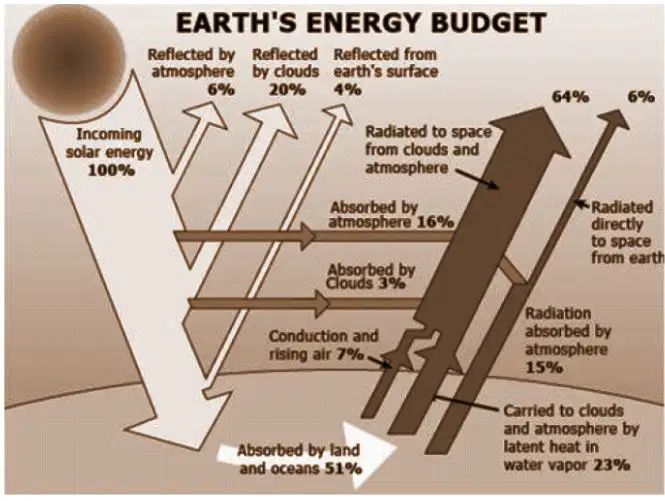
About what fraction of incoming solar energy is reflected back to space?
One-tenth
One-fourth
One-third
One-half
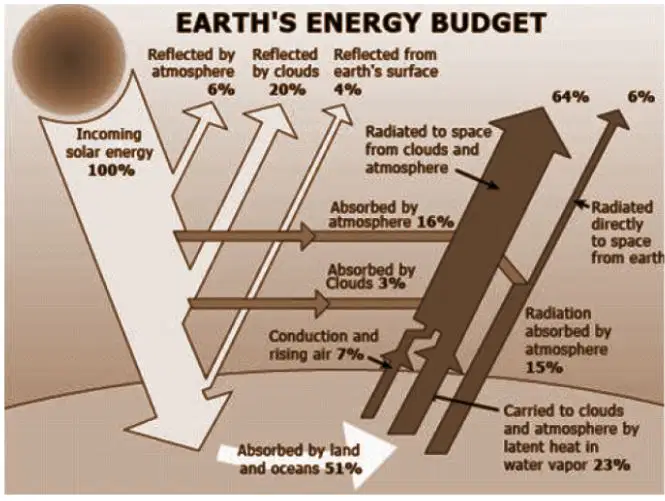
About one-half of the energy striking Earth is absorbed by:
Clouds
Earth’s surface
The ozone layer
Ice caps
Too much carbon dioxide in the atmosphere can:
Improve heat loss to space
Disrupt the energy balance
Increase sunlight reaching Earth’s surface
Strengthen Earth’s magnetic field
Warm air or water rises because it is:
Denser
Cooler
Less dense
Solidifying
The rising and sinking of warm and cool air or water forms:
Radiation
A temperature inversion
Conduction zones
Convection currents
Energy transfer from Earth’s surface that powers global circulation is caused by:
Friction
Condensation
Radiation and convection
Absorption by soil
Earth receives ______ of the Sun’s total energy.
Nearly all
Only a small portion
More than half
None
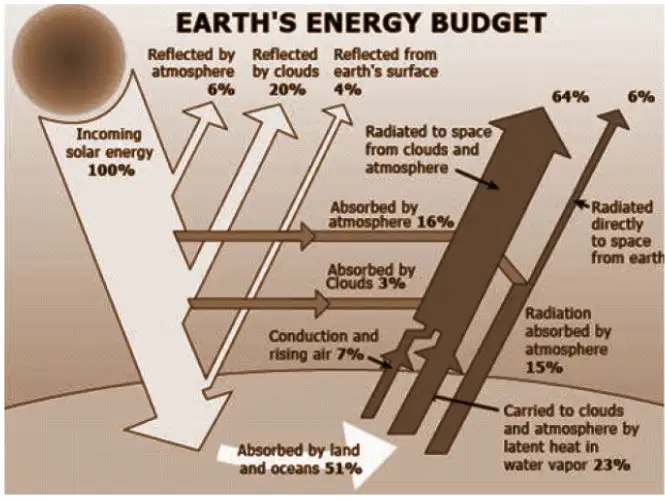
Energy that warms Earth's surface and atmosphere travels mostly by:
Sound waves
Radiation
Static electricity
Chemical reactions
The greenhouse effect occurs when:
Earth absorbs ten times more sunlight
Heat is trapped by certain gases
Ice sheets shrink naturally
Clouds reflect all solar energy
Which gas contributes most to a strengthened greenhouse effect?
Oxygen
Carbon dioxide
Nitrogen
Helium
A resource that can be replaced quickly or does not run out is called:
Nonrenewable
Renewable
Exhaustive
Limited
Biomass includes all of the following except:
Animal waste
Wood
Crops
Uranium
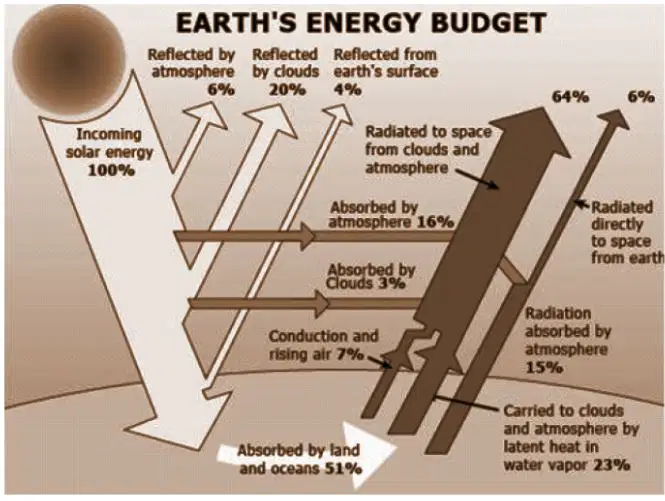
Which of the following reflects solar radiation back into space?
Grass
Clouds
Soil
Volcanoes (only after eruptions)
The uneven heating of Earth's surface results in:
Uniform temperatures
Convection
No atmospheric movement
Constant climates
Conduction transfers energy through:
Electromagnetic waves
Fluid movement
Direct particle contact
Radiation only
Which example does not describe potential energy?
Chemical energy in fuels
A stretched rubber band
Water held behind a dam
Wind blowing across a field
Which are renewable resources?
Solar energy
Wind energy
Coal
Biomass
Natural gas
Which forms of solar radiation reach Earth?
Infrared
Visible light
Ultraviolet
Gamma rays
Microwaves
Which of the following are nonrenewable?
Oil
Natural gas
Uranium
Solar power
Hydroelectric power
Which statements describe the greenhouse effect?
It involves heat being trapped in the atmosphere
It can be strengthened by excess carbon dioxide
It prevents any energy from escaping Earth
It always cools Earth
It helps maintain Earth’s temperature
Two or more atoms make a __.
element
bigger atoms
molecule
Two or more atoms make a __.
element
bigger atoms
molecule
Element abbreviations, like O, Na, N, are called __.
symbols
formulas
letters
Two or more elements make a __, such as NaCl, H2O, and CO2.
element
compound
atom
Anything that has MASS and takes up SPACE is __.
matter
grams
element
__ are the building blocks of all matter.
atoms
elements
liters
Two or more atoms make a __.
element
bigger atoms
molecule
Element abbreviations, like O, Na, N, are called __.
symbols
formulas
letters
Two or more elements make a __, such as NaCl, H2O, and CO2.
element
compound
atom
Anything that has MASS and takes up SPACE is __.
matter
grams
element
__ are the building blocks of all matter.
atoms
elements
liters
the center of the atom where most of the mass is concentrated; the home of the protons and neutrons
electron shells
nucleus
electron
atom
"smaller than an atom" : three particles that make up the atom
element
molecules
properties
subatomic particles
positively charges particles found in the nucleus of the atom
proton
neutron
electron
quarks
particles with no charge or a neutral charge that are found in the nucleus of the atom.
protons
electrons
quarks
neutrons
negatively charged particles that orbit the nucleus of the atom
protons
neutron
electron
a form of matter made up of only one type of atom
molecule
compound
atom
element
a one to two letter representation of an element's name Ex: H for Hydrogen
chemical name
atomic number
atomic mass
chemical symbol
a form of matter made up of only one type of atom
molecule
compound
atom
element
a one to two letter representation of an element's name Ex: H for Hydrogen
chemical name
atomic number
atomic mass
chemical symbol
Equal to the number of protons in the nucleus of an atom
atomic mass
atomic number
element name
chemical symbol
Label the atom
proton
neutron
electron

how many protons are in an atom of Beryllium?
9
4
5
6

How many neutrons are in an atom of Neon?
10
20
21
30

