
 Worksheets
Special Topics 1st Semester Exam Review
Total questions: 50
Worksheet time: 25mins
Name
Class
Date
1.
Which does a monomer most closely resemble?
a)
chain
b)
link in a chain
c)
circle
d)
intersection
2.
Which does a polymer most closely resemble?
a)
intersection
b)
circle
c)
chain
d)
link in a chain
3.
What is the monomer of a carbohydrate?
a)
monosaccharide
b)
nucleotide
c)
amino acid
d)
fatty acid and glycerol
4.
What is the monomer of a protein?
a)
monosaccharide
b)
nucleotide
c)
amino acid
d)
fatty acid and glycerol
5.
What is the monomer of a lipid?
a)
monosaccharide
b)
nucleotide
c)
amino acid
d)
fatty acid and glycerol
6.
What is the monomer of a nucleic acid?
a)
monosaccharide
b)
nucleotide
c)
amino acid
d)
fatty acid and glycerol
7.
What is an example of a carbohydrate?
a)
sugars and starches
b)
fats, oils, and waxes
c)
DNA and RNA
d)
enzymes
8.
What is an example of a protein?
a)
sugars and starches
b)
fats, oils, and waxes
c)
DNA and RNA
d)
enzymes
9.
What is an example of a lipid?
a)
sugars and starches
b)
fats, oils, and waxes
c)
DNA and RNA
d)
enzymes
10.
What is an example of a nucleic acid?
a)
sugars and starches
b)
fats, oils, and waxes
c)
DNA and RNA
d)
enzymes
11.
What biomolecules communicates genetic information?
a)
carbohydrate
b)
lipid
c)
nucleic acid
d)
protein
12.
What biomolecule provides quick energy for organisms?
a)
carbohydrate
b)
lipid
c)
nucleic acid
d)
protein
13.
Which macromolecule is involved in nearly every function in the human body?
a)
carbohydrate
b)
lipid
c)
nucleic acid
d)
protein
14.
Which macromolecule stores energy for an organism?
a)
carbohydrate
b)
lipid
c)
nucleic acid
d)
protein
15.
Which of the following biomolecules typically contains both nitrogen and phosphate?
a)
Lipid
b)
Protein
c)
nucleic acid
d)
carbohydrate
16.
What is a purpose of mitosis?
a)
increase cell volume
b)
create genetic diversity
c)
produce new offspring
d)
replace damaged cells
17.
Chromosomes are ____.
a)
genetic material
b)
in all living organisms
c)
condensed chromatin
d)
all of the above
18.
Mitosis has _____ phases.
a)
one
b)
two
c)
three
d)
four
19.
True or False:
Chromosomes are the genetic material, which is passed on
from one generation to the next.
a)
True
b)
False
20.
True or False:
Cells are the basic units of life.
a)
True
b)
False
21.
What can limit the size of a cell?
a)
frequency of the cell cycle
b)
maximum rate of cell mitosis
c)
nutrient and energy levels
d)
ratio of surface to volume
22.
During the cell cycle, a cell grows ____________.
a)
and dies
b)
and divides
c)
without completing cytokinesis
d)
without completing mitosis
23.
The shortest stage of mitosis is _____________.
a)
prophase
b)
metaphase
c)
anaphase
d)
telophase
24.
The cell grows during which phase?
a)
anaphase
b)
interphase
c)
metaphase
d)
prophase
e)
telophase
25.
Which occurs during cytokinesis?
a)
binary fission takes place
b)
cytoplasm divides
c)
DNA duplicates
d)
spindle apparatus forms
26.
Which of the following shows the correct sequence of the cell cycle?
a)
C🡪M🡪 G1🡪S🡪G2
b)
S 🡪 G1 🡪 G2🡪 M 🡪 C
c)
G1🡪 S🡪G2🡪 M🡪C
d)
none of the above
27.

Identify the phase of mitosis of cell A
a)
anaphase
b)
interphase
c)
metaphse
d)
prophase
e)
telophase
28.
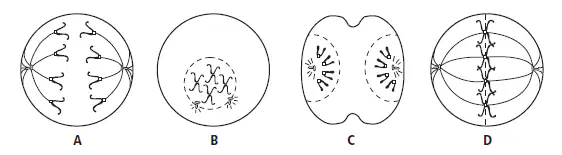
Identify the phase of mitosis of cell B
a)
anaphase
b)
interphase
c)
metaphse
d)
prophase
e)
telophase
29.
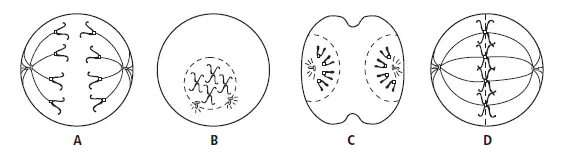
Identify the phase of mitosis of cell C
a)
anaphase
b)
interphase
c)
metaphse
d)
prophase
e)
telophase
30.
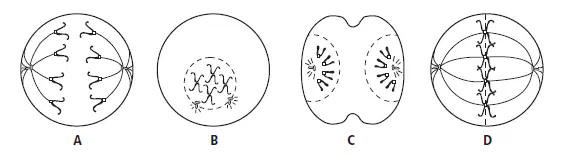
Identify the phase of mitosis of cell D
a)
anaphase
b)
interphase
c)
metaphase
d)
prophase
e)
telophase
31.
The genotype of an organism describes the
a)
A. codons that make up the genes
b)
B. number of genes on the chromosomes
c)
C. genetic make-up of a trait
d)
D. type of chromosomes in the nucleus
32.
Which best explains why children resemble their parents?
a)
A. they eat same foods
b)
B. they have similar DNA
c)
C. they speak the same language
d)
D. they have the same interests
33.
Aa, DD, Bb, yy are all examples of _______
a)
A. genotypes
b)
B. phenotypes
34.
What type of "square" helps us solve genetic problems?
a)
A. carpenter square
b)
B. Mendel square
c)
C. Punnett square
d)
D. genetic square
35.
TT,tt,PP,pp,SS,ss are examples of alleles that are?
a)
A. homozygous
b)
B. different
c)
C. heterozygous
d)
D. homologous
36.
Y for yellow body is dominant over y for blue body. What alleles would produce yellow bodies?
a)
A. YY,yy
b)
B. Yy,yy
c)
C. YY only
d)
D. YY,Yy
37.
If "T" is the allele for tall and "t" is the allele for short, then Tt would produce _________
a)
A. tall
b)
B. short
c)
C. medium
d)
D. not enough info
38.
Which of the following is a heterozygous genotype?
a)
A. tt
b)
B. GG
c)
C. Hh
d)
D. cc
39.
An offspring will receive how many alleles from each parent to determine a specific trait?
a)
A. one
b)
B. two
c)
C. three
d)
D. four
40.
Which of the following is a phenotype?
a)
A. BB
b)
B. Bb
c)
C. bb
d)
D. blue eyes
41.
Who is the Father of Genetics?
a)
A. Gregor Mendel
b)
Dmitri Mendeleev
c)
Dmitri Mendel
d)
Gregor Mendeleev
42.
The passing on of traits and behaviors from parents to their offspring is _________.
a)
A. offspring
b)
B. heredity
c)
C. DNA
d)
D. genes
43.
Which deals with the transmission of inherited traits from one generation to another?
a)
A. anatomy
b)
B. ecology
c)
C. genetics
d)
D. forensics
44.
Which term describes the different forms of a gene?
a)
A. Chromosome
b)
B. Allele
c)
C. DNA
d)
D. Punnett Squares
45.
G = green, g = yellow
The genotype for a yellow plant is...
a)
A. GG
b)
B. Gg
c)
C. gg
d)
D. all of the choices result in yellow
46.
What is the genotype for a pea plant heterozygous for round seeds (R), and homozygous recessive for green seeds (y)?
a)
A. Ry
b)
B. RRyy
c)
C. RrYy
d)
D. Rryy
47.
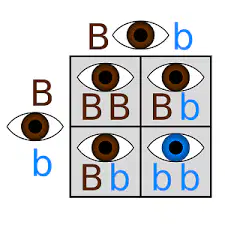
The genotypic percentage resulting from this cross would be _____________________.
a)
A. 25% blue eye, 75 % brown eye
b)
B. . BB= 25%, Bb= 50%, bb= 25%
c)
C. BB= 50%, bb = 50%
d)
D. All brown eyes
48.
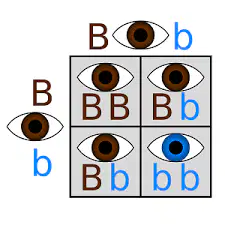
The phenotypic percentage resulting from this cross would be _____________________.
a)
A. 25% blue eye, 75 % brown eye
b)
B. . BB= 25%, Bb= 50%, bb= 25%
c)
C. BB= 50%, bb = 50%
d)
D. All brown eyes
49.
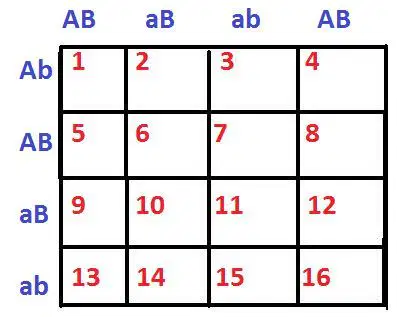
What goes in box 3?
a)
A. Aabb
b)
B. Abab
c)
C. AAbb
d)
D. aaBb
50.

Using the dihybrid cross and key provided, what is the probability of the offspring being tall and white?
a)
A. 2
b)
B. 3
c)
C. 6
d)
D. 9
100 %

