
 Worksheets
Motivation-Biological and Social Motives-part B, period 8
Total questions: 115
Worksheet time: 58mins
Name
Class
Date
1.
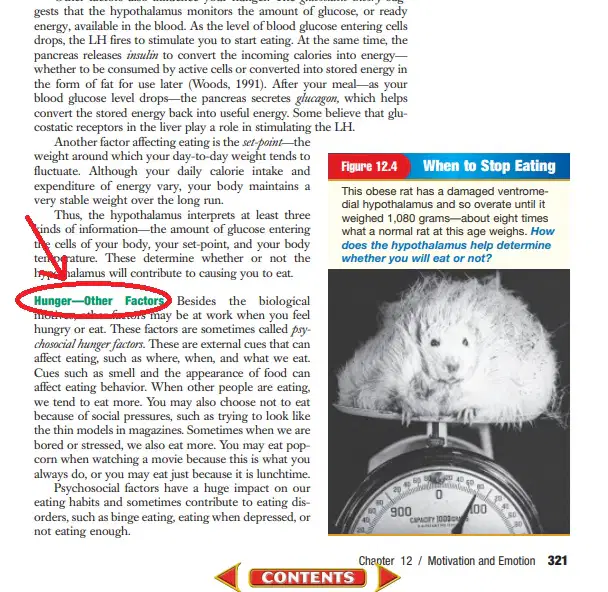
Use the reading "Biological and Social Motives." Go to near the bottom of page 321, where a subsection titled "Hunger-Other Factors" begins. What other factors besides biology can influence your hunger?
a)
Social and mental habits.
b)
Only the size of the stomach.
c)
The color of the kitchen floor.
d)
The type of shoes one wears.
e)
The age of the person eating.
2.
What term describes the non-biological factors in eating?
a)
Psychosocial factors of food.
b)
Biological drives for energy.
c)
Genetic codes for digestion.
d)
Physical limits of the body.
e)
Chemical signals for growth.
3.
What external stimuli can impact a person's desire to eat?
a)
Smell or sight of the meal.
b)
The sound of a distant bird.
c)
The texture of a cold stone.
d)
The price of a new computer.
e)
The weight of a heavy chair.
4.
How do people react when they see others consuming a meal?
a)
They tend to eat more food.
b)
They stop feeling any hunger.
c)
They leave the room at once.
d)
They start to feel very tired.
e)
They drink only cold water.
5.
Why might a person choose to stop eating despite hunger?
a)
Due to social or self image.
b)
Because they lost their keys.
c)
Since the sun is setting low.
d)
As they need to buy new pens.
e)
To listen to a loud song now.
6.
Which emotions can lead to an increase in food intake?
a)
Stress or feelings of fear.
b)
Joy and a sense of calm peace.
c)
Boredom and a lack of focus.
d)
Logic and a clear mental state.
e)
Pride and a feeling of power.
7.
Why do some people eat at set times regardless of hunger?
a)
It is a learned social habit.
b)
Their body needs fuel at noon.
c)
The law says they must do so.
d)
They are trying to save money.
e)
They want to test their taste.
8.
How do psychosocial factors affect our daily eating habits?
a)
They form our regular cycles.
b)
They stop us from ever eating.
c)
They change the way we walk.
d)
They help us sleep much better.
e)
They make us forget all names.
9.
What issues can result from these psychosocial influences?
a)
Eating more than is healthy.
b)
Working too hard at the office.
c)
Buying too many heavy books.
d)
Sleeping for ten hours a day.
e)
Walking far to see a movie.
10.
What data is more available now regarding body weight?
a)
Facts on health and obesity.
b)
Tips on how to build a house.
c)
Notes on the stars in the sky.
d)
Lists of the best world cars.
e)
Guides on how to plant trees.
11.
Which component influences a person's risk for obesity?
a)
The person's genetic makeup.
b)
The brand of the person's car.
c)
The height of the person's bed.
d)
The color of the person's eyes.
e)
The style of the person's hair.
12.
How is a person who is obese defined in the text?
a)
Thirty percent over weight.
b)
Ten percent under the weight.
c)
Five pounds more than normal.
d)
Exactly the same as the mean.
e)
Twice as tall as a small kid.
13.
How is a person who is overweight defined in the text?
a)
Above the ideal body weight.
b)
Below the average food intake.
c)
Short for their specific age.
d)
Tired from a long day of work.
e)
Ready for a new exercise plan.
14.

What percentage of Americans were obese in 1997? Convert the fraction given in the text into a percentage.
a)
About thirty three percent.
b)
Around ten percent of people.
c)
Roughly fifty percent of all.
d)
Nearly five percent of adults.
e)
Exactly twenty percent of men.
15.
What did Schachter find regarding obesity and hunger?
a)
External cues drive eating.
b)
Internal cues are most vital.
c)
Hunger is purely a choice.
d)
Weight has no link to food.
e)
Taste is the only factor used.
16.
How did Schachter test the habits of obese individuals?
a)
Using a cracker taste test.
b)
Making them run a long race.
c)
Asking them to write a story.
d)
Watching them sleep in a lab.
e)
Giving them a hard math test.
17.
What were the cracker test participants asked to do?
a)
Rate the flavor of crackers.
b)
Count every seed on the top.
c)
Throw the crackers in a bin.
d)
Share crackers with a friend.
e)
Hide the crackers in a drawer.
18.
What was the extra step for some cracker test subjects?
a)
They were fed a full meal first.
b)
They were told to sing a song.
c)
They were asked to go for a run.
d)
They were given a cup of coffee.
e)
They were paid to stay awake late.
19.
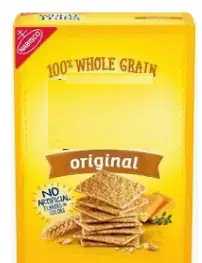
What type of cracker is shown in the picture?
a)
Skinny Squares
b)
Wheat Wells
c)
Wheat Thins
d)
Wheat Ritz
20.
What was the prediction made by Schachter for the test?
a)
Obese eat regardless of full.
b)
Thin eat only when they cry.
c)
No one eats any of the food.
d)
Everyone eats the same amount.
e)
Only men eat the salty snacks.
21.
How did normal weight people act in the cracker study?
a)
They ate fewer when full up.
b)
They ate more when they felt full.
c)
They refused to eat any crackers.
d)
They took all the crackers home.
e)
They cried when they saw crackers.
22.
What did Schachter put in the room for the second test?
a)
A bowl filled with fresh nuts.
b)
A box of cold pepperoni pizza.
c)
A tray of sweet chocolate cake.
d)
A bag of salty potato chips.
e)
A plate of ripe green apples.
23.
When did the overweight subjects eat the provided nuts?
a)
All the time during the test.
b)
Only when the room was very dark.
c)
Just when they were very hungry.
d)
Never while they were observed.
e)
After they finished their work.
24.
What did the nut study show about overweight people?
a)
They respond to food sights.
b)
They hate the taste of almonds.
c)
They only eat in the morning.
d)
They follow rules very strictly.
e)
They are not hungry very often.
25.
How did people of normal weight act toward the almonds?
a)
They ate only if they felt hungry.
b)
They ate every nut in the bowl.
c)
They hid the nuts in their coats.
d)
They threw the nuts on the floor.
e)
They asked for more nuts to eat.
26.
Which answer choice shows the nuts used in the Schacter study about human weight?
a)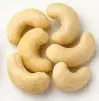
b)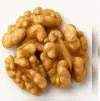
c)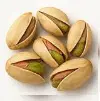
d)
e)
27.
What was Schachter's main claim about obese people?
a)
They ignore internal signals.
b)
They are very active all day.
c)
They only eat healthy snacks.
d)
They have a very slow heart rate.
e)
They hate eating in public areas.
28.
What was Schachter's main claim about thin people?
a)
They listen to internal cues.
b)
They never feel any real hunger.
c)
They eat only sweet desserts.
d)
They love to cook for friends.
e)
They skip most of their meals.
29.
What is the implication of Schachter's work on food?
a)
Weight is tied to cues seen.
b)
Food is not needed for life.
c)
Health is based on luck alone.
d)
Dieting is the only way to live.
e)
Hunger is a mental illusion.
30.
Besides cues, what else leads to the obesity problem?
a)
A lack of physical activity.
b)
Reading too many long books.
c)
Driving a car to the local shop.
d)
Living in a very cold climate.
e)
Wearing clothes that are tight.
31.
What happens when you increase your daily exercise?
a)
You burn off more calories.
b)
You feel much more tired out.
c)
You need to sleep all day long.
d)
You lose your sense of taste.
e)
You grow much taller each week.
32.
Which conditions do NOT cause excessive eating habits?
a)
Common mental health issues.
b)
Feeling very sad for a week.
c)
Being angry at a close friend.
d)
Having a hard day at school.
e)
Wanting to win a large race.
33.
Who suffers from these mental conditions most often?
a)
All groups at the same rate.
b)
Only people who live in cities.
c)
Just the kids who go to school.
d)
Mostly the men who work hard.
e)
Only the very rich and famous.
34.
What is the focus for many social psychologists?
a)
Human social motivations.
b)
The way the heart beats fast.
c)
How the eyes see the light.
d)
The way the skin feels heat.
e)
How the brain stores memories.
35.
How are these social motivations usually learned?
a)
Through our social contacts.
b)
From the food that we consume.
c)
By reading about old history.
d)
From the stars in the night sky.
e)
Through the air that we breathe.
36.
What is the core idea of achievement motivation?
a)
The desire to master goals.
b)
The need to sleep for hours.
c)
The wish to buy new clothes.
d)
The goal to eat sweet candy.
e)
The drive to win every game.
37.
Why is the achievement motive studied so much?
a)
It is seen in many behaviors.
b)
It is easy to find in animals.
c)
It is required for human life.
d)
It is the only drive we have.
e)
It is found in every single cell.
38.
What tool did McClelland use to measure achievement?
a)
The test known as the TAT.
b)
A scale for weighing the body.
c)
A clock for timing a fast run.
d)
A map for finding a new city.
e)
A book for reading out loud.
39.
What must participants do during the TAT assessment?
a)
Write stories about pictures.
b)
Draw a house and a tall tree.
c)
Solve a very hard math puzzle.
d)
Count the dots on a large page.
e)
Name all the colors they see.
40.
Why must the test answers come from the participant?
a)
The images are very vague.
b)
The room is kept very quiet.
c)
The timer is set for one hour.
d)
The pens are a special color.
e)
The rules are explained twice.
41.
What is done with each story the participant creates?
a)
It is coded for key themes.
b)
It is read to a large crowd.
c)
It is thrown in the trash bin.
d)
It is fixed for grammar errors.
e)
It is translated into French.
42.
How are achievement themes scored in the TAT test?
a)
Based on the goal settings.
b)
By the length of the writing.
c)
On the neatness of the page.
d)
With a focus on the characters.
e)
By how fast the story ends.
43.
What story traits earn a high achievement score?
a)
Showing a struggle to win.
b)
Having a happy ending for all.
c)
Being very long and detailed.
d)
Describing the weather well.
e)
Using many words about food.
44.
What shows that the TAT scoring is now refined?
a)
Experts agree on the results.
b)
Computers do all of the work.
c)
The test is over in one minute.
d)
Children can grade the tests.
e)
Every story gets the same mark.
45.
What do high achievement scorers typically do?
a)
Work hard on their own tasks.
b)
Ask others to do their work.
c)
Wait for luck to help them out.
d)
Give up when things get tough.
e)
Sleep until the noon hour.
46.
How did McClelland track the TAT score results?
a)
Following career paths later.
b)
Measuring how tall they grew.
c)
Counting the money they spent.
d)
Seeing how many kids they had.
e)
Checking the cars they drove.
47.
What question did McClelland ask in his follow-up?
a)
Did scores predict careers?
b)
Did they like the test itself?
c)
Were they still living at home?
d)
Did they eat the same foods?
e)
Were they happy with life?
48.
What was found about high achievement students?
a)
They became entrepreneurs.
b)
They stayed in school forever.
c)
They moved to a new country.
d)
They worked in quiet shops.
e)
They stopped working entirely.
49.
Could anyone train to be a high achiever per McClelland?
a)
Yes he taught it to people.
b)
No it is a fixed trait at birth.
c)
Yes if they eat certain food.
d)
No only men can learn it well.
e)
Yes if they go to college long.
50.
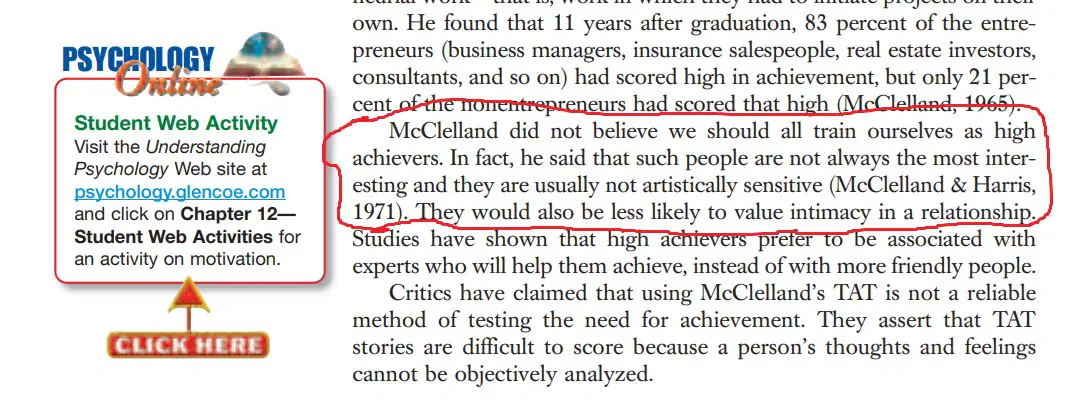
What traits do high achievers usually lack?
a)
Care for art or for people.
b)
Strength to work long hours.
c)
Tools to finish their goals.
d)
Minds to solve hard puzzles.
e)
Needs for any food or water.
51.
What type of bond is less valued by high achievers?
a)
Close personal connections.
b)
Strong work based agreements.
c)
Long term goals for the firm.
d)
Legal rules set by the state.
e)
New ideas for a better shop.
52.
What do people with high achievement scores prefer?
a)
Tasks with moderate risks.
b)
Jobs that are very easy to do.
c)
Work that is purely based on luck.
d)
Roles where no one is the boss.
e)
Tasks that are impossible to win.
53.
What is the critics' main view of using the TAT?
a)
It is not a reliable measure.
b)
It is too hard for kids to do.
c)
It takes too much time to finish.
d)
It is too cheap to be any good.
e)
It is only for people in school.
54.
Why do critics doubt the reliability of the TAT?
a)
Scores change over time.
b)
Pictures are too scary to see.
c)
People do not like to write.
d)
Scoring takes too many days.
e)
Stories are too short to read.
55.
What is a different motive some people might have?
a)
The fear of failing a task.
b)
The need to sleep all the time.
c)
The urge to eat only red fruit.
d)
The drive to buy a fast horse.
e)
The goal to walk to the moon.
56.
What is an example of an internal fear of failure?
a)
Quitting a job that is hard.
b)
Working late on a new project.
c)
Asking a friend for some help.
d)
Buying a book on how to win.
e)
Learning to cook a new meal.
57.
How does fear of failure differ from achievement?
a)
It leads to avoidant choices.
b)
It makes people work harder.
c)
It focuses on winning big prizes.
d)
It helps people learn new skills.
e)
It creates a sense of deep joy.
58.
What is the puzzle choice example used in the text?
a)
Three levels of difficulty.
b)
Ten colors of plastic pieces.
c)
Two shapes made of soft wood.
d)
Four types of metal wire toys.
e)
Five bags of varied paper bits.
59.
Which puzzle do high achievers usually select?
a)
The one with medium difficulty.
b)
The one that is very easy to do.
c)
The one that cannot be solved.
d)
The one that has missing parts.
e)
The one that looks the best now.
60.
What does picking a very easy puzzle indicate?
a)
A high fear of any failure.
b)
A great love for new puzzles.
c)
A need for a very hard task.
d)
A wish to learn a new skill.
e)
A hope to win a gold medal.
61.
Why might a person choose the hardest puzzle?
a)
There is no shame in losing.
b)
They think it is the easiest.
c)
They want to finish it fast.
d)
They like the color of it all.
e)
They are trying to hide a pen.
62.
What is a common pattern for fear-motivated people?
a)
Making excuses for losing.
b)
Trying again and again to win.
c)
Asking for more time to work.
d)
Helping others finish the task.
e)
Finding a way to skip lunch.
63.
Why do people create excuses for poor performance?
a)
To save their own self-image.
b)
To make their boss feel happy.
c)
To get more money from a bank.
d)
To learn how to do better next.
e)
To win a prize for the story.
64.
What is a negative result of using these excuses?
a)
One does not learn or grow.
b)
People think you are very smart.
c)
You get to go home very early.
d)
You win a new job in the city.
e)
You save a lot of your money.
65.
What were the TAT conditions for the male group?
a)
They wrote about a man John.
b)
They drew a picture of a car.
c)
They ran a race against time.
d)
They ate a meal with a friend.
e)
They solved a very hard math.
66.
What was the TAT condition for the female group?
a)
They wrote about Anne's success.
b)
They wrote about a boy named Jim.
c)
They drew a picture of a house.
d)
They sang a song for the class.
e)
They counted the seeds in a fruit.
67.
What trend was seen in the stories from the men?
a)
Success was seen as positive.
b)
They were all very sad stories.
c)
They were very short and bored.
d)
They focused on food and drink.
e)
They were about failing at school.
68.
What trend was seen in the stories from the women?
a)
Success was seen with worry.
b)
They were all about being rich.
c)
They were about winning a game.
d)
They were happy and very long.
e)
They were about travel to Mars.
69.
What new dimension did Horner identify in her work?
a)
The motive to avoid success.
b)
The need to eat only at night.
c)
The drive to sleep for a week.
d)
The wish to live in a forest.
e)
The goal to walk on water now.
70.
Why might some people be socialized to fear success?
a)
It may bring social rejection.
b)
It makes them feel too tired.
c)
It costs too much to be great.
d)
It is banned by the local law.
e)
It causes them to lose weight.
71.
What is the dilemma for women in male-type jobs?
a)
Losing their sense of femininity.
b)
Earning too much money to spend.
c)
Working too many hours at night.
d)
Having to wear a blue uniform.
e)
Moving to a very big new city.
72.
How did female subjects feel about high achievers?
a)
They feared social punishment.
b)
They felt very proud of her.
c)
They wanted to be just like her.
d)
They hoped she would win more.
e)
They asked her for some advice.
73.
What was the link between IQ and fear of success?
a)
Brightest women feared it most.
b)
Smarter people had no fear.
c)
Intelligence had no effect at all.
d)
Only low IQ people were afraid.
e)
High IQ meant a love of winning.
74.
How did high expectations affect bright women?
a)
They feared doing well later.
b)
They worked harder than ever.
c)
They felt very happy and safe.
d)
They bought a lot of new books.
e)
They moved to a better school.
75.
What did Horner conclude from her specific study?
a)
Women are afraid to succeed.
b)
Men are the best at every job.
c)
Success is easy for all to get.
d)
Fear is not a real human drive.
e)
School is the best place to be.
76.
What happened when others repeated Horner's work?
a)
They got very mixed results.
b)
They found the exact same thing.
c)
They proved she was 100% right.
d)
They found men fear it more.
e)
No one could finish the tests.
77.
What challenge did later researchers encounter?
a)
Scoring the TAT is subjective.
b)
The test cost too much to buy.
c)
Students were too busy to help.
d)
The pictures were lost in a fire.
e)
No one wanted to write stories.
78.
Why is it hard to know why people do not try?
a)
Motivation is very complex.
b)
People are just very lazy now.
c)
Everyone is too busy with work.
d)
The text is too hard to read.
e)
No one asks them for a reason.
79.
What was the gender split in med school back then?
a)
Mostly men were in the class.
b)
It was half men and half women.
c)
Only women were allowed in.
d)
There were no doctors at all.
e)
Everyone was from another land.
80.
What changes did later researchers make to TAT?
a)
They used different scenarios.
b)
They used only blue colored ink.
c)
They made the stories much shorter.
d)
They used only male participants.
e)
They did the test in a park.
81.
What was found when TAT prompts were varied?
a)
Both genders can fear success.
b)
Only women showed any worry.
c)
Men became very angry at all.
d)
Women became very happy now.
e)
No one wrote any more stories.
82.
What did the analysis of 64 studies show us?
a)
Results were not consistent.
b)
Horner was right every time.
c)
Men always succeed much more.
d)
Fear of success is a myth.
e)
Every woman is afraid to win.
83.
What is the final word on the fear of success?
a)
It is not just a female trait.
b)
It only affects people in US.
c)
It is the main drive for all.
d)
It is a very rare thing today.
e)
It makes people work harder.
84.
What is the expectancy-value theory by Atkinson?
a)
Success chance and value.
b)
Hunger level and food type.
c)
Sleep hours and energy levels.
d)
Weight gain and exercise time.
e)
Job type and salary amount.
85.
What two concepts are vital in Atkinson's theory?
a)
Expectations and net value.
b)
Strength and the speed of work.
c)
Height and the weight of tools.
d)
Time and the cost of the trip.
e)
Color and the shape of a box.
86.
What is the alternative theory on motivation?
a)
We act based on competency.
b)
We only act if we feel fear.
c)
We act to please our parents.
d)
We act to get a lot of money.
e)
We act because we are bored.
87.
How do too hard or too easy tasks affect us?
a)
They tell us little of self.
b)
They make us feel very smart.
c)
They help us grow very fast.
d)
They show us our true skills.
e)
They cost us a lot of money.
88.
Why do we pick tasks that are just right?
a)
To learn our true abilities.
b)
To avoid doing any real work.
c)
To make our friends feel bad.
d)
To get a prize for the speed.
e)
To finish the job very early.
89.
In the ring-toss study, what could children do?
a)
Stand at any distance to toss.
b)
Throw as many rings as they want.
c)
Use rings of many different colors.
d)
Toss the rings over their heads.
e)
Pick a prize before they started.
90.
How did high achievers act in the ring-toss study?
a)
They stood at a medium range.
b)
They stood right next to the pin.
c)
They stood very far from the pin.
d)
They refused to throw any rings.
e)
They threw rings at the other kids.
91.
Who was a leader of the humanistic approach?
a)
A man named Abraham Maslow.
b)
A man named Stanley Schachter.
c)
A woman named Matina Horner.
d)
A man named David McClelland.
e)
A man named John W. Atkinson.
92.
What three needs did Maslow say we all have?
a)
Biological, social, and self.
b)
Hunger, thirst, and sleep needs.
c)
Money, power, and fame goals.
d)
Food, cars, and a big new house.
e)
Art, music, and a lot of books.
93.
How did Maslow view achievement motivation?
a)
Part of a larger hierarchy.
b)
As the only need humans have.
c)
As a biological drive for food.
d)
As a fear of being a failure.
e)
As a social trick for success.
94.
What happens when base needs are satisfied?
a)
We move up to the next level.
b)
We stop having any more needs.
c)
We fall back to the very bottom.
d)
We feel very sleepy and bored.
e)
We give all our money away now.
95.
What causes a person to drop down the levels?
a)
Loss of a basic necessity.
b)
Winning a very large prize.
c)
Learning a new skill in class.
d)
Moving to a very big new city.
e)
Getting a high score on a test.
96.
What drives are in the first level of Maslow's?
a)
The physiological needs.
b)
The need for a safe home.
c)
The drive for social status.
d)
The wish to be very creative.
e)
The goal to be a better person.
97.
What is Maslow's core claim on basic needs?
a)
They must be met first of all.
b)
They are not really that vital.
c)
They can be ignored for years.
d)
They are only for little kids.
e)
They come after a social goal.
98.
What is the result if a person is very hungry?
a)
They only think about food.
b)
They want to write a new book.
c)
They try to find a new friend.
d)
They want to win a long race.
e)
They feel very safe and happy.
99.
What needs are on the second level of Maslow's?
a)
Safety and security needs.
b)
Fame and power in the world.
c)
Food and the water for life.
d)
Love and a sense of belonging.
e)
Being the best one can be now.
100.
How do social needs compare to biological ones?
a)
Both are needed for health.
b)
Social ones are much more vital.
c)
Biological ones are not real.
d)
Both are met at the same time.
e)
Neither one affects our lives.
101.
What follows a lack of love or esteem in life?
a)
A feeling of being inferior.
b)
A sense of being very strong.
c)
A need to eat more junk food.
d)
A wish to live in a dark cave.
e)
A drive to run a fast marathon.
102.
How might people act to fix internal tension?
a)
By trying to meet the need.
b)
By going to sleep for a week.
c)
By buying a very fast new car.
d)
By walking to the city center.
e)
By reading a very long novel.
103.
What necessity is at the top of the pyramid?
a)
The need for self actualization.
b)
The drive for more money now.
c)
The wish for a safe new house.
d)
The goal to have many friends.
e)
The need for more food and water.
104.
What are two examples of self-actualization?
a)
Being creative or using talent.
b)
Eating food and drinking water.
c)
Finding a job and a safe home.
d)
Having friends and a nice car.
e)
Paying taxes and following laws.
105.
What is required to be truly creative per Maslow?
a)
Lower needs must be fulfilled.
b)
You must have a lot of money.
c)
You must be very young and fit.
d)
You must live in a big factory.
e)
You must have a very quiet room.
106.
Where does self-actualization come from?
a)
From within the person itself.
b)
From a boss at a large office.
c)
From the laws set by the state.
d)
From the food that we consume.
e)
From the money in a big bank.
107.
What was Maslow's contribution to motivation?
a)
A broader view of human needs.
b)
A list of the best foods to eat.
c)
A map of the human brain cells.
d)
A guide on how to build a house.
e)
A law about how to save money.
108.
What research finding contradicts Maslow?
a)
Some skip levels for a goal.
b)
Everyone follows it perfectly.
c)
No one has any biological needs.
d)
Safety is the only thing we want.
e)
High needs are never truly met.
109.
Which historical figure prioritized higher needs?
a)
A person who fasts for a cause.
b)
A king who has all the money.
c)
A child who wants a new toy.
d)
A worker who wants a big raise.
e)
A chef who loves to cook food.
110.
What does the historical figure example show us?
a)
The hierarchy is not universal.
b)
Money is the most vital thing.
c)
Food is not needed to survive.
d)
People are always very greedy.
e)
Laws are meant to be broken.
111.
What is observed about higher needs in some?
a)
They are met before lower ones.
b)
They do not exist for anyone.
c)
They are only for the very old.
d)
They make people feel very sick.
e)
They cost more than lower ones.
112.
What suggestion do some researchers offer now?
a)
Needs are not in a strict order.
b)
There is only one single need.
c)
Biological needs are not real.
d)
Safety is the highest goal for all.
e)
Money solves every human need.
113.
What is the condition for meeting these needs?
a)
They can overlap at one time.
b)
You must finish one before next.
c)
You can only have one at a time.
d)
They are all met at birth only.
e)
No one ever meets any of them.
114.
What insight is given about the dominant need?
a)
It is the one currently lacking.
b)
It is always the biological one.
c)
It is the one that costs the most.
d)
It is the one your boss wants.
e)
It is the one you learned first.
115.
What is true of other needs when one is dominant?
a)
They still exist in the person.
b)
They disappear from the mind.
c)
They become much more vital.
d)
They cost the person more cash.
e)
They make the person feel tired.
100 %

