
 Worksheets
GEN Chem Unit 6-12 Review
Total questions: 154
Worksheet time: 3hrs 16mins
How many Oxygen atoms do I have in the following compound?
2(NH4)3PO4
4
6
8
24
In a ___________change, a substance changes into a different substance.
Physical
Chemical
What are products?
The chemicals that start the reaction.
The chemicals that the reaction produced.
The chemicals that are on the left side of the arrow.
The products are on the right side of the chemical equation.
True
False
Identify the reaction type:
C2H6 + O2 --> CO2 + H2O
Double replacement
Synthesis
Acid base
Combustion
Identify the type of reaction:
ZnCl2 + Mg --> Zn + MgCl2
Precipitate
Single Replacement
Double Replacement
Decomposition
Identify the reaction type:
NaCl + KOH --> KCl + NaOH
Double replacement
Combustion
Synthesis
Decomposition
Identify the reaction type:
H2O2 --> H2O + O2
Decomposition
Synthesis
Combustion
Acid Base
C7H14 + O₂ → CO₂ + H₂O
Decomposition
Single Replacement
Double Replacement
Combustion
Neutralization
Which of the following is NOT a common sign of a chemical reaction?
Formation of a precipitate
Melting of ice
Production of light
Change in temperature
What does it mean if a substance is described as 'aqueous' in a chemical equation?
It is a solid.
It is dissolved in water.
It is a gas.
It is a liquid other than water.
Which of the following symbols represents an aqueous solution in a chemical equation?
(g)
(s)
(aq)
(l)
What does Boyle's Law state about the relationship between the pressure and volume of a gas at constant temperature?
Pressure and volume are directly proportional
Pressure and volume are inversely proportional
Pressure and volume are unrelated
Pressure and volume both increase together
Which temperature scale is used in gas law calculations?
Celsius
Fahrenheit
Kelvin
Rankine
According to Charles's Law, what happens to the volume of a gas when its temperature increases at constant pressure?
Volume decreases
Volume remains the same
Volume increases
Volume becomes zero
Gay-Lussac's Law relates which two properties of a gas?
Pressure and volume
Volume and temperature
Pressure and temperature
Volume and mass
What is the lowest possible temperature on the Kelvin scale called?
Zero Celsius
Absolute zero
Freezing point
Boiling point
Which statement best describes the kinetic molecular theory?
All matter is made of atoms
Gas particles are in constant, random motion
Liquids have a definite shape
Solids expand when heated
If the pressure of a gas is doubled at constant temperature, what happens to its volume according to Boyle's Law?
Volume doubles
Volume halves
Volume stays the same
Volume increases by four times
Which of the following is NOT an assumption of the kinetic molecular theory?
Gas particles have negligible volume
Gas particles attract each other strongly
Gas particles move in straight lines until they collide
Collisions between gas particles are elastic
Convert 25°C to Kelvin.
248 K
273 K
298 K
325 K
Which Gas Law has pressure remaining constant?
Charles Law
Boyles Law
Gay-Lussacs Law
Which Gas Law has temperature remaining constant?
Charles Law
Boyles Law
Gay-Lussacs Law
Which Gas Law has volume remaining constant?
Charles Law
Boyles Law
Gay-Lussacs Law
Which of the following is a unit for pressure?
L
cm^3
Pa
mL
Which unit can be used for volume?
atm
psi
Pa
dm^3
How does elevation impact boiling point?
As elevation decreases, the boiling point increase
As elevation increases, the boiling point increase
Elevation does not impact boiling point
What is the mathematical expression for the ideal gas law?
PV = nRT
V = nRT/P
PV = RT/n
P = nRT/V
Which of the following is NOT an assumption of the ideal gas law?
Gas particles lose energy during collisions
Gas particles move in random, straight-line motion
There are no intermolecular forces between gas particles
Gas particles have negligible volume
If the temperature of an ideal gas is doubled while keeping pressure constant, what happens to its volume?
It remains the same
It doubles
It becomes zero
It halves
Which of the following is a common unit for the amount of gas in gas law calculations?
L
Pa
mol
kg
What is the SI unit for temperature used in the ideal gas law?
Celsius
Kelvin
Fahrenheit
Rankine
Which of the following units is NOT typically used for pressure in gas law equations?
mmHg
Pa
atm
cm

The data table below shows that as the pressure of a gas sample was changed, the volume of the gas changed. The pressure was measured in atmospheres (atm) and the volume was measured in milliliters (mL).
According to the data table, as the pressure of the gas increases, the volume of the gas:
decreases
increases
remains the same

A sample of gas 2.5 L of a gas at 36°C has a pressure of 2.97 atm. How many moles are in this sample?
0.29 mol
3.42 mol
2.51 mol
What is the relationship between temperature and volume?
related: if one goes up, the other goes up
inversely related: if one goes up, the other goes down
What creates pressure?
gas molecules spinning
gas molecules colliding with container walls
potential energy
electrons
According to Boyle's law, when the pressure of a gas increases at a constant temperature, its volume
increases
decreases
decreases, then increases
If volume increases, the pressure __________
increases
decreases
stays the same
Which of the following is NOT a solution?
the air you breathe
carbonated soda
nail polish mixed with acetone
milk
You and your friend have a contest to see who can make sweet iced tea the fastest. Which of the following would NOT help you win?
Cooling the water
Using smaller sugar crystals
Heating the water
Stirring quickly


How does temperature affect solubility for solids?
Define a saturated solution
A solution that can still dissolve additional solute under the same conditions
A solution in which no more solute dissolves at the given conditions
A solution that is unstable and forms crystals when disturbed
A solution that contains no solute particles at all
Which BEST defines a supersaturated solution?
A solution contains less dissolved solute than a saturated solution because crystals form.
A solution contains more dissolved solute than a saturated solution and is unstable to crystallization.
A solution has the same amount of dissolved solute as a saturated solution but appears darker in color.
A solution has no dissolved solute because all of it precipitates immediately.
Which example represents a homogeneous mixture?
Granite
Blood
Air
Gold
A student has a sample with uniform composition throughout that can be separated by physical means. How should it be categorized?
Element
Compound
Heterogeneous mixture
Homogeneous mixture
Which statement best defines a solute in a solution?
The dissolved substance in a solution
The liquid that does the dissolving
A mixture of two liquids that do not mix
The solid that cannot dissolve in any solvent
In salt water, which component is the solvent?
Salt
Water
Sugar
Carbon dioxide
Which pair correctly matches a common solute with the solution it is found in, based on the examples?
Sugar in salt water
Carbon dioxide in soda drinks
Water in table sugar
Salt in pure water with no additives
According to the like-dissolves-like rule, which solute would most likely dissolve best in a nonpolar solvent such as hexane?
Inorganic salts
Sugars
Fats
Acetic acid
Which combination shows a polar or ionic solute with a polar solvent where high solubility is expected?
Waxes in toluene
Inorganic salts in water
Steroids in benzene
Fats in hexane
A student wants to dissolve a sample of wax. Which solvent from the list would be the most suitable choice using the like-dissolves-like principle?
Water
Small alcohols
Benzene
Acetic acid
Which statement best describes how temperature affects the solubility of most solid solutes in water?
Solubility of most solids increases as temperature increases.
Solubility of most solids decreases as temperature increases.
Solubility of most solids is unaffected by temperature.
Solubility of most solids increases only when pressure increases.
According to solubility trends for gases, which condition increases the amount of gas dissolved in a liquid?
Higher temperature and lower pressure
Higher temperature and higher pressure
Lower temperature and higher pressure
Lower temperature and lower pressure
A student wants to dissolve a solid solute more quickly. Which combination would most effectively increase the rate of dissolving based on the trends?
Heat the solution, stir it, and grind the solid into smaller particles.
Cool the solution, avoid stirring, and use large chunks of solid.
Increase pressure above the solution while keeping the solid pieces large.
Only increase the pressure above the solution without changing temperature.
According to the definitions provided, which statement best describes an electrolyte?
A substance whose aqueous solution does not conduct an electric current
A substance that conducts electricity only in the solid state
A substance whose aqueous solution conducts an electric current
A substance that conducts electricity only when dry
Which statement best describes a nonelectrolyte?
A substance that ionizes completely in water
A substance whose aqueous solution does not conduct an electric current
A substance that conducts electricity in molten form only
A substance that dissociates into ions in any solvent
Tap water is more likely to be classified as which of the following based on its ability to conduct electricity?
Electrolyte, because dissolved ions in water allow current to flow
Nonelectrolyte, because water molecules cannot form ions
Nonelectrolyte, because it is a pure covalent compound
Electrolyte, because only pure water conducts electricity well
Pure water has very few ions present. Based on the definitions, how should pure water be classified for conductivity?
Electrolyte, because it produces many ions
Nonelectrolyte, because its aqueous solution does not effectively conduct current
Electrolyte, because any liquid is conductive
Nonelectrolyte, because it is always an acid
Which of the following is a colligative property?
Electrolytic conductivity
Boiling point elevation
Heat of fusion
Surface tension increase
According to the explanation of freezing point depression, what role do solute particles play in a solution?
They strengthen the attractive forces among solvent particles, allowing earlier freezing
They provide nucleation sites that speed up crystallization at the normal freezing point
They interfere with attractive forces among solvent particles, preventing freezing at the normal point
They evaporate first, lowering the vapor pressure to zero at the freezing point
The lesson states that when a solution contains a nonvolatile solute, additional kinetic energy is needed to boil. What is the direct consequence described?
The boiling point of the solution is lower than that of the pure solvent
The boiling point of the solution is higher than that of the pure solvent
The solution cannot reach atmospheric pressure
The solvent molecules stop colliding with each other
A student dissolves a nonvolatile solute in water and observes that the solution freezes at a lower temperature and boils at a higher temperature than pure water. Based on the lesson, which reasoning best explains these observations?
Solute particles enhance solvent attractions, raising both freezing and boiling points equally
Solute particles interfere with solvent attractions, lowering the freezing point; more kinetic energy is required to reach atmospheric vapor pressure, raising the boiling point
The identity of the solute determines both freezing and boiling changes, independent of concentration
Water molecules leave the solution more easily, so both freezing and boiling points decrease
What is the definition of energy in chemistry?
The ability to do work or produce heat
The amount of matter in a substance
The temperature of a system
The color of a chemical compound
Which of the following best defines heat?
The transfer of energy due to a temperature difference
The total mass of a substance
The amount of light emitted by a substance
The density of a material
What is the SI unit for energy?
Joule (J)
Calorie (cal)
Watt (W)
Kelvin (K)
Which of the following is the correct unit for specific heat in the formula q=mcΔT ?
J/g∘C
g/J∘C
J/g
g∘C/J
What does an exothermic reaction do?
Releases heat to the surroundings
Absorbs heat from the surroundings
Does not involve heat
Changes color
Which statement best describes an endothermic process?
A process that absorbs heat from the surroundings
A process that releases light
A process that releases heat to the surroundings
A process that increases pressure
What is the definition of specific heat?
The amount of heat required to raise the temperature of 1 gram of a substance by 1∘ C
The total heat content of a system
The energy needed to break a chemical bond
The heat required to change a solid to a liquid
If a reaction absorbs heat, what type of reaction is it?
Endothermic
Exothermic
Isothermal
Adiabatic
If a chemical reaction causes the surroundings to feel colder, what can you infer about the reaction?
It is endothermic
It is exothermic
It does not involve energy change
It is a physical change
Which scenario is an example of an exothermic process?
Burning wood in a fireplace
Melting ice in a glass
Evaporating alcohol from skin
Photosynthesis in plants
A reaction in a beaker causes the temperature of the solution to drop. Using evidence, what type of reaction is this and why?
Endothermic, because heat is absorbed from the surroundings
Exothermic, because heat is released to the surroundings
Endothermic, because heat is released to the surroundings
Exothermic, because heat is absorbed from the surroundings
A student mixes two chemicals and observes that the container becomes warm. Using reasoning, what can be concluded about the reaction?
The reaction is exothermic, as it releases heat to the surroundings
The reaction is endothermic, as it absorbs heat from the surroundings
The reaction does not involve energy change
The reaction is physical, not chemical
Match the units to the correct variables:
Q/q
J (joules)
m
g (grams)
c
J/g*C
delta T
*C
Match the following variables to their names:
Q/q
heat/energy
m
mass
c
specific heat
delta T
temperature change
Which of the following best describes potential energy?
Energy released as heat
Energy of motion
Energy used to change temperature
Energy stored due to an object's position or arrangement
A ball is held at the top of a hill and then released. What happens to its energy as it rolls down?
Energy is destroyed
Kinetic energy is converted to potential energy
Potential energy is converted to kinetic energy
Both potential and kinetic energy remain constant
Which scenario is an example of kinetic energy?
A moving car on a highway
A stretched rubber band held in place
A book on a shelf
A battery sitting on a table
Which of the following best defines enthalpy?
The total heat content of a system at constant pressure
The amount of work done by a system
The energy required to break a chemical bond
The temperature change during a reaction
What is the symbol commonly used to represent enthalpy in thermochemistry?
G
Q
S
H
During an exothermic reaction at constant pressure, what happens to the enthalpy of the system?
It fluctuates randomly
It remains unchanged
It decreases
It increases
Which of the following best describes the function of a calorimeter?
It measures the amount of heat absorbed or released during a chemical or physical process
It measures the mass of a substance
It determines the color change in a reaction
It calculates the pressure of a gas
What is the main purpose of using a bomb calorimeter in experiments?
To measure the temperature of boiling water
To observe color changes in chemical reactions
To measure the heat of combustion reactions at constant volume
To determine the density of a liquid
When using a coffee cup calorimeter, which variable is typically kept constant?
Concentration
Mass
Volume
Pressure
Which of the following best describes a calorie?
A unit of temperature
A unit of pressure
A unit of mass
A unit of energy
How many joules are equivalent to one calorie?
1.00 J
4.18 J
0.24 J
10.00 J
Which of the following statements correctly describes specific heat in chemistry?
It is the amount of heat required to raise the temperature of 1 mole of a substance by 1°C
It is the total energy stored in a substance
It is the amount of heat required to raise the temperature of 1 gram of a substance by 1°C
It is the energy needed to change a solid to a liquid
In the formula q=mcΔT , what does the variable 'c' represent?
Amount of heat absorbed or released
Mass of the substance
Change in temperature
Specific heat of the substance
Which of the following best defines heat in chemistry?
The amount of matter in a system
The total energy stored in a substance
The transfer of energy between objects due to a temperature difference
The energy required to break a chemical bond
What is the main difference between heat and temperature in chemistry?
Temperature is a form of energy transfer, while heat measures the average kinetic energy
Heat is a form of energy transfer, while temperature measures the average kinetic energy of particles
Heat is the same as temperature
Heat is measured in degrees Celsius, while temperature is measured in joules
In chemistry, how does heat flow between two objects at different temperatures?
Heat flows equally in both directions
Heat does not flow between objects
From the object at lower temperature to the object at higher temperature
From the object at higher temperature to the object at lower temperature
Which of the following best defines the heat of fusion?
The amount of heat needed to vaporize a liquid at its boiling point
The amount of heat released when a gas condenses into a liquid
The amount of heat required to change a solid into a liquid at its melting point without changing temperature
The amount of heat required to raise the temperature of 1 gram of a substance by 1°C
During the process of melting, the heat absorbed by a substance at its melting point is called:
Heat of vaporization
Specific heat
Heat of combustion
Heat of fusion
Which of the following best describes chemical potential energy?
Energy released as heat during a reaction
Energy due to the motion of particles
Energy stored in the bonds of chemical compounds
Energy required to change the temperature of a substance
What happens to the chemical potential energy during an exothermic reaction?
It increases
It is converted to kinetic energy
It is released as heat to the surroundings
It remains unchanged
Which of the following best defines Hess's Law?
The enthalpy change is determined by the temperature of the surroundings
The enthalpy change is always positive
The enthalpy change depends on the rate of reaction
The total enthalpy change of a reaction is independent of the pathway taken
According to Hess's Law, how can the enthalpy change of a reaction be determined?
By counting the number of reactant molecules
By measuring the temperature change only
By observing the color change during the reaction
By adding the enthalpy changes of individual steps that lead to the overall reaction
Which statement correctly describes the principle behind Hess's Law?
The enthalpy change increases with the concentration of reactants
The enthalpy change is always zero for any reaction
The enthalpy change depends on the physical state of the reactants only
The enthalpy change for a chemical reaction is the same, no matter how many steps the reaction is carried out in
Which statement best describes the law of conservation of energy?
Energy only exists in living organisms
Energy cannot be created or destroyed, only transformed from one form to another
Energy is always lost as heat in every process
Energy can be created and destroyed in chemical reactions
Which of the following best defines the heat of combustion?
The amount of heat required to melt a solid at its melting point
The amount of heat released when one mole of a substance is burned completely in oxygen
The amount of heat absorbed during evaporation
The amount of heat needed to raise the temperature of 1 gram of a substance by 1°C
What is typically measured when determining the heat of combustion of a substance?
The temperature change of the surroundings
The mass of the reactants
The pressure of the system
The color change during the reaction
Which of the following best defines the heat of vaporization?
The amount of heat released when a gas condenses into a liquid
The amount of heat needed to raise the temperature of 1 gram of a substance by 1°C
The amount of heat required to melt one mole of a solid at its melting point
The amount of heat required to convert one mole of a liquid into vapor at its boiling point
During which phase change is the heat of vaporization absorbed?
Evaporation
Freezing
Condensation
Melting
Litmus paper can be used to determine the _______ of a substance
relative volume
relative pH
temperature
chemical formula
Which of the following statements is correct?
Blue litmus paper turns red when placed in a base.
Red litmus paper turns blue when placed in a base.
Blue litmus paper stays blue when placed in an acid.
Red litmus paper stays red when placed in a base.
Human blood has a pH between 7.35 and 7.45. Which of the following best describes human blood?
strongly acidic
slightly acidic
strongly basic
slightly basic
Many cleaning solutions are bases. Which of the following is a property of most bases?
feels slippery
white color
can only be liquid
tastes sour
A pH level of 7 indicates
acid
base
neutral
non of the following
The pH scale is a range from:
1-7
1-5
0-14
1-14
Which property is not associated with acids?
Sour taste
strong acids can burn you
turns litmus paper blue
reacts with metals
You test a solution with pH paper, and the paper turns blue. The solution is ______.
neutral
an acid
a base
an acid & a base
True or false: bases are sometimes called alkaline.
True
False
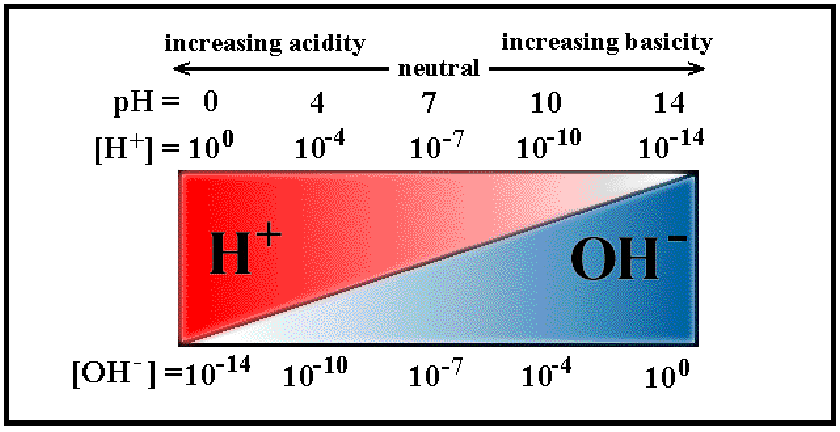
True or false: a neutral solution has equal amounts of H+ and OH-.
True
False
Is the following compound an acid or a base?
HCl
Acid
Base
Which of the following is the strongest acid?
oven cleaner - 13.5
lemon juice - 2.5
soap - 10
blood - 7.4
Which of the following is the strongest base?
soap - 10
HCL - 0
blood - 7.45
soft drink - 3
What does pH measure?
the amount of hydrogen (H+) ions
the amount of hydroxide (OH-) ions
amount of water
all of the above

Why does a higher concentration increase the rate of reaction?
it increases the amount of reactants
it lowers the activation energy
it increases the energy of particle collisions
it increases the frequency of particle collisions
Why does a higher temperature increase the rate of a reaction?
it increases both the frequency and energy of particle collisions
it only increases the frequency of particle collisions
it only increases the energy of particle collisions
it reduces the activation energy of the reaction
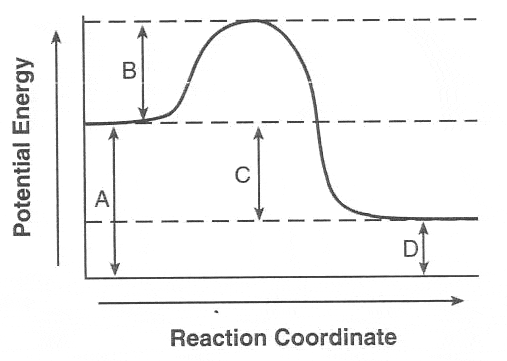
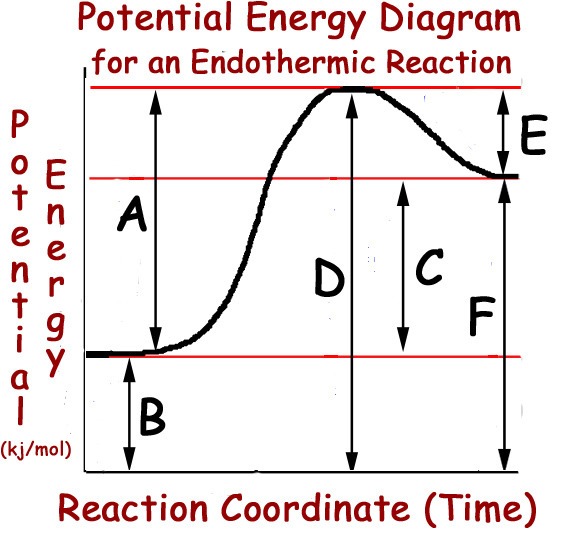
The minimum amount of energy needed for colliding particles to react is called
Chemical Energy
Kinetic Energy
Activation Energy
Potential Energy

What are the two factors to look for when determining if the reaction is at equilibrium?
Forward reaction rate is faster than the reverse and concentrations are equal
Forward and reverse reaction rates are equal and concentration is constant
Forward and revers reaction rates are equal and concentration is equal
Forward reaction rate is faster than the reverse and concentration is equal
Identify the incorrect statement about achieving equilibrium.
achieved when product and reactant concentrations are equal
achieved when forward and reverse reaction rates are same
achieved when concentration of reactants is stable/constant
achieved when concentration ratio of reactants to products becomes stable, thus fixing the equilibrium constant (equilibrium position)


