
 Worksheets
Midterm Review #1
Total questions: 94
Worksheet time: 47mins
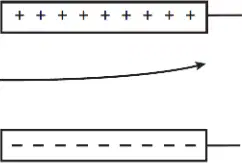
The diagram below represents the path of a subatomic particle as it travels through an electric field between two charged plates. Which subatomic particle is traveling between the charged plates?
electron
neutron
positron
proton
Which sequence of historic developments led to the modern model of the atom?
electrons in shells outside a nucleus, hard sphere, mostly empty space
electrons in shells outside a nucleus, mostly empty space, hard sphere
hard sphere, electrons in shells outside a nucleus, mostly empty space
hard sphere, mostly empty space, electrons in shells outside a nucleus
Which phrase describes the charges and numbers of protons and electrons in an atom?
have opposite charges and are equal in number
have opposite charges and are unequal in number
have the same charge and are equal in number
have the same charge and are unequal in number
The subatomic particles in the nucleus of an oxygen atom include
electrons, only
neutrons, only
protons and neutrons
protons and electrons
Which description of the atom is based on the results of the gold foil experiment in the early 1900s?
Atoms are small, dense, indivisible spheres
Atoms are composed of protons, electrons, and neutrons
Atoms have small, dense, positively charged nuclei.
Atoms have electrons with wavelike properties.
Which conclusion was proposed as a result of an experiment during which some alpha particles were deflected while passing through a thin sheet of gold foil?
Atoms are hard, indivisible spheres
Atoms have small, dense, positive nuclei
Atoms contain negatively charged particles.
Atoms have electrons with wavelike properties.
Which conclusion was developed as a result of the gold foil experiment?
Atoms are mostly empty space.
All atoms are hard, indivisible spheres.
All atoms have different volumes.
All atoms have the same volume.
Which conclusion directly resulted from the "gold foil experiment"?
Atoms are mostly empty space.
Atoms are hard, indivisible spheres.
Electrons are located in shells.
Electrons have a small mass.
Which element is listed with the number of protons in each of its atoms?
nitrogen, 14
silicon, 14
oxygen, 16
phosphorous, 16
All atoms of the element vanadium must have the same
atomic number
mass number
number of neutrons plus electrons
number of protons plus neutrons
The elements on the Periodic Table of the Elements are arranged in order of increasing
atomic number
mass number
number of neutrons
number of valence electrons
On the Periodic Table, the number of protons in an atom of an element is indicated by its
atomic mass
atomic number
selected oxidation states
number of valence electrons
All phosphorus atoms have the same
atomic number
mass number
number of neutrons plus the number of electrons
number of neutrons plus the number of protons
Which quantity represents the number of protons in an atom?
atomic number
oxidation number
number of neutrons
number of valence electrons
What is the approximate mass of an ion that has 12 protons, 13 neutrons, and 10 electrons?
22 u
23 u
25 u
35 u
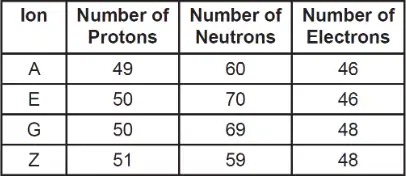
The numbers of protons, neutrons, and electrons in each of four different ions are shown in the table below. Which ion has the greatest mass?
A
E
G
Z
A potassium atom has a mass number of 37. What is the number of neutrons in this atom?
15
18
22
37
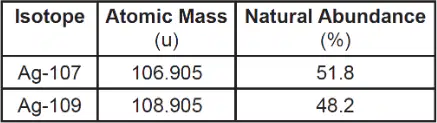
Which numerical setup can be used to calculate the atomic mass of silver?
(106.905 u)(51.8) + (108.905 u)(48.2)
(106.905 u)(51.8%) + (108.905 u)(48.2%)
(106.905 u)(48.2) + (108.905 u)(51.8)
(106.905 u)(48.2%) + (108.905 u)(51.8%)
What is the approximate mass of an atom that has 10 electrons, 10 protons, and 9 neutrons?
10 u
19 u
20 u
29 u
The weighted average of the atomic masses of the naturally occurring isotopes of an element is the
atomic mass of the element
atomic number of the element
mass number of each isotope
formula mass of each isotope
Compared to an atom of C-12, an atom of C-14 has a greater
number of electrons
number of protons
atomic number
mass number
An atom of C-12 in the ground state and an atom of C-13 in the ground state are defined as isotopes of carbon because these atoms have the same number of protons and
the same number of neutrons
the same number of electron shells
a different number of neutrons
a different number of electron shells
Which phrase describes the protons and neutrons in atoms of two different isotopes of the same element?
the same number of protons and the same number of neutrons
the same number of protons and a different number of neutrons
a different number of protons and the same number of neutrons
a different number of protons and a different number of neutrons
Which phrase describes the different isotopes of an element?
same number of electrons and a different number of protons
same number of protons and a different number of electrons
same number of protons and a different number of neutrons
same number of neutrons and a different number of protons
Which statement describes two different isotopes of carbon?
The isotopes contain the same number of neutrons and have the same atomic number.
The isotopes contain the same number of neutrons but have a different atomic number.
The isotopes contain a different number of neutrons but have the same atomic number.
The isotopes contain a different number of neutrons and have a different atomic number.
What is the total number of neutrons in an atom of O-18?
18
16
10
8
The atomic mass of chlorine is the weighted average of the
radioactive isotopes of chlorine
naturally occurring isotopes of chlorine
artificially produced isotopes of chlorine
radioactive and artificial isotopes of chlorine
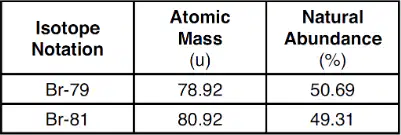
Given information about the naturally occurring isotopes of bromine: Which numerical setup can be used to determine the atomic mass of bromine?
(78.92 u)(50.69) + (80.92 u)(49.31)
(80.92 u)(50.69) + (78.92 u)(49.31)
(78.92 u)(0.5069) + (80.92 u)(0.4931)
(80.92 u)(0.5069) + (78.92 u)(0.4931)
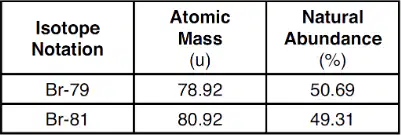
The table below gives the atomic mass and the abundance of the two naturally occurring isotopes of bromine. Which numerical setup can be used to calculate the atomic mass of the element bromine?
(78.92 u)(50.69) + (80.92 u)(49.31)
(78.92 u)(49.31) + (80.92 u)(50.69)
(78.92 u)(0.5069) + (80.92 u)(0.4931)
(78.92 u)(0.4931) + (80.92 u)(0.5069)
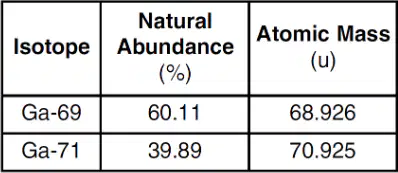
Some information about the two naturally occurring isotopes of gallium is given in the table below. Natural Abundance of Two Gallium Isotopes Isotope | Natural Abundance (%) | Atomic Mass (u) Ga-69 | 60.11 | 68.926 Ga-71 | 39.89 | 70.925 Which numerical setup can be used to calculate the atomic mass of gallium?
(0.6011)(68.926 u) + (0.3989)(70.925 u)
(60.11)(68.926 u) + (39.89)(70.925 u)
(0.6011)(70.925 u) + (0.3989)(68.926 u)
(60.11)(70.925 u) + (39.89)(68.926 u)
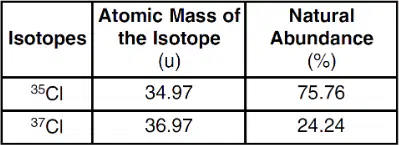
Which numerical setup can be used to calculate the atomic mass of the element chlorine?
(34.97 u)(75.76) + (36.97 u)(24.24)
(34.97 u)(0.2424) + (36.97 u)(0.7576)
(34.97 u)(0.7576) + (36.97 u)(0.2424)
(34.97 u)(24.24) + (36.97 u)(75.76)
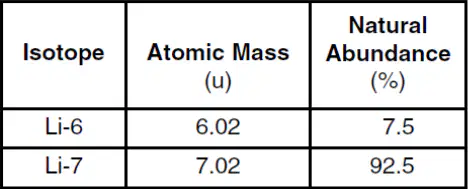
Which numerical setup can be used to determine the atomic mass of lithium?
(0.075)(6.02 u) + (0.925)(7.02 u)
(0.925)(6.02 u) + (0.075)(7.02 u)
(7.5)(6.02 u) + (92.5)(7.02 u)
(92.5)(6.02 u) + (7.5)(7.02 u)
Which statement compares the energy of an electron in the third shell of a rubidium atom to the energy of an electron in a different shell of the same atom?
An electron in the third shell has less energy than an electron in the second shell.
An electron in the third shell has less energy than an electron in the first shell.
An electron in the third shell has more energy than an electron in the first shell.
An electron in the third shell has more energy than an electron in the fifth shell.
Compared to the energy of an electron in the second shell of an atom of sulfur, the energy of an electron in the
first shell is lower
first shell is the same
third shell is lower
third shell is the same
An orbital is defined as a region of the most probable location of
an electron
a neutron
a nucleus
a proton
Which atom in the ground state has an outermost electron with the most energy?
Cs
K
Li
Na
What is the total number of valence electrons in an atom of germanium in the ground state?
8
2
14
4
Which atom in the ground state has a partially filled second electron shell?
hydrogen atom
lithium atom
potassium atom
sodium atom
Which electron configuration represents the electrons in a neon atom in an excited state?
2–7
2–8
2–6–1
2–7–1
As the electron in a hydrogen atom gains energy and moves from the first shell to the third shell, the hydrogen atom becomes an
atom in an excited state
atom in the ground state
ion in an excited state
ion in the ground state
When a ground state electron in an atom moves to an excited state, the electron
absorbs energy as it moves to a higher energy state
absorbs energy as it moves to a lower energy state
releases energy as it moves to a higher energy state
releases energy as it moves to a lower energy state
Which electron configuration represents the electrons of an atom in an excited state?
2-7-3
2-8-2
2-8-8-1
2-8-9-2
Which electron configuration represents the electrons of a phosphorus atom in an excited state?
2-8-5
2-8-6
2-7-6
2-7-4
Which electron configuration represents the electrons in an atom of sulfur in an excited state?
2-8-6
2-7-7
2-8-7
2-7-8
When an electron in an atom returns from a higher energy state to a lower energy state
the atom becomes a negative ion
the atom becomes a positive ion
a specific amount of energy is emitted
a specific amount of energy is absorbed
Which change occurs when an electron returns from a higher energy state to a lower energy state?
An ionic compound is formed, and energy is emitted.
An ionic compound is formed, and energy is absorbed.
A specific amount of energy is absorbed.
A specific amount of energy is emitted.
As an atom in the ground state changes to an atom in an excited state, the atom
absorbs energy
releases energy
increases in mass number
decreases in mass number

Which elements are present in the mixture?
A) L and G
B) L and J
C) E and G
D) E and J
The bright-line spectrum of an element is produced when excited-state electrons
absorb energy and move to higher energy states
absorb energy and move to lower energy states
release energy and move to higher energy states
release energy and move to lower energy states
According to the wave-mechanical model of the atom, electrons are located in
orbitals
circular paths
a small, dense nucleus
a hard, indivisible sphere
According to the wave-mechanical model, an orbital is defined as the most probable location of
a proton
a neutron
a positron
an electron
Which statement describes the relationship between two electrons in an atom of magnesium in the ground state?
An electron in the first shell has the same amount of energy as an electron in the second shell.
An electron in the first shell has a greater amount of energy than an electron in the second shell.
An electron in the second shell has the same amount of energy as an electron in the third shell.
An electron in the third shell has a greater amount of energy than an electron in the second shell.
Which change in electron location in an atom of calcium is accompanied by the greatest amount of energy emitted?
from shell 1 to shell 2
from shell 2 to shell 1
from shell 1 to shell 4
from shell 4 to shell 1
An excited potassium atom emits a specific amount of energy when one of its electrons moves from
the first shell to the fourth shell
the second shell to the fourth shell
the fourth shell to the fifth shell
the fourth shell to the second shell
In the ground state, which shell of a potassium atom has an electron with the greatest amount of energy?
first
second
third
fourth
Compared to the number of electron shells and radius of an aluminum atom in the ground state, a boron atom in the ground state has
fewer electron shells and a smaller radius
fewer electron shells and a larger radius
more electron shells and a smaller radius
more electron shells and a larger radius
What is the number of protons in an atom with the electron configuration of 2–5?
5
2
3
7
Which electron configuration could represent the electrons in a sodium atom in an excited state?
2-8
2-8-1
2-7-1
2-7-2
Which electron configuration represents the electrons in an atom of sodium in the ground state at STP?
2-8-1
2-7-2
2-8-6
2-7-7
Which electron configuration represents the electrons of an atom in an excited state?
2-5
2-8-5
2-5-1
2-6
In the ground state, all atoms of Group 15 elements have the same number of
valence electrons
electron shells
neutrons
protons
What is the number of electrons in an atom of scandium?
21
24
45
66
The valence electrons in an atom of phosphorous in the ground state are all found in
the first shell
the second shell
the third shell
the fourth shell
Element X reacts with chlorine to form the compound XCl3. In which group on the Periodic Table of the Elements is element X located?
Group 1
Group 2
Group 13
Group 18
The elements on the Periodic Table are arranged in order of increasing
atomic mass
atomic number
ionization energy
electronegativity
As the elements with atomic numbers 11 through 17 are considered in order of increasing atomic number, the classification of the elements changes from
metal to metalloid to nonmetal
metal to nonmetal to metalloid
nonmetal to metalloid to metal
nonmetal to metal to metalloid
An element that is a very reactive metal could have an atomic number of
A) 9
B) 2
C) 19
D) 79
Which element has chemical properties most similar to sodium?
magnesium
oxygen
phosphorus
rubidium
Which Group 15 element is classified as a metal?
N
P
As
Bi
The elements on the Periodic Table of the Elements are arranged in order of increasing
atomic mass
atomic number
mass number
oxidation state
The element in Group 14, Period 3, of the Periodic Table is classified as a
metal
noble gas
metalloid
nonmetal
Which list of elements includes a metal, a metalloid, and a noble gas?
Rb, Cl, Ne
Sr, Si, Rn
Rn, Cl, Ne
Si, Rb, Sr
Which list of elements consists of a metal, a metalloid, and a noble gas?
aluminium, sulfur, argon
magnesium, sodium, sulfur
sodium, silicon, argon
silicon, phosphorous, chlorine
Which statement describes a chemical property of copper?
Copper has a red-orange color
Copper can be flattened into sheets
Copper reacts with oxygen
Copper conducts an electric current.
Which statement describes a chemical property of iron?
Iron is malleable.
Iron conducts electricity.
Iron reacts with nitric acid.
Iron has a high melting point.
Which element has chemical properties that are most similar to potassium?
calcium
cesium
nitrogen
sulfur
Which statement describes a chemical property of iron?
Iron oxidizes.
Iron is a solid at STP.
Iron melts.
Iron is attracted to a magnet.
At STP, graphite and diamond are two solid forms of carbon. Which statement explains why these two forms of carbon differ in hardness?
Graphite and diamond have different ionic radii.
Graphite and diamond have different molecular structures.
Graphite is a metal, but diamond is a nonmetal.
Graphite is a good conductor of electricity, but diamond is a poor conductor of electricity.
Which phrase describes the molecular structure and properties of two solid forms of carbon, diamond and graphite?
the same molecular structures and the same properties
the same molecular structures and different properties
different molecular structures and the same properties
different molecular structures and different properties
Which atom, in the ground state, has a stable valence electron configuration?
Bi
Cs
Pb
Rn
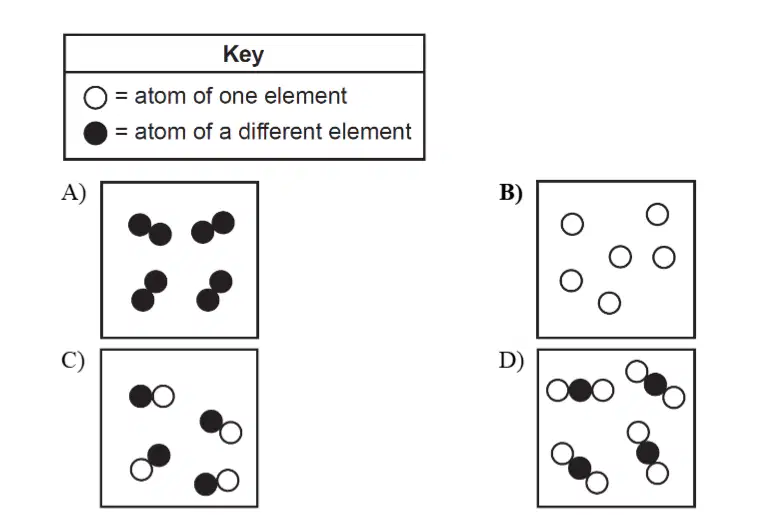
Which particle model diagram represents a noble gas at STP?
[diagram A]
[diagram B]
[diagram C]
[diagram D]
Krypton atoms in the ground state tend not to bond with other atoms because their
second electron shell contains eight electrons
third electron shell contains eighteen electrons
innermost electron shell contains two electrons
outermost electron shell contains eight electrons
Which statement explains why a xenon atom is electrically neutral?
The atom has fewer neutrons than electrons.
The atom has more protons than electrons.
The atom has the same number of neutrons and electrons.
The atom has the same number of protons and electrons.
Which element symbol represents a metalloid?
Ba
Cs
Te
Xe
Which element is classified as a metalloid?
Cr
Cs
Sc
Si
Which element is malleable at STP?
chlorine
copper
helium
sulfur
What is the total number of neutrons in an atom of K-42?
19
20
23
42
At STP, which element is malleable and a good conductor of electricity?
xenon
silicon
platinum
hydrogen
At STP, O₂(g) and O₃(g) have different properties because O₃(g) has
more dense nuclei than in O₂(g)
more protons per atom than in O₂(g)
molecules with a different structure than in O₂(g)
molecules with fewer covalent bonds than in O₂(g)
How do the molecular structures and properties of oxygen, O₂, and ozone, O₃, compare?
They have different molecular structures and the same properties.
They have different molecular structures and different properties.
They have the same molecular structure and the same properties.
They have the same molecular structure and different properties.
Oxygen can exist as diatomic oxygen gas, O2(g), or ozone, O3(g). These two forms of oxygen have
the same molecular structure and the same properties
different molecular structures and different properties
the same molecular structure and different properties
different molecular structures and the same properties
At STP, two forms of solid carbon, diamond and graphite, have different properties because
diamond has a different percent composition than graphite
diamond has more electrons per atom than graphite
diamond has stronger hydrogen bonding than graphite
diamond has a different crystal structure than graphite
Which element has the lowest density at 298 K and 101.3 kPa?
argon
fluorine
nitrogen
oxygen
At STP, which property of tungsten remains the same for all samples of tungsten?
density
mass
surface area
thermal energy

