
 Worksheets
Module 7 - Inheritance
Total questions: 74
Worksheet time: 40mins
Which scientist's experiments with pea plants established principles of inheritance in the mid-1800s?
Charles Darwin
Gregor Mendel
Louis Pasteur
James Watson
Inheritance in Modern Terms: Fill in the blank. Homozygous means ________.
having identical alleles of a gene
having different alleles of a gene
having no alleles of a gene
having two dominant genes
Heterozygous means ________.
having two different alleles of a gene
having two identical alleles of a gene
having no alleles of a gene
having three alleles of a gene
Inheritance in Modern Terms: Which of the following describes a homozygous organism?
Having identical alleles of a gene
Having two different alleles of a gene
Carrying no alleles
Carrying three alleles
What is the definition of genotype? Fill in the blank: Genotype is the particular set of ______ carried by an individual.
alleles
chromosomes
proteins
cells
What is the definition of phenotype? Fill in the blank: Phenotype refers to an individual's ______ traits.
observable
genetic
hidden
inherited
An allele is dominant when its effect masks that of a recessive allele paired with it.
True
False
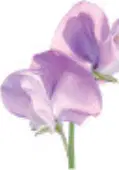
According to the diagram 'Genotype Gives Rise to Phenotype', what is the phenotype of a pea plant with the genotype PP (homozygous for dominant allele P)?
White flower
Purple flower
Pink flower
Yellow flower
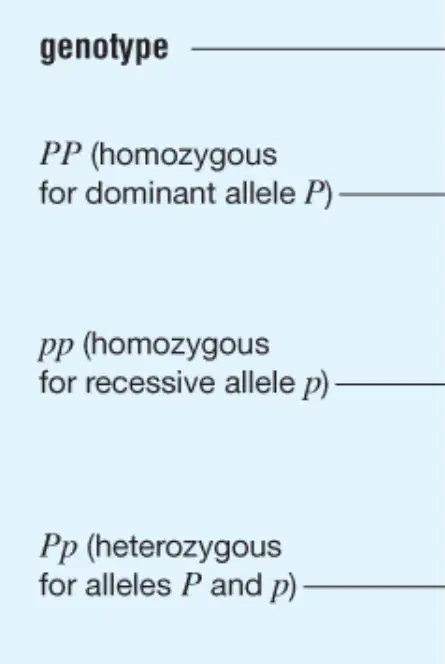
According to the diagram 'Genotype Gives Rise to Phenotype', what is the genotype of a pea plant that has white flowers?
PP
Pp
pp
Pp or PP
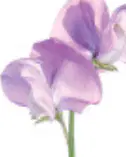
According to the diagram 'Genotype Gives Rise to Phenotype', fill in the blank: A pea plant with the genotype Pp (heterozygous for alleles P and p) will have _______ flowers.
purple
white
yellow
red
When homologous chromosomes separate during meiosis, the gene pairs on those chromosomes _______.
separate
duplicate
mutate
combine
Each gamete that forms carries only one of the two _______ of a pair.
genes
cells
chromosomes
alleles
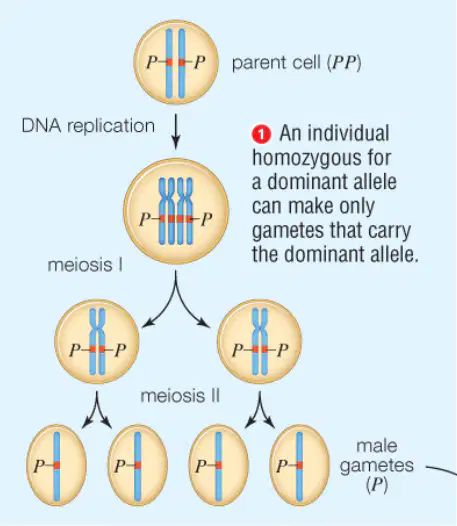
An individual homozygous for a dominant allele (PP) can make only gametes that carry which allele?
Dominant allele (P)
Recessive allele (p)
Both P and p
Neither P nor p
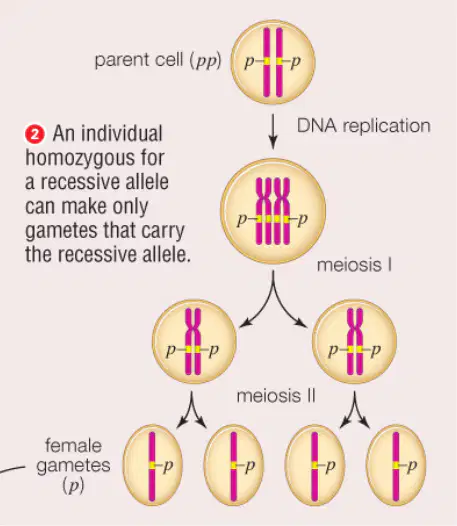
An individual homozygous for a recessive allele (pp) can make only gametes that carry which allele?
Dominant allele (P)
Recessive allele (p)
Both P and p
Neither P nor p
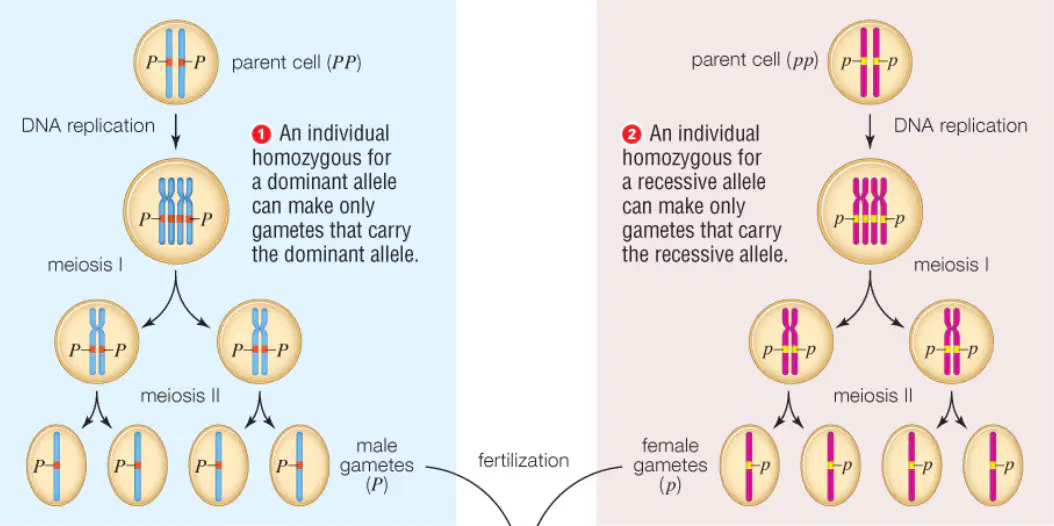
According to the diagram on 'Segregation of Genes', if a homozygous dominant individual (PP) is crossed with a homozygous recessive individual (pp), what will be the genotype of all offspring?
Pp (heterozygous)
PP (homozygous dominant)
pp (homozygous recessive)
PpPp (double heterozygous)
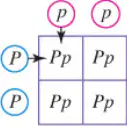
Refer to the Punnett square in the diagram on 'Segregation of Genes'. What is the expected genotype ratio of the offspring when a PP individual is crossed with a pp individual?
1 PP : 1 pp
1 Pp : 1 pp
100% Pp
50% PP : 50% Pp
Punnett Squares: What do Punnett Squares calculate?
The probability of the genotype and phenotype of offspring of crosses
The age of offspring
The color of offspring
The number of offspring
In a testcross, an individual with a dominant trait (but an unknown genotype) is crossed with an individual known to be ______ for the recessive allele.
homozygous
heterozygous
hemizygous
polyploid
Punnett Squares: The pattern of traits among offspring can reveal whether the tested individual is heterozygous or homozygous.
True
False
What is a monohybrid cross?
A cross in which individuals with the same alleles of a gene are crossed.
A cross in which individuals with different alleles of a gene are crossed.
A cross in which individuals with three alleles of a gene are crossed.
A cross in which individuals with no alleles of a gene are crossed.
Fill in the blank: The frequency at which two traits appear in the second generation provides information about ________ relationship between two alleles.
dominance
recessiveness
mutation
linkage
Fill in the blank: Dominant trait will have a ___:___ phenotype ratio.
3:1
1:1
2:2
9:7
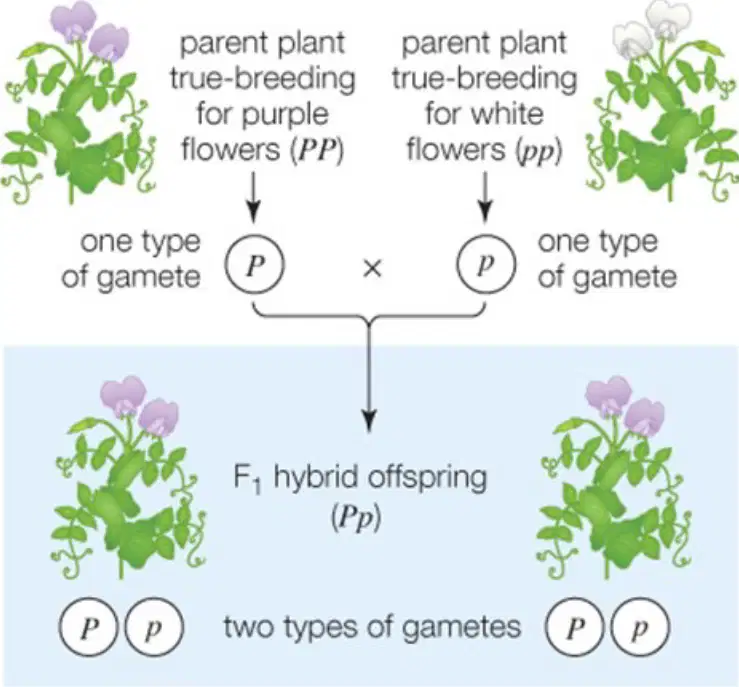
What are the genotypes of the parent plants used in the initial cross?
PP (true-breeding for purple flowers) and pp (true-breeding for white flowers)
Pp (heterozygous for purple flowers) and pp (true-breeding for white flowers)
PP (true-breeding for purple flowers) and Pp (heterozygous for purple flowers)
pp (true-breeding for white flowers) and pp (true-breeding for white flowers)
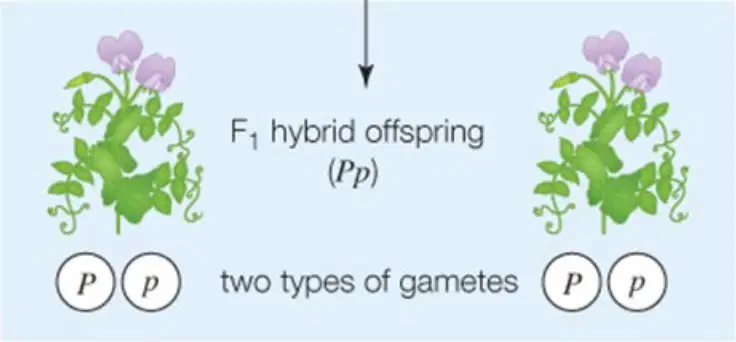
Refer to the diagram of the monohybrid cross. What is the genotype of the F1 hybrid offspring?
Pp
PP
pp
pP
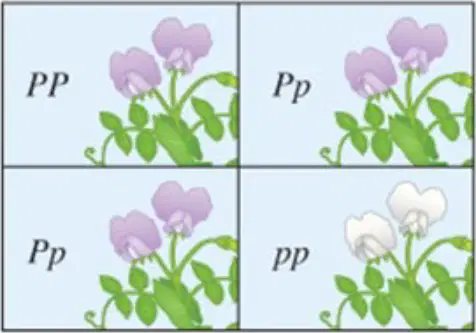
What are the possible genotypes of the F2 offspring?
PP, Pp, pp
PP, pp, PpPp
Pp, pp, pP
PP, PP, pp
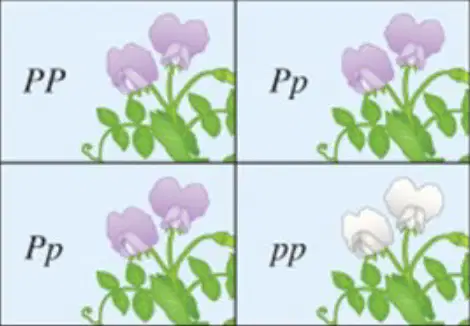
What is the phenotypic ratio of purple to white flowers in the F2 generation?
3:1 (three purple-flowered plants to one white-flowered plant)
1:1 (one purple-flowered plant to one white-flowered plant)
2:1 (two purple-flowered plants to one white-flowered plant)
4:1 (four purple-flowered plants to one white-flowered plant)
In the monohybrid cross shown, which allele is dominant?
P (purple)
p (white)
Explain why the F1 generation in the monohybrid cross all have purple flowers, even though they carry one allele for white flowers.
Because the purple allele is dominant over the white allele.
Because the white allele is dominant over the purple allele.
Because both alleles are equally expressed in the F1 generation.
Because the F1 generation only inherits purple alleles.
Mendel’s dihybrid crosses showed inheritance of one trait did not affect inheritance of other traits.
True
False
What is a dihybrid cross?
An experiment involving one gene
An experiment in which individuals with different alleles of two genes are crossed
An experiment with no alleles involved
An experiment involving only dominant alleles
As with monohybrid cross, ______ relationships between alleles are revealed.
dominance
recessive
codominant
incomplete
What is the overall ratio of phenotypes in a dihybrid cross?
9:3:3:1
1:2:1:2
3:1:1:3
2:2:2:2
What does independent assortment mean?
A) Genes are always inherited together
B) A gene tends to be distributed independently of how other genes are distributed
C) Only dominant genes are inherited
D) Genes are never inherited independently
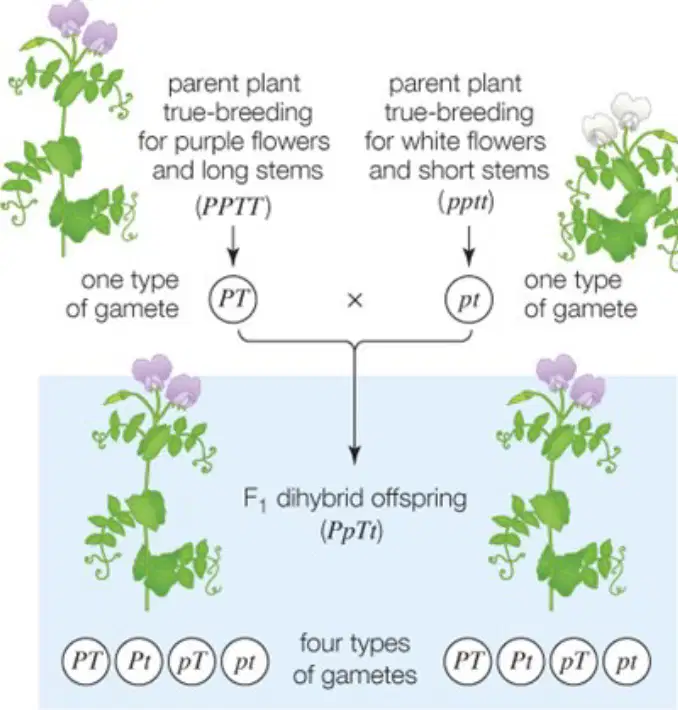
Based on the diagram 'An Example of a Dihybrid Cross', what is the genotype of the parent plant that is true-breeding for purple flowers and long stems?
PpTt
PPTT
pptt
PpTT
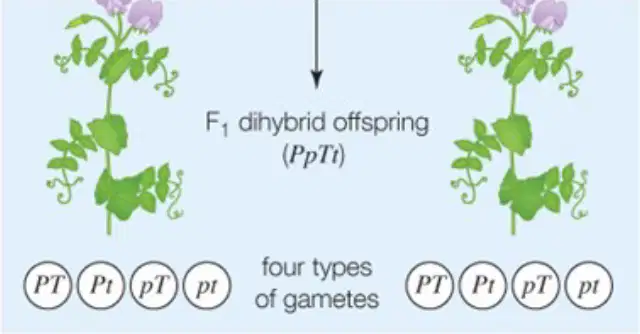
Based on the diagram 'An Example of a Dihybrid Cross', what are the four types of gametes produced by the F1 dihybrid offspring (PpTt)?
PT, Pt, pT, pt
PP, TT, pp, tt
Pp, Tt, pT, Pt
PT, pT, Pt, TT
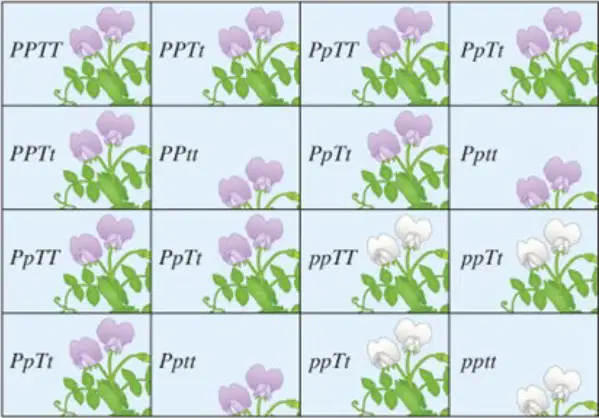
In the Punnett square shown in the diagram 'An Example of a Dihybrid Cross', which genotype represents an offspring with white flowers and short stems?
PPTT
PpTt
pptt
PpTT
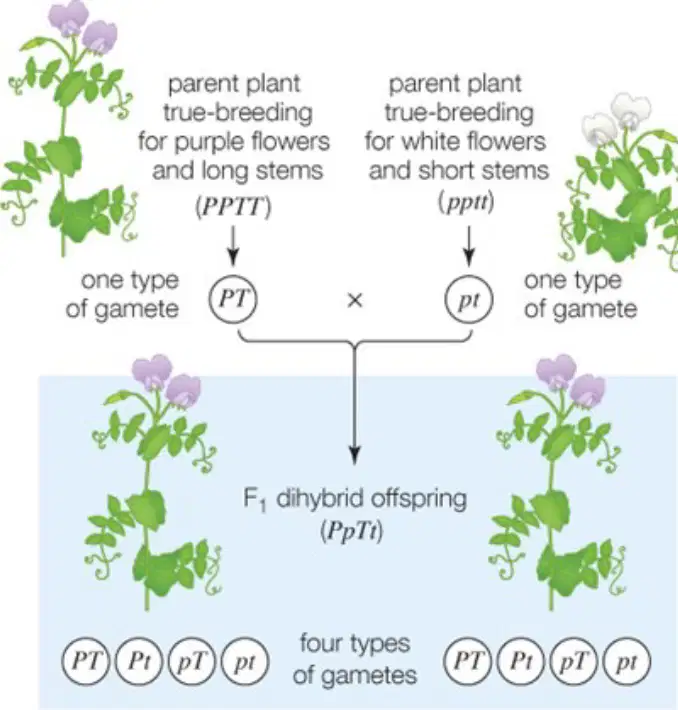
According to the diagram 'An Example of a Dihybrid Cross', what is the genotype of the F1 dihybrid offspring produced from the cross between PPTT and pptt?
PpTt
PPTT
ppTT
Pptt
Two genes located close together on the same chromosome tend to be ________ together.
inherited
mutated
expressed
deleted
When two genes on the same chromosome are far apart, crossing over occurs more frequently between them. They tend to ________ independently.
assort
mutate
replicate
combine
What is incomplete dominance?
Condition in which one allele is fully dominant over another
Condition in which one allele is not fully dominant over another, so the heterozygous phenotype is intermediate between the two homozygous phenotypes
Refers to two alleles that are both fully expressed in heterozygous individuals
Example: Blood types in humans
Fill in the blank: Codominant refers to two alleles that are both ______ expressed in heterozygous individuals.
fully
partially
rarely
never
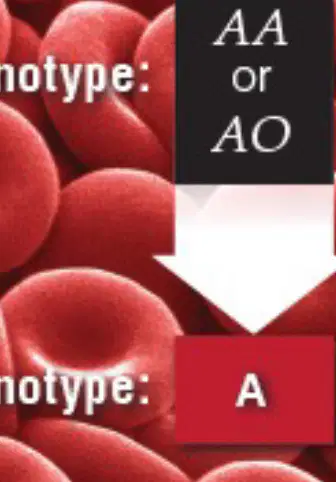
Refer to the diagram titled 'Codominance and Blood Type'. What is the phenotype for the genotype AA or AO?
AB
O
A
B
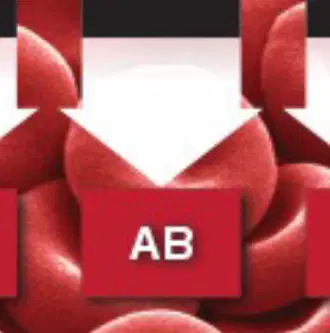
What is the phenotype for the genotype AB?
AB
O
A
B
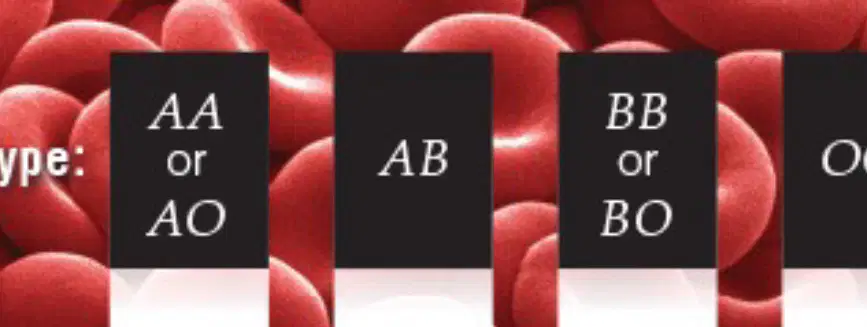
Refer to the diagram titled 'Codominance and Blood Type'. What is the phenotype for the genotype BB or BO?
AB
O
A
B
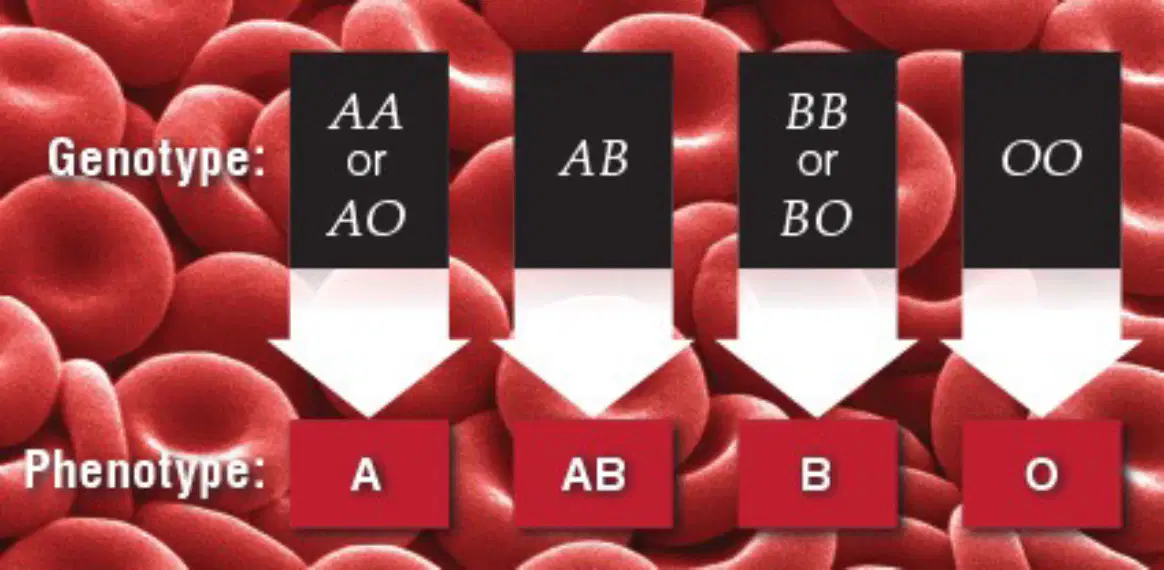
Refer to the diagram titled 'Codominance and Blood Type'. The phenotype for genotype OO is _______.
O
A
B
AB
What is pleiotropy?
A) A single gene influences multiple traits
B) Multiple genes influence a single trait
C) A single gene influences a single trait
D) Multiple genes influence multiple traits
Mutations in the gene’s product affect _________?
all the traits
only dominant traits
only recessive traits
no traits
Mutations in pleiotropic genes are associated with which of the following diseases?
Sickle-cell anemia
Cystic fibrosis
Marfan syndrome
All of the above
What is epistasis? Fill in the blank: Epistasis is the effect in which a trait is influenced by the products of ________ genes.
multiple
single
dominant
recessive
Which of the following is an example of epistasis?
Labrador retriever coat color
Human blood type
Pea plant height
Fruit fly eye color
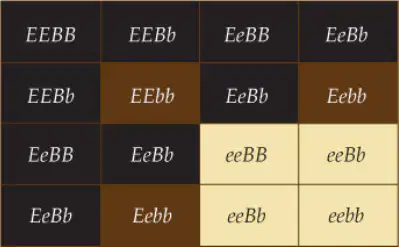
Which genotype results in a black coat color in dogs?
EEBB
EEBb
EeBB
EeBb
All of the above
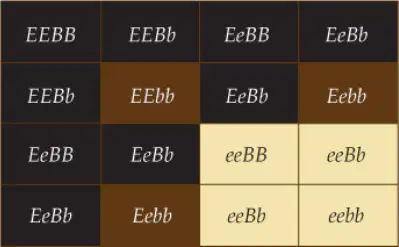
Refer to the diagram showing the Punnett square and the images of dogs with different coat colors. The genotype 'eeBB' results in a ______ coat color in dogs.
yellow
black
brown
white
Refer to the diagram showing the Punnett square and the images of dogs with different coat colors. What is the effect of having two recessive 'e' alleles (ee) on the coat color of dogs, regardless of the B gene alleles?
Having two recessive 'e' alleles (ee) results in a yellow coat color, regardless of the B gene alleles.
Having two recessive 'e' alleles (ee) results in a black coat color, regardless of the B gene alleles.
Having two recessive 'e' alleles (ee) results in a brown coat color, regardless of the B gene alleles.
Having two recessive 'e' alleles (ee) results in a spotted coat color, regardless of the B gene alleles.
Mutations, interactions among genes, and environmental conditions can affect one or more steps in a metabolic pathway and contribute to variation in phenotypes. Which of the following is NOT an example of this phenomenon?
A) Seasonal changes affect production of pigments that color the skin and fur of many animals.
B) Water flea phenotypes depend on whether the aquatic insects that prey on them are present.
C) Genetically identical yarrow plants grow to different heights at different altitudes.
D) All individuals of a species always look identical regardless of environment.
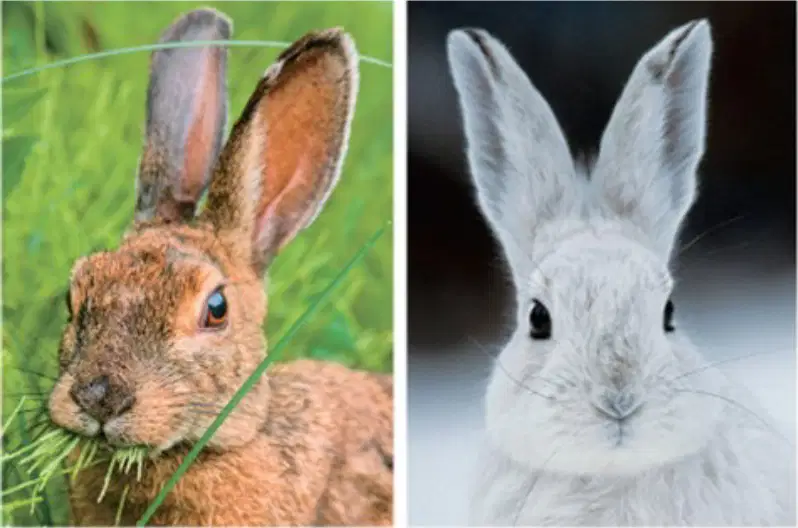
The color forms of the snowshoe hare's fur offer seasonally appropriate _______ from predators.
camouflage
shelter
food
warmth
What is continuous variation in genetics?
A trait influenced by a single gene
A range of small increments of phenotype in a trait influenced by the products of multiple genes
A trait that does not change
A trait only found in plants
Fill in the blank: The more genes and other factors that influence a trait, the more ________ the distribution of phenotype.
continuous
discrete
random
static
Fill in the blank: A ________ is a curve that results when the range of variation in a continuous trait is plotted against frequency in a population.
bell curve
pie chart
bar graph
scatter plot
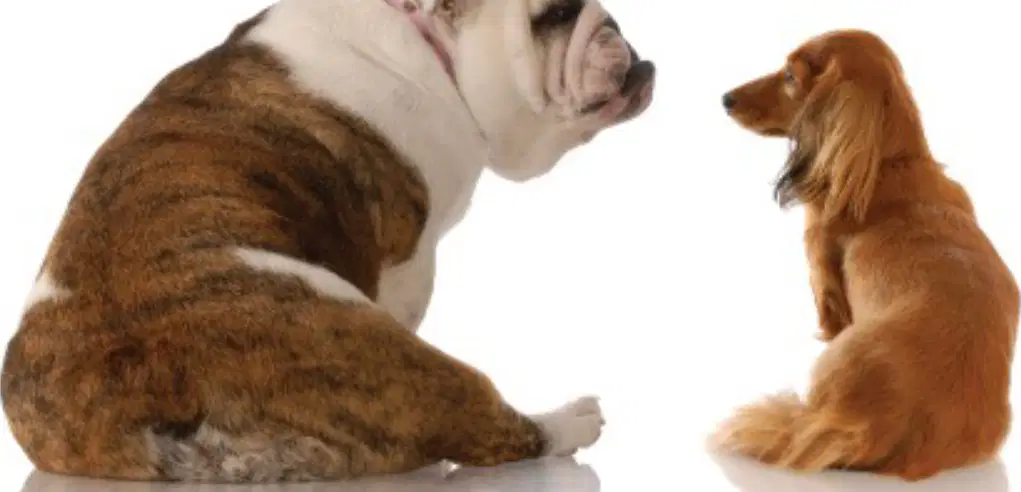
Based on the image and the title 'Determining Whether a Particular Trait Varies Continuously,' do the differences between the two dogs suggest that certain traits in dogs can vary continuously?
True
False
Which of the following best describes pedigrees in human genetic analysis?
Charts illustrating phenotypes of family members and their genetic connections
Charts showing only dominant alleles
Charts used for animal genetics only
Charts showing environmental factors
Pedigrees are used to study inheritance patterns in humans.
True
False
Pedigrees show whether a trait is associated with a ________ or ________ allele.
dominant; recessive
homozygous; heterozygous
autosomal; sex-linked
linked; unlinked
What is a genetic disorder? Fill in the blank: A genetic disorder is _________.
A heritable condition that results in a syndrome of mild or severe medical problems.
A contagious disease caused by bacteria.
A temporary illness caused by environmental factors.
A condition caused by lack of exercise.
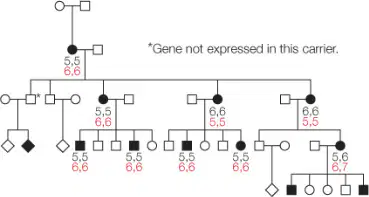
What does the pedigree chart show?
It shows the inheritance of polydactyly through five generations, indicating the number of fingers and toes for each individual.
It shows the dietary habits of a family over five generations.
It shows the migration patterns of a family across different countries.
It shows the blood pressure readings of each family member over five generations.
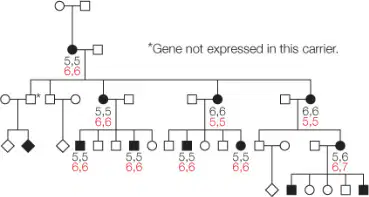
In the pedigree chart, what does a filled black circle or square represent?
An individual with the trait being studied (polydactyly).
A carrier of the trait being studied.
A male without the trait being studied.
A female without the trait being studied.
Fill in the blank: Some dominant or recessive alleles on autosomes or the X chromosome are associated with ________ or disorders.
genetic abnormalities
nutritional deficiencies
environmental changes
physical exercises
An autosomal dominant allele is expressed in which types of individuals?
Only in homozygotes
Only in heterozygotes
In homozygotes and heterozygotes
Only in males
Fill in the blank: An autosomal recessive allele is expressed only in ________.
homozygotes
heterozygotes
dominants
carriers


Differences in offspring and parents due to sexual reproduction.
Mitosis
Asexual Reproduction
Clones
Genetic Variation

Looking at the picture, what does this process create?
Increase of Genetic diversity
Identical genes
Mitosis cells
Somatic cells
growth and development
All of the following create genetic variation EXCEPT..
Mutations
DNA Replication
Law of Independent Assortment
Crossing Over
Monozygotic twins can look different to one another because:
they have different genetic material from the mother but the same genetic material from the father.
they have different genetic material from the father but the same genetic material from the mother.
the environment is determinative of phenotype.
a mutation has occurred in one twin during embryonic development.

