
 Worksheets
Thi tay nghề bác sĩ giỏi
Total questions: 60
Worksheet time: 31mins
What testing should be included when screening for ethambutol optic neuropathy?
central visual field testing
fluorescein angiography
macular optical coherence tomography
Goldmann kinetic perimetry
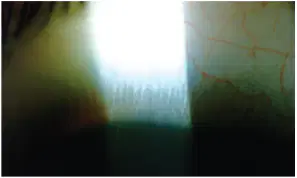
Name the blue-gray corneoscleral limbus structure in the picture above
Palisades of Vogts
Limbal corneal degeneration
Sign of limbal stem cell deficiency
Limbal corneal scar
The most common sites of scleral rupture following blunt trauma are
in the superonasal quadrant, near the limbus
in a circumferential arc parallel to the corneal limbus, opposite the site of impact
behind the insertion of the rectus muscles
All of the above
Which of the following sequelae of a carotid cavernous sinus fistula is the most common cause of visual disability?
Strabismus
Proptosis with corneal exposure
Spontaneous choroidal detachment
Elevated intraocular pressure with progressive optic nerve damage
A 30-year-old man is evaluated in the emergency room for trauma to the right orbit. The patient has marked proptosis and an intraocular pressure of 40 mm Hg on the affected side. A CT scan shows intraorbital hemorrhage. Which of the following actions would be the least effective in acutely reducing intraocular pressure?
Lateral canthotomy and cantholysis
Administration of high-dose oral corticosteroids
Administration of topical aqueous suppressants
Administration of intravenous mannitol
What is the least likely ocular complication from endoscopic sinus surgery?
Diplopia
Blindness
Tearing
Ptosis
What is the approximate volume of the orbit in an adult?
5 mL
15 mL
30 mL
50 mL
What vessels perfuse the choroid?
central retinal artery
choriocapillaris
long and short posterior ciliary arteries
major arterial circle
What is the normal density of corneal endothelial cells centrally in young adults?
8000 cells/mm2
3000 cells/mm2
1000 cells/mm2
500 cells/mm2
What is the cellular function of the gene product that is defective in cases of retinoblastoma?
contribution to cellular structure
production of energy
regulation of the cell cycle
transportation of cell wall proteins
What is the maximum amount of fluid an eye can hold prior to tearing?
5–10 μL
15–20 μL
25–30 μL
35–40 μL
What cycloplegic agent has the longest duration of action?
atropine sulfate, 1%
cyclopentolate HCl, 1%
homatropine hydrobromide, 5%
scopolamine hydrobromide, 0.25%
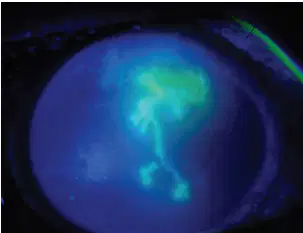
Which diagnosis is most consistent with the findings in this image?
Herpex simplex virus keraritis
Fungal keratitis
Bacterial keratitis
Loose corneal epithelium
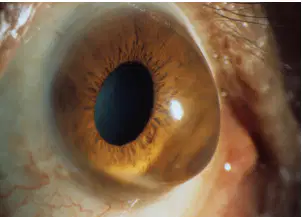
Which diagnosis is most consistent with the findings in this image?
Keratoconus
Dilated pupil
Pellucid marginal degeneration
Cornea dystrophy
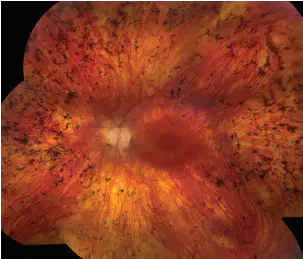
Which diagnosis is most consistent with the findings in this image?
Retinitis pigmentosa
Stargardt disease
Fundus flavimaculatus
Polypoidal Choroidal Vasculopathy
Which layer of the cornea is not replaced when it is destroyed?
Bowman layer
Descemet membrane
epithelium
stroma
On gonioscopy, which anatomical landmark marks the termination of Descemet membrane?
iris root
Schwalbe line
scleral spur
trabecular meshwork
Which histologic feature best explains the opaque appearance of the sclera?
loose fibrovascular tissue
presence of melanocytes
sparse vascularization
variable collagen orientation
What is the most likely location for metastasis from uveal melanoma?
bone
brain
liver
lung
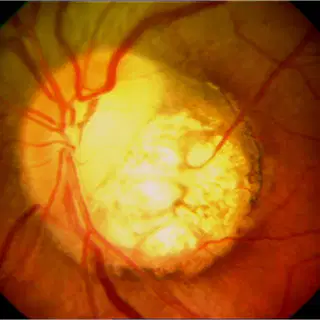
What abnormality of embryologic development is responsible for the this finding?
incomplete closure of the embryonic fissure
incomplete regression of the primary vitreous
trauma
long axial length
What is the study of choice for the evaluation of fractures in acute orbital trauma?
Orbital ultrasound
Computerized tomography
Magnetic resonance imaging
Nerve conduction
A patient with acute dacryocystitis, reflux of pus from the canaliculi, and preseptal cellulitis should be treated with which of
the following?
Immediate dacryocystorhinostomy
Massage
Systemic antibiotics
Probing and irrigation for diagnosis confirmation
If a patient has a ruptured globe in addition to a symptomatic blowout fracture, what should the surgeon do?
Repair both injuries at the same time
Repair the ruptured globe immediately and delay the floor exploration for 2 to 4 weeks
Wait 48 hours and then repair both injuries at the same time
Repair the ruptured globe immediately and delay the floor exploration for 4 months
When passing a probe down the cannalicular portion of the lacrimal excretory system, at what length does the tip of the
cannula enter the lacrimal sac?
12-16 mm
16-20 mm
8-12 mm
4-8 mm
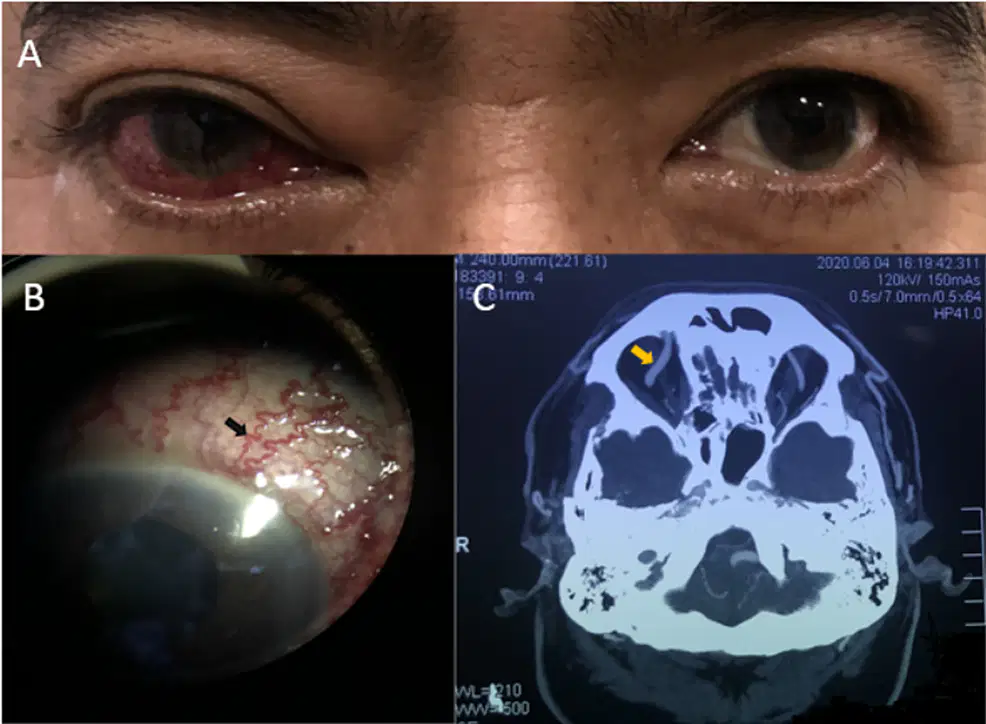
When diplopia develops in the setting of traumatic carotid cavernous fistula, what is the most likely pathophysiology?
Compression of the fourth cranial nerve as it exits the brainstem
Compression of the superior rectus muscle within the muscle cone
Damage to the third cranial nerve from elevated intracranial pressure
Compression of the sixth cranial nerve within the cavernous sinus
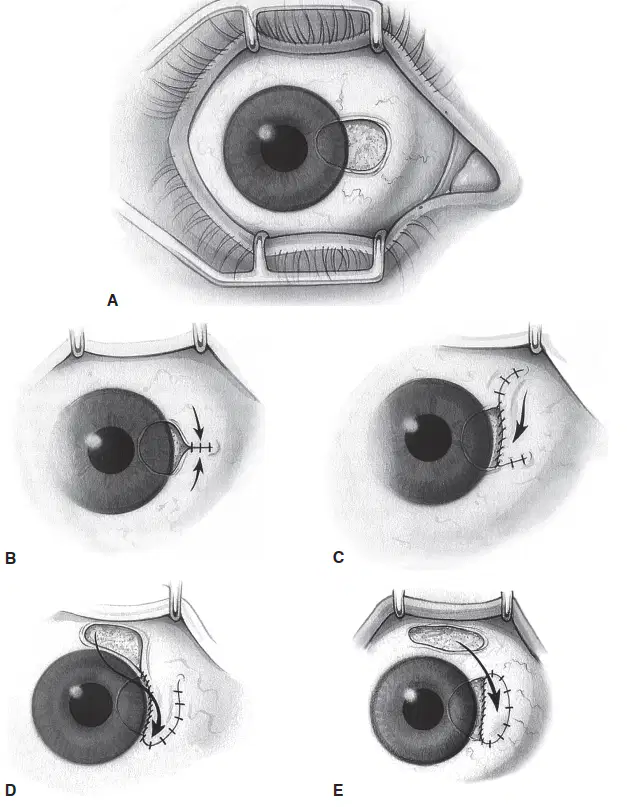
Which surgical wound closures following pterygium excision have the lowest recurrence rate?
A
B
C
D
E
In which clinical scenario would anterior segment optical coherence tomography (ASOCT) be preferable to ultrasound biomicroscopy (UBM)?
to detect increased thickening of the corneal and conjunctival epithelium
to visualize structures located posterior to the iris pigment epithelium
to visualize rupture or detachment of Descemet membrane in the presence of corneal edema
to assess for ciliary body pathology
In addition to topical antibiotics, what is an appropriate initial treatment for a corneal perforation that is less than 2 mm in diameter?
observation
cyanoacrylate glue
amniotic membrane graft
conjunctival flap
Which type of glaucoma is NOT a secondary glaucoma?
Pseudoexfoliation glaucoma
Pigmentary glaucoma
Corticosteroid-induced glaucoma
Juvenile open-angle glaucoma
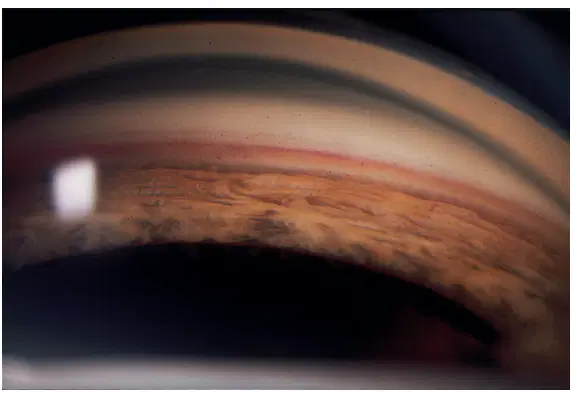
What can be stated about this finding on gonioscopy?
Blood in the Schlemm canal
Neovascular at the angle
Accumulation of pigment at the angle
Iris nevus
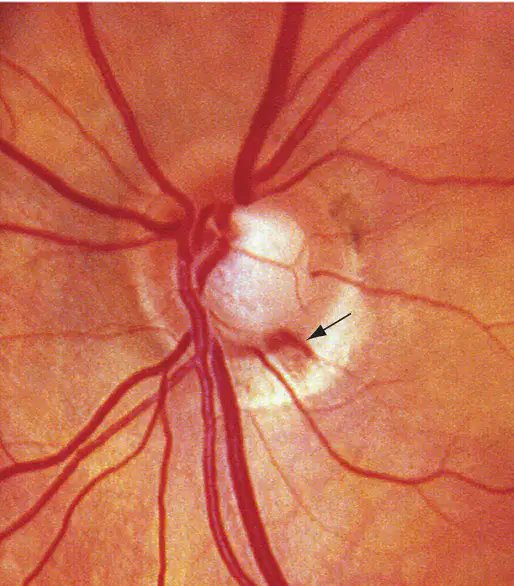
What finding is at the black arrow?
Flame- shaped optic disc hemorrhage
Rim notching
Optic pit
Artifacts
A patient presents with narrow angles and findings suggestive of iris and/or ciliary body cysts. What is the best imaging modality for further investigation?
anterior segment optical coherence tomography
anterior segment ultrasound biomicroscopy
B- scan ultrasonography
computed tomography scan of the orbits
When is a false- positive error recorded in perimetry?
when, on retesting, the patient does not respond to a stimulus that was previously seen
when the patient falsely responds to a stimulus presented in the blind spot
when the patient moves their eyes from the central fixation point
when the patient responds even though no stimulus was presented
Choose the correct concentration of travoprost eyedrop
0,005%
0,004%
0,0015%
0,04%
Which agent reduces IOP by decrease aqueous humor production?
brimonidine
brinzolamide
dorzolamide
All of the above
Which FDC is safe to use on a glaucoma patient who has COPD?
Simbrinza
DuoTrav
Azarga
Cosopt
On day 1 postoperative trabeculectomy, a patient presents with high IOP, shallow anterior chamber and a present bleb. What can cause this condition?
Tight flap sutures
Malignant glaucoma
Overfiltration
Choroidal effusion
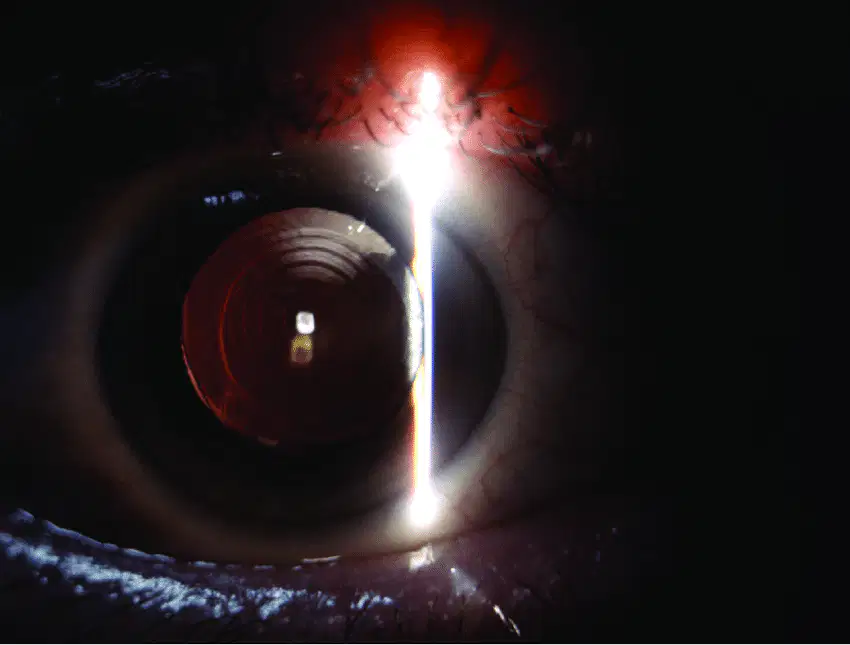
What type of lens is this?
Monofocal IOL
Toric IOL
Multifocal IOL
ICL
If the potential visual acuity obtained prior to cataract surgery is better than the acuity obtained postoperatively, which of the following is not a possible cause?
Postsurgical cystoid macular edema
A pupil that was dilated during testing
An irregular corneal surface
Amblyopia
What finding after alkali chemical injury to the eye is the strongest risk factor for a poor prognosis?
Blanching of most of the perilimbal vessels
Total loss of corneal epithelium
360 degrees of limbal injection
corneal edema
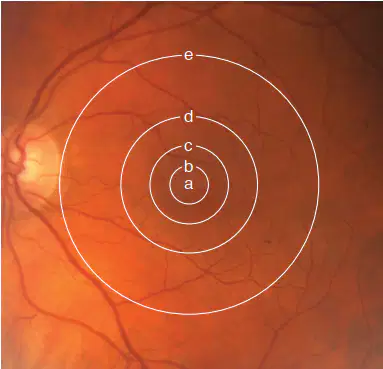
Which zone is the fovea?
a
b
c
d
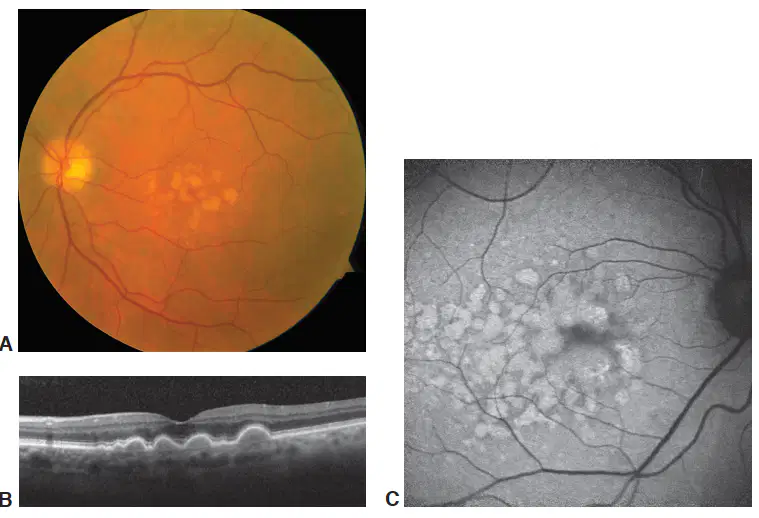
Name these lesions
Soft drusen
Hard exudate
Chroidal neovascular
Polypoidal Choroidal Vasculopathy

What is the most consistent diagnosis of this fundus?
CRVO
Diabetic retinopathy
CRAO
Hypertension retinopathy
What symptom following intravitreal injection would be unexpected and warrant immediate evaluation?
progressive floaters with progressive blurring of vision
sharp pain following the injection
foreign body sensation
small floaters that are noticed immediately after injection
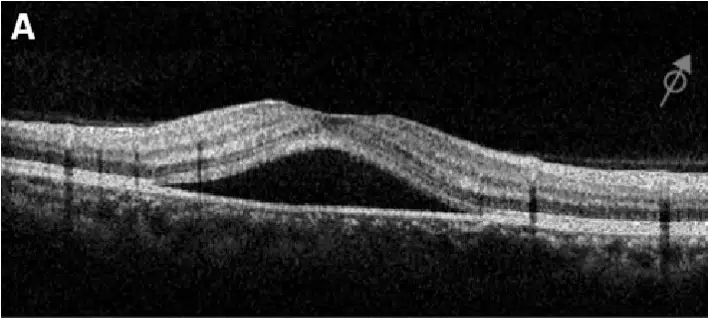
A 35-year-old otherwise healthy man presents with recent onset of unilateral slightly blurred vision. On evaluation, the right eye has a visual acuity of 20/25. The patient is minimally symptomatic. What is the most appropriate initial management?
observation
topical steroids
laser photocoagulation therapy
Intravitreal anti-VEGF
All of the following side effects may be seen with the use of a prostaglandin analogue except:
conjunctival hyperemia
cystoid macular edema
decrease in iris pigmentation
hypertrichosis
Which one of the following contributes to the aqueous layer of the tear film?
Glands of Wolfring
Glands of Zeis
Goblet cells
Meibomian gland
Tại Bệnh viện Mắt, Bảo hiểm y tế chấp nhận thanh toán toa chứa thuốc nhỏ nhóm CAIs trong trường hợp nào sau đây?
Bệnh hắc võng mạc trung tâm thanh dịch
Phù hoàng điểm do đái tháo đường
Phù hoàng điểm dạng nang
Phù hoàng điểm do tắc mạch võng mạc
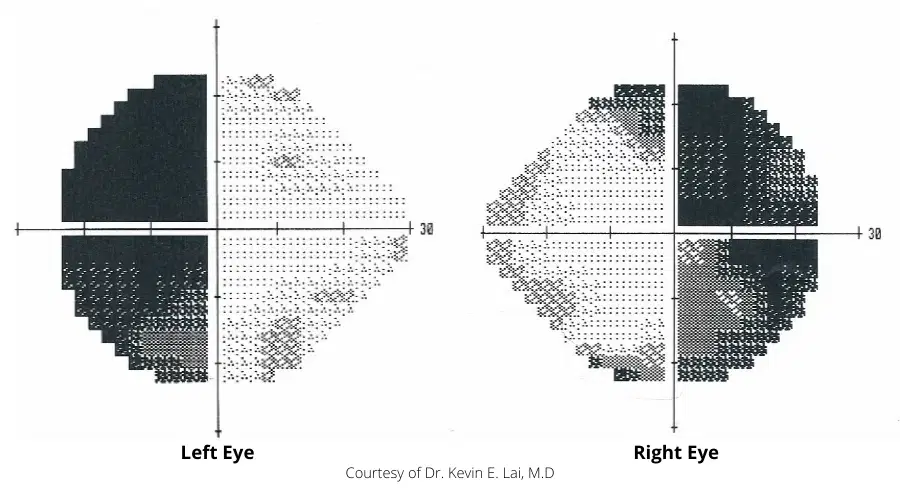
A 30 year-old male presents with headaches and visual disturbances. His visual field test returns as above? Which is the most likely cause of his hemianopsia?
Pituitary Tumor
Normal tension glaucoma
Optic neuritis
Migraine
Khi thực hiện bệnh án điện tử trong phiên trực cấp cứu, đối với trường hợp có chỉ định phẫu thuật cấp cứu, các thao tác nào sau đây là chính xác?
Bác sĩ cột 2 lập phiếu điều trị trình bác sĩ trưởng phiên trực xin ý kiến phẫu thuật cấp cứu
Bác sĩ cột 2 lập phiếu điều trị trình bác sĩ cột 1 xin ý kiến phẫu thuật cấp cứu
Bác sĩ cột 1 lập phiếu điều trị trình bác sĩ trưởng phiên trực xin ý kiến phẫu thuật cấp cứu
Bác sĩ trưởng phiên trực khám và quyết định phương pháp phẫu thuật thông qua phiếu điều trị, bác sĩ cột 1 và cột 2 không có vai trò
Theo theo tư 01/2025/TT-BYT, người bệnh được cơ sở khám bệnh, chữa bệnh bảo hiểm y tế hẹn khám lại trong trường hợp nào sau đây?
Cần tiếp tục theo dõi tình trạng bệnh hoặc kiểm tra lại kết quả của đợt khám, điều trị đó theo yêu cầu chuyên môn
Người bệnh chỉ được hẹn tái khám 01 lần duy nhất
Người bệnh yêu cầu
Người bệnh mắc bệnh mãn tính
Thông tư số 26/2025/TT-BYT ngày 30 tháng 6 năm 2025 của Bộ Y tế về Quy định về đơn thuốc và việc kê đơn thuốc hóa dược, sinh phẩm trong điều trị ngoại trú tại cơ sở khám bệnh, chữa bệnh, các bênh nào sau đây được áp dụng kê đơn thuốc ngoại trú trên 30 ngày?
Glôcôm
Viêm giác mạc
Viêm hắc võng mạc
Tất cả các bệnh trên
Bác sĩ A đăng ký tham dự Hội nghị nhãn khoa Châu Á Thái Bình Dương năm 2026 tại Hongkong, kinh phí tự chi trả. Như vậy bác sĩ A thuộc trường hợp nào sau đây?
Cần xin phép phê duyệt đi nước ngoài về việc riêng, sử dụng ngày phép cá nhân
Cần xin phép phê duyệt đi nước ngoài về việc công, sử dụng ngày phép cá nhân
Cần xin phép phê duyệt đi nước ngoài về việc riêng, không mất ngày phép cá nhân
Cần xin phép phê duyệt đi nước ngoài về việc công, không mất ngày phép cá nhân
Hình thức đăng ký khám bệnh nào sau đây chưa được áp dụng tại Bệnh viện Mắt
Qua tổng đài đặt hẹn
Qua website Medpro
Qua Zalo OA
Trực tiếp
A patient with no prior history of glaucoma had recent complicated cataract surgery with an anterior chamber intraocular lens
(IOL) inserted. There are many cortical and nuclear fragments in the vitreous, and the intraocular pressure (IOP) is 40 mm
Hg on timolol, dorzolamide, and brimonidine. What is the most appropriate surgery?
Pars plana vitrectomy
Trabeculectomy with mitomycin C
Anterior chamber washout
Glaucoma implant (tube-shunt)
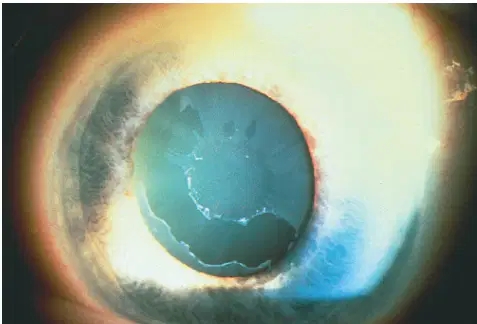
Which one of the following statements is false concerning the condition depicted in this picture?
It has a worse prognosis than primary open-angle glaucoma (POAG)
It may be monocular or binocular.
Lens extraction will cure the condition
The intraocular pressure (IOP) is often higher than in POAG.
Topical anesthetic agents produce analgesia in which of the following ocular structures?
Cornea and iris
Conjunctiva and ciliary muscle
Conjunctiva and cornea
Conjunctiva and dilator muscle
A patient with visually significant cataract is found to dilate poorly on preoperative examination. Which of the following is the
most likely cause of this poor dilation?
Pigment dispersion syndrome
Pseudoexfoliation syndrome
Atopic dermatitis
Hypertension
What is the most characteristic type of cataract in steroid-induced cataract?
Posterior subcapsular cataract
Anterior polar cataract
Nuclear sclerotic cataract
Cortical spoke cataract
When evaluating a patient with a traumatic hyphema, which of the following is the most likely cause of low intraocular
pressure (IOP)?
Inflammatory cells in the trabecular meshwork
Cyclodialysis cleft
Red blood cells in the trabecular meshwork
Pupillary block

